Skip to content
DevMeme
2555 of 7435
When language-tool fit goes full clown mode in dev conversations
Languages Post #2830, on Mar 9, 2021 in TG

When language-tool fit goes full clown mode in dev conversations

Why is this Languages meme funny?

Level 1: Two Clowns, Wrong Tools

Imagine two clowns having a conversation about how they’re going to do their jobs using the completely wrong tools, and both of them think it’s a terrific idea. One clown says, “I’m going to build a high-tech science project using only this tiny hammer,” and the other clown responds, “Oh yeah? I’m going to build a heavy brick wall using just whipping cream!” Each idea by itself is ridiculous, but the fact that they’re agreeing with each other makes it even funnier. In the picture, that’s exactly what’s happening: two silly characters are proudly planning to do things in the most impractical way possible. This is funny because anyone listening can see they’re both setting themselves up for failure, yet neither of them realizes it. It’s like watching two people in a circus act confidently swap tools and completely miss the point – they’re both wrong, and somehow they’re validating each other. The humor comes from that absurd mismatch between the task and the tool, and the image literally shows them as clowns to drive home how foolish the whole chat is. In simple terms, the meme is joking that these two programmers are acting like clowns by trying to use the wrong languages for their jobs, and they’re basically just clowning around together without knowing it.

Level 2: Wrong Tool for the Job

Let’s break down why the two statements in the meme come off as silly to developers. The text of the meme is formatted like a chat between two programmers:

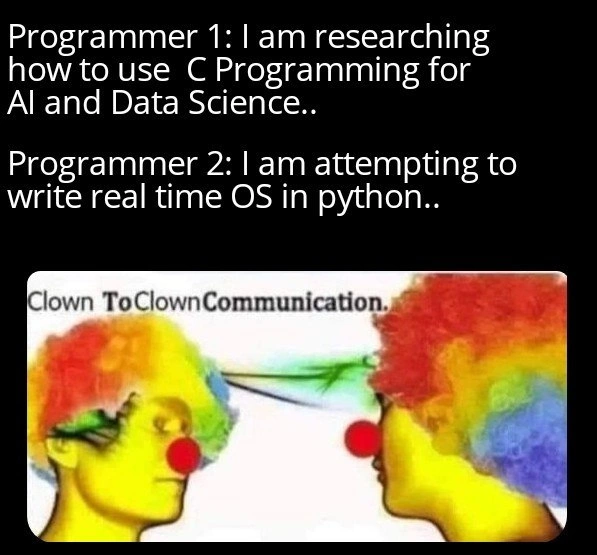
Programmer 1: I am researching how to use C Programming for AI and Data Science..

Programmer 2: I am attempting to write real time OS in python..

Beneath these lines, the image shows two bright, rainbow-haired clowns facing each other with a green laser connecting their foreheads, labeled “Clown To Clown Communication.” The whole setup is highlighting a comedic scenario of mutual misunderstanding in a developer conversation. Now, why exactly are these two programmers’ statements considered “clownish”? It boils down to using the wrong tool for the job in each case:

  • C for AI and Data Science: The C programming language is a low-level, compiled language famous for system programming (like writing operating systems, device drivers, embedded software). It gives the programmer a lot of control over the computer’s memory and processor, but it doesn’t provide much built-in help for things like data analysis or machine learning. AI (Artificial Intelligence) and Data Science usually involve tasks like crunching large datasets, doing complex math (like matrix operations), and building models quickly to experiment and iterate. High-level languages such as Python or R are commonly used for these tasks because they have rich libraries and tools (for example, Python has NumPy for fast math, pandas for data manipulation, and frameworks like TensorFlow/PyTorch for machine learning). These libraries are optimized (often their critical parts are written in C or C++ under the hood), and using them in Python means you can accomplish in a few lines what would take you hundreds of lines of C code. If someone says, “I want to use C for data science,” an experienced developer might raise an eyebrow. It’s not that you can’t do data science in C – after all, anything you can compute in Python you can compute in C – but you’re making things unnecessarily hard on yourself. You’d be manually handling minutiae (like memory allocation and array resizing) that Python would handle for you automatically. It’s a bit like choosing to build a house using only a pocket knife: C is powerful, but for this task (data science) it’s going to be an uphill battle without the right tools. This is why Programmer 1’s statement comes off as naive or over-engineered – they’re ignoring all the purpose-built tools available for AI/DS and opting for one that gives them no shortcuts.

  • Python for a Real-Time OS: Python is a very high-level, interpreted language known for its simplicity and ease of use. It’s dynamically typed (you don’t have to declare variable types) and has automatic memory management (so you don’t manually allocate or free memory). These features make Python fantastic for things like scripting, web development, automation, data science (as mentioned), etc., because you can write code quickly without worrying about the low-level details. However, an Operating System (OS) – especially a real-time OS – is about as low-level as programming gets. An operating system is the fundamental software that directly manages the computer’s hardware resources (CPU, memory, device input/output). Writing an OS involves dealing with things like processor interrupts (signals from hardware), scheduling which program (or task) runs at what time, and ensuring critical operations happen within strict time limits (that’s what “real-time” means – for example, if a sensor signals that a machine arm needs to stop in 5 milliseconds, the OS has to interrupt whatever else it’s doing and handle that immediately). Typically, languages like C or C++ are used for OS development because they compile down to machine code that runs very fast and you can control exactly what the hardware is doing. Python, on the other hand, runs on top of a pre-existing runtime (you normally need an OS just to start Python!). It’s interpreted, meaning there’s an extra layer between your code and the machine – that layer makes Python handy for developers, but it means Python programs execute more slowly and not always predictably in terms of timing. Also, Python has something called a Garbage Collector (part of its memory management) that can pause program execution momentarily to clean up unused memory in the background – that’s fine for a web app or a script, but could be devastating in a real-time system if it pauses right when you needed to respond to hardware. So, when Programmer 2 says they’re attempting to write a real-time OS in Python, it sounds almost like a joke. It’s a mismatch because to meet real-time requirements you typically avoid any language features that add uncertainty in execution time. Python is pretty much built out of such features – it prioritizes developer convenience over bare-metal performance. It would be like trying to run a marathon in flippers: you’ve got the wrong gear for the job.

The meme calls this conversation “Clown To Clown Communication” because both programmers are essentially talking nonsense (from a technical standpoint), and yet they’re trading these ideas as if they make sense. In developer culture, calling something “clown” is a way to say it’s foolish or laughably wrong. Each of these programmers is acting like a clown by proposing a technology stack that is comically ill-suited to the goal. The image of two clowns connected by a laser implies that they’re on the same (silly) wavelength – no one in this conversation is there to inject reality, so they’re just reinforcing each other’s bad ideas. This speaks to a broader humor in tech: Language quirks and over-engineering can lead to scenarios where very smart tools are applied to the wrong problems, yielding absurd results. It’s funny to developers because we usually spend a lot of time thinking about choosing the right programming language or tool for a project (a concept often called “fit for purpose”). Seeing an obviously poor fit – twice over – presented so earnestly is like watching someone earnestly try to jam a square peg into a round hole while another person cheers them on. Both halves of the conversation are inverted misaligned expectations: we know Python shines in AI and C shines in OS development, but they’ve each chosen the other’s domain, creating a kind of tech-world absurdity.

In summary, Programmer 1 is essentially saying “I’m going to do this super high-level, math-heavy project with a low-level language that gives me no help,” and Programmer 2 replies “Oh yeah? I’m going to do this low-level, hardware-near project with a high-level language that won’t let me touch the hardware properly.” Each one is a recipe for frustration and failure, and that’s exactly why it’s depicted as clown behavior. The meme falls under CodingHumor and TechHumor because it laughs at these language choice mismatches. The categories Languages and OperatingSystems are explicitly referenced here – it’s making fun of how certain LanguageWars or misunderstandings can lead to crazy ideas like misusing a programming language in a domain where it really doesn’t belong. Even if you’re a junior developer or just someone learning programming, you’ll likely understand the simple idea being conveyed: different tools have different uses, and picking the wrong one can be very, very silly. This meme just takes that silliness to an extreme for comedic effect.

Level 3: Clown-Driven Development

On an industry-insider level, this meme perfectly captures a flavor of DeveloperHumor that pokes fun at blatant misalignment between a tool and a task. It’s essentially a satirical case of “Clown-Driven Development,” where two developers are proudly espousing absurd development plans. Each programmer has picked a language totally unsuited to the problem domain, and they’re enthusiastically doubling down on it. This juxtaposition is instantly recognizable to experienced engineers because it’s a tongue-in-cheek inversion of the usual best practices. Normally, if someone says they’re doing AI and Data Science, you’d expect to hear languages like Python or R mentioned (with their rich libraries and easy syntax). And if someone talks about building a real-time OS, you’d bet they’re using C, C++ or maybe Rust – something low-level that compiles to efficient machine code and lets you manage hardware and memory directly. Instead, here we have the opposite scenario: one dev boasting about using straight C for high-level analytics, and another trying to build low-level system software with Python scripts. It’s as if each person looked at the other’s toolbox and said, “Hey, I’ll use your tools for my job!” – resulting in a pair of equally misguided plans.

This contrast is humorous because it highlights a common pitfall in programming discussions: improbable language choice. We’ve all seen heated LanguageWars and endless LanguageComparison debates where enthusiasts claim their favorite language can do anything. This meme takes that to an extreme parody. The first programmer’s idea of doing data science in C feels like over-engineering taken to clownish heights – it conjures an image of someone stubbornly refusing to use pandas or Python because they want to hand-craft everything with pointers and printf statements. The second programmer’s plan of writing an OS in Python feels like naive under-engineering (or perhaps hubris) – imagining that a few Python scripts could wrangle the complexity of hardware interrupts, CPU scheduling, and memory management. By putting these two statements together, the meme achieves a comedic balance: both participants are equally absurd, so they’re on the same wavelength – hence the caption “Clown To Clown Communication.” They’re two clowns nodding along with each other’s ridiculous ideas, implicitly validating each other. It’s the developer version of a mutual folly handshake. 🤡🤝🤡

Anyone who’s been in software development for a while can relate to the unspoken truth this meme riffs on: choosing the wrong tool for the job can lead to disastrous or laughable outcomes. Sometimes newcomers or overconfident devs will propose something wild – like coding an entire web server in Bash, or using a database where a simple file would do, or yes, writing an OS in a scripting language – and you get that facepalm moment across the team. Often these ideas come from misunderstanding what a language or technology is optimized for, or from the overenthusiastic desire to use a favorite language everywhere (“I love Python, so let’s use Python for absolutely everything!” or conversely, “C is super fast, so I’ll even use it for tasks that don’t need it!”). The meme exaggerates this to an extreme for comedic effect. It resonates because many of us have sat through meetings or forum discussions where someone insisted on a tech stack that made the rest of the room exchange knowing glances. This image just strips that scenario down to its clownish core: two people, dressed as clowns, effectively saying “I’m going to do this very advanced thing with the least appropriate tool,” and both of them think the other’s idea is great.

From an organizational perspective, it also hints at the communication gap that can happen when developers are talking but not making sense – essentially a protocol of nonsense. The phrase “Clown To Clown Communication” at the top of the image sarcastically labels the protocol in use. It’s like a play on technical jargon (think of Peer-to-Peer Communication or Client-Server Communication in network diagrams) but here it’s two fools transmitting bad ideas back and forth with a green laser beam of ignorance. The humor lands because it’s TechHumor that merges engineering terminology with a circus visual. The green laser connecting the clowns’ heads parodies the idea of a direct data link – except the “data” being exchanged is essentially ridiculous notions. This is a send-up of those dev conversations where everyone outside that bubble can tell it’s absurd, but the participants are dead serious and even encouraging each other. We laugh with a bit of pain because we’ve either been that person early in our career or had to gently (or not so gently) point out to someone that they’re on the wrong track.

In practice, what these clowns are suggesting would lead to epic failure or a herculean slog of work. A senior engineer reading this might chuckle and think, “Been there, seen someone try that.” Perhaps they recall the intern who tried to implement a high-frequency trading system in Python (and hit performance walls), or the overzealous colleague who thought rewriting a data pipeline in pure C would magically solve all efficiency problems (only to discover it took ten times longer to develop and debug). The meme distills those war stories into a simple, punchy exchange. It’s pointing at the MisalignedExpectations we sometimes encounter: like expecting a high-level scripting language to meet real-time constraints, or expecting a low-level language with no native data analytics libraries to be a quick solution for complex data science tasks. If a team lead heard these proposals, they might sarcastically respond with, “Well, that’s one way to ensure job security – you’ll be the only one crazy enough to maintain that code!” It’s a joke that underscores why we have appropriate technologies for each domain.

To sum it up in seasoned-dev speak, this meme is a commentary on the importance of proper language-tool fit. It ridicules the kind of overconfident brainstorming where people ignore decades of software engineering wisdom. The reason it’s so funny (and a bit cringey) to experienced developers is because it’s a textbook example of what not to do, blown up to circus proportions. We see both the over-engineering and the under-engineering at play, and we immediately get the punchline: the joke’s on the clowns who think these plans will end well. As the saying goes in software, “Just because you can do something doesn’t mean you should” – and these two have totally missed that memo, to hilarious effect.

Problem Domain Common-Sense Approach “Clown Mode” Approach
AI & Data Science Use high-level languages like Python/R with powerful libraries (e.g. TensorFlow, Pandas) for quick development and prototyping. Leverage existing optimized numerical routines. Use low-level C with no libraries, implementing everything from scratch (parsing data, linear algebra, ML algorithms) by hand for the sake of… performance? 🤡
Real-Time OS Development Use low-level languages like C/C++ or Rust; manage hardware directly, ensure deterministic execution and timing. Possibly use assembly for critical sections. Basically, get as close to the metal as possible for reliability. Use high-level Python running on an interpreter, hope that the garbage collector and interpreter overhead won’t introduce massive latency. Maybe pretend time.sleep() is a real-time scheduler. 🤡

Level 4: Bare Metal vs Bytecode

At the deepest technical level, this meme highlights a fundamental mismatch between low-level computing requirements and high-level language abstractions. Writing a real-time operating system (RTOS) in Python defies the very purpose of real-time systems, which demand precise timing and direct hardware control. Real-time OS kernels are typically written in C (or even assembly) to run on bare metal, where code translates directly into machine instructions controlling memory and hardware registers. Such systems rely on predictable execution: interrupts must be serviced within microseconds, thread scheduling follows deterministic algorithms (like Rate Monotonic or Earliest Deadline First), and there’s no tolerance for unpredictable delays. Python, by contrast, runs on a bytecode interpreter (the CPython virtual machine, for instance) and employs a Garbage Collector and a Global Interpreter Lock (GIL). These features introduce non-deterministic pauses and limit true parallel execution of threads. In a hard real-time context – say, an embedded system for a pacemaker or automotive brake controller – a sudden garbage collection pause or the GIL stalling one thread could be disastrous. Essentially, a Python-based kernel would struggle to guarantee that a high-priority interrupt (like a timer tick or sensor trigger) is handled exactly on schedule, because the interpreter might be busy doing something else (like managing memory or executing another bytecode) when it should be context-switching. A traditional RTOS in C can disable interrupts and carefully manage context switches in a few CPU instructions; a Python program can’t – it’s always running under the control of an existing runtime. It’s the difference between bare metal timing vs. dancing through layers of abstraction.

To illustrate how impractical this is, consider that even starting a Python interpreter usually requires an underlying OS or runtime support. If you tried to boot a machine into a Python-based kernel, you’d essentially have to bundle a minimal C runtime to host the Python VM – a bit paradoxical, since now your “Python OS” is relying on C under the hood just to get off the ground. (There are projects like MicroPython that run on microcontrollers, but even those use a C/C++ core to interact with hardware.) Moreover, Python’s dynamic nature (flexible types, memory management, etc.) means it’s hard to achieve the predictability required for an OS scheduler. Real-time systems often pre-allocate all necessary memory up front to avoid the unpredictable timing of allocation and garbage collection. Python, however, allocates objects on the fly and its garbage collector can kick in at arbitrary times – imagine your Python OS halting all tasks because it decided to clean up a few objects; that’s a nightmare scenario for real-time guarantees. And let’s not forget Python’s interpreted execution: each Python command has to be translated by the interpreter into lower-level operations, adding overhead. In a loop that toggles a hardware pin with microsecond precision, those extra nanoseconds of interpretation matter. The meme’s absurdity is rooted in these OS internals: it’s practically a physical law of computing that you don’t build a hard real-time scheduler in a language with a built-in pause button.

On the flip side, using C for AI and Data Science means forsaking the conveniences that make those fields productive and accessible. Modern AI and data science workflows lean on high-level languages (like Python, R, or Julia) because they come with rich ecosystems of math libraries, data structures, and interactive tools. C is a powerful low-level language, revered for systems programming and performance, but it’s too close to the metal for the fast-paced, iterative nature of data analysis. In C, there’s no built-in concept of a high-level DataFrame or an automatic tensor library – you’d be implementing those from scratch. Need to load a CSV file with millions of entries and compute statistics? In Python, you’d reach for pandas.read_csv() and get a ready-to-use data structure with one line of code. In C, you’d be opening files with fopen(), manually parsing text line by line, tokenizing numbers, using atoi()/atof() to convert strings to numeric types, allocating arrays with malloc(), and hoping you don’t miscalculate a pointer offset, leak memory, or overflow a buffer. Every step that is one line in Python becomes dozens of lines of careful C code. And after all that, you still haven’t done any actual data science – you’ve just labored to get the data into memory! Advanced algorithms like training a neural network or performing a huge matrix multiplication in pure C would require writing or leveraging complex libraries (indeed, many such libraries are written in C/C++ for performance, but they’re used via higher-level interfaces). If someone insists on doing AI in C “from scratch,” they’re essentially reimplementing what existing frameworks already provide – it’s an over-engineering exercise with a high chance of bugs and a very slow development cycle. Yes, C will give you raw speed for number crunching, but only if you manage to vectorize operations and handle memory efficiently. Achieving this is so non-trivial that most data scientists prefer to let battle-tested libraries (often written in C/C++/Fortran behind the scenes) handle the heavy lifting, while they use Python as the glue. So the clownishness here is imagining a lone programmer reinventing NumPy, TensorFlow, or PyTorch in vanilla C just to say they did – it’s a bit like deciding to forge your own scalpel out of iron ore before performing surgery. Technically possible? Maybe. Sensible? Not really.

In both cases, the humor draws on an understanding of system design trade-offs. A seasoned developer knows that programming languages are tools optimized for certain domains: Python provides high-level expressiveness at the cost of low-level control, while C provides low-level control at the cost of developer time and safety. The meme’s two programmers have each chosen a tool wildly unsuited to their problem domain, violating a core principle of software engineering – use the right tool for the job. It’s as if they’ve decided to challenge fundamental computing paradigms for the sake of it. There’s an underlying theoretical irony here: in computational theory, all Turing-complete languages are equally capable in terms of what they can compute, but practically speaking, the differences in how they compute (in performance, abstraction, and ecosystem) make some languages an absurd choice for certain tasks. A real-time OS demands timing guarantees that a garbage-collected, interpreted language just can’t reliably give. AI and data science demand rapid prototyping and high-level math support that a low-level language won’t easily provide. By showcasing the exact inverse of conventional wisdom – a low-level language for a high-level task, and a high-level language for a low-level task – the meme appeals to our understanding of these inherent technical mismatches. It’s a reminder (with a chuckle) of the physical and logical limits in computing: you wouldn’t write an ISR (Interrupt Service Routine) in Python, just as you wouldn’t write a pandas DataFrame manipulation in pure C for fun – unless you’re in full clown mode. 🤡🎪

Description

The meme has a black background with white text that reads: “Programmer 1: I am researching how to use C Programming for AI and Data Science..” followed by a blank line and then “Programmer 2: I am attempting to write real time OS in python..”. Beneath this text is an image captioned “Clown To Clown Communication” showing two brightly-coloured clowns in profile, each with a red nose and rainbow-hued faces, staring at one another while a green laser-like beam connects their foreheads. The joke highlights the absurd mismatch of using low-level C for high-level data science and using high-level Python for a real-time operating system, poking fun at over-engineering and poor language-task alignment common in developer discussions

Comments

20
Anonymous ★ Top Pick That moment in the architecture review when one dev insists on rewriting TensorFlow in C for “maximum speed” and another pitches a hard-real-time kernel in asyncio - you realize you’ve walked into CORBA: Clown-Oriented Requirements Brainstorming Assembly
  1. Anonymous ★ Top Pick

    That moment in the architecture review when one dev insists on rewriting TensorFlow in C for “maximum speed” and another pitches a hard-real-time kernel in asyncio - you realize you’ve walked into CORBA: Clown-Oriented Requirements Brainstorming Assembly

  2. Anonymous

    Nothing says 'I understand system constraints' quite like trying to meet hard real-time deadlines with a garbage-collected, GIL-locked interpreter, or manually managing memory for tensor operations when PyTorch exists. It's like watching someone try to write a kernel module in JavaScript - technically possible with enough abstraction layers, but your colleagues will stage an intervention

  3. Anonymous

    Two developers walk into a bar discussing their projects: one wants to rewrite NumPy in pure C for 'better AI performance' (ignoring that it already is), while the other is building a hard real-time OS in Python (apparently unaware that the GIL and garbage collector make deterministic microsecond timing about as achievable as getting a Jira ticket estimate right on the first try). Both are technically possible in the same way that using a screwdriver as a hammer is 'possible' - sure, you can do it, but everyone watching knows you're choosing violence against both the tool and the problem

  4. Anonymous

    Clown-to-clown RPC: one wants to rebuild NumPy in C, the other wants a hard RTOS on a GIL - WCET by import random, jitter courtesy of the GC

  5. Anonymous

    AI in C and a real‑time OS in Python - bold architecture: let the GIL be your scheduler and pointer arithmetic your feature engineering

  6. Anonymous

    C for ML: valgrind your gradients. Python RTOS: GIL your interrupts

  7. @digital_pathologist 5y

    first is not as terrible as the second..... depends on the task

    1. @zmiccer 5y

    2. @sam0and 5y

      In TinyML for example

  8. Deleted Account 5y

    Nah, write it in brainfuck.

  9. @doodguy1991 5y

    Make static binary in python

  10. @digital_insanity 5y

    It is hard to make a real-time os even in C

    1. Deleted Account 5y

      is there something that's easy to make in c?

      1. @digital_insanity 5y

        Yup. College homework for CS.

        1. @RiedleroD 5y

          what's not easy is finding out what version of java your teachers have and if it's going to compile on their end if you use a certain function.

          1. @RiedleroD 5y

            had a teacher that still had Java 7. My main language is german, and we do use german in our assignments, so when I gave a function the name "getHärte", I promptly got 0 points.

            1. @tnov1k 5y

              Well guess it's anyway a bad idea to use any chars apart from english ones in the code

              1. @RiedleroD 5y

                yes and no; I very much dislike using the ae/oe/ue style of writing these, but I do agree that writing your code in english is the best compromise. My point is that you basically can't use any features introduced after Java 8, and even then you can't be sure everybody can run your code.

                1. @tnov1k 5y

                  Yes, that's a problem. I'm learning python and our teacher has python 3.3 in our testing system so there are lots of cool features wich aren't available for us. Actually he has some problems with php which is used there so he can't update python

                  1. @RiedleroD 5y

                    bruh. I usually don't have mercy for people using a version less than 3.6, but that sounds like a good reason. At least he's not stuck on python 2.

Use J and K for navigation