The Enthusiast's Random Number Generator vs. The Pragmatist's Nightmare
Why is this Cryptography meme funny?
Level 1: Colorful Chaos
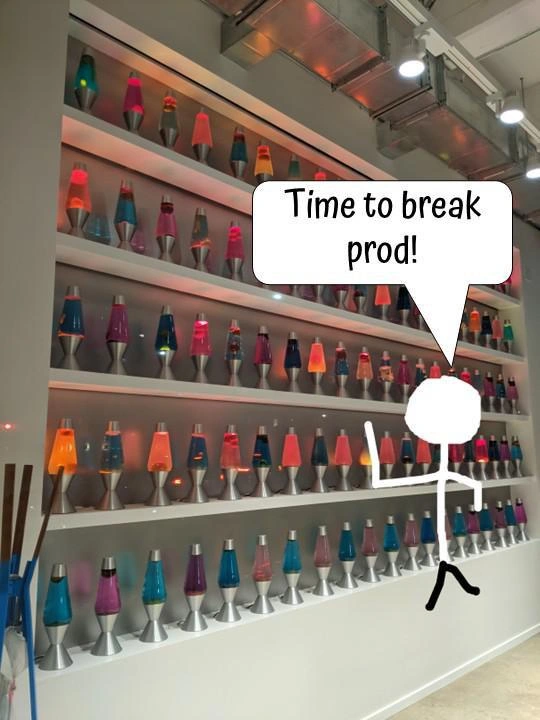
Imagine you and your friend want to pick a truly random winner for a game. You suggest, “Let’s just roll a die.” But your friend has a wild idea: they set up a whole wall of goofy, gooey lava lamps and start filming them. The lamps have globs of wax floating and bouncing in different colors and directions. After a while, your friend points at the screen full of swirling shapes and says, “There! Our random choice will come from this!” It’s completely unexpected and kind of silly – you asked for a random pick, and they gave you a mini light show. But here’s the funny part: those lava lamps are so unpredictable that using them is like drawing a surprise out of a magic hat that no one else can rig. The meme is joking that to get a really, really random result, someone went overboard in the coolest way possible. It’s as if to say, “We didn’t want just any random – we wanted the craziest random!” Seeing a simple request answered by a wall of colorful chaos is what makes it both funny and clever. Even if you don’t get the tech side, you can laugh at how far they went just to pick a random number.
Level 2: Understanding Entropy
So, what’s the deal with these lava lamps and random numbers? Let’s break it down in simpler terms. A random number generator (RNG) is basically any system or tool that gives you an unpredictable number. Computers often use pseudorandom generators – these are like very complex recipes that produce a sequence of numbers that look random. They start from a seed (a starting number) and crunch it to get a new number, then repeat. The catch: if you know the recipe and the seed, the “random” numbers aren’t a surprise at all! For everyday tasks like games or simulations, that’s usually fine. But for security (think encryption keys, passwords, lottery draws), “fine” isn’t enough – you want numbers no one can guess, ever. That’s where true randomness comes in, and it often comes from the physical world. Entropy in this context just means “randomness collected from unpredictable events.” Computers gather entropy from things like mouse movements, keyboard timing, or tiny hardware noise. On a server with no keyboard or mouse, getting entropy is trickier, so engineers get creative with physical_entropy_sources. Cloudflare’s lava lamps are a famous example: each lava lamp’s blobs of wax form random shapes and colors. A camera captures these unpredictable visuals. All those weird patterns translate into a bunch of random data (imagine reading the color values of each pixel – it’s like a huge, messy random number). This data gets mixed into the computer’s entropy pool (basically a storage bucket of randomness). From there, whenever a program asks for a secure random number (like generating a new encryption key), it’s drawing from a well-stocked pool of truly jumbled-up, unpredictable bits. It’s like having a bunch of dice constantly rolling in the background, so you always have fresh random outcomes. The term Lavarand actually comes from an old project where engineers first tried this lava lamp idea back in the 90s – proving it wasn’t just a crazy stunt, but a solid technique. In modern systems, there are also dedicated hardware RNG devices (for instance, a chip that measures electronic noise) that serve the same purpose. The meme is funny to junior devs because it shows a literal and extreme solution: the dev asks for randomness, and the ops answer isn’t a code snippet but a wall of colorful, bubbling lamps. It highlights how sometimes solving a software problem means thinking outside the computer – literally adding lava lamps to your network rack! And while it’s humorous, it’s also educational: it shows the importance of good entropy in cryptography. In simple terms, the more random your random numbers really are, the safer your secrets. That’s why an internet infrastructure company would go as far as using cloudflare_lava_lamps as part of their security toolkit. After all, a hacker might predict a standard algorithm, but nobody can predict the dance of a hundred lava lamps.
Level 3: Bright Idea for RNG
This meme hits home for seasoned engineers because it references a legendary real-world solution: Cloudflare’s wall of lava lamps for generating random numbers. In the first panel, the developer says, "we need a random number generator", probably expecting a software library call or maybe plugging into Linux’s /dev/urandom. But the ops team one-ups any ordinary solution by literally wheeling out an entire lava-lamp wall as the RNG. It’s funny and absurd at face value – imagine asking for a simple function and getting a psychedelic light show instead – yet it’s also a nod to best practices in high-stakes Security infrastructure. Why go to such lengths? Because entropy is serious business. Past incidents have taught senior engineers that bad randomness leads to real disasters: think of the Debian OpenSSL fiasco where a predictable PRNG seeded every encryption key, or how early web browsers like Netscape shipped with weak random seeds and got cracked. In an enterprise setting, especially in CryptographyAlgorithms, you need cryptographically secure randomness for things like TLS handshakes, API keys, session tokens – if those aren’t truly random, attackers can guess them. A tired ops veteran might quip, “You’ve got a better idea? I’ll wait,” implicitly referencing how even CPU-provided random instructions (like Intel’s RDRAND) or standard libraries could be flawed or untrustworthy (there have been rumors of backdoors or biases). So, they deploy something delightfully analog: a camera filming dozens of unpredictable lava lamps, feeding that data into the system’s randomness entropy pool. It’s an hardware_rng approach taken to an artistic extreme – the lava lamps’ glow isn’t just mood lighting, it’s actively scrambling bits for security. Seasoned folks chuckle because they recognize Cloudflare’s implementation (the pasted photo in the meme is essentially their lobby). The last blurred, speechless characters mirror how newcomers react when first hearing this – “Wait, you secure the internet with… lava lamps?!” But senior devs and ops pros nod knowingly. They’ve lived through entropy droughts on headless servers and seen the ingenuity needed to avoid them (like jitter entropy daemons or even plugging in a USB physical_entropy_source that measures thermal noise). The meme perfectly captures the culture of infrastructure engineering: sometimes the most outrageous solution (a rainbow wall of lava lamps) is actually the most pragmatically secure. It’s a cheeky celebration of out-of-the-box thinking – literally using a box of lava lamps – to solve a fundamental problem. And indeed, anyone tempted to scoff is challenged by the caption: “Tell me your ideas that are better, I’ll wait.” Because in terms of both cryptographic rigor and pure geek style, it’s hard to beat the lava lamp wall.
Level 4: Molten Entropy
In cryptography, the quality of randomness can make or break security. A computer algorithm by itself, being deterministic, cannot conjure true randomness from thin air – any pseudorandom number generator (PRNG) ultimately follows rules. At best, it can simulate randomness if seeded with some unpredictable input. This is where entropy comes in: entropy is a measure of uncertainty or surprise in data (higher entropy = more unpredictability). To get truly unpredictable bits, systems tap into chaotic physical processes. Enter the lava lamps: a playful example of harnessing physics for randomness. The chaotic motion of wax in a lava lamp is governed by fluid dynamics and heat, producing patterns so complex that they’re effectively impossible to predict or replicate. Each video frame of those lamps contains massive Shannon entropy – essentially a wealth of random bits. Cloudflare’s famous lava-lamp wall is a real-world physical entropy source feeding randomness into their cryptographic systems. This isn’t just for show: it’s grounded in serious theory. Randomness extraction from physical processes was pioneered by systems like Lavarand in the 1990s, where images of lava lamps were hashed to generate seed data. The concept leverages the fact that, according to information theory and thermodynamics, microscopic variations (like tiny differences in wax globs and pixel noise) amplify into unpredictable macroscopic changes. You could say the lava lamp rig is a tangible implementation of a hardware RNG, akin to quantum random number generators or electronic noise diodes, but much more fun to look at. By mixing such chaotic analog signals into a system’s entropy pool, we edge closer to true randomness as defined in theoretical computer science — something no purely algorithmic method can achieve without assuming a random oracle. In practical terms, this means stronger cryptographic keys and Security that even state-of-the-art attackers, with all their computational power, can’t easily undermine. The meme’s scenario highlights this deep truth humorously: when absolute unpredictability is required, we sometimes literally need to illuminate our solutions via the laws of physics, not just clever code.
Description
A four-panel comic meme format depicting a conversation between developers. In the first panel, a smiling character enthusiastically suggests, 'we need a random number generator'. The second panel shows another smiling character, with a thought bubble or background image displaying a real photograph of a large wall filled with dozens of colorful, glowing lava lamps. This is a direct reference to Cloudflare's 'Wall of Entropy,' which uses the chaotic patterns of lava lamps to generate cryptographic-grade random data. A vertical line separates these two panels from the last two, which show two other characters with expressions of horror, confusion, and despair. This meme humorously illustrates the classic engineering conflict between creating a technically 'cool' and novel solution versus a practical and maintainable one. While using lava lamps for entropy is a clever, real-world application of generating true randomness, the characters on the right represent the pragmatic viewpoint of senior engineers and SREs who foresee the immense operational and maintenance nightmare of such a physically-dependent system, when a simple call to a standard cryptographic library would suffice
Comments
39Comment deleted
It's all fun and games until you have to write the Terraform provider for 'cloudflare_lava_lamp_instance' and the acceptance tests have a 30-minute warm-up time
"Sure, we could just call /dev/urandom - but legal said FIPS likes its entropy with a side of mood lighting."
Somewhere a principal engineer is screaming 'Just use /dev/urandom!' while the infrastructure team is already calculating the TCO of a quantum entropy harvesting cluster with redundant cosmic ray detectors for 'true randomness at scale.'
When your junior dev suggests using blockchain for generating random numbers, and you realize they've been reading too many whitepapers. Sure, you could use Math.random() or /dev/urandom, but why not burn enough electricity to power a small city and contribute to global GPU shortages? At least the entropy is... distributed. The real random number here is how many months until the electricity bill bankrupts the project
If your RNG seed fits in a Terraform variable, it’s not entropy; point a webcam at a wall of lava lamps, hash it into the kernel pool, and call it FIPS-compliant office decor
After the VM’s entropy pool starved and TLS handshakes stalled, we fixed it the enterprise way: a webcam pointed at 100 lava lamps - finally, a microservice with literally good vibes
The original CSPRNG: perfectly reproducible across runs - dog-ear page 314159 and watch it never drift
hash from last comment Comment deleted
https://en.wikipedia.org/wiki/Hardware_random_number_generator Comment deleted
I'm actually sad by not seeing any mentions of RDRAND Comment deleted
rdrand can be shitty sometimes https://github.com/google/security-research/security/advisories/GHSA-4xq7-4mgh-gp6w Comment deleted
Yep, but the same applies to almost any other device when you need A LOT of random numbers This is a whole reasoning behind lava lamps :D Comment deleted
i know, i just wanted to mention that Comment deleted
Mainly that's the reasoning behind 1) mixing all the entropy sources and feeding it to CPRNG 2) actually measuring the entropy Comment deleted
Regarding point 1 - input is crucial part, it’s not separate from any CRNG but key part of the design for any Depending on context and how CRNG is being used, "measuring the entropy" might differ so this one is also unclear Comment deleted
Anyway Comment deleted
the RDRAND attack used 4: https://m.xkcd.com/221/ ;-) Comment deleted
I'm saddened by how much I had to scroll till I saw this classic Dilbert. Comment deleted
glorified uncalibrated clock Comment deleted
*cock Comment deleted
*uncalibratable If it could be calibrated it could be predicted. Comment deleted
Fluctuations in my shitty eastern European electricity network Comment deleted
keysmash from your local queer person :3 Comment deleted
:3 Comment deleted
A glass to cum into. When in need of the next value, it is calculated based on the current cumlings' position. Comment deleted
bruh Comment deleted
I hear Quantinuum thinks they can sell quantumly random numbers…. I guess when all your machine can do is make random numbers you have to make lemonade somehow Comment deleted
When life gives you random numbers 🤷♂️ Comment deleted
ask a lot of people what's the most random number 1-100, and pick most chosen. End up with 37, which must be really random if a lot of people agree 🌚 Comment deleted
This is cloudflare Comment deleted
finally, i had to scroll thru a lot of comments to find someone else who recognised it Comment deleted
It feels like people in the field burn out so fast that they do not remember events from 5 years ago Though I googled and it was in 2017. Maybe most of followers didn't even wrote their first line of the code 8 years ago? Comment deleted
Sad😭 Comment deleted
But I am still not sure how "random" this is. I mean I see how overcomplicated it is and I understand hashes but still. "What if someone models all atoms and predicts their behavior?" /s Comment deleted
You forgot camera's noise That little boy is a real banger Comment deleted
Yes I thought about it too Comment deleted
But then why use the lavalamps at all? Comment deleted
Digits of Pi but backwards Comment deleted
you mean based on this photo it will go to the next value? Comment deleted