FFmpeg Reminds AWS Which Services They Power, Unpaid
Why is this AWS meme funny?
Level 1: The Bake Sale Built on Grandma's Pie
A big lemonade-stand company posts a fun game: "Tell us your name and we'll say which of our amazing drinks you are!" Then the quiet neighbor who grows all their lemons for free leans over the fence and says: "We already know which drinks we are — you make them from our lemons, and you've never even said thanks." Everyone at the stand goes silent. It's funny because the big company walked right into it with a cheerful party question, and the answer was the one thing they never wanted said out loud — that the whole stand runs on someone else's unpaid work.
Level 2: Why FFmpeg Gets to Make That Joke
FFmpeg is a free, open-source command-line toolkit for working with audio and video. If you've ever converted an .mkv to .mp4, compressed a screen recording, or streamed video on practically any website, FFmpeg or its libraries were almost certainly involved somewhere. It's the invisible plumbing of internet video — used inside countless commercial products.
AWS (Amazon Web Services) sells cloud computing, including media services that transcode video at scale — services widely understood to wrap open-source tools like FFmpeg in a managed, pay-per-use API. Open-source licenses permit exactly this: anyone, including trillion-dollar companies, may use the code commercially for free. "Contributions" in FFmpeg's reply means what companies could voluntarily give back: funding, developer time, bug fixes submitted upstream, security support.
The tweet format is engagement bait — a brand asking followers to reply so the algorithm boosts the post. The risk, demonstrated here, is that replies are open to everyone, including the unpaid project your billable services depend on. For anyone early in their career, this exchange is a compact lesson in how the software economy actually works: the most critical code is often maintained by a handful of volunteers, and "free" software has a cost that someone, somewhere, is quietly absorbing.
Level 3: The Dependency That Tweets Back
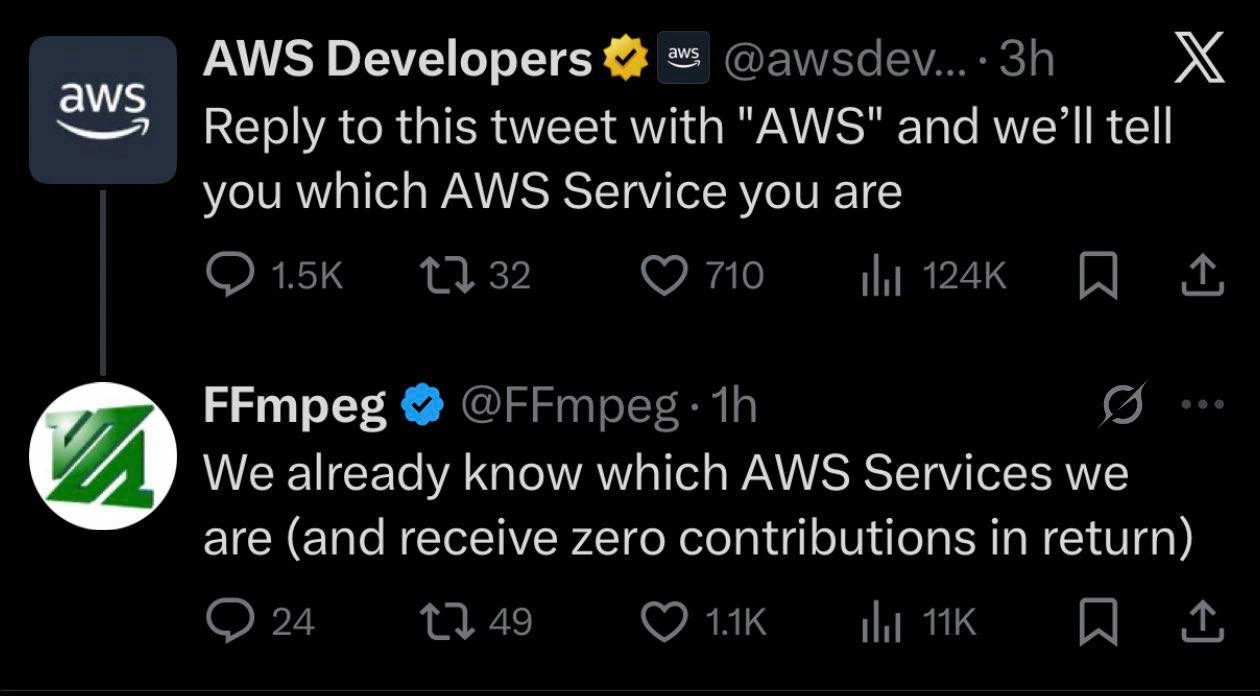
AWS Developers: "Reply to this tweet with 'AWS' and we'll tell you which AWS Service you are" FFmpeg: "We already know which AWS Services we are (and receive zero contributions in return)"
Corporate engagement bait meeting the one account on the platform with standing to end the conversation — this is the open-source sustainability debate compressed into two tweets. AWS's social team posts a harmless personality-quiz prompt; FFmpeg, the volunteer-maintained multimedia framework that decodes, encodes, transcodes, and muxes essentially every video format in existence, replies with the receipts. The engagement metrics visible in the screenshot tell the story of who won: AWS's parent tweet shows 710 likes against 1.5K replies (a ratio that, in platform vernacular, is a crime scene), while FFmpeg's one-liner pulls 1.1K likes on a fraction of the views.
The burn works because the underlying claim is broadly understood to be true in kind. Cloud media services — transcoding pipelines, format conversion, thumbnail generation, stream packaging — are, across the industry, built atop FFmpeg and the codec libraries in its orbit (libx264 and friends). FFmpeg's LGPL/GPL licensing makes this perfectly legal: the license demands source availability under specific conditions, not gratitude, money, or upstream patches. And that's precisely the structural problem the FFmpeg account has spent years publicizing — the project's maintainers triage decades-old C code, fuzzing reports, and a relentless stream of CVEs as volunteers, while hyperscalers convert that labor into managed-service margins measured in billions. Legal compliance and ecosystem health turn out to be entirely different axes.
This is the xkcd-2347 economy — all modern digital infrastructure balanced on one load-bearing project thanklessly maintained by a few people — except the load-bearing project got a verified account and discovered ratio mechanics. The strategy is genuinely novel: traditional maintainer complaints (mailing lists, conference talks, burnout blog posts) reach other maintainers. Replying to a megacorp's own engagement bait reaches the megacorp's marketing audience, converting a sustainability grievance into a public-relations cost. It's the only leverage an infrastructure project has against a customer that already has the source code: embarrassment, deployed with precise comedic timing. The unspoken corporate fix — sponsor the maintainers, upstream your patches, fund a security audit — costs a rounding error of one service's revenue, which is what makes the silence around it so eloquent.
Description
A screenshot from X (Twitter) in dark mode. The top tweet, from verified account 'AWS Developers' (@awsdev..., 3h, 1.5K replies, 32 reposts, 710 likes, 124K views), reads: 'Reply to this tweet with "AWS" and we'll tell you which AWS Service you are.' Below it, the official FFmpeg account (@FFmpeg, blue check, green logo, 1h, 24 replies, 49 reposts, 1.1K likes, 11K views) replies: 'We already know which AWS Services we are (and receive zero contributions in return).' The burn lands because AWS media services (Elastic Transcoder, MediaConvert, etc.) are widely understood to be built on FFmpeg, and the FFmpeg project has publicly criticized trillion-dollar companies profiting from volunteer-maintained open source without funding or upstream contributions
Comments
4Comment deleted
AWS's personality quiz has one guaranteed result: whatever service you are, the transcoding layer is FFmpeg with a markup
Are they, really? What does cloud hosting have to do with video codec software? 🤔 Comment deleted
https://aws.amazon.com/mediaconvert/ Comment deleted
"non-existent" Comment deleted