Skip to content
DevMeme
7219 of 7435
Marie Kondo on Project Timelines: Upfront Design Sparks Joy
SDLC Post #7917, on Apr 13, 2026 in TG

Marie Kondo on Project Timelines: Upfront Design Sparks Joy

Why is this SDLC meme funny?

Level 1: Building Without a Picture

Imagine two kids building the same LEGO castle. The first kid spends a few minutes looking at the instructions, then builds it, then fixes one little tower at the end — easy and fun. The second kid throws the instructions away and starts snapping bricks together immediately — and then spends the whole rest of the day pulling walls apart, rebuilding them, finding new broken bits every time something gets fixed, until the day is gone and the castle still wobbles. The tidy lady in the picture is smiling at the first kid's day and horrified by the second kid's day, because a little bit of thinking before you start saves a mountain of fixing after — and everyone who builds things for a living has learned that the hard way at least once.

Level 2: Reading the Bars

  • Design: the phase before coding where you decide what to build and how — data shapes, component boundaries, failure cases. Output is sketches and decisions, not code. In the healthy bar it's small but real; in the chaotic bar it's nearly zero.
  • Bug fix: correcting defects after the code exists. Some bugfixing is normal (top bar's sliver); a schedule that's mostly bugfixing (bottom bar) signals the team is discovering the design by colliding with its absence.
  • Refactor: restructuring existing code without changing behavior — untangling the mess so future changes stop hurting. Note where it appears in the meme: only in the bad timeline, as emergency archaeology rather than routine hygiene.
  • Marie Kondo / "sparks joy": the tidying expert whose method asks you to keep only items that spark joy. The meme format uses her smiling/grimacing panels to bless one option and condemn another.

The junior-dev rite of passage encoded here: your first "quick" project where you start typing immediately because design feels like stalling — and three weeks later you're fixing bug #14 caused by fixing bug #11, realizing the hour of whiteboarding you skipped is now a month of whack-a-mole. The aphorism the meme illustrates is the classic inversion: weeks of coding can save you hours of planning.

Level 3: The Stabilization Quarter Nobody Budgeted

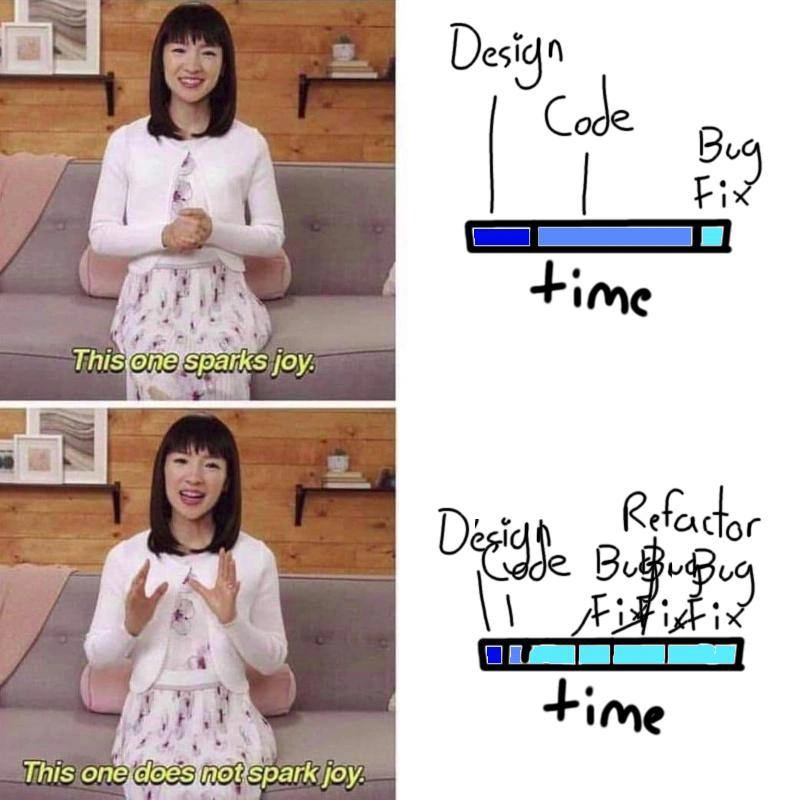
The two hand-drawn timeline bars in this meme are more honest than most Gantt charts, and that's the joke. In the top bar — "This one sparks joy."Design takes a modest slice, Code the comfortable middle, and Bug Fix a sliver at the end. In the bottom bar, Design and Code are crushed into two tiny chips at the left edge, and the rest of the schedule dissolves into an overlapping scribble of Refactor and Bug Fix Bug Fix Bug Fix, with the labels themselves crashing into each other — the typography enacting the chaos it describes. Same total bar length. Same time axis. Radically different lives.

The senior-engineer truth being smuggled in: you don't actually skip the design phase — you just pay for it later, at compound interest, under a different line item. The bottom bar's bugfix treadmill is the design phase, executed in production, with customers as QA and incident channels as the whiteboard. Every architectural question you declined to answer up front ("what happens when two writers race?", "who owns this state?") gets answered anyway — by a pager, at the worst possible moment. That's the mechanism of technical debt: the principal is invisible at sprint planning, the interest payments arrive as an endless "stabilization" backlog that somehow never stabilizes, because each hot-patch applied without a model of the system creates two fresh defects in corners the patcher couldn't see.

Why do smart teams keep choosing the bottom bar? Incentives, mostly. Demo-driven cultures reward visible motion: a week of design produces a document nobody applauds, while a week of coding produces a screenshot for the stakeholder deck. Velocity metrics count shipped tickets, not avoided rework. And there's the industry's pendulum-swing overcorrection in the background — having escaped Big Design Up Front waterfall purgatory, many teams internalized "agile" as "thinking is waterfall," when the original agile literature assumed continuous design, not its absence. The meme's Marie Kondo framing is sharper than it looks: her method isn't "never own things," it's deliberate curation before accumulation — which maps exactly to deciding what belongs in the system before the codebase becomes a junk drawer you're afraid to open.

Description

A two-panel Marie Kondo meme. In both panels she sits on a gray couch against a wood-paneled wall in a white cardigan and floral dress. Top panel: smiling with hands clasped, captioned 'This one sparks joy.' next to a hand-drawn timeline bar where 'Design' takes a small dark-blue slice, 'Code' a large medium-blue middle portion, and 'Bug Fix' a tiny cyan sliver at the end, labeled 'time'. Bottom panel: grimacing with hands raised, captioned 'This one does not spark joy.' beside a chaotic timeline where 'Design' and 'Code' are crammed into tiny slivers at the start, followed by an overlapping scribbled mess of 'Refactor', repeated 'Bug Fix Bug Fix Bug Fix' segments filling most of the bar. The meme contrasts a healthy upfront-design project lifecycle with the all-too-common rush-to-code approach that converts the schedule into an endless bugfix-and-refactor treadmill

Comments

4
Anonymous ★ Top Pick Weeks of coding can save you hours of design - and fund an entire roadmap quarter labeled 'stabilization'
  1. Anonymous ★ Top Pick

    Weeks of coding can save you hours of design - and fund an entire roadmap quarter labeled 'stabilization'

  2. @SamsonovAnton 2mo

    Intense joy

  3. @SamsonovAnton 2mo

    Pure joy

  4. @SamsonovAnton 2mo

    Nirvana

Use J and K for navigation