Stack Overflow: The Art of Code Acquisition
Why is this DevCommunities meme funny?
Level 1: Finders Keepers
Imagine you’re doing a tough homework problem and you just can’t figure it out. Then you peek at your friend’s notebook and see the perfect answer. You quickly copy it down onto your homework sheet. When you hand in the assignment, you act like it’s your answer now. That’s basically what’s happening in this meme, but with computer code. The frog in the picture is like a cheeky kid grabbing someone else’s toy or answer and saying, “It’s mine now!” It’s funny because the developer didn’t actually create that solution – they just found it and took it. Just like copying your friend’s homework, it solves the immediate problem, but it’s a bit sneaky and you didn’t learn how to do it yourself. The meme makes us laugh and nod because it’s showing a playful truth: developers often borrow answers from others and pretend it’s their own work, much like a kid saying “finders keepers!”
Level 2: Monkey See, Monkey Paste
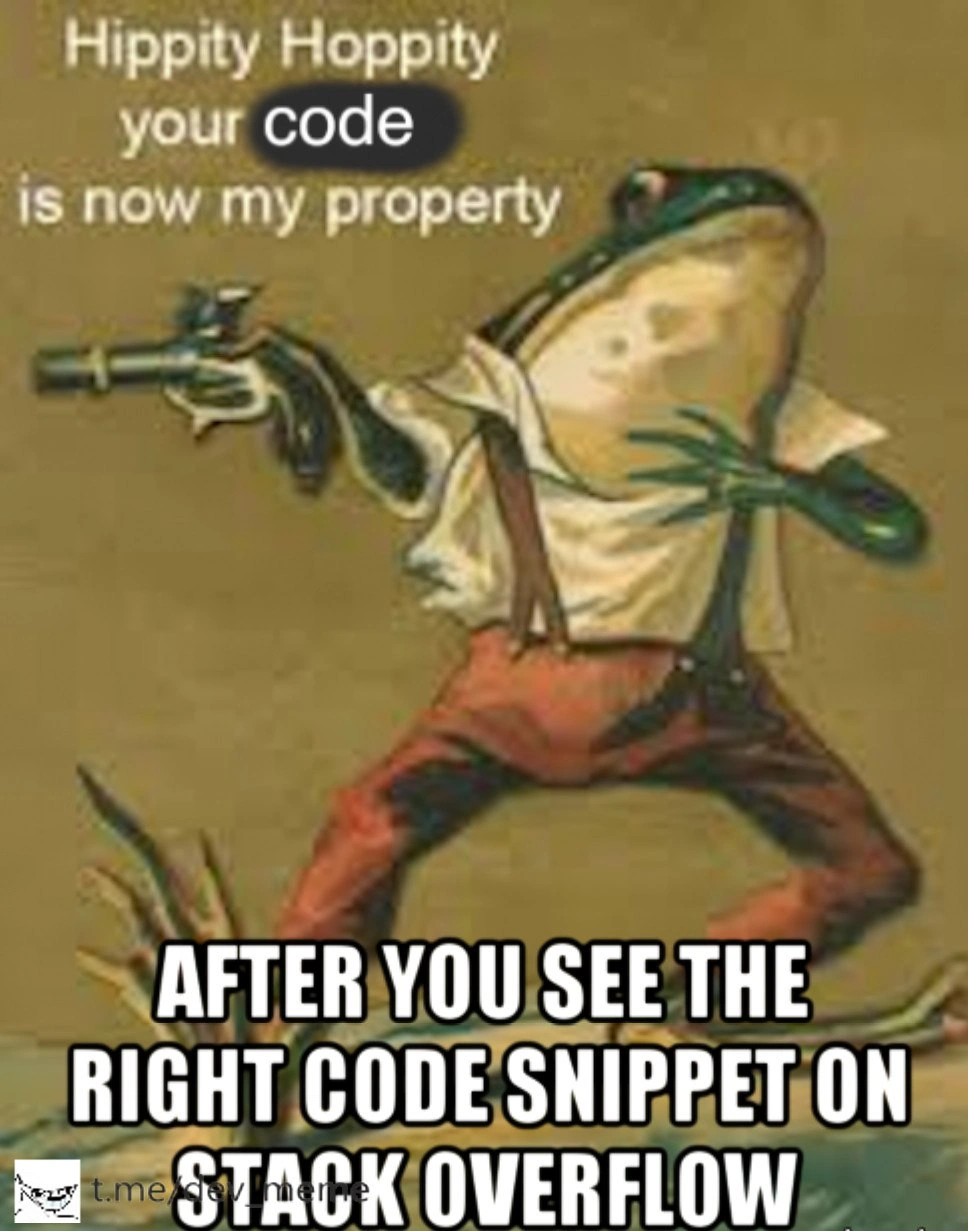
This meme is highlighting a well-known habit in the developer world: copying code from the internet to solve your problems. Stack Overflow is an online Q&A forum and developer community where programmers ask questions and get answers – often including handy code snippets (small pieces of example code). When you’re new or on a tight deadline, finding the “right code snippet” on Stack Overflow feels like a lifesaver. For example, say you’re stuck on how to sort a list or parse a date in your program. You search the error or question, and someone on Stack Overflow has posted a solution with code that does exactly what you need. The moment you see it, you might excitedly copy and paste it into your project. The meme text “After you see the right code snippet on Stack Overflow” describes that impulsive moment. The joke is that the developer immediately treats the discovered code as their own – “your code is now my property.” It’s a play on the phrase kids might use, “finders keepers,” but applied to software.
In the image, a frog dressed like an old-fashioned gangster (red suspenders, pistol in hand) represents the developer in a comical way. He’s basically saying to the original author of the code, “I’m taking this, and now it’s mine!” This represents copy-paste coding: taking someone else’s solution and dropping it into your codebase (your project’s code collection, often called a repo or repository). Every developer’s repository is the place where their application’s source code lives. By copying the snippet, you’ve effectively made it part of your own project. The humor comes from the frog’s aggressive stance – as if the programmer is robbing the code – which is an exaggeration of how we sometimes thoughtlessly take code from Stack Overflow.
Now, why is this funny or notable? Because it’s so common. Many junior developers (and let’s be honest, even experienced ones sometimes) do this when they’re in a bind. It’s like a student copying the answer to homework – quick and convenient, but done without fully understanding the solution or considering if it’s the perfect fit. There’s an entire running joke in developer humor about building applications by stringing together solutions from the internet. We even have slang for it: calling it “Stack Overflow Driven Development.” On the positive side, reusing code examples can help you learn and save time – why reinvent the wheel if someone already solved the exact problem? This is a form of code reuse, which in principle is a good thing in software engineering. But on the cautionary side, you have to be careful with what you copy. The snippet might not exactly match your needs or could have hidden issues. And technically, code isn’t free just because it’s online – there are licenses (legal rules) attached to most code. Stack Overflow requires that if you copy a significant chunk, you give credit, because the original author has some rights. In practice, though, newbies often don’t realize this. They just see an answer, think “Oh perfect, I’ll use that,” and forget about attribution.
The meme is essentially poking fun at how developers sometimes grab code without asking (or understanding). The phrase “your code is now my property” in this context is a sarcastic way to say “I’m using this code as if I wrote it myself now.” It highlights issues of code quality and originality. Dumping a foreign code snippet into your project can make the codebase messy or inconsistent. Imagine an application where each function is written in a slightly different style because they came from different authors on the internet – that can be confusing! Yet, in day-to-day engineering, especially when racing against time, people often do this and later justify it with “well, it works, doesn’t it?” The frog with a gun is a silly visual metaphor for the process: it’s like the developer is holding up Stack Overflow at gunpoint saying, “Hand over the solution, now!” Don’t worry, no actual frogs or developers were harmed – it’s all playful exaggeration. The takeaway for a young developer is: Yes, Stack Overflow is super helpful and everyone uses it, but remember to use those snippets wisely (understand the code, check if it fits, and ideally give credit). The meme makes us laugh because we’ve all felt that rush of joy when an online solution instantly fixes our bug, followed by the cheeky feeling of “I totally own this now.”
Level 3: The Copy-Paste Bandit
When a developer finds a Stack Overflow answer that perfectly solves their bug, it can feel like striking gold. The meme’s Hippity Hoppity frog brandishing a pistol is a tongue-in-cheek representation of us devs as outlaws, pilfering code snippets and declaring, “your code is now my property.” It’s a satire of DevCommunities culture: we’re all encouraged to share knowledge on Q&A sites, but in practice we often steal reuse that knowledge wholesale. This image captures the moment “After you see the right code snippet on Stack Overflow” – a developer SWAT-teams the code into their project repo without a second thought. The humor hits home for any battle-scarred programmer who’s copy-pasted an answer at 3 AM to save a production app, effectively acting like a masked bandit of open-source solutions.
On a serious note, experienced developers recognize a few unspoken truths behind this meme. First, there’s the license oblivious reality: content on Stack Overflow is typically licensed under Creative Commons (CC BY-SA), meaning you’re supposed to credit and share alike. But under a deadline, who stops to check the fine print? (Answer: almost nobody.) The frog’s smug slogan “your code is now my property” wryly highlights how we just assume that code on the internet is free for the taking. It’s a gentle jab at our tendency to treat community-contributed code as public-domain copy pasta. In a senior engineer’s world, this translates to potential legal and quality concerns. Blindly copying a snippet can introduce a license conflict in your codebase – imagine accidentally mixing a GPL-licensed snippet into your proprietary project. That’s the kind of nightmare scenario the seasoned pros joke about when they say “Hippity Hoppity, say hello to our new IP attorney”.
Then there’s the CodeQuality aspect. A high-rep Stack Overflow answer might be correct, but it wasn’t written specifically for your codebase. Seasoned devs have all seen the fallout of CopyPasteCoding: inconsistent coding styles, variables named foo and bar suddenly appearing in production code, or an ostensibly “perfect” snippet that doesn’t handle an edge case in your environment. We chuckle because we’ve been guilty of this. One moment you’re a desperate coder googling error messages, the next you’re a Copy-Paste Commando, dropping someone else’s function into your project with a comment // Source: some StackOverflow post. In our heads, we’re thinking, “It compiled and the tests passed, ship it!” The meme exaggerates this by depicting the coder as an actual robber grabbing loot. Code reuse is a double-edged sword: it accelerates development, but it can also import unknown bugs or security flaws. Senior devs often joke that our codebase is “written by Stack Overflow contributors” because so many fixes come from there. It’s funny and a little painful – a shared secret that behind many tight deadlines and shaky systems is a chunk of code copied from an answer by Jon Skeet or some other savior on the forums.
Finally, the imagery of a vintage frog outlaw adds an extra layer of irony. It implies this practice is like an old-timey crime – as if plundering code is an age-old tradition among programmers. In reality, developers have been sharing and borrowing code since the dawn of computing (from Usenet forums and BBSes long before Stack Overflow). The meme nods to that history: the frog’s swagger says “I’ll be taking that”, just like countless coders before us who grabbed a convenient snippet and moved on. We laugh in recognition: the Stack Overflow-driven development workflow is practically a rite of passage in software engineering. Sure, in an ideal world we’d write original, well-documented solutions for every problem. But when the build is broken and the boss is waiting, hippity hoppity, that snippet is now in our code repository. What could possibly go wrong? 😅
Description
A meme featuring a vintage-style illustration of a large, anthropomorphic frog wearing a shirt, suspenders, and trousers, and brandishing an old pistol. The top text reads, 'Hippity Hoppity your code is now my property', with the word 'code' highlighted with a black oval. The bottom text, in a bold, impactful font, says, 'AFTER YOU SEE THE RIGHT CODE SNIPPET ON STACK OVERFLOW'. This meme humorously captures the universal developer experience of finding the perfect solution on Stack Overflow after a long struggle and immediately claiming it for their own project. The aggressive, possessive stance of the frog represents the developer's feeling of triumphant discovery and ownership, glossing over the nuances of licensing and attribution. A watermark for 't.me/dev_meme' is visible at the bottom
Comments
7Comment deleted
The most dangerous code isn't from a junior dev; it's from a Stack Overflow answer from 2012 with a single checkmark and a comment saying 'Works on my machine'
“Hippity hoppity - turns out that 6-line Stack Overflow fix just relicensed our whole microservices platform under GPLv3; good luck with the IPO due-diligence deck.”
After 15 years in the industry, I've learned that the real skill isn't writing original code - it's knowing exactly which Stack Overflow answer to trust when there are 47 conflicting solutions, each with their own edge cases that the accepted answer from 2012 definitely doesn't handle
The modern software development lifecycle: 1) Google the problem, 2) Find the Stack Overflow answer with 847 upvotes from 2012, 3) Copy the accepted solution verbatim, 4) Commit with message 'implemented custom algorithm', 5) Hope nobody notices it's the exact same variable names. Bonus points if you later become the senior engineer who has to explain to juniors why that 'custom' implementation uses deprecated APIs and why the comment says 'TODO: understand what this does'
You paste the perfect Stack Overflow snippet, tests go green - then Legal wants CC BY‑SA attribution, prod has a hidden N+1, and your new principal engineer is ‘user1347’ from 2011
Stack Overflow snippets: battle-tested by a million copy-pastes, outliving your microservices refactor by years
SODD: paste, pass CI, merge - then inherit CC BY-SA obligations, a hidden global, and an on-call rotation whose bus factor is whoever wrote that 2013 answer