Skip to content
DevMeme
779 of 7435
The Eternal Struggle of Unit Testing
Testing Post #883, on Dec 2, 2019 in TG

The Eternal Struggle of Unit Testing

Why is this Testing meme funny?

Level 1: Eat Your Vegetables

Think of it like a parent telling their child, “You have to eat your vegetables before you can have dessert.” The vegetables are healthy and good for you (just like testing your code is good for the software), but the child really just wants the ice cream for dessert (that’s the fun part, like rolling out a cool new feature). Now imagine the kid crosses their arms and shouts back at the parent, “I’m not eating these stupid veggies! You eat them!” – basically throwing a tantrum. It’s a rude and over-the-top reaction to being told to do something responsible. In this analogy, eating your vegetables is like a developer writing their unit tests, and dessert is like quickly getting to release the new feature.

The meme is funny because it shows a developer acting like that stubborn kid. We all know the parent (or the team lead) is right – the veggies will make you strong, and the tests will make the code strong. But we also understand the kid’s temptation: vegetables can be yucky and tests can feel tedious. Seeing that childish rebellion play out in a dramatic jungle battle scene makes us laugh. It exaggerates a very common feeling: everyone knows they should do the boring, good-for-you task, but a part of us just wants to yell, “No, I don’t wanna!” and skip straight to the fun part.

Level 2: The Testing Rebellion

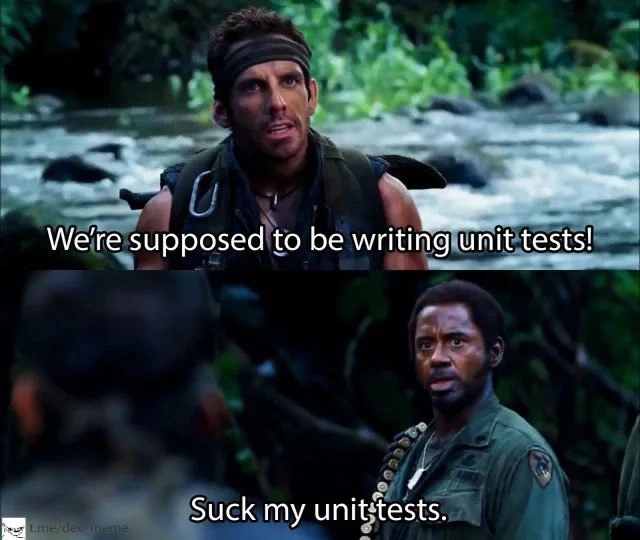
Imagine you're a junior developer on a team, and the company says every code change must come with unit tests. This meme shows that situation in an extreme, funny way. The “soldiers” here are actually developers on a software team. The first panel’s text, "We’re supposed to be writing unit tests!", is one team member reminding everyone of the rule: they should be adding tests for their code because the boss or lead told them so. The second panel’s reply, "Suck my unit tests," is a very rude refusal from another developer who doesn’t want to follow that rule. In a normal office, of course, nobody would respond to a testing policy with such profanity (unless they really wanted to get fired!). But as a joke, it captures the frustration some developers feel when they're forced to do something that they think slows them down.

Let’s break down the terms and scenario in simpler words:

  • Unit Testing: A unit test is a short program or script that checks a tiny part of your code (usually one function or module) to make sure it works correctly. For example, if there's a function add(x, y) that should add two numbers, a unit test would call something like add(2, 3) and expect to get 5. If the code accidentally subtracts instead, the test will fail and alert the team. Unit tests are like an automatic double-check for your code. They help catch bugs early, before the software gets to real users. Think of it as writing a small example to prove that your code does what you think it does.

  • Mandatory Testing Directive: This means the team has an official rule (likely from management or a lead developer) that everyone must write tests for their code. Sometimes it's informal like, "Hey team, please remember to write tests." Other times it's enforced by tools – for instance, the project might require, say, 80% code coverage. Code coverage is a metric that measures what percentage of your code is executed by your tests. If coverage is below the target, the continuous integration (CI) system might even block your code from being merged until you add more tests. So a 'mandatory unit testing directive' could be as strict as: no code goes into the product without a certain number of tests. In the meme, when the first soldier says “We’re supposed to be writing unit tests!”, he's basically citing that policy (the "orders from above").

  • Feature Squad vs. Code Quality: A feature squad is a team focused on delivering new features to the product quickly. They often work under tight deadlines, and their success is measured by how many features or improvements they ship in each release. On the other hand, ensuring code quality (which includes writing tests, doing code reviews, etc.) makes sure the product is stable and maintainable. There’s a natural tension here: writing tests takes extra time now but can save time later by preventing bugs. If the schedule is too tight or the team isn’t convinced of the long-term benefits, they might see tests as a speed bump. The meme dramatizes this conflict. One side (first soldier) is waving the flag for quality: “Let’s do the right thing and test our code.” The other side (second soldier) is basically saying, “No way, that will just slow us down,” in a very crass manner. It’s quality vs. speed in a nutshell.

  • Team Culture and Pushback: Some development teams have a strong testing culture. You’ll hear terms like Test Driven Development (TDD), which means writing tests before writing the actual feature code, and using those tests to guide development. In these teams, even a junior developer is expected to write a bunch of unit tests for every new piece of code. Other teams are more lax about testing: they might do minimal tests or skip them if they’re in a rush, relying on a QA team or just hoping everything works. If a company suddenly tries to impose a strict testing rule on a team that isn’t used to it, there can be grumbling and resistance. The second panel’s rebellious response reflects that kind of grumbling in an exaggerated way. It’s essentially the developer saying, “I don’t care about your rule; I’ve got other priorities.” It’s the equivalent of a student rolling their eyes at being given extra homework when they just want to be done for the day.

Now, why is this funny or relatable? Many developers (especially those early in their careers) have felt a twinge of annoyance when the team lead or a code reviewer says, “Hey, where are the tests for this code?” If you’re excited about coding a cool new feature, pausing to write tests for every little part of it can feel tedious. It's a bit like being a kid who wants to go play outside, but your parent insists you clean your room first. There’s that moment of ugh, do I really have to? The meme takes that everyday internal protest and blows it up to comedic proportions: instead of a mild complaint, the developer basically declares war on the idea of tests, which is ridiculous and therefore laughable.

The phrase "Suck my unit tests" itself is humorous because it mixes a very unprofessional insult with a very professional term. "Unit tests" are a dry, nerdy topic that usually wouldn’t appear in trash talk. By using that phrase as an insult, the meme creates a jarring, silly contrast. It’s as if a character in a serious war film started complaining about writing paperwork in the middle of a gunfight – the contrast is funny.

In summary, this meme is a piece of developer humor that exaggerates a real scenario for laughs. On one side, there’s the best practice: write your tests, do your due diligence. On the other side, there’s the reality of CodingFrustration: tight deadlines, the thrill of just getting the feature done, and the feeling that writing tests is an annoying extra step. The meme shows a team member trying to enforce good practice and another basically acting like a stubborn rebel. It’s relatable because most programmers have seen some version of this tension between doing things the fast way versus the right way. And by casting it as a parody of a dramatic movie scene, it lets us laugh at our own occasional stubbornness. After all, in real life we (hopefully) settle these disagreements more calmly, but the fact that it can feel like a battle makes the joke spot-on.

Level 3: Battleground: Unit Testing

In the codebase jungle, writing unit tests has become an all-out war. This meme grabs a scene from a war movie (likely the satirical action flick Tropic Thunder) to portray a battle between developers over testing. The first soldier (with a Ben Stiller-like intensity) shouts, "We’re supposed to be writing unit tests!" – effectively echoing a mandate from high command (management or the QA department). The second soldier, in full rebel mode, snaps back, "Suck my unit tests." It's a parody of a profane war-movie one-liner, swapping in “unit tests” to fit our coding context and making the whole exchange absurd.

"Reminding coworkers to test their code be like..."

The meme’s caption suggests that simply asking colleagues to write tests feels like entering a combat zone.

For seasoned developers, this scene triggers flashbacks. It's depicting the classic feature vs. quality conflict that haunts many software teams. Management (or a team lead) issues a mandatory unit testing directive – perhaps decreeing, “Thou shalt write tests for every new feature,” or enforcing a minimum code coverage percentage. The intention is noble: improve CodeQuality and reduce bugs. But on the ground, in the trenches of a fast-paced feature squad, such directives can ignite pushback. Developers are under pressure to deliver new features ASAP, and writing tests is often viewed as a time-consuming code chore. So when someone in the team (maybe a quality-conscious engineer or an enforcer from QA) reminds everyone “we should be writing unit tests,” the immediate visceral response from an overburdened coder might as well be “Yeah? How about no.” In the meme it’s crassly (and hilariously) phrased as “Suck my unit tests,” capturing that exact mix of frustration and defiance.

This dark humor resonates because it’s a relatable developer experience. Nearly every senior dev has witnessed some form of unit_test_resistance. Perhaps after a nasty production outage, upper management rolls in with a new edict: all code must have 80% unit test coverage. On paper, it sounds reasonable – who can argue against testing? But the DeveloperExperience (DX) of a mandate like that can be awful if it's dropped on engineers without support. Suddenly, feature teams feel like they're fighting on two fronts: building features and appeasing arbitrary test coverage metrics. It’s not unheard-of for devs to begrudgingly comply in the most minimal way possible. They might write flimsy tests that assert nothing meaningful, just to satisfy the metric. It's like raising a white flag while covertly subverting the spirit of the order. For example, a truly jaded team might add a test file like this:

# A rebellious unit test example:
def test_placeholder():
    assert True  # Always passes, increases coverage, tests absolutely nothing

This snippet is a cynical reality in some codebases: a test that always passes (True is always true) and effectively says “here’s your darn test, happy now?” It technically bumps the coverage percentage and placates the CI gatekeepers, but it doesn't improve quality one bit. It's the coding equivalent of a soldier firing blanks in the air to pretend he's following orders. The Testing mandate is being openly mocked – exactly what the second soldier’s one-liner conveys.

The humor cuts deep because it exaggerates a truth: pushing for rigorous testing in a team that only cares about rapid delivery can feel like waging war. The meme leverages the absurdity of a jungle firefight to mirror office tension. The soldier yelling “We’re supposed to be writing unit tests!” could be that one team member fresh from a company with a strong testing culture (or an embattled QA engineer embedded in the team). He’s effectively shouting over the din of a hectic sprint, trying to get others to follow best practices. The retort “Suck my unit tests” is the burnout-fueled response of a developer who’s tired of being nagged about process when crunch time is looming. It's outrageous – you’d never actually say that to your boss or coworker without severe consequences – but as an under-the-breath mutter or a joking meme in the team chat, it captures the rebellious sentiment perfectly. Experienced engineers laugh at this because it’s an almost caricatured replay of discussions they’ve had in real life (minus the explicit rudeness, hopefully).

From an industry perspective, this meme satirizes a common anti-pattern: testing_discussion_dysfunction. Instead of a healthy dialogue about quality, things devolve into a standoff. Why does this happen? Often, it's due to systemic issues. Deadlines are relentless, and many organizations reward developers for shipping features more than for preventing bugs. So quality initiatives like testing get lip service. Developers learn that while the company mantra might be “Don’t ship untested code,” the unspoken reality is “Just get it done by Friday.” Over time, cynicism grows. A top-down directive (“write unit tests or else”) without addressing why developers skip tests (lack of time, brittle legacy code that’s hard to test, inadequate tooling, or no training on testing) just breeds resentment. The feature squad feels like commandos on a mission: carrying the extra weight of tests might slow them down and jeopardize the mission (the sprint goal). So they ditch the heavy safety gear. They'd rather risk the bugs (bullets) than miss the deadline for sure.

The war metaphor is painfully apt. Skipping tests is like sprinting through a dense jungle without scouting – you might move fast initially, but you risk stepping on a hidden landmine (a severe bug) that blows up later. The technical debt and undiscovered bugs are the lurking dangers in the foliage. The first soldier’s plea “We should be writing unit tests!” is the voice of someone trying to perform reconnaissance and clear those landmines before marching forward. The second soldier’s macho rebuff is basically “I don’t have time for that, I’ll take my chances.” Seasoned engineers have seen this movie before (pun intended). The rebellious developer might think he’s saving time now, but then 3 AM rolls around and an untested feature crashes in production. Cue the emergency alarms and frantic patching – the chaotic battle aftermath that the whole team must endure. As the cynical saying goes, “Quality assurance happens either by discipline upfront, or by disaster later.” This meme gets a laugh because it freeze-frames that pivotal decision point – and we all know exactly which path the defiant character is choosing in the heat of the moment.

Finally, the phrasing “Suck my unit tests” itself is a comedic gem of developer humor. It's a juvenile double entendre that merges workplace-safe terminology with the cadence of a classic R-rated insult. This captures the immature streak that even experienced developers can exhibit when frustration runs high. It’s poking fun at how a serious discussion about code quality can devolve into something absurd when communication breaks down. By quoting a war comedy scene, the meme lets developers safely say what they’d never dare say in a real meeting. It’s cathartic: we laugh at the big absurdity of it, but a part of us is also nodding, recalling those tense moments where reminding a teammate to write tests felt like walking into an ambush. In short, the meme turns a dry workplace conflict into an over-dramatic battle scene, highlighting both the absurdity and the familiarity of the unit testing rebellion.

Description

A two-panel meme taken from the movie 'Tropic Thunder'. In the top panel, a determined-looking Ben Stiller, in character as Tugg Speedman, is dressed in combat gear in a jungle setting and exclaims, 'We're supposed to be writing unit tests!'. In the bottom panel, Robert Downey Jr.'s character, Kirk Lazarus, also in combat gear, looks back with a dismissive and weary expression, retorting, 'Suck my unit tests.' This meme humorously captures the perennial conflict in software development between adhering to best practices (like writing thorough unit tests) and the pressures of deadlines or, in some cases, a cynical disregard for those practices. For senior developers, this resonates as a familiar debate, representing the clash between the idealistic 'by-the-book' engineer and the pragmatic (or jaded) veteran who sometimes prioritizes shipping code over perfect test coverage
Comments

7
Anonymous ★ Top Pick Unit tests are like flossing. Everyone agrees it's good for you, but most just tell the dentist they do it
  1. Anonymous ★ Top Pick

    Unit tests are like flossing. Everyone agrees it's good for you, but most just tell the dentist they do it

  2. Anonymous

    Management’s 90% coverage edict turns every sprint into jungle warfare: we all salute, then carpet-bomb the diff with assertTrue(true) until SonarCloud declares victory

  3. Anonymous

    The real unit test is whether your code survives production on Friday at 4:59 PM - everything else is just theater for the coverage reports that nobody reads until the post-mortem

  4. Anonymous

    This perfectly captures the eternal struggle between the architect who designed the 'comprehensive test pyramid' in the wiki three years ago and the senior engineer who's been shipping features to production on Friday afternoons with a 'works on my machine' certificate ever since. The real unit test is whether the deployment survives the weekend

  5. Anonymous

    Our “unit tests” are integration tests in witness protection - renamed FooServiceUnitTest to slip past the coverage gate

  6. Anonymous

    Unit tests: the side quest no dev finishes before mainlining to prod

  7. Anonymous

    Our enterprise TDD: write a test, mark it @flaky, drop the coverage gate to diff-only 0%, and call it “risk‑based testing” in the retro

Use J and K for navigation