The Holy Grail of Software Architecture: Middle End
Why is this DesignPatterns Architecture meme funny?
Level 1: Sandwich Peacemaker
Think of a sandwich with two slices of bread. One slice is the front-end and the other slice is the back-end. Now, these two pieces of bread sometimes argue about which one is more important for the sandwich. The front slice might say, “I’m on top, I’m the first thing people see, I’m the best!” and the back slice says, “I support everything from the bottom, I’m the foundation, I’m the best!” They keep bickering, and the sandwich isn’t getting made.
So along comes a clever chef (like the scientist in the meme) who puts a yummy filling in between them – let’s say peanut butter and jelly, or maybe a nice burger patty with cheese. Now the two bread slices have a middle piece holding them together, making the whole sandwich delicious. Suddenly the front bread and back bread aren’t fighting anymore, because this middle layer (the filling) makes them both taste good as one sandwich. In our story, that tasty filling is like the “middle end.” It’s a made-up middle part between front and back that helps everything work together happily.
The joke is funny because normally we only talk about the two slices (the front and back) and there isn’t a “middle slice” in a sandwich – the filling isn’t called a slice at all. By pretending there is a special new slice called the middle end, it surprises us – it’s silly and unexpected. It’s like saying the secret to stop the bread slices from arguing was just to give them some peanut butter jelly to share. 😊 In the same way, the meme imagines a magical middle part of a software app that would solve the fights between front-end and back-end developers. It makes us laugh because it’s treating a simple common-sense idea (“let’s all work together”) like a big scientific breakthrough. Just like a sandwich needs both pieces of bread and something in the middle to be complete, software teams need front-end and back-end to cooperate – the “middle end” is a goofy way of saying teamwork or a connecting piece can save the day.
Level 2: Meet the Middle
In software, we often talk about the front end and the back end. The front-end (client-side) is the part of the application that users interact with directly. It’s what you see on your screen – all the buttons, text, and visuals in a website or app. Front-end code is usually written with technologies like HTML (for structure), CSS (for styling), and JavaScript (for interactivity) and runs in your web browser. For example, when you click “Play” on a music app and the button changes or a menu drops down, that’s front-end code at work in the user interface.
The back-end (server-side) is the behind-the-scenes part that users don’t see. It’s the brain of the application running on servers or in the cloud. Back-end code handles logic, data storage, and retrieval. It might be written in languages like Python, Java, Ruby, or Node.js (JavaScript on the server). This is where the app decides what to do with data: for instance, checking your login credentials against a database, or saving a photo you uploaded, or calculating what video to recommend next. When the front-end needs some data or an action performed (say, “get all my messages” or “save this post”), it sends a request to the back-end. The back-end then processes that request, talks to the database if needed, and sends a response back to the front-end.
Now, what about this meme’s idea of a “middle end”? Normally, we don’t use that term – it’s made up for this joke. But it’s referencing something real: the idea of a middle layer or middleware in software. In many modern applications, there is indeed a layer in between the front-end and back-end. For example, think of an API server: when your browser JavaScript (front-end) calls fetch('https://api.myapp.com/data'), that URL might hit an intermediate server (we can call it the API layer). This server then gathers or crunches data (maybe by calling other back-end services or databases) and then returns just what the front-end needs in a nice format. That API layer is part of the back-end technically, but conceptually it sits between the user interface and the deep database layer. This is what people often mean by middleware – software that sits in the middle to help two other parts talk to each other.
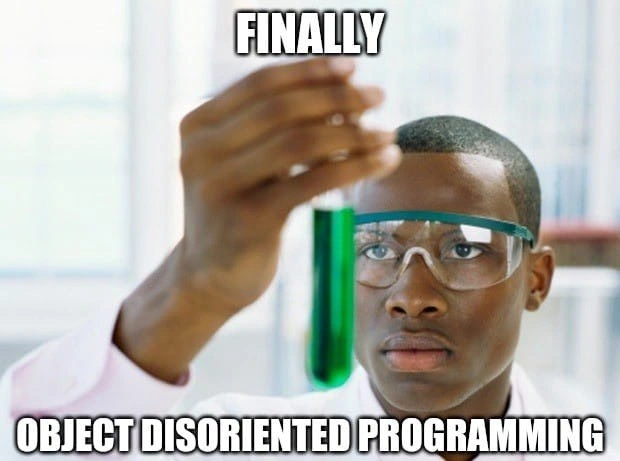
The meme shows a scientist holding a test tube with green liquid, looking amazed, and captions it with “FINALLY” at the top and “MIDDLE END” at the bottom in big block letters (that classic meme font style). It’s presenting this “middle end” as if it were a groundbreaking discovery. The humor here is that front-end and back-end developers sometimes bicker or jokingly argue about whose work is more important or who causes bugs. (Example: a front-end dev might blame a slow app on the back-end not sending data fast enough, while the back-end dev might blame the front-end for making inefficient requests or not handling the data properly.) This playful rivalry has been around forever in tech teams. So the meme jokingly says: Eureka! We found the solution – a middle end. In other words, introduce a new layer that sits between front and back to solve the conflict! It’s poking fun at the idea that if two sides can’t agree, maybe a middle side will fix everything.
In real life, there are indeed software architecture patterns that introduce an extra layer between front-end and back-end. One common pattern is the three-tier architecture:
- Presentation tier – the front-end (UI/UX, what the user sees).
- Logic tier – the middle (business logic, rules, and data processing, often an application server).
- Data tier – the back-end (database and data storage).
This architecture has existed for a long time. We just usually refer to the middle part as the “application server” or “service layer” rather than calling it an “end.” If you’ve heard of terms like client-server model or n-tier architecture, they’re all about stacking the software into layers that handle different things. The front-end vs back-end split is a simplified two-tier view (client and server), but in practice, that server often has sub-layers (for example: a web server, an application server, and a database). The meme’s joke is essentially proposing “let’s formally acknowledge the middle layer and call it the middle-end!” – something no one actually says. 😄
For a newer developer or someone learning, it might help to relate this to what you’ve seen:
- When you open a page like Instagram, the front-end is the code that runs in your phone’s app or browser to display the feed and handle your touches or clicks.
- When that app needs data (like new photos or your friend list), it calls an API. That API call goes to a server – that’s part of the back-end – which might have to get info from a database.
- Sometimes, the app doesn’t directly talk to the deepest back-end service. It might go through a specialized API server that knows how to get exactly the data the app needs from various sources and package it nicely. That API server is like a middle layer.
So if we label these: the app’s UI = front-end, the database = back-end, the API server in between = what this joke calls the “middle end.” In technical terms, we often just call it an API or middleware, but you get the idea. It’s the layer between front-end and back-end.
Why is this funny? Because the term “middle end” doesn’t actually exist in any official sense – it’s a pun. It would be like someone inventing a new part of a car between the engine and the wheels and saying it solves disputes between engine mechanics and tire specialists. It sounds goofy, right? The scientist in the image looks so serious about this bright green chemical, which adds to the comedy – he’s treating a simple idea like a huge breakthrough. Developers find this hilarious because it exaggerates a real-world situation in a absurd way. We do have real middleware, but no one would grandly call it a whole new “end.”
Also, notice the wording “At last, the mythical middle end” in the title of the post. They call it mythical because it’s like a legend – people joke about something that would perfectly connect front and back. Similarly, in teams, you sometimes hear about the mythical “full-stack developer” – someone who’s an expert at both front-end and back-end. (Full-stack devs exist, but being equally skilled in everything is hard, so it’s a bit mythical 😅.) The meme riffs on that, implying this “middle end” could be the domain of such mythical full-stack wizards who unite the two sides.
In simpler terms, the meme is just a lighthearted DeveloperHumor joke. It takes a complex idea – software architecture layers – and makes it sound like a new fantasy element. Front-end people and back-end people can both laugh at it because it’s saying, “Hey, instead of fighting, what if we just had a magical middle piece to take care of the problems?” It’s not suggesting a real solution, just making fun of the fact that sometimes adding more layers or abstraction in tech is treated as a cure-all. If you’ve ever heard the phrase “adding another layer of indirection can solve any problem (except maybe too many layers),” that’s the kind of wink this meme is giving.
To a junior developer, the takeaway is: front-end and back-end are two essential parts of modern apps, and between them often lies some form of middleware. This meme jokingly personifies that in-between part as the heroic “middle end” that will save the day. It’s a fun reminder that software often isn’t just front or back – there are many pieces working together. And when those pieces don’t perfectly align, tech folks humorously imagine creating yet another piece to make everyone happy. It’s satire on SoftwareArchitecturePatterns and how we sometimes over-engineer solutions. But hey, at least now you know what front-end, back-end, and middleware are! So the next time you deploy a web app, you can chuckle at the idea of adding a “middle end” to impress your teammates. 😉
Level 3: Grand Unified Stack
The meme triumphantly proclaims “FINALLY … MIDDLE END” over a lab scientist holding a green concoction, as if a groundbreaking discovery in software architecture has been made. It’s a tongue-in-cheek nod to the age-old Frontend vs Backend rivalry. In real engineering terms, a “middle end” isn’t an official thing – it’s a playful way to highlight the often-forgotten middleware. Seasoned developers recognize this joke as classic software layering humor: taking the familiar split of front-end (UI) and back-end (server/database) and inserting a nonexistent layer in between for comic effect. Essentially, the meme suggests inventing a new tier in the application architecture to finally settle the debates between UI folks and server folks.
From a senior developer’s perspective, this hits on a real design pattern: the three-tier architecture. We’ve always had a “middle” tier (often called the business logic layer or application server) sitting between the user interface and the database. So the mythical middle end in the meme is basically that middle-tier repackaged as a miracle solution. It’s as if someone proudly re-discovered a known concept and gave it a flashy new name. The humor is that we typically don’t call it an “end” – only front-end and back-end get that label. By elevating the middle layer to “end” status, the meme pokes fun at how tribal the front vs. back division can be. It’s saying, “Look, we solved it – we’ll just add another layer!” – an obviously satirical silver-bullet solution that experienced devs know won’t truly resolve any turf wars.
This middleware joke lands because front-end and back-end teams often have a bit of a sibling rivalry. Picture a real-world scenario in a software team: the front-end devs complain the API responses are awkward to use, and the back-end devs retort that the front-end should handle data formatting. Enter a hypothetical “middle-end developer” who says, “I’ll write an intermediate service to handle all that!” In practice, teams do introduce an API gateway or a BFF (Backend-For-Frontend) service as a layer between front and back. These are real architecture solutions meant to mediate data between a client and multiple microservices. A senior engineer will chuckle here because they know adding an extra layer has trade-offs. Sure, an API Gateway or GraphQL server (common middle-layer tech) can translate and combine data for the front-end’s convenience. But it also becomes another component that can fail, and another place for front and back to point fingers when something breaks. The meme’s genius is capturing that shared industry experience: “fixing” a front/back disconnect by tossing in an extra logic layer, only to discover you’ve created a new point of failure (and a new target for blame).
The DesignPatterns_Architecture angle is strong here. In design pattern lingo, what is this “middle end” if not the classic Mediator concept applied at a system level? The mediator pattern resolves communication between components by introducing a mediator object. Similarly, many web apps resolve front-back tension with an intermediary: e.g., a Node.js server that sits between a React frontend and legacy backends to harmonize data exchange. We’ve given fancy names to this over the years – middleware, service layer, integration tier – but never “middle-end.” That’s why it’s funny: it sounds just official enough to be believable, yet it’s entirely made up. Experienced devs recall numerous fads where something old is rebranded as new. (Remember when serverless computing emerged and some joked “it’s just someone else’s server”? Similarly, “middle end” is just another name for what we already had.) This meme winks at the habit of our field to coin new terms for old concepts and declare the problem solved. The scientist with the test tube dramatizes that feeling of “Eureka! We’ve found the missing link!” when in reality, that link was there all along in every robust architecture.
Behind the laughter, there’s a grain of truth that senior devs appreciate. Modern FullStackDevelopment often blurs the line between front and back. For instance, a full-stack developer might write UI code and the API that the UI talks to. In effect, that person is the “middle end,” connecting the two worlds. The meme is essentially satirizing the full-stack aspiration by assigning it a facetious new layer name. There’s also a hint of “unicorn” culture here: people speak of mythical full-stack unicorns who can do it all. Well, what’s more unicorn-like than conjuring a whole new end of the stack out of thin air? 🦄 In meetings, when front and back folks endlessly debate where a feature should live, a sarcastic architect might quip, “Maybe we need a middle-end team to handle this!” That joke would get exactly the kind of groan-laugh this meme does. It’s funny because it’s a bit absurd yet oddly relatable: we’re always trying to abstract or partition responsibilities in new ways, sometimes to a ridiculous extent.
In summary, at the senior level this meme is a wink at all the BackendVsFrontend squabbles and the architectural solutions (and extra complexity) we introduce to bridge that gap. It satirically celebrates the “discovery” of a one-size-fits-all fix — a Middle End — knowing full well that in real life, technology layers are no silver bullet. Instead of taking sides in the front vs. back debate, the meme toasts the idea of a truce via a new layer, which is both brilliantly simple and comically oversimplified. For those in the know, it’s a clever reminder that in software architecture, solving one tension often means adding another piece to the puzzle, for better or worse.
Description
This meme uses a stock photo of a scientist intently examining a test tube with green liquid. The image has large, white, impactful text at the top and bottom. The top text says 'FINALLY', and the bottom text says 'MIDDLE END'. The humor is derived from the absurdity of the term 'middle end' in the context of software development, where 'front end' (client-side) and 'back end' (server-side) are well-defined and universally understood concepts. The meme pretends that 'middle end' is a groundbreaking discovery, a missing piece of the puzzle that developers have been searching for. It's a surreal, nonsensical joke that plays on industry jargon and would be amusing to any developer familiar with the standard architectural layers
Comments
7Comment deleted
The 'Middle End' is where GraphQL queries go to have an existential crisis before resolving
Behold the Middle End: the microservice that converts “can we just move this button?” into a 12-step Kafka saga so both front-end and back-end can blame each other in peace
After 20 years of arguing whether business logic belongs in the frontend or backend, we've finally discovered the middle-end: it's just GraphQL resolvers running in edge functions that nobody wants to maintain
After years of being told 'we need someone who can do both frontend and backend,' the industry finally invented a role that perfectly captures the liminal space between React state management and database queries - where you're too senior to just write CSS, but not quite trusted with the actual database schema
Middle-end: where all the “temporary” business logic in the BFF/API gateway quietly becomes the real monolith
We call it the middle end - a BFF that proxies GraphQL to REST, SSRs the SPA, lives at the edge, and quietly becomes the new monolith nobody admits owning
Middle-end: where 10% of optimizations justify 90% of the yak-shaving in your nightly builds