Skip to content
DevMeme
4596 of 7435
The Developer's Hero Fantasy: Saving the Day with Regular Expressions
CS Fundamentals Post #5043, on Nov 27, 2022 in TG

The Developer's Hero Fantasy: Saving the Day with Regular Expressions

Why is this CS Fundamentals meme funny?

Level 1: Tech Hero Daydream

This meme is showing a funny daydream where a computer coder becomes a superhero by using a new skill. The person in the comic learned how to use a special text-search tool (called regex, kind of like a super-smart “find” command). They imagine a big dramatic scene: there’s a huge stack of emails and a missing clue to catch a bad guy, and everyone is panicking because it seems impossible to find. Then our coder jumps in like an action hero and says, “Stand back, I can do it!” Using their new skill, they quickly search through all the emails and miraculously find the address that reveals where the villain is. The other characters watch in amazement as the computer lights up – the day is saved! It’s funny because it’s an exaggeration: in real life, running a search on a computer isn’t exciting to watch at all. But many of us have felt proud after learning something new and have playfully imagined using it in an epic, movie-like scenario. Just like a kid who learns a neat trick and fantasizes about saving the world with it, the coder here is turning a simple tech skill into a superhero moment in their mind.

Level 2: Regex Detective Work

Okay, so what’s actually happening here? The comic’s joke centers on RegularExpressions (regex) – basically a special pattern syntax that programmers use to search and match text. Think of regex as an advanced “find” tool: instead of searching for a fixed word, you write a little formula that can match a general pattern. For example, a regex pattern can say “find any sequence of 5 digits” or “find a word that starts with capital letter and ends with Street.” They’re incredibly handy for digging through large text because they can describe flexible patterns, not just exact phrases. In the comic scenario, the characters are faced with sifting through 200 MB of emails (imagine tens of thousands of email messages all dumped together) looking for something that “looks like an address.” Manually reading that much text for a clue would be mind-numbing and near impossible – like searching for a needle in a digital haystack. But this is exactly the kind of slog where computers shine. A single well-crafted regex can scan the entire haystack automatically, checking each line for the address-like pattern.

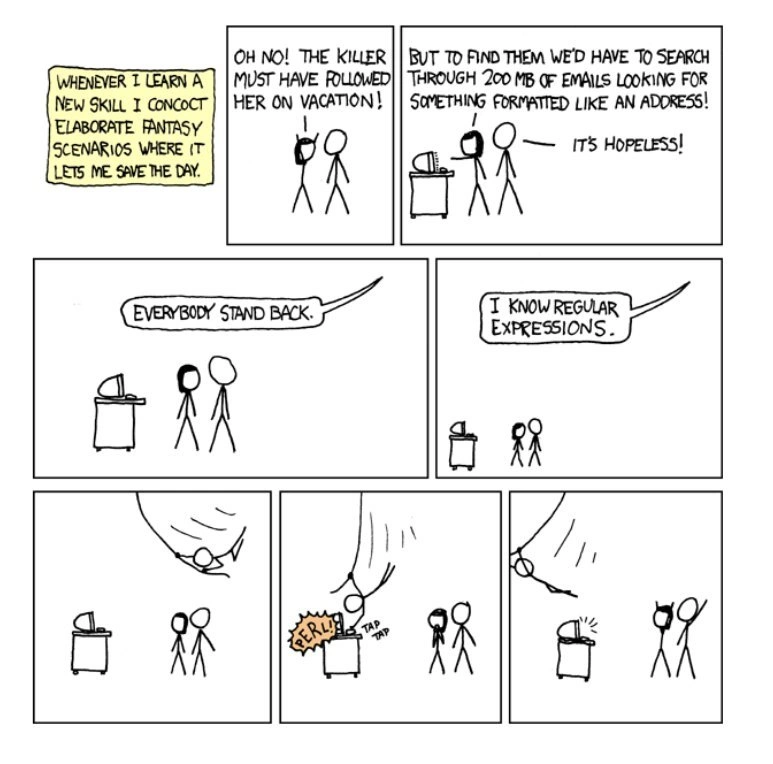
Enter our hero, the developer who just “mastered regex.” They step up and essentially say, “I have a tool for this!” The line “I know regular expressions.” is portrayed as if they said “I can pick the lock” or “I can disarm the bomb” in a thriller movie. It’s funny because knowing how to write a regex is a very nerdy skill to treat with that level of drama. The next panels show them physically descending from the ceiling on a rope, which parodies mission-impossible style heroics. Of course, in a real office you don’t need to rappel down to use a computer 😅 – this visual exaggeration represents the developer’s inner action hero fantasy. The tap tap sound effect shows them rapidly typing a command or script into the old computer (notice it’s drawn as an old CRT monitor and tower, which gives the scene a retro hacker vibe). The big “PERL!” flash is a multi-layered joke: Perl is a programming language that was (and still is) great for text processing with regex. In fact, Perl made regex so convenient that doing something like searching 200MB of text for a pattern could be done in one short command – often referred to as a Perl one-liner. So, “PERL!” here is like the Kapow! in a comic fight, implying “I run my Perl script with a powerful regex now.”

After the hero’s dramatic typing, the final panel shows the bystanders looking at the computer’s output glowing on the screen. We can infer that the regex matched the pattern – meaning the script found an address in the email dump. The previously panicked characters are now amazed, illuminated by the screen’s glow as if witnessing some high-tech miracle. This mirrors scenes from detective or hacker movies where, after a tense moment, the query finally returns a result (“We found the suspect’s location!”) and everyone is in awe. In our everyday developer terms, what likely happened is the coder used their regex skill to quickly filter out any lines in those emails that resemble an address format, surfacing the crucial clue. PerlScripting comes with commands like perl -ne 'print if /pattern/' file.txt which effectively acts as “find all lines matching this pattern in the given file.” Using a regex pattern for an address could be something like \d+\s+\w+\s+(Street|St|Avenue|Ave|Road|Rd) (meaning “one or more digits, followed by whitespace, followed by word characters, followed by a street type like Street/St/Avenue/etc”). That would catch a simple address like “123 Code Rd”. In a real investigation, patterns might be more complicated (and physical addresses vary a lot), but in the spirit of the comic, one regex was enough to crack the case!

The humor also lies in how ordinary tech skills are blown up to action-movie proportions. Most programmers have had that moment of giddy pride after writing a tricky regex or nifty script that parses a log file instantaneously. It’s a quiet victory, but inside you might feel like a genius sleuth. The comic just externalizes that feeling: the fantasy_scenario_heroics of using brainy skills to be a hero. It’s tagged as RelatableDeveloperExperience because many developers remember the first time they wielded a tool like regex and thought “Wow, I have superpowers now.” It’s a rite of passage in coding: regex is notorious for looking like gibberish at first (lots of symbols and punctuation), so mastering it even at a basic level is a confidence boost. And with confidence can come a bit of over-confidence – cue the daydreams of vanquishing impossible tasks with a single line of code. The meme playfully mocks that tendency. After all, in a normal office, saying “I know regular expressions” might get you a thumbs up at best, not gasps of awe. But here, our regex-wielding coder imagines getting the full hero treatment, complete with dramatic lighting and grateful colleagues. In summary, it’s a fun mash-up of tech humor and action movie tropes: a developer uses pattern matching as their superpower to turn a dull data search into a triumphant mission success.

Level 3: One-liner to Save Them All

For seasoned developers, this meme hits on a very relatable archetype: the coder who just leveled up their skill set and is itching for a dramatic real-world use case. The scenario is hilariously over-the-top: a 200 MB archive of emails (which is tens or hundreds of thousands of messages) needs to be combed for a clue, and everyone else is despairing “It’s hopeless!”. Enter the developer with a newly polished RegularExpressions skill – “Everybody stand back. I got this.” It’s the tech equivalent of shouting “I know kung fu!” and striking a pose. In a flourish of confidence, they drop down from the ceiling, literally rappelling to the computer, symbolizing how they swoop in like an action hero. Instead of wielding a sword or gun, our protagonist wields a one-liner of code. The PerlScripting “PERL!” sound effect is a brilliant touch: Perl is famous for being able to do complex text searches and manipulations in just a few characters of code. It’s the language that old-school sysadmins and hackers proudly used for one-liners (single-line scripts executed directly from the command line) to perform feats that felt like black magic to onlookers. By exclaiming Perl! as he lands at the keyboard, the comic frames the act of writing a regex-laden script as if it were throwing a punch or detonating a charge in an action movie.

This level of detail tickles any experienced DeveloperHumor enthusiast. We’ve all met that colleague (or been that colleague) who, after learning a cool new technique, kind of wants a problem to arise just to show off the freshly acquired superpower. In this case, the superpower is pattern matching at scale. Searching 200MB of text by eye would be hopelessly tedious – a proverbial haystack full of emails – but using a regex pattern to find an “address” is exactly what computers excel at. The humor comes from mixing the mundane with the cinematic. In reality, running a regex search through a large text file is a quiet affair: you write a command, hit Enter, and maybe get a matching line or two as output. It’s quick and effective, but hardly something that would make bystanders gasp in awe at a glowing monitor. Yet the comic portrays exactly that: the other stick figures stand back, eyes wide, basking in the glow of the CRT screen as the regex does its job. It’s a send-up of those Hollywood hacker scenes where the screen lights up with “ACCESS GRANTED” and everyone marvels. Here, the realistic accomplishment of parsing emails with a one-liner is framed with fantasy heroics.

From a senior developer perspective, there’s also an inside chuckle at the choice of regex for addresses. Sure, basic patterns can catch something that looks like an address (for example, \d+\s+\w+\s+(Street|St|Avenue|Ave|Road|Rd) might snag “123 Code Road”), but it will also likely miss or misidentify a lot. But that’s part of the joke – our hero isn’t sweating the nuances. They’re brimming with new-skill bravado, convinced that their regex-fu will pinpoint the villain in those emails instantly. This bravado is something many of us recognize: the first time you write a regex that actually matches what you intend, it feels awesome – you want to flex it! Perhaps you even dream up wild scenarios (“What if the entire company’s fate rested on me crafting the perfect regex!?”). The comic nails that new skill high. The fantasy_scenario_heroics tag is apt: it’s a fantasy scenario where the developer is the action hero, and the weapon is knowledge.

Historically, there’s truth here too. Before slick IDEs and powerful desktop search, folks who knew regex (especially with command-line tools like grep, or scripting languages like Perl/Python) really could save the day in certain situations. Need to quickly sanitize a huge data file? Extract error logs from millions of lines? The “regex person” on the team would whip something up in seconds that might’ve taken hours manually. They sometimes did become office heroes in a pinch – albeit in a much more low-key way than rappelling through the ceiling 😊. The meme simply exaggerates this dynamic to delightful effect. It resonates because it captures both the competence (regex is genuinely useful for such tasks) and the comic exaggeration (turning that usefulness into a Hollywood blockbuster scene). And for those of us who’ve written an ugly 150-character regex to solve a problem, there’s a bit of pride and cringe: we see ourselves in that caped coder, if only our workdays were that dramatic.

Level 4: Kleene Star Power

At the deepest technical level, this comic celebrates the theoretical might of regular expressions. In computer science, a regular expression defines a regular language, which is exactly the set of patterns that a finite automaton can recognize. In simpler terms, underneath the heroics, our coder’s secret weapon is essentially a state machine blitzing through 200 MB of text at lightning speed. The term Kleene star (the * operator in regex) is named after mathematician Stephen Kleene, who formalized these pattern-matching capabilities way back in the 1950s. When the stick-figure proclaims “I know regular expressions” and leaps into action, they’re leveraging decades of computer science theory: a properly constructed regex can scan enormous text data in O(n) time relative to input size. 200 MB of emails might sound like a mountain, but to a well-tuned regex engine (often built on automata theory), it’s just a lengthy stroll through characters, matching patterns as it goes.

However, the comic also cheekily references Perl, a programming language whose regex engine is famously powerful (the “P” in PCRE stands for Perl). Perl’s regex implementation uses a backtracking algorithm, which isn’t purely automaton-based and can handle complex patterns (like backreferences) that traditional DFAs/NFAs can’t. This is why Perl became synonymous with one-liner text processing wizardry. The onomatopoeic “PERL!” in the panel is drawn like a comic-book action sound – a nerdy twist on “Bam!” or “Pow!”. It implies our hero executed a Perl one-liner script, unleashing a torrent of pattern-matching prowess. Under the hood, that might involve compiling the regex into an internal bytecode and efficiently traversing the email text, possibly line by line, hunting for the telltale address format. It’s as if the developer dropped a finely-tuned automaton into the data, slicing through the noise to find the signal – much like a superhero’s gadget that pinpoints the villain’s coordinates.

There’s rich irony in this fantasy: in reality, crafting a single regex to reliably match “something formatted like an address” can be fiendishly complex. Real-world addresses are semi-structured and vary widely; fully matching them might require elaborate patterns or even a different approach like a parser. Beyond a certain complexity, regexes become hard to maintain or can exhibit pathological performance (catastrophic backtracking). Indeed, there’s an old joke in programming: “Some people, when confronted with a problem, think ‘I know, I’ll use regular expressions.’ Now they have two problems.” 😜 This comic turns that joke on its head – here regex isn’t the cause of problems, but the almost magical solution. The humor lands because, from a theoretical standpoint, regex are powerful (regular languages! NFAs! DFAs!) – but real life often tempers that power with quirks and caveats. In our hero’s imagined scenario, none of those pesky edge cases exist: the regex works flawlessly, the 200MB search completes in a montage-worthy moment, and computer science theory literally saves the day.

Description

This is a multi-panel comic from the popular webcomic xkcd, known for its stick-figure art style. The comic begins with a narrator's box stating, 'WHENEVER I LEARN A NEW SKILL I CONCOCT ELABORATE FANTASY SCENARIOS WHERE IT LETS ME SAVE THE DAY.' The subsequent panels depict such a fantasy: two characters are faced with a seemingly impossible task - searching '200 MB of emails' for something formatted like an address to find a killer. One declares the situation 'HOPELESS!' At this moment, the protagonist dramatically announces, 'EVERYBODY STAND BACK. I KNOW REGULAR EXPRESSIONS.' The final panels show the character heroically rappelling from the ceiling, landing on the computer, and furiously typing, accompanied by a 'PERL!' sound effect. The computer screen flashes, and the onlookers cheer as the problem is solved. The humor lies in the relatable developer experience of imagining a high-stakes, action-movie scenario where a niche, technical skill like writing regular expressions becomes the key to saving the day. It perfectly satirizes the feeling of power that comes from mastering a complex tool to solve a data-processing problem that seems intractable to others


Comments

17
Anonymous ★ Top Pick Some people see an unsolvable problem. A senior engineer sees a problem that's just one unreadable, write-only regex away from being solved. Now, if you'll excuse me, I need to go save the world with a line of Perl
  1. Anonymous ★ Top Pick

    Some people see an unsolvable problem. A senior engineer sees a problem that's just one unreadable, write-only regex away from being solved. Now, if you'll excuse me, I need to go save the world with a line of Perl

  2. Anonymous

    Swinging into the incident channel screaming ‘I know regex’ feels heroic - right up until your Perl one-liner gets promoted to critical microservice and you’re on-call forever

  3. Anonymous

    The real plot twist is when you realize the killer's address is in a PDF attachment and your regex now needs to handle binary data extraction while the PM asks why you're not using the email client's built-in search function

  4. Anonymous

    Every senior engineer has had that moment where they confidently declared 'I'll just use regex for this' - right before spending three hours debugging why their pattern matches everything except what they actually need, ultimately resorting to a simple string split. The real crime here isn't the murder mystery; it's thinking you can reliably parse structured data from 200MB of emails with regex instead of reaching for a proper parser. As the ancient wisdom goes: 'Some people, when confronted with a problem, think "I know, I'll use regular expressions." Now they have two problems.'

  5. Anonymous

    Any time someone shouts “I know regular expressions,” you’ve just replaced a data model with a backtracking NFA and a Perl one‑liner that compliance will be diffing in audits for the next decade

  6. Anonymous

    “Stand back, I know regex” - solves it in 30 seconds with a Perl one‑liner, melts a core in 30 minutes via catastrophic backtracking, and funds the RE2 migration next quarter

  7. Anonymous

    Regex heroics: Conquers 200MB email chaos flawlessly - until a multiline signature triggers catastrophic backtracking

  8. @azizhakberdiev 3y

    \w*[A-Z0-9]*\s.+(0-9)?r

  9. @azizhakberdiev 3y

    but why perl?

    1. @RiedleroD 3y

      perl was the first to implement it in its stdlib I think? It's definitely one of the oldest regex standards that are still relevant tdoay.

      1. @CcxCZ 3y

        *grimaces in AWK* But yeah, that comic is old

        1. @LionElJonson 3y

          *AWKward moment*

  10. @im_ali_pj 3y

    😂😂😂

  11. @Algoinde 3y

    "Wait, forgot to escape a space. Wheeeeee[taptaptap]eeeeee."

    1. dev_meme 3y

      whoops, infinite loop check

  12. @Algoinde 3y

    posting xkcd without title text? blasphemy

  13. Deleted Account 3y

    Credit the author

Use J and K for navigation