Skip to content
DevMeme
6275 of 7435
AI Fact-Checks Chernobyl Disaster Denial
AI ML Post #6878, on Jun 11, 2025 in TG

AI Fact-Checks Chernobyl Disaster Denial

Why is this AI ML meme funny?

Level 1: Alexa, Is It On Fire?

Picture this: there’s a big fire in your house – the kitchen is in flames, smoke everywhere. It’s obviously an emergency! Now imagine instead of calling the firefighters or shouting for help, you turn to your smart voice assistant (like Alexa or Siri) and calmly ask, “Alexa, is the house on fire?” That sounds pretty silly, right? You can see the fire; you even feel the heat. You already know it’s real without Alexa telling you.

That’s basically the joke of this meme. In the meme’s story, something terribly bad is happening in a computer system (as serious as a nuclear reactor accident, which is about the worst disaster you can think of). One person sees a huge warning sign of the disaster – kind of like seeing flames – and tells everyone. But instead of immediately acting on it, another person asks a computer program if it’s truly happening. It’s funny because it’s the last thing you should do in a crisis. It’s like they’re saying, “I know it looks really bad, but let’s see if the computer thinks it’s bad.” We laugh because the situation is so obviously dangerous that asking a robot for confirmation is just ridiculous. Even a child knows that if you see something on fire, you don’t need to ask a robot helper to confirm it – you just try to put out the fire or get help. The meme is a tech-world way of showing that same obvious idea, and that’s why it’s amusing.

Level 2: AI vs On-Call

For those newer to these concepts, let’s clarify what’s going on in this meme. It’s drawing a parallel between a nuclear disaster and a tech disaster, using some specific jargon and references:

  • Sev-0: This stands for Severity Level 0, which is often the designation for the most critical kind of problem in a system. Companies rank incidents by severity; Sev-0 (or sometimes called P0 or Sev1, depending on the scale) means “our top-priority service is down or something extremely bad is happening right now.” Think of it as a five-alarm fire in the digital world – all hands on deck, immediate action required. In the meme, detecting “graphite on the ground” is the nuclear equivalent of a Sev-0 event – absolute emergency.

  • On-call SE: “On-call” refers to a person (often a Site Reliability Engineer (SRE) or developer) who is rostered to be available at any time to respond to such emergencies. If something breaks at 3 AM, the on-call engineer’s pager or phone app will alert them to jump in and fix it. They have the responsibility to start triage (initial investigation and mitigation). Here, the joke is that instead of contacting the on-call human (the person trained to handle Sev-0s), the team member reaches out to an AI. That’s very unusual – normally you’d page a real engineer right away.

  • LLM (Large Language Model): This is the type of AI being referenced with @grok. An LLM is essentially a very advanced text-based AI (like ChatGPT or similar). It’s trained on a huge amount of text data and can answer questions or generate content that sounds pretty human-like. Companies sometimes integrate such an AI into their workspace tools (Slack, etc.) as an AI assistant. For example, you might be able to tag @grok in a chat and ask “How do I deploy our service?” or “What’s the documentation for X?” and it will respond with an answer gleaned from internal docs or its training. It’s like having a super-smart (but not always accurate) chatbot in the office.

  • Slack-style @-mention: Slack is a popular workplace chat app used in tech teams. In Slack (and similar platforms), prefixing a name with @ sends a notification to that person or bot. So @grok implies the user is addressing the grok bot directly in the chat, asking it to respond. The meme’s bottom text “@grok is this true?” is formatted exactly like a Slack message where someone tags the grok bot to ask a question. This detail tells us the setting is a digital chatroom (just like many incident war rooms), and grok is not a person but a bot listening for its name.

  • Graphite on the ground: In case the nuclear reference is unfamiliar – graphite in this context refers to graphite moderator blocks used in the Chernobyl reactor’s core. Under normal circumstances, those blocks are inside the reactor core. If a worker sees them lying on the ground outside, it’s definitive evidence that the core has been breached or exploded (a catastrophic failure). In simpler tech terms, it’s like saying “I peeked into our server room and I see actual server pieces and flames on the floor” – something that unquestionably means a major disaster has occurred. It’s not a subtle clue; it’s the worst sign imaginable.

So the meme’s scenario in plain terms: A major incident is happening (Sev-0), one person reports a highly alarming observation (like “the server’s core is exposed”), and another person – instead of immediately trusting this and acting – asks a company AI bot if that’s really true. This is funny (and absurd) because if you visibly see evidence of a disaster, it’s generally obvious what’s happening. It shouldn’t require an AI’s confirmation the way you might ask for a second opinion on a trivial matter. It’s as if they’re saying, “Hey robot, are we really in trouble?”

Why would someone even think to ask an AI? That touches on the AI hype and modern workflows. These days, tech teams are exploring using AI for help with coding, troubleshooting, or documentation lookup. There’s a bit of hype that these assistants are super smart. In an ideal case, one might hook the AI up to monitoring data so it can answer questions like “Is service X down right now?” by checking real metrics. But in many cases, the AI just has general knowledge and whatever chat history you give it – it doesn’t actually know new real-time facts unless connected to live data sources. So asking “@grok is this true?” means the person is either hoping the AI has some monitoring info to confirm the graphite situation, or (more humorously) they’re just desperately asking the closest “expert,” even if that expert is a bot.

The meme highlights a couple of things a junior dev might not know yet:

  • Incident Protocol: In a real Sev-0, the protocol would be to page the on-call engineer (if they aren’t already aware) and probably assemble an incident response team on a call or chat. Speed and clear communication are crucial. You wouldn’t normally rely on a generic AI to tell you if the site is down; you’d use monitoring dashboards, logs, and direct reports from engineers.
  • AI Limitations: A tool like an LLM is useful for certain tasks (like suggesting code or answering FAQ-type questions), but when it comes to ground truth verification (“is the database crashed right now?”), it’s not authoritative. Unless specifically programmed with data feeds, it might just guess based on past info. There’s even a risk it could give a misleading answer (for example, “I’m not detecting any issue” because it doesn’t have the latest data or it misunderstood the question).
  • ChatOps Culture: It’s increasingly common to control systems via chat commands. For example, typing something like /deploy backend in a Slack channel might trigger a deployment script. People also set up bots to answer things like “@monitorbot status of service X”. So the idea of asking a bot isn’t far-fetched – it’s just that in this meme they’re doing it at the worst possible time and expecting the bot to validate something huge.

In essence, the meme is using an extreme example to poke fun at how we might lean on technology inappropriately. If you’re new: imagine your car’s engine is smoking and making loud noises, and instead of calling a mechanic or pulling over, you ask your phone’s AI, “Hey, is my engine okay?” You probably see why that’s silly. The seasoned engineers reading this meme are chuckling because they’ve seen minor versions of this – like someone trusting an automated tool too much – and the meme blows it up (literally, with a reactor explosion analogy) to drive the point home.

Level 3: Denial as a Service

This meme brilliantly mashes up a historical disaster with a modern DevOps disaster, creating a darkly funny commentary on how teams handle emergencies. The two green-tinted images are from HBO’s “Chernobyl” – a series dramatizing the 1986 nuclear reactor meltdown. By using this imagery, the meme makers equate a Sev-0 production incident (the highest level of urgency in tech, basically “the system is in full meltdown”) with the Chernobyl reactor core explosion (about as catastrophic as it gets in real life). It’s an extreme comparison that seasoned engineers find both amusing and a little too on-the-nose. If you’ve ever been on an on-call rotation during a major outage, you know it can feel like a nuclear disaster unfolding: alarms everywhere, confusion, managers in denial about the severity – exactly the mix this meme captures.

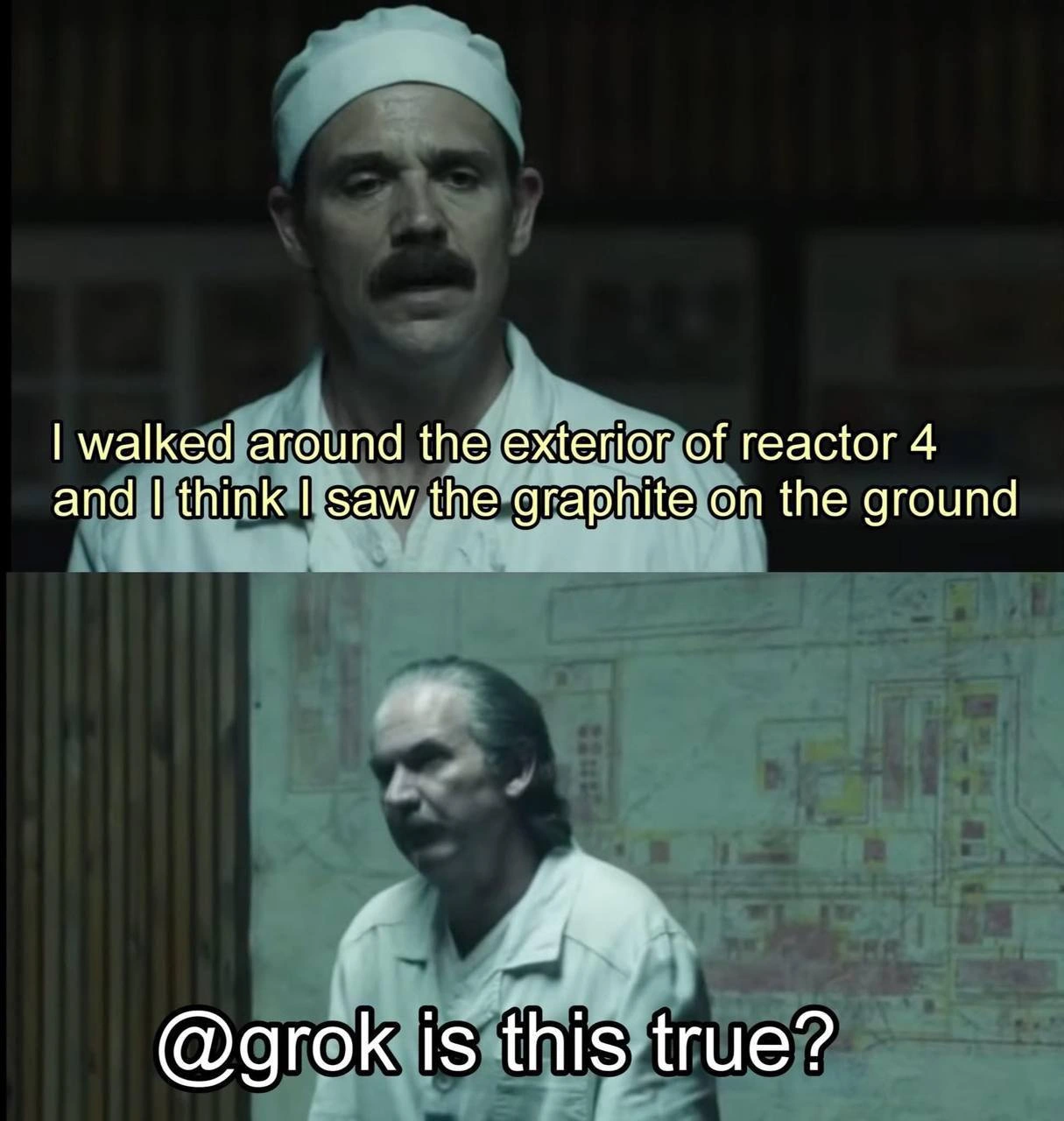
Let’s break down the scene and the laughter: in the top frame, a reactor worker in panic says, “I walked around the exterior of reactor 4 and I think I saw the graphite on the ground.” For context, graphite is what the core of the Chernobyl reactor was made of. Seeing chunks of graphite outside the reactor building was undeniable evidence that the core had exploded. In that real historical moment, it’s the kind of news that turns a bad situation into an unthinkably horrific one. Now, translate that to tech: it’s like an engineer saying “I checked our production servers, and I think I saw the database on fire and disk platters scattered on the floor.” It’s the ultimate “we’re screwed” report in an outage. Seasoned devs reading this instantly recognize that graphite on the ground = “the core system has failed catastrophically.”

So what happens in the meme? Instead of immediate action (like hitting the big red shutdown button or paging every on-call engineer awake), the second frame shows another worker – presumably a supervisor or manager – standing by a wall diagram in disbelief. The overlaid text has him asking, “@grok is this true?”. Here’s the kicker: @grok is portrayed as if it’s a user in a Slack channel – in reality it’s an AI bot (our Large Language Model assistant) integrated into the company chat. By @-mentioning it, he’s effectively pinging the office LLM for confirmation of the disaster. This is where the ChatOps satire comes in. In modern dev culture, it’s become trendy to use chat platforms (Slack, Microsoft Teams, etc.) not just for human communication but to interact with systems and bots – a practice dubbed ChatOps. We trigger deployments, get monitoring info, and ask bots for help, all in a chatroom. It’s like having R2-D2 on your Dev team, chiming in with logs or running scripts when asked.

But the meme cranks this up to ridiculous heights: a Sev-0 incident is happening (think users screaming, revenue hemorrhaging, maybe data at risk), and someone decides to treat the company AI assistant as the source of truth about the crisis. This blends two satirical targets:

  • Management denial and delay: In the real Chernobyl event, higher-ups infamously refused to believe the reactor could have exploded, delaying life-saving action. Similarly, in corporate life, there are those moments when a manager or lead says, “It can’t be that bad” or “Are we sure?” – buying time, sometimes in harmful denial of what the data (or an on-site engineer) clearly says. Here the boss-character literally won’t believe “the graphite is on the ground” until some other authority confirms it. It’s a poke at that impulse to double-check the obvious because the truth is too scary.
  • Over-reliance on shiny AI tools (AI hype vs reality): The meme skewers the modern tendency to throw AI at every problem. We have this powerful new toy – an LLM that can answer questions – so why not ask it about our raging production incident, right? Sarcasm mode on: Of course the chatbot, which was probably trained on Stack Overflow and our documentation, would know more about the state of Reactor 4 than the guy who just saw it with his own eyes. What could possibly go wrong? Sarcasm off. It’s highlighting that absurd leap of faith. Seasoned engineers chuckle (or groan) here because we’ve seen management or colleagues put too much trust in whatever the latest tech fad is. Today it’s AI. Yesterday it was some overhyped monitoring dashboard that always said “All systems go” even as servers burned. The meme is basically saying, “Yup, management would sooner ask a clueless AI than believe the engineer on the ground.”

Imagine this happening during a real on-call nightmare: you (the on-call SE) are racing to diagnose a massive outage. A junior dev or a manager in the Slack war room tags the AI assistant: @grok – maybe because the company implemented an “AI Ops” tool that’s supposed to help. Everyone waits a few precious seconds for the bot’s reply. Will it confirm the disaster? Will it soothingly output, “All systems are nominal,” because it doesn’t have real data? Either way, this is precious time wasted. The meme zeros in on that dark comedy: instead of grabbing the fire extinguisher, they’re asking ClippyGPT if it thinks the fire is real. It’s both funny and painfully true to anyone who’s seen overly bureaucratic incident response or drunk the AI Kool-Aid.

Furthermore, naming the bot “grok” is itself an inside joke. The word “grok” (from classic sci-fi literature) means to deeply understand something. Many tools and bots have cheeky names like that. By saying “@grok, is this true?”, the meme implies the team treats this AI as an omniscient oracle. It’s as if they’re saying, “Hey all-knowing bot, confirm our reality for us because we can’t even.” In practice, an LLM doesn’t truly grok the live system state – but the team’s faith (or desperation) is played for laughs. It also slyly references how companies brand their AI features with bold names and sell the idea that these bots deeply understand your systems (spoiler: they often don’t).

The humor really lands for those of us in DevOps/SRE roles because it mixes ChatOps culture with a scene of absolute meltdown. During incidents we do use Slack heavily – there’s frantic message scrollback, commands being run via bots, metrics graphs posted, maybe even an AI summarizing logs if we’re fancy. But no sane team would escalate solely to an LLM in a true Sev-0 — that’s like asking your Magic 8-Ball if the data center is actually on fire. The meme exaggerates to make a point: AIHype vs Reality. In reality, an AI assistant can be helpful (maybe it can quickly query a knowledge base or suggest known fixes), but it’s not the source of truth. Yet the meme’s scenario isn’t entirely fiction: some organizations have indeed tried AI-driven incident management. And oftentimes, the first real ProductionIncidents those systems encounter show the gap between the sales brochure and real life. Seasoned engineers have a healthy skepticism, expressed here as dark humor. We remember earlier silver bullets – whether it was an “all-knowing” monitoring system, or an “intelligent” autoscaler – that failed spectacularly when things got weird. Today’s AI assistants are cut from that cloth. They’re cool, but in a crisis? They might give you anything from a generic answer, to false reassurance, to a hallucinated analysis that sends you on a wild goose chase. Meanwhile, the clock is ticking and your on-call human is still in the dark if you haven’t actually called them!

In summary, Level 3 reveals why this meme resonates with experienced devs:

  • It uses a meltdown meme (Chernobyl reference) to dramatize a ProductionIncident of the highest order, a relatable nightmare scenario for on-call staff.
  • It satirizes incident escalation via AI by showing a Slack-style @mention to a bot, lampooning our industry’s sometimes misplaced trust in automation and AIAssistants.
  • It nods to management denial and the human tendency to seek a second opinion (even from a clueless source) when facing an inconvenient truth.
  • And it gives a wink to all the battle-scarred ops folks: a reminder that when you see “graphite on the ground” (be it literal or metaphorical), you don’t waste time – you act. Or at the very least, you page the poor on-call engineer before asking the talking computer for advice.

The result is a meme that’s as instructive as it is humorous. It’s telling us, in the voice of sarcasm: “In case of emergency, break glass – don’t just ask the AI if the glass is really broken.”

Level 4: Graphite on the Grounding Problem

At the most fundamental level, this meme highlights a Large Language Model (LLM) being asked to confirm a critical real-world event – a scenario that exposes the grounding problem in AI. An LLM like the office @grok is essentially a sophisticated text predictor, trained on vast amounts of historical data. It can imitate understanding by generating plausible responses, but it doesn’t possess ground truth awareness. In AI terms, it has no direct sensor input or factual oracle about the current state of your systems – it only knows what it’s been fed or what’s in its training corpus. This is analogous to asking a super-intelligent parrot whether the nuclear reactor core is exposed: it might have read about reactors in training data, but unless it’s explicitly given live readings (and even then, it lacks true comprehension), it’s blind to the actual situation.

This is a classic case of AI inference versus reality. The meme shows graphite on the ground, which in a nuclear reactor means the core has exploded – a fact observable in the physical world. But the poor LLM has no Geiger counters or camera feeds; it can only infer from text. Fundamentally, this hints at the concept of symbol grounding: our AI assistant can manipulate symbols (words like “graphite” and “reactor”) and draw on learned correlations (maybe it’s read Chernobyl transcripts or incident postmortems), but it doesn’t truly “know” if graphite is presently scattered on the facility floor. The alignment problem also lurks here: the AI’s objectives (likely to be helpful and not spread panic) might conflict with bluntly confirming a catastrophe. It could even end up hallucinating a reassuring lie if the prompt or its training biases it toward optimism or if it misinterprets the query. In other words, at a theoretical level, the team in this meme is leaning on a probabilistic language model to establish empirical truth – a fundamentally flawed approach because the AI’s confidence is not the same as a Geiger counter reading. This highlights why in high-stakes systems (whether nuclear plants or prod servers at Sev-0) we rely on direct instrumentation and experienced judgment, not just an AI’s statistically generated hunch. The humor here is underpinned by this disconnect: you have graphite on the ground, an unmistakable physical fact, being second-guessed by an algorithm that has never stepped outside a data center. It’s a tongue-in-cheek reminder that no matter how advanced our AI assistants get, they remain disembodied brains without real-world senses – making them hilariously ill-suited to confirm whether the figurative (or literal) house is on fire.

Description

A two-panel meme using scenes from the HBO series 'Chernobyl'. The top panel shows Anatoly Dyatlov, the deputy chief engineer, looking serious, with the subtitle: 'I walked around the exterior of reactor 4 and I think I saw the graphite on the ground'. This quote is famous for showing his initial, stubborn denial of the reactor core's explosion. The bottom panel shows another character looking skeptical and worried in front of a large technical diagram, with the text '@grok is this true?' overlaid in a large, white font. The meme humorously blends a dramatic moment of historical denial with the modern tech trend of using AI chatbots for verification. It satirizes the sometimes-misplaced faith in LLMs as arbiters of truth, contrasting a complex, catastrophic event with a simple query to an AI. For developers, it pokes fun at the limitations and the sometimes absurd applications of AI in the quest for information integrity
Comments

10
Anonymous ★ Top Pick Querying an LLM to verify if the RBMK reactor core exploded is the modern equivalent of being told 'it's not great, not terrible' while holding a piece of its graphite moderator
  1. Anonymous ★ Top Pick

    Querying an LLM to verify if the RBMK reactor core exploded is the modern equivalent of being told 'it's not great, not terrible' while holding a piece of its graphite moderator

  2. Anonymous

    If your post-mortem timeline includes “asked the chatbot to confirm core damage,” your RFO is probably going to be longer than your RCA

  3. Anonymous

    Just like Dyatlov refusing to believe graphite could be outside the reactor, we've all worked with that architect who asks ChatGPT if the database is really down while the entire monitoring dashboard is blood red and customers are literally calling the CEO

  4. Anonymous

    When your monitoring dashboard shows the core's exposed but the AI assistant still needs to verify if there's actually a problem - classic 'not great, not terrible' energy. Just like asking Grok to confirm that yes, your GraphQL resolver is indeed leaking memory at 3.6 roentgen per second. The real question isn't whether the graphite is on the ground; it's whether your incident response plan accounts for the blast radius when someone finally acknowledges the N+1 query problem that's been melting down production for the last three hours

  5. Anonymous

    SRE walkaround classic: 'Graphite on the ground' - cue xenon poisoning the cluster and a glowing pager

  6. Anonymous

    Seeing graphite on the ground is a sev‑0 signal; if the next step in your runbook is “@grok is this true?”, you’ve replaced instrumentation with vibes and added a positive void coefficient to incident response

  7. Anonymous

    When the SRE reports graphite on the ground and the incident commander says ask the LLM, you know observability has been replaced by a stochastic-parrot quorum

  8. Deleted Account 1y

    @grokAI is this image true?

    1. @Sun_Serega 1y

      > The image appears to be a meme referencing the Chernobyl disaster, specifically the explosion of Reactor 4. The text "I walked around the exterior of reactor 4 and I think I saw the graphite on the ground" is a dramatized and likely exaggerated statement, possibly inspired by scenes from the TV series Chernobyl. In reality, graphite did scatter outside the reactor after the explosion due to the use of graphite-tipped control rods, but the idea of someone casually walking around and noticing it is not historically accurate. This seems to be a humorous or fictional depiction rather than a factual account.

  9. @hyena_stuff 1y

    More like: “In reality, graphite was not visible on the ground outside. RMBK reactor cores cannot explode, so the explosion was most likely caused by hydrogen igniting in the tanks.”

Use J and K for navigation