Skip to content
DevMeme
6274 of 7435
The Golden Age of Game Dev: Before Jira and Sprints
TechHistory Post #6877, on Jun 11, 2025 in TG

The Golden Age of Game Dev: Before Jira and Sprints

Why is this TechHistory meme funny?

Level 1: Waiting Forever in Olden Times

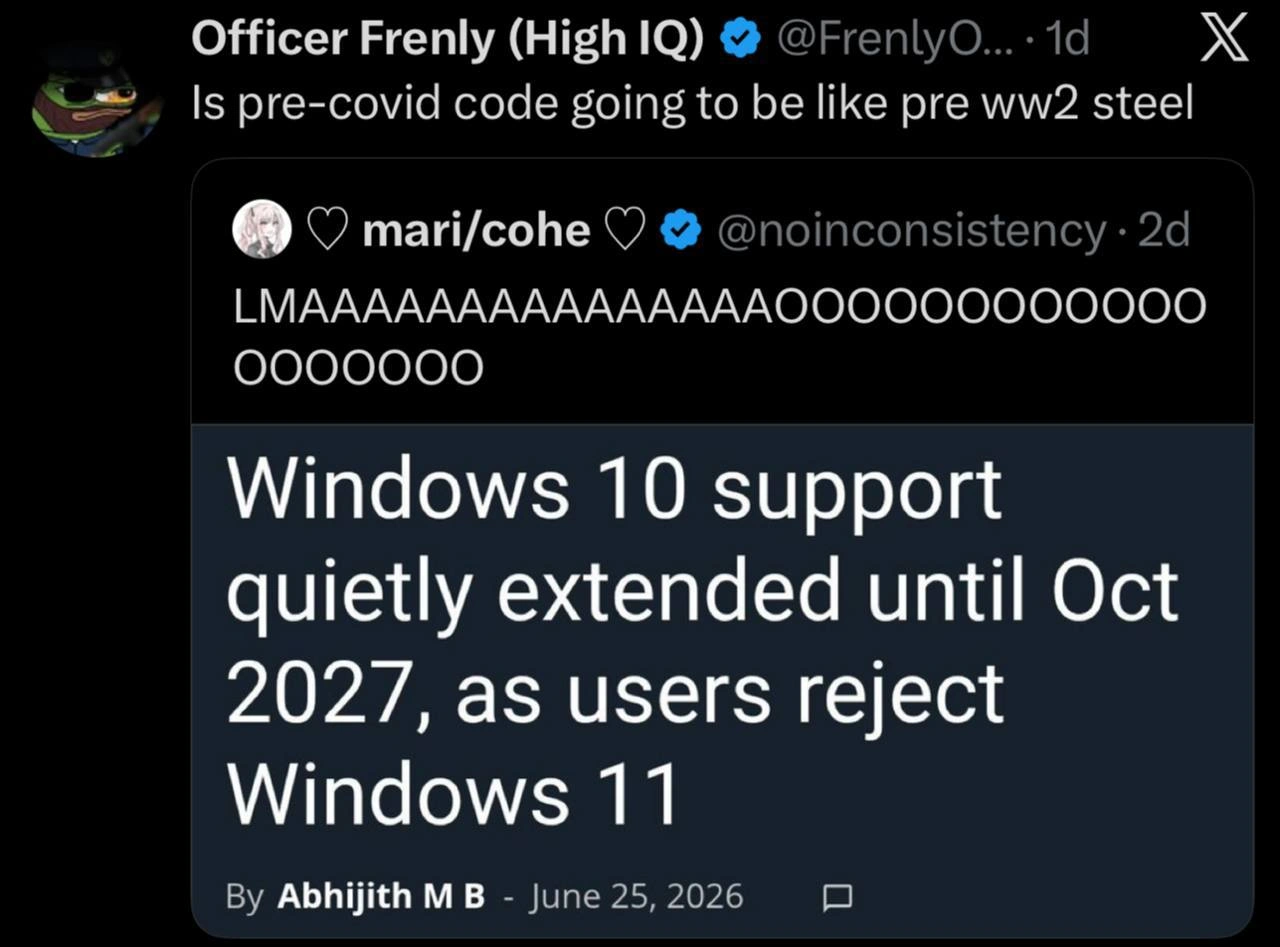
Imagine you have to bake a giant cake using a tiny toy oven, and it takes all night to finish. You’re so tired waiting that by morning you joke you’ve “turned into a skeleton.” That’s the feeling this funny picture is showing, but with computer code! A long time ago (before you were born), people used big, boxy computer screens (like old TVs) that glowed in dark offices. They had to work late into the night to finish their projects because the computers were very slow at cooking up the code. In the picture, wires are hanging from the ceiling and everything’s a bit messy – kind of like when you build a huge Lego project and have pieces everywhere. It shows how rushed and chaotic it could be when a deadline (like a due date) was close.

There’s a toy skeleton sitting on one computer. That skeleton is a silly way to say, “I’ve been waiting forever for this to be done!” It’s like if you asked your friend to download a big game on really slow internet, and it took so long you pretended to turn into a skeleton as a joke. The office workers in the photos are wearing casual clothes, drinking soda, and listening to music while working late. They’re not having a regular 9-to-5 day; it’s more like a sleepover where everyone’s trying to finish a big group project overnight. Back then, people didn’t have the fancy tools we have now to speed things up, so they often had to pull all-nighters (staying awake all night) to get everything done on time.

The little quote in the meme says something like, “Jira? sprints? what are you talking about… check out this cool trick Carmack did!” – which in simple terms means: instead of talking about planning and meetings (that’s Jira and sprints, which are work planning tools), the person just wants to show a friend a super cool thing someone discovered in the code. It’s as if during homework time, one kid said “Shouldn’t we organize our tasks?”, and the other kid replied “Forget that, look at this awesome shortcut I found in the game!” 😄 It highlights how in those days, people were more excited about clever ideas and less concerned with formal planning.

So, this meme is funny because it exaggerates how slow and chaotic making software was in the 90s. The skeleton is the punchline – nobody literally turned to bones waiting for a program to run, but it sure felt like it sometimes! It makes us laugh and also appreciate that today things are a bit more tidy and faster (no offense to our skeleton friend).

Level 2: Manual Builds & Midnight Oil

Let’s break down what’s happening in this meme for those who didn’t live through it. We have an old-school 1990s dev office in crunch mode (crunch = working super late hours to meet a deadline). The computers in the photos are beige CRT monitors – bulky pre-flat screen displays that used cathode-ray tubes (think old TV sets). They give off a distinct flickering glow and quite a bit of heat. Under the desks are big tower PCs (the computer cases) lying on carpet. Placing computers on carpet is bad for airflow, but space was tight and nobody was thinking about ergonomics or fire hazards at 2 AM. The whole vibe is informal: developers wearing jeans and band t-shirts, some with headphones blasting music, soda cans strewn about – this was normal “hacker culture” before tech offices got beanbags and kombucha on tap.

Now, the ceiling: you can see missing ceiling tiles with cables dropping down, looking like a nest of spaghetti. Those are likely Ethernet cables hastily run to hook up more machines or dev kits. In a proper office, cables run neatly in the ceiling, but here panels are popped open – maybe this game studio expanded quickly or was rigging a local network for a multiplayer test. It’s both funny and symbolic: the office infrastructure is literally held together with loose wires, much like their project’s schedule. “Office_cabling_spaghetti” is a perfect tag: it’s chaotic and not by the book, just like a lot of software projects in that era. No Wi-Fi back then, so everything was wired, and adding a new connection often meant dropping a cord from the ceiling last-minute. The mess makes IT folks cringe, but in crunch time you care more about shipping than tidiness.

On one desk sits a small plastic skeleton figurine on top of a monitor, next to a stack of floppy disks and thick paper manuals. This skeleton is a visual gag: it’s as if a programmer started waiting for the program to compile and turned into a skeleton by the time it finished. Why? Because build times were slow. When we say “build,” we mean running the code through a compiler to turn it into a working program. In the ’90s, if you wrote software in C or C++ (which most PC games and apps were), you’d frequently hit “compile” and then… wait. And wait. A large project could take minutes or hours to compile on the hardware of the day. (For reference, a high-end PC in 1998 might have a 233 MHz CPU and maybe 64 MB of RAM – laughably weak by today’s standards.) If the code didn’t compile because of an error, you had to fix the code and start the whole build again. No handy real-time error feedback or super-fast CI server to catch things for you. It was common to take a snack break or soda run while building – or to joke that you could grow old (or die!) waiting. Hence the skeleton: it’s the ultimate “I’ve been waiting forever” joke prop. 💀⌛

The stack of floppy disks is another blast from the past. Floppies were those 3.5-inch square disks that held a whopping 1.44 MB of data each. Teams used them for everything from driver updates to sharing builds or source code, especially if the network was too slow or a file was too large to email (seriously!). Seeing floppies on the desk cements the time period. Also, those big books could be programming references or printed source code! In pre-Google days, developers actually thumbed through manuals or books for documentation. Imagine that: no Stack Overflow, just a giant Windows 95 Programming Secrets book on your lap at 1 AM.

The meme also nods to how software deployment worked then. Today, we have CI/CD (Continuous Integration/Continuous Deployment) systems that automatically build and even deploy our code to testing or production environments. In 1998, continuous integration wasn’t a mainstream idea. Instead, a “build pipeline” might literally be: Dave compiles the program on his machine, then copies the output to a network drive, and someone else manual tests it, and eventually they run an installer on a server. Lots of manual steps and potential for error. “Fragile pipeline” means if any step fails (or Dave falls asleep), everything stops. And because these builds took so long, teams often did overnight_builds – like start the process at end of day and pray it’s done by next morning. If it crashed midway (maybe one of those dangling cables got unplugged or a compiler error popped up), you lost a whole night. This is why integration late in a project was so scary: a single bug could set you back an entire day or more.

Then there’s the term crunch time. This refers to a period of intense work, usually unpaid overtime, leading up to a deadline. The photos show people coding late at night (notice out the window: city lights against a dark sky – it’s definitely after hours). The soda cans are likely Jolt Cola or Mountain Dew – the classic caffeine of choice for staying awake when you’ve already been at work 12+ hours. Crunch was (and unfortunately still is, in some places) common in game development and startups. Teams would essentially live at the office for days or weeks, going home only to shower, all for the sake of shipping on time. It’s both a bonding experience and a recipe for burnout. The meme captures both the camaraderie (people around in the middle of the night, joking, hacking, helping each other debug) and the absurdity (a literal skeleton as an honorary team member).

Finally, the text snippet in the meme’s post highlights the contrast with modern practices. JIRA is a popular tool today for tracking software tasks and bugs, and sprints are a key concept in Agile methodology (short, time-boxed periods of development, usually 1-2 weeks, with specific goals). In the 90s, nobody in a small dev studio was talking about “ticket grooming” or “sprint velocity.” The quote essentially says: “What do you mean process? Get over here and see this cool thing!” It’s poking fun at how today’s developers can be very process-driven, whereas the older generation was more Wild West. The mention of “Carmack” is referring to John Carmack, a famous programmer from that era (lead programmer of Doom and Quake). He was a hero to many devs, known for genius-level optimizations in graphics engines. So telling Dave to forget JIRA and come see Carmack’s new optimization is like saying “Ditch the paperwork, come be inspired by real engineering magic!” It emphasizes how, in that 90s culture, DeveloperHumor and excitement came from technical breakthroughs, not from closing JIRA tickets.

So, putting it all together: this meme shows a chaotic 90s office during a late-night coding marathon. The technology is old (CRTs, floppies), the process is old (long manual builds, no continuous integration), and the culture is old (waterfall-ish schedules with massive crunch at the end, informal hacker vibes). The skeleton and the dangling cables drive home the joke – everything’s held together with hope and a bit of dark humor. For younger devs, it’s a peek into how LegacyCode was born under duress; for older devs, it’s a nostalgia trip (with a shiver of “glad we don’t do that anymore… mostly”).

Level 3: Hanging by a Thread

In the waterfall era of the 1990s, software development sometimes felt as precarious as those dangling Ethernet cables in the ceiling. The meme’s collage of CRT-lit cubicles and ad-hoc wiring satirizes the fragility of pre-DevOps build practices. Back then, a “build pipeline” was often a single monstrous Visual C++ compile on a developer’s own Pentium II tower. One mistake (like a missing semicolon) and the entire 2-hour build would crash near the end, forcing a weary restart at 3 AM. It’s a scene painfully familiar to any senior dev who survived those “integrate at the end” projects: a lone coder hunched over a beige CRT, the office quiet except for the whir of case fans and the hum of fluorescent lights (when they weren’t burnt out, like those missing ceiling tiles).

The humor hits home because the build system here is literally held together with spaghetti—spaghetti code and spaghetti cabling alike. We see network and power cables hanging overhead in a jumbled mess, much as the codebase itself might have been: global variables everywhere, functions thousands of lines long, and a makefile no one dared touch. The physical disorder mirrors software entropy. One careless tug on those cables (or one bad commit) could bring everything down.

And check out the plastic skeleton perched on the monitor: that’s classic developer dark humor. It implies the code is compiling so slowly that the programmer turned to dust waiting for it to finish. In the ’90s, multi-hour builds were routine for large projects. Teams would kick off a nightly build and literally go home, hoping to find a fresh executable by morning. If the build broke overnight, well, nobody knew until the next day. Continuous Integration was not yet standard; if you were lucky, you had a nightly cron job and a dream. This fragile cycle meant integration hell near deadlines – all-nighters fueled by caffeine and youthful optimism.

The corporate culture of this scene is pure 90s hacker vibe. Notice the jeans, band t-shirts, and headphones: it’s a far cry from today’s stand-up meetings and JIRA tickets. Back then, management might set a due date months out (hello, crunch time), then mostly leave the devs alone until the “drop dead” deadline loomed. That’s when the office turned into a nocturnal cave of pizza boxes and soda cans (energy drinks weren’t a big thing yet). DeadlinePressure meant you did whatever it takes – even if that meant sleeping under your desk while the code compiled, then fixing errors at 2 AM when you woke up shivering from the AC that never turns off. Everyone was young enough to survive on junk food and adrenaline. It was fun and brutal all at once.

This meme also pokes fun at how DeveloperCulture has shifted. The post text jokes:

“Jira? sprints? what are you talking about dave? get over here and check out this neat optimization Carmack figured out.”

In other words, in 1998 nobody was saying “let’s groom the backlog” – it was more like “OMG look at this assembly hack that makes our blitting 5% faster!” 😄 The reference to Carmack (legendary game developer John Carmack) is no accident: he was famous for squeezing unbelievable performance out of hardware through clever code. In a ’90s game dev shop, a breakthrough optimization was way more exciting than any project management process. The meme contrasts the modern obsession with Agile rituals against the old-school joy of pure coding wizardry. Why have a sprint retrospective when you could be reverse-engineering the Quake engine’s latest trick at 1 AM? The skeleton in the room might chuckle, if only it had lungs.

What makes all this funny (and a bit tragic) to veteran engineers is how tangible everything is. Today’s workflows – CI/CD pipelines, cloud builds, one-click deploys – are invisible, tidy, and mostly automated. In 1995, by contrast, the pain was right in your face (and under your feet). You could literally trip over the network cabling that deployed your code. The ceiling was open, the infrastructure improvised, reflecting how software itself was cobbled together with minimal safety nets. Those of us who’ve crawled under a desk to reseat a SCSI cable at 4 AM or swapped a tape backup can almost smell this photo. It smells like dust, ozone from CRTs, and cold pizza. It’s a nostalgic aroma of a bygone time when coding felt like a gritty garage band jam session rather than a well-conducted orchestra.

So the meme lands its punchline in a single image: a developer literally turning into a skeleton waiting for the build. It’s absurd, but only slightly more absurd than the reality it caricatures. This is a loving roast of LegacySystems and late-night coding marathons – a reminder that behind today’s slick DevOps pipelines are the ghosts (and skeletons) of projects past that somehow shipped on time… after infinite cans of Jolt Cola and a few mild electrocutions.

Description

A four-panel collage of photographs from the early 1990s showing the id Software team during the development of the iconic game 'Doom'. The top-left panel features a young John Carmack programming intensely at a multi-monitor setup. The top-right shows John Romero, with long hair and headphones, equally focused on his workstation. The bottom panels depict the wider office environment: a chaotic, wire-strewn space filled with beige CRT monitors and developers engrossed in their work, capturing the raw energy of 'crunch time'. The accompanying caption reads: 'jira? sprints? what are you talking about dave? get over here and check out this neat optimization carmack figured out'. This meme serves as a nostalgic homage to a legendary era in game development, contrasting the unstructured, passion-driven, and innovation-focused 'hacker' culture of early id Software with the highly structured, process-oriented methodologies like Agile (Jira, sprints) that dominate modern software development. It romanticizes a time when breakthroughs were driven by individual genius and relentless focus, rather than project management tools
Comments

19
Anonymous ★ Top Pick Modern stand-ups are a distributed system's attempt to achieve consensus on what they're not going to ship this sprint. The id Software method was a single node with root access pushing to master at 3 AM after discovering a new rendering technique
  1. Anonymous ★ Top Pick

    Modern stand-ups are a distributed system's attempt to achieve consensus on what they're not going to ship this sprint. The id Software method was a single node with root access pushing to master at 3 AM after discovering a new rendering technique

  2. Anonymous

    The skeleton’s been on the team since ’97 - HR says it can finally go home once the full-clean build links without ‘unresolved external symbol _main’.

  3. Anonymous

    Back when 'deploying to the cloud' meant the smoke coming from your overclocked Pentium III, and the only containers we knew were the pizza boxes stacked next to our CRT monitors during all-night debugging sessions

  4. Anonymous

    Back when 'cloud computing' meant the cigarette smoke in the office, 'pair programming' was you and a skeleton, and 'work-life balance' was choosing which CRT monitor to stare at for 16 hours. Notice how the skeleton is the only team member who hasn't burned out yet - truly the most reliable engineer in the room. This is what 'move fast and break things' looked like before it became a Silicon Valley mantra; we were just breaking our backs and our circadian rhythms with beige boxes and drop ceilings

  5. Anonymous

    Proof that cloud-native once meant holes in the ceiling: deploy by burning a CD, observe via swivel-chair tracing, and autoscale by borrowing QA's spare CRT

  6. Anonymous

    Pre-K8s orchestration: Post-Its for tasks, floppies for deploys, and CAP theorem dictated by the coffee pot's uptime

  7. Anonymous

    CI/CD used to mean “Check-In/Compact Disc”; the skeleton is just waiting for the single-threaded link step while the “temporary” Cat5 in the drop ceiling quietly becomes part of the architecture diagram

  8. dev_meme 1y

    I wasn't born yet on these days. But I feel strong nostalgia about that times. I don't know why. I started exploring the Internet around 2007 with dialup modem. And I miss that simpler, easier IT. I want to be part of early IT and coding. Simple programs,. NET3. 5, Windows Vista. I miss good old days that I almost never been in.

    1. @Art3m_1502 1y

      We found the only person who miss windows vista because he never used it

  9. Sure Not 1y

    Strong why.

  10. @SheepGod 1y

    How about no

    1. Sure Not 1y

      Yes.

  11. @NickNirus 1y

    the humanoid cyborg disguised in a layer of experimental NASA skin John Carmack

  12. @greyxray 1y

    doom creators be like

  13. @SamsonovAnton 1y

    Structured cabling detected!

  14. @alexeiman800 1y

    Watching romero play... Those where the days

  15. @HarrisonDv 1y

    Days before github, docker, npm, pip and all those other modern tools.

  16. @the_doom_guy 1y

    // what the fuck

  17. @Broken_Cloud_1 11mo

    waht

Use J and K for navigation