Skip to content
DevMeme
3389 of 7435
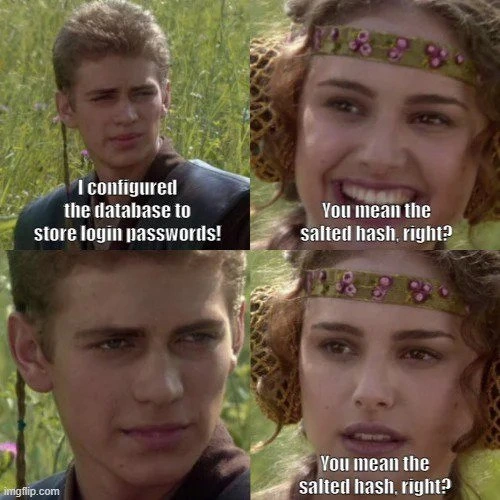
Anakin discovers the dark side of password management
Security Post #3722, on Sep 19, 2021 in TG

Anakin discovers the dark side of password management

Why is this Security meme funny?

Level 1: Key Under the Mat

Imagine a kid proudly telling his parents, “I wrote down all the secret family recipes and hid them in our house!” The parents smile, thinking that’s fine as long as the secrets are safe. But then they pause and ask, “You didn’t just put that notebook of secrets under the welcome mat, right?” If the kid just gives a blank look, the parents’ hearts sink. Sticking a key (or secret info) under the doormat is basically the first place a burglar would check — it’s not safe at all! In this analogy, the password is like the secret recipe, the database is the house, and storing the password in plain text is like hiding that secret recipe book under the mat. The parents (like Padmé in the meme) were really expecting the kid to say he locked the recipes in a safe or at least hid them somewhere clever (that would be the “salted hash” equivalent — a secure hiding method). The meme is funny because the junior developer acts like he kept things safe, but he actually left the “keys” out in the open. Padmé’s worried question, “Salted hash, right?”, is just like those parents asking about a proper locked safe: it’s the obvious thing anyone would do to protect important secrets. When it turns out he didn’t do that, it’s both comical and a little scary — a classic “you forgot the most important step!” moment. Even without tech knowledge, anyone can understand the lesson: you don’t leave sensitive secrets where anyone can find them. The joke works on that simple level, making us grin and wince at the same time.

Level 2: Hashing It Out

Let’s break down the issue in simpler terms. The junior developer in the meme proudly says he set up the database to save user passwords. That sounds okay at first — we do need to remember users’ passwords to check them when they log in. But the critical detail is how those passwords are stored. Storing them in plain text (just as the users typed them, readable to anyone with access) is a huge mistake. Instead, the standard practice is to store a hashed and salted version of the password.

So, what does that mean? A hash is basically a one-way scramble. You take the password (say "letmein123") and run it through a special algorithm (like a mathematical blender) to produce a fixed-length string of seemingly random characters. For example, "letmein123" might hash to something like "5f6c3e..." (just gibberish). If you change even one letter of the input, you get a completely different hash output. Crucially, this process is one-way: given "5f6c3e...", you can’t feasibly turn it back into "letmein123" — there's no undo button for a good hash function. This is great for security: even if someone sees the hash, they shouldn’t be able to figure out the original password without massive guessing.

However, there's a catch: if two users have the same password, they would get the same hash. Also, hackers have clever tricks: they can precompute hashes for lots of common passwords. To counter these issues, we add a salt. In tech terms, a salt is just a random chunk of data (like "X1Y2Z3...") that we mix in with the password before hashing. The salt is different for each user. So instead of hashing "letmein123" alone, the system might hash "letmein123X1Y2Z3...". Your friend’s identical password would be hashed with a different salt, say "letmein1239Z8W7V...". The resulting stored hashes will be totally different, even though the original passwords were the same. This unique salt also means that those precomputed hacker tables won’t match, because the hacker would have to factor in the unknown salt for each user — a much harder task.

To visualize the approaches:

Method Stored Data (Example) Outcome
Plaintext (bad) password123 Unsafe: The actual password is stored. If anyone gets the database, they see your password in plain text.
Hashed (no salt) 5f4dcc3b5... Better, but weak: It’s a hash (gibberish), not the real text. However, attackers can recognize common hashes or use lookup tables to reverse easy passwords.
Salted Hash (good) cf7a9... (with unique salt) Secure: Even if someone grabs the database, they only see random salted hashes. Each one is unique, and they'd have to spend a lot of time cracking each password individually, if they can at all.

In the table above, "5f4dcc3b5..." is actually a famous hash – it’s the MD5 hash of "password". Without a salt, hackers who have that hash can tell it's "password" almost instantly because they've seen it before! By contrast, "cf7a9..." here represents a salted hash which would be different for each user even if the password was "password". The salt (not shown fully) is combined with the password, so an attacker can’t just look up "cf7a9..." in a pre-made list; they'd have to brute force it specifically with the known salt.

Now, how do we use a salted hash in practice? The idea is that when a user signs up or changes their password, the system generates a random salt for them. It then computes the hash of password + salt and stores both the hash and the salt in the database (the salt isn't a secret; it can be stored alongside). Later, when the user tries to log in, the system takes the password they enter, retrieves the stored salt for that user, hashes the entered password with the same salt, and checks if it matches the stored hash. If it matches, that means the password was correct without ever needing to save or even know the original password in the database after registration. This way, even the application owners or DB admins never see users’ actual passwords — they see only the hashed versions.

By following this procedure, we dramatically improve security. Even if a bad actor obtains the database contents, all they get are salted hashes which are extremely difficult to reverse. It’s like storing the information in a safe rather than leaving secret info out in the open. Pretty much every modern framework does this for you or provides easy tools for it. For instance, in Node.js you might use the bcrypt library’s hash() function; in Python, the bcrypt or hashlib modules; in Java, maybe a PBKDF2WithHmacSHA1 function via a security library; etc. These tools implement the hashing and salting under the hood so developers don't have to invent their own (which could be error-prone).

The meme uses the Star Wars Anakin/Padmé format to make this point in a lighthearted way. In the first panel, the junior developer (Anakin) is excited because he did the naive part — storing credentials — thinking the job is done. In the second panel, Padmé smiles because she assumes, of course, he did it the right way (she's expecting to hear “...stored passwords securely”). The third panel has Anakin’s blank face when he doesn’t continue with “...securely,” which implies something is very wrong (he didn’t even realize the crucial step he missed). Finally, in the fourth panel Padmé has that worried look and asks, "Salted hash, right?" Her tone (in our minds) is getting nervous, basically hoping it was just a misunderstanding. It’s funny to those of us in tech because we instantly know what’s gone wrong even though nothing explicit was said — we fill in the gap: he must have stored them in plain text! The humor comes from that shared understanding. We all expect the words “salted hash” to complete the sentence, and when it’s absent, we get that jolt of panic just like Padmé.

In summary, the junior developer’s statement triggers a lesson on good password storage practices: always hash and salt passwords in a database rather than keeping them as-is. It’s a meme, but it’s also practically an educational poster — after seeing this, even a newer developer will likely remember to never store passwords plainly. Padmé’s little line, “Salted hash, right?”, is now almost a community punchline meaning “please tell me you handled the security part correctly.”

Level 3: Seasoned but Unsalted

The humor in this meme hits every experienced developer right in the gut. Imagine sitting in a code review or stand-up meeting where a junior cheerily announces, “I configured the database to store login passwords!” There's a moment of silence as all the seniors exchange that look 😳 – did they really say passwords, not password hashes? That one word is a huge red flag. In the meme’s panels, Anakin (the junior) boasts about his accomplishment, and Padmé (the peer or senior developer) smiles at first, assuming everything is fine. Of course the app needs to store credentials, right? But then it dawns on her – how exactly are those passwords being stored? Her face falls in the third panel (that iconic blank stare), which perfectly captures the collective security_facepalm moment. Every veteran dev reading that first panel is mentally adding “…hashed and salted, of course” to the end of Anakin’s sentence. Hence Padmé’s concerned follow-up: “You mean the salted hash, right?”

This interaction satirizes a classic Security mistake that most of us have encountered (or unwittingly made) early in our careers. Storing raw passwords in a database is basically the cardinal sin of SecurityBestPractices. Why? Because if that database gets compromised – and breaches happen all the time – it’s game over. An attacker won’t just get some indecipherable gibberish; they’ll have the literal keys to every user’s account. It’s the difference between a thief finding a vault full of locked safes (hashed passwords) versus finding a vault with hundreds of open safes containing neatly labeled keys (plaintext passwords). The meme exaggerates this with Padmé’s alarmed expression: she knows that without hashing, a simple SQL data dump could lead to a major SensitiveDataExposure incident.

In real-world developer culture, this scenario is both horrifying and darkly comedic. There are infamous cases where companies leaked millions of plaintext or weakly-hashed passwords. (For example, the RockYou breach in 2009 spilled 32 million user passwords that were stored in plain text — a treasure trove for hackers and a security nightmare for everyone else.) Everyone hopes these are lessons learned long ago, yet here comes “Anakin” unknowingly repeating history. The meme’s Star Wars characters add an extra layer of irony: Anakin is literally a Padawan (apprentice) doing something dangerously naive, and Padmé (usually not a techie in the movies, but here representing the wiser dev) is about to get very worried. The bright meadow setting from the film contrasts with the dark realization of a looming disaster.

Technically, what Padmé expects is that the junior implemented proper DatabaseSecurity measures: at minimum, storing a hashed version of the password (so you never keep the actual secret) and, crucially, using a salt to protect against common attack patterns. When she says “Salted hash, right?”, she’s really asking: You did run the passwords through a hash function with a unique salt for each user, correct? It's almost pleading: please tell me we aren't one step away from our user table being an attacker’s shopping list. A “salted hash” means each user's password like "FluffyBunny!" is combined with a unique random salt (e.g. "FluffyBunny!{X1Y2...}") before hashing, producing something like "5d414d..." that's stored in place of the actual password. Even if two users choose "FluffyBunny!" as their password, their stored hashes will differ due to different salts. Without salts, identical passwords produce identical hashes, tipping off hackers and enabling faster cracking via shared work.

A seasoned dev might also expect the junior used a strong hashing algorithm such as bcrypt with a proper cost factor, rather than a fast, outdated hash like MD5 or SHA-1. Best practice is to use libraries or frameworks that handle this for you. For instance, many frameworks have a create_user() method or a password field that automatically does bcrypt hashing under the hood. If writing it manually, it would look something like this:

# BAD: storing raw password (plaintext) directly in the database
db.save_user("alice", password="wonderland123")  # ❌ Security nightmare!

# GOOD: storing a salted hash instead of the raw password
salt = os.urandom(16)  # 16 bytes of cryptographic random salt
hashed_pw = hashlib.pbkdf2_hmac('sha256', b"wonderland123", salt, 100000)
db.save_user("alice", salt=salt, password_hash=hashed_pw)  # ✅ Secure storage

In the bad case above, if someone gains access to the database, they'll see "wonderland123" as Alice's password in plain text — she’s utterly compromised. In the good case, an attacker finding salt and password_hash still can't easily recover the original password. They would need to guess a candidate password, hash it with that exact salt, and check if it matches hashed_pw. With a strong hash function and a high iteration count (100,000 in the example using PBKDF2, or a cost factor if using bcrypt), this process is intentionally slow and must be repeated for each guess. It’s a night-and-day difference in terms of security. One approach hands over secrets on a silver platter; the other forces intruders to grind and sweat for every single password (and they still might not succeed if the passwords are sufficiently complex).

This meme resonates because it encapsulates that “Oh no…” moment — when a team member realizes a huge oversight. The phrase "store login passwords" without mention of hashing is practically a horror story among developers. It's like saying "I left the door unlocked" to a security consultant. Padmé’s second line is exactly what any senior dev or security engineer would blurt out in panic: a quick check to confirm whether this is a false alarm or a five-alarm fire. The comedic element is that the junior is blissfully proud of a task done (probably thinking "I made login work!"), completely oblivious to the Pandora’s box of vulnerabilities he just opened. Meanwhile, the seasoned folks are already facepalming and imagining the urgent refactor that needs to happen yesterday. In short, the meme pokes fun at the gap between what newbies might do and what experienced devs expect – a gap filled here by the all-important missing “salted hash.”

Level 4: Rainbow Table Buffet

For a seasoned security engineer, discovering plaintext passwords sitting in a database is like walking into an all-you-can-crack buffet for hackers armed with rainbow tables. In cryptography, a rainbow table is a precomputed database of hash values for common passwords (and many not-so-common ones). If passwords are stored unsalted and hashed (or worse, not hashed at all), an attacker can take a hash from the database and simply look it up in a rainbow table to instantly find the original password. It's a devastatingly effective shortcut when the proper precautions (like salting) aren't in place.

Under the hood, password hashing should rely on a one-way cryptographic hash function – a function that is easy to compute but practically impossible to invert. This one-way property, known as preimage resistance, means given a hash output H, finding an input password P such that hash(P) = H is astronomically difficult without brute force. However, there's a catch: humans tend to pick common passwords, and compute power is cheap. Attackers exploit this by pre-hashing millions of potential passwords. When a site stores unsalted hashes, the attacker doesn't have to brute-force each account individually; they can just compare the stored hashes against their giant list. If they see 5f4dcc3b5aa765d61d8327deb882cf99 in the database, they know immediately the password was "password" – no need to break the hash mathematically when a lookup suffices. This is why unsalted hashes are so fragile.

Enter the salt: a random string of data unique to each password. By concatenating a user-specific salt with the password before hashing (often conceptualized as hash(password + salt)), we transform the hashing process from a static mapping into an individualized one. Now even if two users have the same password "123456", their salted hashes will be completely different because each uses a different salt (say, "userA" has salt X1Y2... and "userB" has salt 9Z8W...). This uniqueness demolishes the efficiency of rainbow tables – an attacker would have to generate a new lookup table for every single salt value. If the salt is sufficiently large (e.g. 16 bytes of randomness for ~2^128 possibilities), precomputing that many tables is computationally infeasible. In effect, salt forces the attacker down to brute-forcing one password at a time, greatly slowing any breach.

Even brute force becomes less fruitful thanks to how modern password hashing is designed. Functions like bcrypt, scrypt, and Argon2 include built-in salts and also deliberately consume more CPU and memory (a technique called key stretching). Instead of a hash function that runs in microseconds (like a single SHA-256), bcrypt might run in tens of milliseconds or more for a single password, especially with a high cost factor. That may not sound like much, but it means an attacker can only try maybe a few hundred guesses per second instead of millions. Multiply that slowdown by unique salts per user, and the defender’s odds improve drastically. BcryptPasswordHashing and its peers enforce this slowdown so that even if a database is compromised, the SensitiveDataExposure is limited – cracking each password will take so much effort that only the weakest, most common passwords might fall, and even those not without significant time.

From a theoretical perspective, this practice aligns with Kerckhoffs's principles: even if the attacker knows our hashing algorithm and sees our data, they still shouldn't be able to recover the secret. We assume the worst (database leaks) and still ensure passwords remain secret. The mathematics behind one-way functions (like the avalanche effect, where a tiny change in input wildly changes the output) and the combinatorial explosion introduced by per-user salts put the advantage back on the side of the good guys in terms of DatabaseSecurity. Historically, this approach is nothing new – as far back as the 1970s, Unix systems used salted password hashing (e.g., the old crypt(3) function with DES-based hashing included a salt) once it became clear that even early attackers could precompute hashes of common words. Over decades, the industry learned these SecurityBestPractices the hard way through countless breaches.

So when Padmé anxiously asks, “You did mean a salted hash, right?”, she is invoking this entire body of security knowledge. It's not just pedantry – it's the voice of experience recognizing that if Anakin truly saved raw passwords, he’s effectively handed a superweapon to any future attacker. In other words, never underestimate the Dark Side of skipping proper password hashing: the fundamentals of computer science and cryptography will come back to haunt you every time. The meme’s humor comes from this deep truth: a junior developer proudly announces something that completely ignores decades of well-established cryptographic wisdom, and every expert’s alarm bells immediately start ringing.

Description

A four-panel meme using the 'For the better, right?' format with Anakin Skywalker and Padmé Amidala from Star Wars. In the first panel, a proud Anakin says, 'I configured the database to store login passwords!'. In the second panel, a smiling Padmé replies, 'You mean the salted hash, right?'. The third panel shows Anakin with a blank, silent stare, implying he has no idea what she's talking about. In the final panel, Padmé's smile has vanished, replaced with a look of dawning horror as she repeats, 'You mean the salted hash, right?'. A watermark for 'imgflip.com' is in the bottom-left corner. This meme hilariously captures a terrifyingly common scenario for senior developers: discovering a junior engineer has implemented a critical security feature (like password storage) in the most insecure way possible - storing plaintext passwords. It highlights the fundamental importance of security practices like hashing and salting to protect user data from breaches
Comments

25
Anonymous ★ Top Pick Storing passwords in plaintext is the technical equivalent of writing 'please rob me' on your server's welcome mat. At least with a salted hash, you make them work for it
  1. Anonymous ★ Top Pick

    Storing passwords in plaintext is the technical equivalent of writing 'please rob me' on your server's welcome mat. At least with a salted hash, you make them work for it

  2. Anonymous

    If your schema still has a `password` column instead of `password_hash`, congrats - you just provisioned both user auth and the future breach post-mortem in a single DDL statement

  3. Anonymous

    The real horror isn't finding plaintext passwords in production - it's discovering they're stored in a VARCHAR(20) column because 'nobody needs passwords longer than that' and the senior who wrote it is now the CTO

  4. Anonymous

    When your junior dev proudly announces they've 'optimized' authentication by storing passwords in plain text for 'faster lookups,' and you realize your next sprint will be entirely dedicated to explaining why SELECT * FROM users WHERE password = ? is a resume-generating event, not a feature. Bonus points if they've already pushed to production and you're now speedrunning GDPR violation bingo

  5. Anonymous

    Plaintext passwords in the DB? That's just a SELECT * FROM breach waiting to happen

  6. Anonymous

    Salted hash, right? If your strategy is SHA-256 plus one global salt and the “pepper” in an env var, congrats - you’ve built seasoned plaintext

  7. Anonymous

    Nothing says 'enterprise security' like a VARCHAR(255) password column and a Jira ticket titled 'hashing - post‑MVP.'

  8. @feskow 4y

    Where do you keep the salt - hard coded, in database or using characters from username?

    1. @CcxCZ 4y

      Salt is typically part of the output of the password hasing function. On Unix-like platforms this is handled by crypt() standard library function and most modern password hashes mimic it's interface. It uses random string by default and it should be as random as possible unless you have a good reason to make the output more predictable. (Postgresql has decent crypt library built-in by the way) You may be thinking of pepper which is extra step done in application to prevent leaking too much info in case someone gets raw access to SQL server, possibly via command injection.

      1. @feskow 4y

        Wait, isn't salt a part of the input of hash function?

        1. @CcxCZ 4y

          Yes, if you are verifying you need to produce the exact same output. If you are generating new hash though it should be random/unpredictable. The library usually handles that for you.

          1. dev_meme 4y

            Salt? Unpredictable? Again someone on internet doesn’t understand difference between salt and pepper!

            1. @CcxCZ 4y

              Yes unpredictable. It was designed to defeat precomputation attacks.

              1. dev_meme 4y

                It should be predictable, man. It shouldn’t be used by anyone else. E.g. userEmail + userId Good salt Very predictable

              2. Deleted Account 4y

                how will you check the password if the salt was unpredictable, lol

                1. @CcxCZ 4y

                  Store it in the crypt() format https://en.m.wikipedia.org/wiki/Crypt_(C)#Key_derivation_functions_supported_by_crypt

            2. Deleted Account 4y

              I know salt but what's pepper?

              1. dev_meme 4y

                Part added to hashed data which must be kept in secret (salt - public and easy to found, stored directly in DB or there are clear alghorthm how to get it) For pepper there shouldn't be way to found it, except known by user (e.g. manually written stirng additional string)

                1. Deleted Account 4y

                  Not added to hashed data, added to prehash data

                  1. dev_meme 4y

                    Added to data before it is hashed, sure, otherwise there is no reasob to to do)

              2. @p4vook 4y

                I've always thought that it's a password to symmetric encryption of the hashes, that could be regularly changed

        2. dev_meme 4y

          No, salt isn’t required input for hash function

  9. @Truth_0000 4y

    Can someone send a blank template for this?

    1. @Eddy_Rex 4y

      google my friend

      1. @Truth_0000 4y

        Nice advice

Use J and K for navigation