When 'I hope this email finds you well' meets reality
Why is this MentalHealth meme funny?
Level 1: It Found Me Exhausted
Imagine you're home sick with a bad cold, and a friend sends you a card that says, "I hope you're feeling wonderful today!" In reality, you're buried under blankets, coughing and feeling miserable. The friend's words are very kind and polite, but they just don't match how you actually feel. That's exactly what's happening in this meme. The email’s greeting is super cheerful ("hope you're well"), but the person reading it is completely worn out – the opposite of "well." It's funny in a simple way: the nice words and the real situation are total opposites, and that mismatch is what makes people laugh.
Level 2: Polite Email Meets Burnout
At first glance, this meme shows a very polite email greeting and a very tired developer. The text at the top says, "I hope this email finds you well." That’s a common phrase people use at the start of formal emails – basically a fancy way to say "I hope you're doing okay today." It's part of standard business email etiquette. If you've ever written to a professor or applied for a job, you might have used a similar polite opener. It's friendly and professional, even if it's a bit of a cliché. People include it to sound courteous, even when emailing coworkers in the tech world.
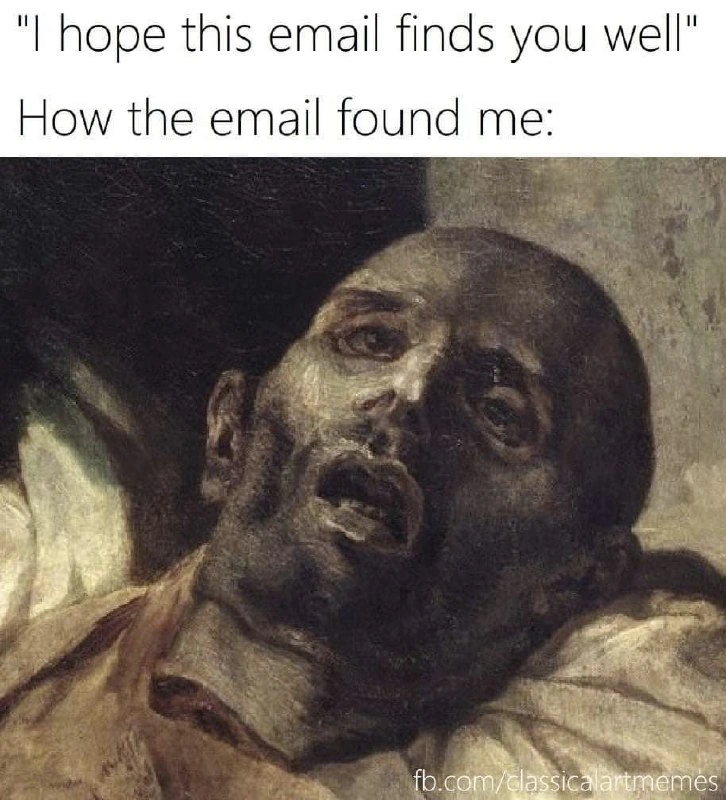
Right below that greeting, the meme shows an image labeled "How the email found me:" and then reveals a scene from an old classical painting. The person in the painting looks exhausted, sickly, and completely worn out. His eyes are half-closed and he’s slumped over as if he can barely stay upright. In other words, he does not look "well" at all! This is the meme’s way of saying: the email may have hoped to find me well, but look – it actually found me feeling like this guy. The painting is used humorously to exaggerate how bad the recipient (here, a developer) feels. This style of joke, using classical art to depict modern situations, is common in classical art memes. The old art gives a dramatic, sometimes darkly funny visual to match the modern caption. Here it really highlights the idea of burnout by showing someone who appears completely drained and hopeless.
So what is developer burnout? Burnout is a term for extreme exhaustion and stress caused by overwork or tough situations at a job. When a developer is "burnt out," it means they've been working too hard for too long without enough rest or support. They might feel very tired all the time, lose passion for their work, and have trouble concentrating or finding motivation. In tech, you often hear this term when someone has been crunching (working intense overtime) for weeks on end. Mental health in tech has become a big talking point because many programmers and engineers experience burnout due to long hours, tight deadlines, or constant pressure to learn new things. The meme is directly pointing at this: the person reading the email is an overworked developer who is mentally and physically exhausted – basically the email "found" them in a burnt-out state.
Now let's talk about the communication part. Communication overhead is a term that might sound complicated but it’s actually simple: it's the extra time and effort that it takes to communicate or coordinate with others, on top of doing your actual work. For a developer, this overhead could be reading and replying to emails, checking messages on Slack, attending meetings, writing status reports, and so on. All those tasks don’t directly produce new code or features, but they are necessary to keep the team in sync. However, when a developer is already tired or under pressure, dealing with constant emails and messages can make things worse. Every time you stop coding to answer an email, you have to switch your mind out of "programming mode" to "communication mode." That context switch can be tiring, especially if it happens many times a day. It’s a bit like if you were reading a book and someone interrupted you every 5 minutes – you’d lose your place and get frustrated, right? In the tech world, that frustration contributes to feeling burnt out. So the phrase "communication overhead" here just means the burden of all the emails and chats that developers have to handle in addition to their coding work.
Now consider the phrase "I hope this email finds you well" in a real-life office scenario. Suppose it's Monday morning and a project manager or team lead sends this greeting at the start of an email that also includes some new tasks or maybe feedback on your work. The manager is being polite and probably doesn't intend any harm with that line. It's just how people professionally start emails. But if you're a developer who's coming off a tough week – say you spent your weekend fixing server crashes or you haven’t been sleeping well because of stress – reading "hope you're well" might feel a bit ironic. You might think, "Actually, no, I'm not well, but I guess I'll have to deal with this email anyway." It’s not that the manager did something wrong by saying it; it's just that the cheerful tone can unintentionally highlight how not okay you actually feel.
This contrast between polite language and harsh reality is where the humor comes from. It's a kind of workplace humor that many people find relatable. Almost everyone with an office job (especially in tech) has gotten messages that start super polite during times when they themselves were struggling or overwhelmed. We keep a professional tone in writing, but that doesn’t mean everything is fine behind the scenes. The meme pokes fun at that disconnect. On the surface, you have this nice, well-mannered email greeting. Underneath, you have a developer barely holding it together due to stress and exhaustion. The classical painting exaggerates it to make it obvious and a bit sarcastic – basically saying "I'm the opposite of 'well' right now."
For a newer developer or someone early in their career, this meme is also a bit of a lesson about corporate culture in tech. It’s showing that people will often speak to you in a very courteous, upbeat way in emails (using phrases like "Hope you're doing well"), and that's normal – but it doesn't always reflect reality. The person writing that greeting might also be tired or burnt out! It's just a standard way to communicate positively. So even if you're exhausted, you'll still receive and probably respond with polite emails. Part of being in a professional environment is learning these communication habits, while also remembering to take care of yourself so you don't actually end up feeling like that painting too often.
In summary, the meme humorously highlights how a typical nice email greeting can clash with the reality of developer exhaustion. It's funny to people in tech because it's true – many of us have been that tired person reading an overly cheerful email. The elements like the dramatic classical art image make the message extra clear (and a bit darkly funny), but you don't need to know the specific painting to get it. You just need to know what it's like to be really, really tired at work. When you do, "I hope this email finds you well" almost sounds ironic, and that’s exactly why this meme makes people smirk.
Level 3: Unhandled BurnoutException
The phrase "I hope this email finds you well" is the quintessential corporate email opener – a friendly, polite handshake in text form. It's used so reflexively in CorporateCulture that it's practically boilerplate. But in this meme, that smooth salutation collides head-first with the grim reality of developer burnout. Beneath the polite greeting, the meme shows a slumped, ashen-faced figure from a classical painting, looking like all the life (or maybe the last deployment) has been drained out of him. The humor sparks from that jarring contrast: a formulaic expression of goodwill versus the brutal truth of how the email actually found its recipient. (Spoiler: not well at all.)
As a battle-scarred engineer, I can't help but smirk at the accuracy. We all know that line is rarely a sincere health check – it's more like an HTTP 200 OK header on every message, a default status with no real meaning. The exhausted developer reading it is probably thinking, "Yeah, if only you knew..." while running on four hours of sleep and a cold cup of coffee. It's the email equivalent of a no-op: a nice greeting that doesn't change anything under the hood. In fact, the fluffier the email intro, the more it feels like a red flag. It's almost a running gag in tech: the friendlier the opener ("Hope you're doing well!"), the more likely it precedes an unpleasant request or the ninth production issue of the week. The greeting says "all is well," but the reality is more like an unhandled exception – something's cracked and the system (i.e. the developer) is about to crash.
The visual punchline drives it home. That classical art image – courtesy of the classical_art_meme genre – is a dramatic representation of DeveloperExhaustion. The slumped, vacant-eyed man in muted browns and greys looks like he's been through a war... or at least a hellish on-call rotation. It's comedic exaggeration, sure, but not by much on some days. Any senior dev who's survived a death march project or a week of 2 AM outage calls recognizes that thousand-yard stare. It's the look of absolute burnout: when you've debugged so much and slept so little that you practically feel like a ghost in your own codebase. By using a centuries-old painting of someone clearly suffering, the meme cheekily equates epic, classical suffering with the modern tech industry's own form of torment – MentalHealth strain and burnout on the job.
Then there's the matter of communication overhead. The meme hints at it in a tongue-in-cheek way. Email is a form of asynchronous communication – theoretically great because it doesn't require an immediate response, letting you reply at your own pace. But when you're drowning in work, that backlog of unread emails just becomes another source of stress waiting to ambush you. Every new message – whether it's an email or a Slack ping – is an interruption, a context switch. Ever tried to focus on a tricky bug while Outlook keeps chiming or Slack messages stack up like a Jenga tower? Each ding yanks your brain out of "the zone," incurring a mental context-switch penalty. It's like a CPU handling too many interrupts – eventually, you hit a point of thrashing. No wonder by the time you open an email that cheerily hopes to find you well, you're feeling more like a program about to throw a BurnoutException than a human in peak form.
This meme also nails a truth about office life: polite communication often glosses over brutal realities. In many workplaces, there's an unwritten rule to maintain a façade of positivity and politeness no matter what. That opening line is a prime example. It's a tiny ritual of empathy in an environment that otherwise might be ignoring your 80-hour work weeks. In a darkly funny way, "Hope you're well" has become code for "brace yourself." It's a piece of CorporateHumor we all recognize, poking fun at the dissonance between cheery WorkplaceHumor niceties and the actual working conditions. We chuckle because otherwise we'd cry, right? The seasoned dev brain auto-parses that greeting and immediately braces for the real payload of the email – usually something that will add to your already burning workload.
Ultimately, this meme resonates because it's painfully relatable. It's tapping into RelatableHumor for anyone in tech who's been there: reading a chirpy email greeting while you feel like the walking dead. There's a camaraderie in that shared absurdity. We laugh (with a bit of a groan) because we've all been on the receiving end of that mismatch between tone and reality. It's a coping mechanism as much as a joke – acknowledging with sarcasm that a cheery one-liner in an email does nothing to alleviate real DeveloperBurnout. In short, the meme is the developer community collectively rolling its eyes and saying, "This email didn't find me well at all – and isn't that the truth behind our polite office emails."
Description
A two-part meme contrasting a polite email greeting with a depiction of extreme exhaustion. The top section contains the text '"I hope this email finds you well"' followed by 'How the email found me:'. The bottom section features a classical painting, specifically Théodore Géricault's 'The Head of a Guillotined Man,' showing a pale, gaunt man lying down, seemingly on his deathbed or deceased, with a dark, somber background. The man's mouth is agape and his eyes are half-open, conveying a state of utter depletion. The watermark 'fb.com/classicalartmemes' is visible in the bottom right corner. The meme humorously captures the intense burnout and stress experienced in the tech industry. For senior developers, the innocuous email could represent a late-night production alert, an impossible stakeholder request, or the final straw in a long week of meetings, making the dramatic reaction feel deeply relatable
Comments
8Comment deleted
I hope this email finds you well. The email is a 3 AM PagerDuty alert about a critical vulnerability in a core library you personally chose eight years ago
“Hope this email finds you well” - it did, right between the 3 AM PagerDuty page and the moment I realized our 2007-era monolith still deadlocks on a mutex named after me
The only thing more dead inside than this painting's subject is the senior engineer who just received their 47th 'quick sync' meeting invite for the week, each one promising to be 'just 15 minutes' but somehow always involving a product pivot that invalidates the last three sprints of carefully architected work
When the VP sends 'hope this email finds you well' at 3 AM while you're SSH'd into production, frantically rolling back a deployment that took down the payment gateway, and your monitoring dashboard looks like a Christmas tree of red alerts - that's not an email finding you well, that's an email finding you in the seventh circle of distributed systems hell, contemplating whether your architecture decisions were sound or if you should have just stuck with a monolith and called it a day
“I hope this email finds you well” - it found me failing health checks with a negative error budget and a “green” dashboard cached from yesterday
Like Kubernetes scheduling a critical pod on the node screaming 'OOMKilled'
“Hope this finds you well” - meanwhile my status was 503, liveness probe failing, and PagerDuty was retrying with exponential backoff
Also how I found email: Comment deleted