The Junior Dev's Hilarious Request for the Mythical Manual
Why is this Documentation meme funny?
Level 1: No Manual Included
Imagine you join a new club where the older kids have been playing a really complicated game for a long time. You, being new, ask, “Hey, do we have a rulebook or instructions I can read so I know how to play?” As soon as you ask this, all the older kids start laughing out loud. Not because you told a joke, but because the idea of having written instructions is just super funny to them – they never wrote any down! In this little story, you’re like the junior developer, and the older kids are like the executives. The funny part is that you expected clear instructions (which is a normal thing to expect), but the experienced group thinks that’s hilarious because they’ve always just kept the rules in their heads. They learned the game by memory and word-of-mouth, and they expect you will too. So now you have to learn by watching and asking questions, since there’s no rulebook to read. It’s a bit like getting a new toy with no instructions in the box – you ask for the missing booklet, and the grown-ups just chuckle and say, “Oh, there aren’t any, you’ll figure it out!” The humor comes from that mismatch: you thought there’d be a helpful manual, but everyone else knew that “manuals, guidebooks… we don’t do that here!” It’s funny and a little frustrating, because it shows how silly things can be when something as simple as instructions are missing.
Level 2: But Did We Document It?
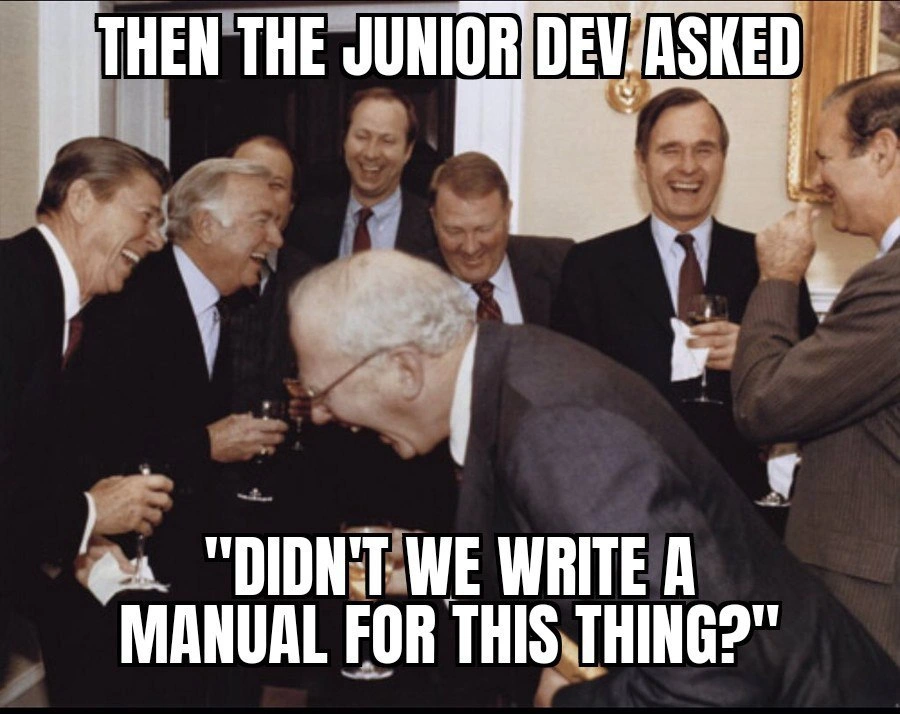
At its core, this meme highlights the surprise and confusion a new developer feels when they discover no documentation for a project. The image shows a group of executives laughing, with text implying they are reacting to a junior developer’s question about a project manual. The top caption reads: “THEN THE JUNIOR DEV ASKED”, and the bottom caption continues with the junior’s quote: “Didn’t we write a manual for this thing?” – complete with a question mark to show genuine curiosity. The humor comes from the idea that asking for a manual or documentation is apparently so silly in this company that it makes the higher-ups burst into laughter.
Let’s break down what all this means in a normal software team context:
Documentation / Manual: In software, documentation is any written material that explains a project. This can include a user manual, developer guide, setup instructions, or an onboarding document for new team members. A manual for a project would typically explain how to install the software, how to use its features, how to troubleshoot common issues, etc. When the junior dev asks, “Didn’t we write a manual for this thing?”, they are expecting that someone took the time to write down how the project works or how to operate it. It’s a very reasonable expectation – in school or personal projects, you often have at least a README file or some instructions.
Junior Developer vs. Executives: A junior dev is someone new to the industry or company (often just started their career or this is their first big project). They tend to assume that proper processes are in place – like documentation existing. The executives laughing in the image represent the company’s leadership or very senior folks. The meme suggests these execs find the junior’s question amusing because, from their perspective, writing a manual was never done or even considered. This points to a gap in CorporateCulture: the leaders didn’t ensure documentation was created, and now they think it’s cute (or unrealistic) that a newcomer expects it to be there.
Corporate Culture and Tribal Knowledge: The phrase corporate culture refers to the habits and norms within a company. In some corporate cultures, unfortunately, writing things down is not a priority. People rely on what we call tribal knowledge – information that is known by existing team members and passed along informally, but nowhere officially recorded. If someone says a company runs on tribal knowledge, it means: “If you need to know how something works, you have to ask the right person or have been there to see it – it’s not written in a document.” That’s what’s happening in this meme. The new dev expected a written guide (the manual), but the reality is all the knowledge is probably just in senior engineers’ heads or scattered in chat history. The tribal_knowledge approach can make newcomers feel lost because there’s no single source of truth to read.
Runbook / Manual absence: A runbook is a specific kind of documentation, usually a step-by-step guide on how to run systems or handle common problems (often used in IT and operations teams). For example, a runbook might have “How to restart the server” or “What to do if the database crashes.” The context tags mention runbook_absence, which means the runbook is absent – there’s no guide for what to do when something goes wrong. So when the junior asks for a manual, we can imagine they might be looking for something like a runbook or any setup guide for the project. The executives laughing implies that no such runbook was ever created. Essentially, if the servers go down or if someone new needs to set things up, there’s no written help available. You’d have to rely on memory or find a person who knows those steps. This is obviously not ideal, and that’s why it’s a point of humor (and pain) among developers. It’s DocumentationWoes at its finest: the woe (problem) is that documentation is missing.
Onboarding struggles: Onboarding is the process by which a new employee (like a junior developer) gets introduced to a project or company and learns how to do their job. Good onboarding often includes giving the new person documentation to read, training materials, or manuals so they can understand the project’s history and how things work. When documentation is missing, onboarding becomes much harder. The new dev will struggle to learn the system, because they have to constantly interrupt colleagues with questions or try to piece things together themselves. The context tag onboarding_struggles is exactly that – the difficulties a newcomer faces when there’s no guide or manual to help them. In the meme, the junior dev is in that situation: they ask for what should be a basic onboarding item (a manual), and the leaders just laugh because apparently even they know nothing like that exists.
Why it’s funny (and not): The laughter in the meme is obviously exaggerated for comedic effect – in real life, executives might not literally laugh in a junior’s face. But it captures a truth in a funny way. It’s poking fun at a disconnect between JuniorVsSenior perspectives. Newer developers often assume that established projects have things like documentation sorted out. They come in thinking, “Surely someone wrote things down.” Meanwhile, those who have been in the industry (or at that company) longer have grown accustomed to poor documentation. They might even be a bit jaded – they’ve seen that writing docs was promised and postponed too many times. So when a junior earnestly asks “Where’s the manual?”, experienced folks might share a knowing smile or chuckle, because the sad reality is: nope, there is no manual, and it’s kind of ridiculous how common that is. It’s funny in a dark way because it’s true in so many places.
Miscommunication: The meme also highlights a bit of miscommunication or misaligned priorities. The junior dev expects communication in the form of documentation. The executives (and by extension the company) communicated priorities differently – maybe they focused on pushing code out and never communicated the need for docs. So when those two worlds collide (junior’s expectation vs. company reality), it results in a comical moment. The tags like DocumentationHumor and CorporateHumor apply because this is humor coming from an office scenario that many find all too familiar.
In summary, at Level 2 we see that the image uses a popular “laughing executives” meme format to tell a short story: a new dev asks a straightforward question about whether there’s any written guide for the project, and the higher-ups find it absurdly funny because, in their world, thorough documentation is almost a mythical idea. It underscores the common situation where documentation gap exists – there’s a big gap between what documentation should be there and what’s actually there (often nothing or very little). This leaves new developers struggling as they join (onboarding headaches) and forces them to depend on verbal instructions or chasing down people for answers (tribal knowledge approach). The meme resonates with developers because many have lived through this exact scenario, making it a mix of humor and a gentle critique of workplace practices.
Level 3: Tribal Knowledge Base
In this meme’s scene, a junior developer innocently asks if there’s a written manual for the project, and a gaggle of suited executives roar with laughter. It’s the classic executive laugh meme repurposed to highlight a painful tech truth: vital documentation is often nonexistent, and everyone except the newbie knows it. The humor lands because it’s an exaggerated yet relatable snapshot of corporate tech culture. The junior dev’s reasonable question – “Didn’t we write a manual for this thing?” – is met not with answers, but with uproarious laughter. Why? Because in many organizations, the very idea of a thorough runbook or manual for an internal system is a mythical luxury. Everyone shares a tacit understanding that the project’s knowledge lives in a chaotic mix of old emails, tribal memory, and maybe an outdated Confluence page – certainly not in any up-to-date manual. The gulf between best practice and actual practice is exactly what’s being ridiculed here.
This scenario reflects a widespread documentation gap in the industry. Projects launch under tight deadlines, and anything not immediately delivering features – like writing docs – gets pushed aside. Leadership often measures success in releases and revenue, not in well-crafted manuals. So proper docs become an afterthought, if not an ongoing joke. The CorporateCulture on display prizes short-term delivery (“ship it now!”) over long-term maintainability (“we’ll write the docs later, promise”). The result is a repository of documentation woes: new hires flounder during onboarding, critical knowledge becomes siloed with a few veterans, and teams accumulate dangerous “bus factor” risks (if that one go-to person got hit by a bus, all their undocumented know-how would disappear). It’s so common that a junior’s naïve question about a manual feels almost funny in its optimism. The execs in the meme are basically saying through their laughter, “A manual? Oh, that’s adorable – we barely had time to write the code!”
To seasoned developers, this meme hits a nerve. We’ve all encountered systems that have zero or missing_manual documentation. The only way to learn is to bother a busy senior engineer or spelunk through convoluted source code. This reliance on tribal knowledge means that critical information is passed along like campfire stories, not written in any official guide. New team members often endure an onboarding_struggles montage of trial-and-error because the promised “knowledge base” is just Bob from DevOps and a scatter of sticky notes. The meme exaggerates with execs literally laughing, but behind that hyperbole is a real dynamic: those in charge either assume that documentation exists somewhere (it usually doesn’t), or they long ago accepted its absence as normal and even humorous. In some cases, leadership might have even discouraged spending time on docs – “If it isn’t coding a new feature, it can wait.” Over time, this attitude forms a tribal_knowledge culture where asking for a manual is like asking for snow in the desert.
Let’s break down a few all-too-familiar patterns being mocked here:
- “The Code Is the Documentation” – A cynical mantra at many companies. Instead of providing a guide, veterans tell newcomers to read the source code to understand the system. Reading code is useful, sure, but it’s no substitute for a well-written overview. It’s like handing someone a novel when they asked for the summary – technically all the info is in there, but good luck extracting it quickly.
- Outdated Wiki Graveyard – Perhaps there was an attempt at documentation once: a Confluence wiki or internal read_the_docs_ironically site. But it’s hopelessly outdated, last edited 3 years ago by an intern. Relying on it is more dangerous than helpful. It’s a runbook_absence situation in disguise – a manual exists in name, but practically it’s as useful as a blank page.
- “Just Ask Bob” Knowledge Silos – Instead of a manual, new devs are told to seek out a resident expert (e.g., “Ask Bob in QA, he’s the only one who knows how the payment gateway really works”). Knowledge gets hoarded in individuals, creating knowledge silos. If Bob is OOO or leaves the company, well, too bad – nothing was written down. The entire team becomes dangerously dependent on a few people’s memories.
- “We’ll Document It Later” – The perpetual lie. During crunch time, documentation is postponed with promises to write it post-release. Spoiler: “later” never comes. The project moves on, people forget the details, and the manual remains unwritten. It’s a running joke in many teams – everyone nods that docs are important, but when crunch time hits, docs are the first item cut from the schedule.
Totally forgottenconveniently deferred, the docs task languishes forever in the backlog.
To visualize the DocumentationHumor at play, consider what often greets a junior who bravely goes looking for that elusive manual. Maybe they open the project’s repository hoping to find a README or guide. What do they see? Possibly something like this:
$ cat README.md
# SuperCriticalProject
TODO: Write the docs once the project's finished
Yep, a README that’s basically a placeholder from day one – a promise that was never fulfilled. Or they might search for a docs folder, only to find nothing:
$ ls docs/
ls: cannot access 'docs/': No such file or directory
In other words, “Manual? What manual?”
The meme lands its punch by showing those well-dressed execs laughing, as if saying: “Documentation? Oh, that’s rich!” It’s an image of people who should value good process (they’re high-level leaders after all) openly dismissing it. This speaks to a miscommunication and disconnect: leaders often assume engineers will “figure it out,” while juniors assume there’d be written guidance. The result is a cycle of onboarding struggles – every new person has to re-learn the system from scratch, often by hunting down busy team members for answers or piecing together clues from code and commit messages. It’s inefficient, but it’s become normalized to the point of being darkly comedic. Seasoned devs laugh (to keep from crying) because they’ve been on both sides of this. First, as the confused newcomer asking “Where’s the manual?” and later as the jaded veteran smirking when another newbie asks the same. The meme perfectly encapsulates that shared experience.
Ultimately, “Executives laughing as junior dev asks if documentation exists” is a humorous critique of workplace reality. It pokes fun at the DocumentationHumor gap between what we all know we should do (write clear docs, maintain updated manuals) and what actually happens under pressure (shipping takes priority, docs get ignored). The absurdity of execs literally laughing drives home how ingrained this problem is. It’s as if thorough documentation is such a foreign concept in some companies that it’s laughable to even mention it. Every developer who’s had to fix a server at 3 AM with no instructions, or rewrite a feature by reverse-engineering the code because no specs were around, will chuckle and wince at this meme. It’s funny because it’s true – painfully true.
Description
This meme uses the popular 'And Then They Said' or 'Laughing Politicians' photo, which shows a group of men in suits, including former U.S. presidents, laughing uproariously. The top text, in a bold white font, reads, 'THEN THE JUNIOR DEV ASKED'. The bottom text continues the joke with, '"DIDN'T WE WRITE A MANUAL FOR THIS THING?"'. The humor is deeply rooted in a common, painful reality of software development: documentation is almost always nonexistent, incomplete, or hopelessly outdated. The junior developer's innocent and logical question is hilariously absurd to the seasoned veterans (represented by the laughing politicians), who have long accepted that the only reliable documentation is the source code itself. It perfectly captures the moment a junior's idealism clashes with the harsh reality of legacy systems and tight deadlines

Comments
8Comment deleted
The senior devs are laughing because they know the 'manual' is just a 3-year-old Confluence page with a broken link to the original spec and a single comment from a guy who left the company two years ago
Sure there’s a manual - it's just event-sourced across 47 stale Confluence pages, three buried Slack threads, and the memory of the architect who left in 2017
The manual exists in the same repository as the comprehensive test suite, the up-to-date architecture diagrams, and the accurate time estimates - right next to the unicorns in production
The junior dev's question about documentation triggers uproarious laughter because in most codebases, the 'manual' is actually a scattered collection of outdated README files, cryptic inline comments from 2014, a Confluence page that contradicts the actual implementation, and Steve from DevOps who's been here since the Paleozoic Era and is the only one who truly understands how the authentication service works - but he's on vacation for the next two weeks
Our docs are highly available: an archived Confluence space, a 2017 Slack thread, and Dave's memory - active/passive/passive with a 3‑week RTO
In our org, “manual” means a Confluence page last touched pre‑microservices; the real runbook is a Slack DM to the one person with prod‑only incantations
We wrote the manual to end questions; now it's the FAQ for 'where's the manual?'
Awesome 🤣 Comment deleted