Why we code: it's easier than people
Why is this DevCommunities meme funny?
Level 1: Puzzles Are Easier Than People
Imagine you have a big puzzle to solve, with all the pieces clearly shaped and a picture on the box. You know that if you put the right pieces together in the right way, the puzzle will be solved – the rules are clear and it’s kind of satisfying, right? Now imagine you’re playing with friends and one of them is upset, but they won’t say why. They’re giving only tiny hints by the look on their face or how they’re sitting, and you have to guess what those hints mean. That’s a lot harder, isn’t it? This meme is joking that for some people (like our programmer friend), working with code is like doing the easy puzzle with clear rules, while dealing with people feels like trying to guess a secret with hardly any clues. It’s funny because it’s true for many – figuring out a computer problem is straightforward, but figuring out feelings can be really confusing! So the programmer chose a job with the kind of puzzles they’re good at solving. In simple terms, the picture is saying: “I’m better at understanding laptops than I am at understanding laps and smiles.” And that little honest joke makes everyone who’s ever felt shy or confused by social stuff smile and think, “Yep, I get that!”
Level 2: Prefers Syntax to Small Talk
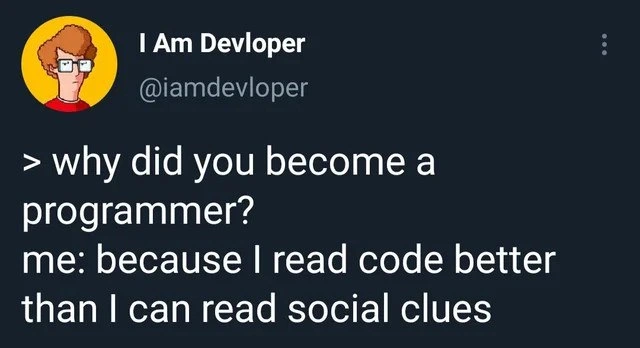
For a less seasoned developer (or someone new to this humor), let's break down the joke. The meme is basically a screenshot of a tweet formatted as a little Q&A exchange. The question asks, “Why did you become a programmer?” and the answer is, “Because I read code better than I can read social clues.” This punchline contrasts reading code with reading social cues. In simpler terms, the author is saying: “I’m better at understanding computers than understanding people.” It’s a popular form of developer humor because many folks in tech find it relatable.
Let’s clarify some terms and ideas here:
- Code Syntax: In programming, syntax is the set of rules that define the combinations of symbols and keywords that are considered a correctly structured program in a given language. It’s like grammar for code. For example, in JavaScript,
if (x > 0) { console.log(x); }follows the correct syntax. If you put a wrong symbol or order (like forgetting a{), you get a syntax error. Code syntax is very strict – every programmer must follow it, and if you do something wrong, the computer usually tells you exactly what and where the mistake is. - Social Cues (Social "Clues"): These are the subtle signals people give off in conversation and interaction. It includes things like tone of voice, body language, facial expressions, and implied meanings. For instance, if someone crosses their arms and frowns, the social cue might be that they’re unhappy or uncomfortable. Unlike code, there’s no compiler or interpreter to parse these cues for you – you have to read between the lines. The tweet spells it as "social clues," which isn’t the common spelling (it’s usually social cues), possibly to emphasize that for the programmer, these signals are like mysterious clues in a puzzle that he often misses.
- Soft Skills: This generally refers to personal attributes and interpersonal skills that enable someone to interact effectively and harmoniously with others. In a workplace, soft skills cover things like communication, teamwork, empathy, and conflict resolution. For developers, a common joke is that we’re better at the technical “hard skills” (like coding, algorithms, debugging) than at soft skills (like giving a good presentation or understanding office politics). A soft skills gap means someone’s technical abilities are strong but their people-skills might be lacking. This meme humorously highlights that gap.
The phrase "code syntax is easier than human syntax" (as mentioned in the title) is a playful way to say computer languages are easier to understand than human social rules. Of course, “human syntax” isn’t a literal term – it’s jokingly treating human behavior like a language. The programmer in the meme implies that the “language” of human interactions is confusing for them, whereas programming languages are straightforward.
If you're a junior dev or a student, you might already have noticed this dynamic. Maybe you find it simpler to follow a well-documented tutorial or fix a bug in your code than to figure out what a colleague really meant by an ambiguous comment. For example, understanding a known error message like NullPointerException is easier for some of us than catching a hint of sarcasm in someone’s voice. 😅 This is exactly the kind of everyday CommunicationGap the meme is pointing to.
Even the format of the meme – a tweet – is familiar in developer circles. Often, funny tweets from devs are screenshots shared around as memes. The user I Am Devloper (@iamdevloper) is known for posting comical observations about programmer life. The avatar (a cartoon face with glasses in this case) and the dark background with white text give it that techie vibe. (Fun fact: many developers prefer dark mode for their code editors and apps, so it’s almost an inside joke that even the tweet meme is in dark mode!) The quote arrow > at the start of the question is a way to show a quoted question, as if someone asked the programmer “why become a programmer?” and the “me:” indicates the reply from the person posting the tweet. This styling makes it feel like a mini-dialogue, which is a common meme format on Twitter to set up a joke.
So why is this funny to developers in particular? Because it’s relatable humor. It takes a personal quirk that a lot of programmers share – being a bit unsure in social situations – and spins it in a positive way (hey, at least it led to a successful programming career!). It’s acknowledging a miscommunication tendency with a smile. In tech and IT circles, people often jokingly call themselves "awkward" or "introverted." This meme basically says: I chose a job interacting with computers more than people, and this is why! It’s self-mockery, but in a proud, tongue-in-cheek manner. After all, being able to “read code” well is a point of pride for programmers, and if that comes at the expense of reading humans, well, we laugh it off together. And importantly, it opens up the conversation that coding isn’t just about machines – eventually you realize those soft skills matter, even if we tease ourselves about not having them. In summary, to a newer developer, this meme is explaining a common sentiment: many of us in tech feel like code speaks to us more clearly than people do!
Level 3: Software vs Soft Skills
Interviewer: "Why did you become a programmer?"
Developer: "Because I read code better than I can read social clues."
This witty tweet from @iamdevloper (a popular tech-humor account) nails a classic programmer trope: being more comfortable with machine language than human language. The meme’s humor comes from a grain of truth that seasoned developers affectionately acknowledge. In many DevCommunities, there's a running joke that writing or reading source code – with its strict syntax and logical rules – is so much easier than navigating the ambiguous world of human communication. Here, the developer quips that deciphering code is a breeze compared to deciphering social cues (spelled as "social clues" in the tweet for an extra wink of self-mockery). It’s a bit of developer self-deprecation that resonates widely in tech circles.
On a serious note, experienced engineers know that thriving in software development isn’t just about coding – it also involves people. Yet the “soft skills gap” is real: many highly skilled programmers struggle with things like reading a colleague’s mood or social dynamics in tech teams. The tweet’s Q&A format (> why did you become a programmer? me: ...) is a familiar sight on Tech Twitter, often used to deliver punchlines about programmer personality. By saying he “reads code better than social cues,” the poster pokes fun at an introvert programmer stereotype: the coder who finds a well-structured codebase more comprehensible than unspoken social expectations. It’s funny because it’s relatable – plenty of us have felt “clueless” during small talk but totally in control when scanning through a complex if/else block.
From a senior perspective, there's an ironic truth here about Developer Experience (DX): we spend years mastering programming languages (which have versioned documentation and throw errors when we mess up), but human interactions come with no manual and often no immediate feedback. Why do veteran devs chuckle (or cringe) at this? Because they've lived it:
- Deterministic vs. Ambiguous: Code is deterministic. It follows strict rules – miss a semicolon or a brace, and you'll get a clear error. Human communication is fuzzier; someone’s “I’m fine” could mean everything except fine. No compiler or linter will flag that mismatch for you.
- Clear Errors vs. Hidden Missteps: In programming, a syntax error or failing unit test points straight to the problem. In social settings, misreading a tone or missing a hint might quietly hurt a relationship, and you might not realize the bug in your approach until much later (no stack trace for awkward silences!).
- Well-Defined Syntax vs. Unwritten Rules: Each programming language has a formal grammar and documentation. Social interaction, on the other hand, is like an undocumented API – loaded with unwritten conventions. An engineer used to explicit specs might feel lost when the “requirements” (social norms) are implicit and ever-changing.
The contrast is both comical and a little cathartic. As developers, we often joke that computers are easier to deal with than people – computers follow logic and they don’t get offended if you bluntly tell them what to do. 😅 The meme plays on this sentiment. It highlights the communication gap by implying the author chose a programming career to play to his strengths (analytical reading) and avoid his weakness (reading the room). It’s an old joke in tech culture: “I speak C++ better than I speak human.” Many senior developers have counselled that improving soft skills is crucial for career growth, precisely because it doesn’t come as naturally as coding. Yet here we are lightheartedly admitting: Yep, code just makes more sense!
Historically, the stereotype of the socially awkward programmer has been around since the earliest days of computing (think of classic nerdy characters in movies – brilliant with algorithms, baffled by basic social interactions). This meme continues that tradition in a modern “tweet” package. The dark-mode Twitter screenshot (white text on navy) even adds to the developer vibe – of course the meme is in dark theme, as if it’s literally optimized for programmers’ eyes. In tech-twitter culture, developer humor like this thrives on shared experiences: the frustrations of miscommunications at work, the comfort of a logical code routine, and the tongue-in-cheek pride in being a bit of a socially oblivious programmer personality. The tweet from "I Am Devloper" (notice the missing 'e' – even the handle itself is a playful glitch) succinctly captures a mini comic scenario in two lines. It’s funny because so many of us in software have felt seen by that punchline. When someone asks, “Why tech, of all fields?”, a veteran dev might half-jokingly answer, “Because reading code is simpler than reading minds.” And behind every laugh is a knowing nod – a recognition that the structured world of code can indeed feel like a safe haven from the perplexing subtleties of human interaction.
Description
A screenshot of a tweet from the popular developer humor account 'I Am Devloper' (@iamdevloper). The tweet is formatted as a short dialogue. A question is posed: '> why did you become a programmer?'. The response is, 'me: because I read code better than I can read social clues'. The image captures a widely-felt sentiment in the software development community, playing on the stereotype of developers being more comfortable with the logical, predictable world of machines and code than with the ambiguous and often confusing nuances of human social interaction. It’s a self-deprecating and relatable joke for many senior engineers who find solace in the clarity of a well-structured algorithm compared to the 'undocumented API' of social etiquette
Comments
7Comment deleted
Social cues are like an undocumented, legacy API with a 90% error rate and responses that vary based on the time of day. Code is... well, it's also an undocumented legacy API, but at least I can attach a debugger to it
Human conversations are eventually consistent and the last write wins; I picked programming because git at least shows me the merge conflict before I embarrass myself
After 20 years in tech, I've mastered distributed systems, Byzantine fault tolerance, and CAP theorem trade-offs, but I still can't figure out if that Slack emoji reaction means 'good job' or 'please never do this again'
The real reason many of us became developers: we discovered that compilers give you clear, deterministic error messages, while humans respond to 'Hello World' with 'It's complicated.' At least with code, when something doesn't compile, you get a stack trace instead of passive-aggressive silence
Small talk needs an OpenAPI spec and a linter - right now it’s a flaky, undocumented RPC with undefined behavior
Humans are the only API with no schema, no logs, and constant breaking changes - no wonder my parser prefers source code
Code has explicit types; social cues are just Any - runtime errors guaranteed