A Developer's Diabolical 'Brute-Force Protection' Logic
Why is this Security meme funny?
Level 1: The Locked Door Prank
Imagine you have a door that plays a mean prank on you every day. You use the correct key to unlock it – the key fits, you turn it perfectly – but the first time you try, the door refuses to open. It flashes a red light and says “Wrong key, try again!” even though your key is actually right. So you sigh, insert the same key again, turn it, and now the door happily opens. Sounds silly, doesn’t it? Why would anyone design a door to not open on the first correct try? Supposedly, the idea was to confuse burglars: a thief who by some miracle picks the right key on the first attempt would be tricked into thinking it’s the wrong key and give up. But in real life, burglars almost never get the perfect key immediately – and meanwhile every honest homeowner is stuck dealing with a door that lies to them once before letting them in. It’s like a prank lock that prioritizes messing with people over being convenient. The comic is funny because we know no normal person would tolerate a door or a login that behaves this way – it’s a ridiculous trade-off. It protects almost nothing, but it sure annoys the good guys. In simple terms, the meme is joking about a security feature that’s so overzealous, it becomes a bug – turning a basic everyday task like logging in (or opening your door) into a confusing ordeal for absolutely no good reason.
Level 2: Anti-Bruteforce Gone Wrong
For those newer to coding and security, let’s break down why this login logic is jaw-droppingly bad. In authentication systems, a brute force attack means an attacker systematically tries many username/password combinations (often very quickly) hoping to eventually guess correctly. It’s like a thief trying every possible key on a lock, one after another. To combat this, good systems use strategies like:
- Rate limiting or lockouts: e.g. after 5 wrong attempts, the account locks or inserts a time delay.
- CAPTCHAs or second-factor: to ensure a real person is behind the attempts and not an automated script.
- Progressive delays: each wrong try makes the next attempt slower, discouraging rapid-fire guessing.
These methods aim to slow down or detect brute force attacks without ruining the experience for legitimate users.
Now, what does our comic’s code do? It flips the idea of protection upside-down. The check if (isPasswordCorrect && isFirstLoginAttempt) literally means “if the user actually entered the right password on the first try, treat it as wrong.” This is presented as a brute-force attack mitigation, but it's completely misguided. The developer essentially said: “No matter what, the first login attempt must fail, even if the user did everything right.” The result? SecurityVsUsability at its worst. Real users who know their password and type it correctly are punished with a fake error: "Wrong login or password". They might think, “Huh, did I mistype? Let me try again.” On the second attempt (assuming they re-enter the same correct password), isFirstLoginAttempt is now false, so the code would finally let them in. The system only grants access on the second try or later.
This “always fail the first login” behavior is a textbook example of a SecurityFlaw created by trying to be too clever. The supposed benefit is to confuse automated attackers: a brute force script that miraculously guesses the right password on its first attempt for an account would get a failure and possibly move on, missing the chance to know it was correct. But think about it: what’s the probability an attacker’s very first guess is the user’s exact password? Nearly zero, especially if passwords are properly complex. Meanwhile, what’s the probability a legitimate user’s first guess is their own password? Almost 100%! Legit users usually get in on the first try (they know their password), or maybe the second if they had a typo. So this code hurts almost every real user by forcing at least one failure each time, creating confusion and frustration. It’s a classic case of user_experience_sacrifice for the sake of a dubious security gain.
Breaking trust with users is a huge no-no in security. Error messages like "Wrong login or password" should mean exactly that – either the username or password was incorrect. Here it’s a lie, an intentional misinformation. That’s almost akin to security through obscurity: a technique where you hide or mislead to gain security. Professionals consider that weak because it relies on trickery rather than solid defense. An attacker who figures out this pattern (say, they notice “the second try always works”) will just adjust their script to attempt each password twice. Then the protection is completely defeated, and all you’ve done is annoy users and maybe doubled the traffic on your login system. Not a great trade-off!
For a junior developer, it might not be obvious at first why this code is so harmful. In fact, the snippet is a bit of a SubtleBug trap. The condition mixes a legitimate check (isPasswordCorrect) with something unrelated to password validity (isFirstLoginAttempt). It’s very unusual to see a correct password lead to an error path. During code review or debugging, a junior might stare at this and think, “That can’t be right… if the password is correct and it’s the first attempt, we show an error? That’s backwards!” Exactly – it’s backwards on purpose. This is not standard practice by any stretch. In well-written authentication code, the logic flow is straightforward: if correct -> success, else -> error. Additional brute-force protections happen behind the scenes (like incrementing attempt counters, adding delays, etc.), not by inverting the core login result.
The meme highlights EngineeringAbsurdity because no sane security guideline would recommend this. It’s an anti_bruteforce_hack dreamed up either out of desperation or lack of understanding. Remember, robust security should never require legitimate users to jump through bizarre hoops like “fail once before succeeding.” If you ever encounter something like this in a codebase, it’s a huge red flag. Good CodeQuality and security design means clear, truthful logic and protecting users without tricking or hurting them. As a learning takeaway: always consider the impact on real users. If a “security fix” makes life harder for honest users than for attackers, it’s probably a bad fix. This comic just takes that idea to an extreme for comedic effect – and as a cautionary tale.
Level 3: Security Through Absurdity
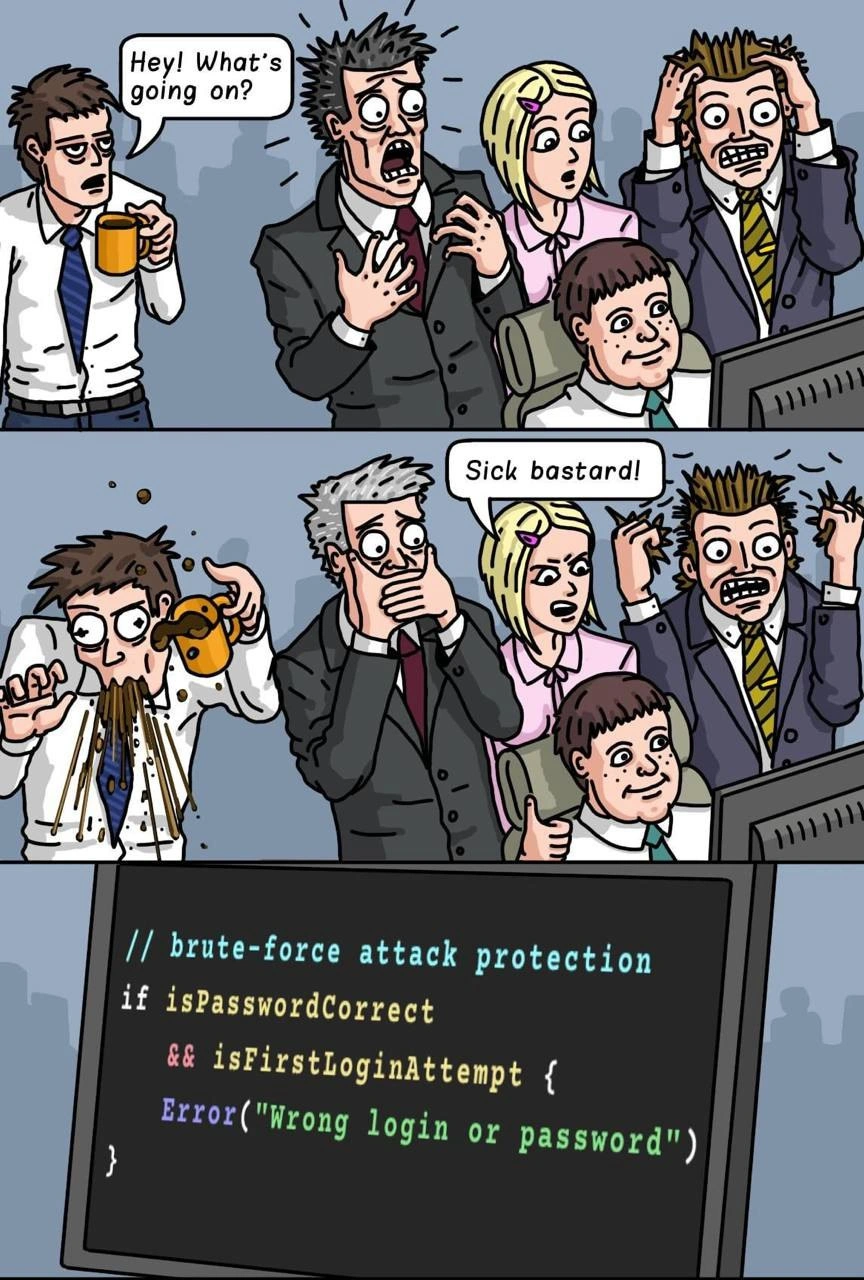
At first glance, this code snippet looks like a cruel joke to any seasoned developer. A comment // brute-force attack protection precedes a conditional that deliberately rejects a correct password on the first try. Yes, you read that right. The logic is essentially:
// brute-force attack protection
if (isPasswordCorrect && isFirstLoginAttempt) {
Error("Wrong login or password");
}
In other words, if the credentials are actually correct and it’s the user’s first login attempt, the system pretends the login failed. This twisted anti-feature is supposed to thwart brute force attacks, but all it really thwarts is the user’s trust. It’s a prime example of security and code quality gone off the rails – an EngineeringAbsurdity that triggers both SecurityFlaws and usability nightmares in one go. Experienced devs have seen some wild hacks, but intentionally throwing an error on a valid login? That’s a new level of SecurityVsUsability hell.
From a senior perspective, it’s painfully clear why everyone in the comic recoils in horror (spilled coffee and all). This isn’t a clever Easter egg or a one-off bug – it’s an explicit design decision that turns a SubtleBug into a feature. The team’s reaction (“Sick bastard!”) is exactly how a code review panel would respond. Why is this so appalling? Because it subverts the fundamental contract of an authentication system: correct credentials should log you in, not be silently sabotaged. By forcing a false failure on first attempt, the developer is effectively gaslighting users for the sake of “security”. It’s security through obscurity taken to absurd extremes – or as we can dub it, security through absurdity.
Let’s unpack the twisted rationale: In theory, a brute-force bot that somehow guesses the right password on the very first try would be thrown off by this false failure. The attacker might assume the password guess was wrong and move on, thus never realizing they actually had the correct password. But in practice, the chance of a blind attacker nailing the exact password on attempt number one is astronomically low – it’s like winning the lottery on your first ticket. So this anti_bruteforce_hack “protects” against a virtually nonexistent scenario, while every single real user now experiences a login_error_obfuscation. It’s the ultimate bad trade-off: sacrificing honest users on the altar of a hypothetical attacker. Seasoned engineers know that good security design balances protection with usability. Here, the balance is shattered – users get punished every single time they remember their password on the first try.
The horror doesn’t end with frustrated users. Imagine the maintenance headache: any integration test or QA engineer would go crazy trying to figure out why logins always fail the first time. Customer support would be flooded with “I’m sure I typed it right, why did it say wrong password?” calls. A fix requires admitting that this was implemented intentionally – an embarrassing conversation for any security team. This kind of code reeks of last-minute, poorly-thought-out requirements (“we need brute-force protection ASAP!”) implemented by someone who didn’t stop to consider the consequences. It’s a perfect storm of CodeQuality issues: misleading comments, logic that violates user expectations, and likely no documentation of this anti-feature. The meme is hilarious because it’s an exaggeration of real-world security oversights and overzealous measures. It tickles that darkly comic spot in a senior dev’s soul: “We’re supposed to protect users, not attack them with our security measures.” In summary, this snippet embodies a veteran developer’s worst nightmare – a SecurityFlaws fix that is itself a flaw, causing more damage than the threat it was meant to guard against.
Description
A three-panel comic strip depicting an office scene. In the first panel, a group of colleagues looks on in horror at a developer's computer screen, with one asking, 'Hey! What's going on?'. The developer at the computer has a smug look. In the second panel, the horror intensifies: one man spits out his coffee, others are in shock, and a woman exclaims, 'Sick bastard!'. The developer gives a calm thumbs-up. The third panel reveals the cause of their reaction: a close-up of a monitor displaying a code snippet. The code, under a comment '// brute-force attack protection', reads: 'if isPasswordCorrect && isFirstLoginAttempt { Error("Wrong login or password") }'. The humor comes from the deliberately perverse and chaotic logic. Instead of protecting against attacks, this code ensures that a user with the correct password will be locked out specifically on their first attempt, causing maximum confusion and frustration, while likely failing to prevent any actual security threats
Comments
32Comment deleted
This isn't a security feature; it's a CAPTCHA for emotions. It just checks if the user is human enough to feel infuriated
Why bother rate-limiting when you can ship Schrödinger’s password - simultaneously valid and invalid until attempt two?
This is the authentication equivalent of a bouncer who only lets you into the club if you give the wrong password - but just on your first try. After 20 years in this industry, I've seen this exact pattern deployed to production at least three times, usually right before a major product launch when the CEO decides to 'test the login flow personally'
When your brute-force protection is so sophisticated it tells attackers 'You got the password right, but I'm going to pretend you didn't because it's your first try.' It's like having a bouncer who says 'Nice try with that correct password, buddy, but company policy says I have to reject you once before letting you in.' This is the authentication equivalent of implementing rate limiting that only triggers after you've already given away whether the credentials are valid - a masterclass in defeating your own security measures through helpful error messages
If your threat model is 'users who know their password,' this control is airtight
Marketed as “brute-force protection,” it’s really a human-only rate limit - bots just wrap curl in while(true) and your helpdesk explodes
Rate-limits successes to gaslight legit users while brute-forcers feast on silent failures - peak architectural irony
THAT'S DEPRAVITY Comment deleted
but also very smart Comment deleted
I sometimes wonder if reddit has that Comment deleted
actually that makes sense.. though the checks should be swapped Comment deleted
Exactly, one less check Comment deleted
USB-A authors have managed to do the same in hardware! Comment deleted
https://t.me/mmmeme_channel/6677 Comment deleted
thats fucking gold Comment deleted
Skill issue /s Comment deleted
You actually CAN insert a USB jack into an Ethernet port. Anyway, there are no wrong ports, there are weak people. Comment deleted
and thats how I broke PS/2 kb port (by flipping the plug accidentally) Comment deleted
Художественный фильм "Спиздили" Comment deleted
English Comment deleted
exactly our uni website Comment deleted
Whats limit? Comment deleted
2. but the bot only counts the warns, so in the end, the moderator decides if the person gets another chance Comment deleted
Ah okay Comment deleted
the code is poorly written btw Comment deleted
did you expect the prod code to be posted online? Comment deleted
no, I expect meme code to be written pretty Comment deleted
How to explain this in music terms Comment deleted
done Comment deleted
Well... Why it won't work? Comment deleted
It's actually brilliant Comment deleted
😂😂 Comment deleted