Skip to content
DevMeme
5380 of 7435
Google's Hiring Gauntlet vs. The Daily Login Screen
Interviews Post #5899, on Feb 23, 2024 in TG

Google's Hiring Gauntlet vs. The Daily Login Screen

Why is this Interviews meme funny?

Level 1: All That for Sign-In

Imagine you had to pass a bunch of really hard tests to join a super cool club – like solving tricky puzzles, answering tough questions, and proving you’re the best. After all that hard work, you finally get accepted into the club. You’re probably expecting something exciting on your first day, right? But instead, the first thing they ask you to do is something super simple, like write your name on a piece of paper or sign a form. It’s such a big build-up for such an ordinary task that you can’t help but laugh a little. That’s what’s going on in this meme: getting a job at Google is the big, hard challenge (many interviews and tests), and then actually starting the job begins with something as basic as logging in to your computer. It’s funny because it feels like “Wait, I did all that work just for this?!” – a huge effort followed by a tiny, everyday task.

Level 2: Algorithms vs Authentication

This meme lays out, step by step, how complicated it is to get a job at Google, then contrasts it with how simple and banal the actual first task at work can be. Let’s break down the parts, especially for those newer to the tech world:

Getting hired at Google involves a lot of stages, each designed to vet candidates thoroughly:

  • Screening process: This is the initial filter. It could be a recruiter scanning your résumé or an automated system looking for keywords. The goal is to check if you meet the basic qualifications (like the right degree, skills, or experience) before proceeding. Many people get filtered out here if they don’t fit the criteria on paper.
  • Phone interview: If you pass screening, you’ll typically have a phone call (or video call) with a Google interviewer. This is a short interview to evaluate your basic knowledge and communication. For an engineering role, they might ask you a simple coding question or two, or quiz you on fundamental concepts. It’s a preliminary check to decide if you should come in for more interviews.
  • Online assessment: Google often uses an online coding test or quiz. They’ll send you a timed challenge on a platform like HackerRank or a Google form. You might have to solve coding problems or answer multiple-choice questions about algorithms. This step tests your programming ability under time constraints.
  • On-site interviews: If you do well in the earlier rounds, you’ll be invited to on-site interviews (nowadays sometimes done via video calls, but traditionally at a Google office). This isn’t just one interview – it’s usually a series of interviews, often around 5 interviews in one day. Each interview is about 45 minutes to an hour, one-on-one with a different interviewer. These can be tough: you’ll get data structure and algorithm problems to solve on a whiteboard or laptop, maybe a system design question (like how to design a scalable service), and possibly behavioral questions to see how you work in a team. It’s a long day and can be pretty intense, since Google wants to really understand your problem-solving skills and knowledge depth.
  • Extensive technical assessments: After all those interviews, Google doesn’t immediately decide. First, the interviewers write up feedback on how you did. They’ll note how you approached problems, whether your solutions were optimal, how well you communicated, etc. These results undergo an extensive review. In other words, Google carefully assesses all the technical feedback. They’re checking: did you show strong coding skills? Did you use good algorithms? Even things like code style and clarity can matter. This step is basically the company making sure the quality of your answers meets their standards.
  • Hiring committee review: This is a unique part of Google’s process. A hiring committee is a group of senior Googlers (who were not your interviewers) that reviews your entire candidate packet. This includes your résumé, interview feedback, test scores – everything. They discuss and decide if you’re a hire or no-hire. The idea is to ensure a fair, unbiased decision (so it’s not just the opinion of the few people who interviewed you). It’s another safeguard that the candidate truly meets Google’s hiring bar.
  • Background check: Finally, if the hiring committee gives a thumbs up and Google wants to make an offer, they will perform a background check. This is usually handled by an HR or third-party agency. It verifies that your employment history and education are accurate and that you don’t have any serious red flags (for example, no undisclosed criminal record). Pretty much any big company does this step before the hire is official.

All of that above is the hiring process. It’s a long, multi-step journey, often spanning several weeks or even months from start to finish. HiringAndInterviews at top tech firms are known to be challenging, and Google’s process in particular is almost legendary in the tech industry. If you’ve ever heard friends or online posts talk about cramming LeetCode or studying algorithms for job interviews, Google is one of the reasons why. They helped popularize that kind of interview.

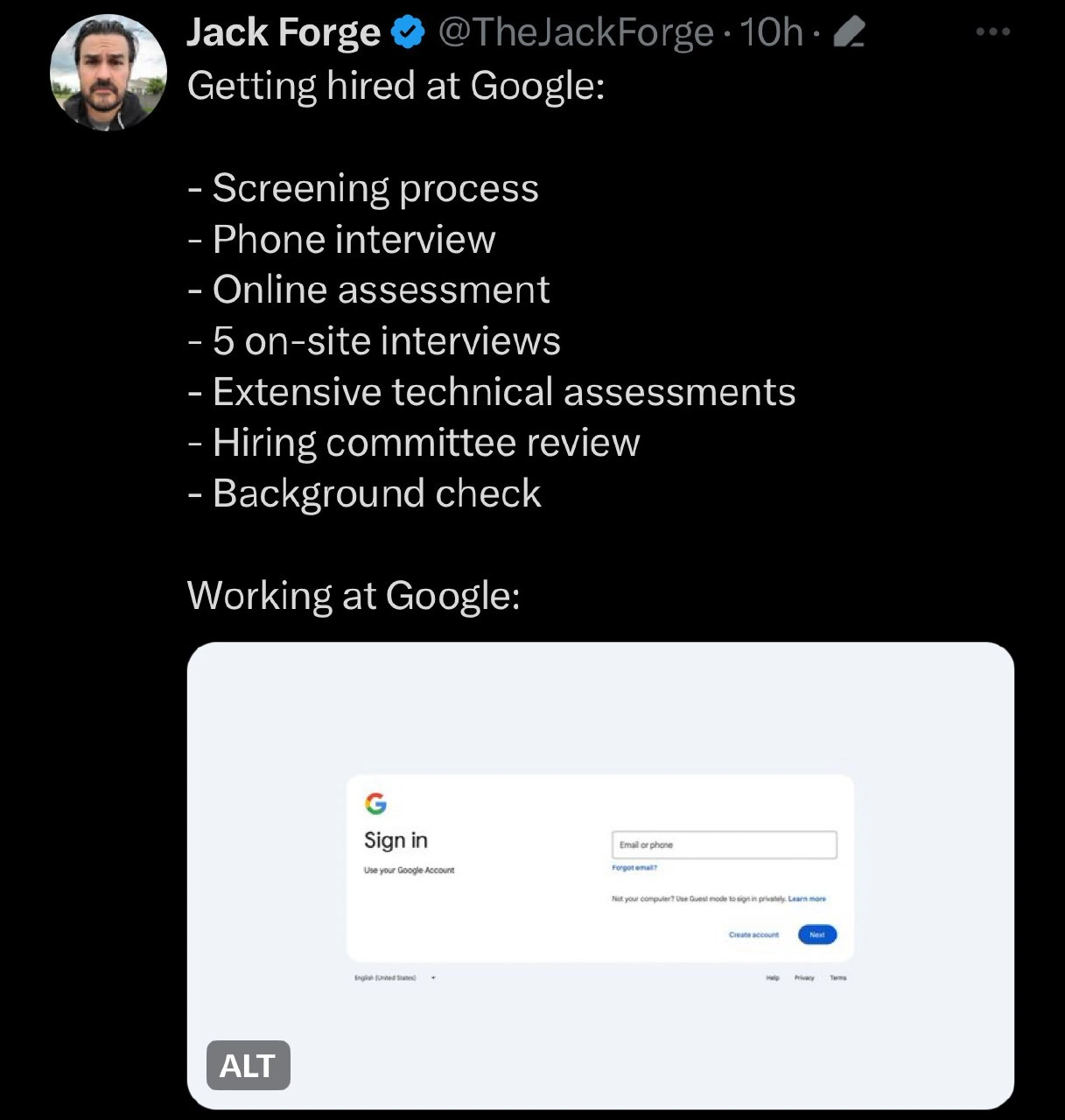
Now, the meme then juxtaposes this with Working at Google: and only shows an image of the Google Sign-In page. That is the standard login screen where you enter your Google account email and password, with a big “Next” button. In other words, it’s implying that after you go through all those tough interviews, the first thing you do as an employee is something as simple as logging into your account. No special super-coding task on day one – just sign in like any normal user.

Why is that significant? Well, for anyone who’s started a new tech job (or even an internship), this might sound familiar. The first day (or even first week) on the job usually isn’t about diving into complex projects immediately. It’s about onboarding, which includes things like: setting up your laptop, installing the necessary software, getting access to the company’s internal tools, and yes, creating or logging into your new company email and accounts. It’s routine stuff. At Google or any big company, there are tons of internal systems (code repositories, bug trackers, chat, etc.), and you need to sign in to all of those and often configure permissions. So the very first “task” is often literally to log into the company portal or email system with your new credentials.

For a junior developer or someone straight out of school, this contrast can be surprising. You go from the high-pressure environment of interviews – solving tricky coding problems on a whiteboard under time pressure – to a very calm, basic task: “Let’s get you logged in.” The meme is funny because it exaggerates that contrast. It’s saying: look at all the extraordinary effort to hire someone, and then look at how ordinary the start of the actual job is. InterviewProcess vs. real CorporateCulture daily life, in one picture.

Think of it this way: the punchline is essentially “After all that, my first job is just to sign in?!” For many people, that rings true. Your first day you might mostly fill out HR forms, read company policies, set up two-factor authentication on your account, and maybe say hi to your team – very normal, non-glamorous stuff. It doesn’t mean you won’t do cool engineering work soon; it’s just that the immediate reality is kind of anti-climactic compared to the journey to get hired.

So, in summary, this meme highlights the tech industry humor in the difference between expectation and reality. Getting into Google = a long, intensive series of interviews and tests. Working at Google (at least at the start) = dealing with common everyday tasks. It’s a humorous commentary on big tech culture, and anyone who’s been through a similar hiring ordeal will likely chuckle at how true-to-life it feels.

Level 3: Gauntlet vs Login Screen

So you survived the eight-round Google interview gauntlet – a marathon of coding puzzles, system design whiteboard sessions, and grilling by multiple engineers – and you finally land the job. You'd think the hard part is over, right? The meme humorously reveals what comes next: your first task is just signing into your account. This contrast is immediately funny to any seasoned developer. After proving you can juggle complex algorithms and ace an extensive hiring process, your grand reward is an utterly mundane chore that any regular user does every day. It’s a classic Big Tech reality check: Google puts candidates through a legendary hiring gauntlet (think: endless InterviewProcess loops) only for the new hire’s initial experience to be bog-standard corporate onboarding.

Why is this so humorous? It highlights the disparity between the epic journey of getting hired at a place like Google and the ordinary day-to-day work once you’re in. Google’s hiring process is famously intense. The tweet lists out each stage dramatically:

  • A screening to cull the resume pile.
  • A phone interview to do a quick skill check.
  • An online assessment to test your coding under pressure.
  • Then 5 on-site interviews (yes, five!) back-to-back, drilling down into data structures, algorithms, system design – the works.
  • Follow that with extensive technical assessments, meaning your interview answers and code are scrutinized for quality.
  • Then a hiring committee review, which is a panel of Googlers who double-check that you meet Google’s high bar.
  • And finally a background check to verify you are who you say you are.

It’s a multi-stage hiring gauntlet that filters for top talent with almost absurd thoroughness. By the end, you’ve basically defeated the “final boss” of tech interviews. And what does “Working at Google” start with? A bright white Sign-In page asking for your email and password. The meme shows that exact familiar Google login screen as the punchline. It’s the same generic page everyone uses to sign into Gmail – nothing special for all your trouble. This stark enterprise_bureaucracy_irony makes veteran engineers smirk: after all those whiteboard battles and LeetCode-style challenges, your first hurdle on the job is entering credentials into a form.

In other words, the meme is poking fun at how CorporateCulture can take something outstanding (hiring only the best after a grueling process) and immediately level it with bureaucracy (okay, now fill out these forms and log in). It’s a scenario many in tech have experienced. You might’ve spent weeks mastering advanced algorithms (reversing binary trees! dynamic programming!) to impress the hiring committee, but on Day 1 you’re grappling with trivial tasks like setting up your dev environment or waiting for IT to give you access. It’s not that Google engineers don’t do challenging work – they certainly do – but the joke is that the very first thing you do feels comically underwhelming given all the hoops you jumped through. As a result, the meme resonates with anyone who’s felt the anticlimax of InterviewHumor in the tech industry.

Let’s put it in code for extra irony. Here’s a pseudo-code representation of the situation:

def survived_google_gauntlet(candidate):
    # multi-stage interview process: screening -> phone -> online -> 5 on-site -> committee -> background
    return (candidate.passes_screening() 
            and candidate.passes_phone_interview() 
            and candidate.passes_online_assessment() 
            and all(candidate.aces_on_site(i) for i in range(5))  # 5 on-site interviews
            and hiring_committee.approves(candidate) 
            and background_check.clears(candidate))

if survived_google_gauntlet(candidate):
    new_employee = Google.hire(candidate)
    # Day 1: The "exciting" first mission at work
    new_employee.sign_in_to_corporate_portal()  # ...use your Google Account to log in

The code above condenses that google_hiring_gauntlet into one big condition. You see the candidate must clear every step (passes_screening, passes_phone_interview, etc., including all 5 on-site interviews!). Only then do they become a new_employee. And what happens immediately after hiring? new_employee.sign_in_to_corporate_portal(). In plain terms: “Congrats, you’re hired! Now please log in so you can start.” The sheer triviality of that next line after the heavy logic is what makes us laugh.

For senior engineers, this hits home. It’s a nod to the overengineered nature of hiring in big tech versus the often routine start to the actual job. The meme’s author, Jack Forge, effectively says: “Getting hired at Google is a monumental quest – but working at Google starts with something as dull as logging in.” It’s a gentle jab at how even at a world-class tech giant, an engineer’s journey can begin just like any office worker’s, with a login screen and a sigh. BigTechCompanies often have these ironic disparities, and that shared understanding is what fuels the humor. Everyone who’s been through a long interview HiringProcess only to find their first week filled with account setup and mandatory training will chuckle (or facepalm) at this meme.

Description

A screenshot of a tweet from user Jack Forge (@TheJackForge). The tweet is structured as a two-part joke. The first part, under the heading 'Getting hired at Google:', lists a notoriously long and complex hiring process: 'Screening process', 'Phone interview', 'Online assessment', '5 on-site interviews', 'Extensive technical assessments', 'Hiring committee review', and 'Background check'. The second part, under the heading 'Working at Google:', displays a single, simple image: the standard Google account 'Sign in' page. The humor arises from the stark contrast between the extreme difficulty of the hiring process and the mundane, universal task of logging in, implying that the day-to-day reality of the prestigious job can be anticlimactic and bureaucratic

Comments

42
Anonymous ★ Top Pick Google's interview process is a globally distributed, multi-stage pipeline designed to filter for the 1% of engineers who can solve NP-hard problems, only to have them spend their days debugging access permissions for a login page
  1. Anonymous ★ Top Pick

    Google's interview process is a globally distributed, multi-stage pipeline designed to filter for the 1% of engineers who can solve NP-hard problems, only to have them spend their days debugging access permissions for a login page

  2. Anonymous

    Nothing like seven rounds of graph-theory whiteboarding to prepare you for your first production bug: the SSO redirect loop on the login page you just opened

  3. Anonymous

    After surviving Google's seven-layer hiring burrito of algorithms, system design, and behavioral interviews, you spend most of your time fighting with the same SSO login that times out every 8 hours - just like the rest of us mere mortals who only had three rounds at our no-name startups

  4. Anonymous

    After surviving Google's seven-circle hiring gauntlet - where you've proven you can invert binary trees blindfolded, design systems at planetary scale, and convince a hiring committee you're the chosen one - your first day boils down to the same OAuth flow your grandmother uses to check Gmail. It's the ultimate distributed systems problem: how do you reconcile the O(n⁷) complexity of getting hired with the O(1) simplicity of actually logging in? Turns out the real technical challenge was the friends we made during the five on-site interviews

  5. Anonymous

    After HC and five onsites, you learn throughput is bounded by the SSO token TTL - every few minutes the IdP throws a 401 and your flow state gets garbage-collected

  6. Anonymous

    Five on-sites to invert a binary tree; Q1 disappears debugging OAuth redirect loops after a committee toggles SSO - identity is the hardest distributed system

  7. Anonymous

    Survived the O(n^5) interview loop just to hit Google's ultimate rate limiter: your own forgotten 2FA code

  8. @beton_kruglosu_totchno 2y

    explanation brigade pls

    1. @douglas_adams 2y

      не форма, а детская поделка... Сапожник без сапог

      1. @sylfn 2y

        please use english in this chat

        1. @douglas_adams 2y

          Not the form but a child's craft project... A cobbler without shoes.

  9. Felix 2y

    really curious now what could have been said in this context that would merit a ban

    1. @sylfn 2y

      A usual NFT spam tr: you'll regret not taking it fast

  10. @JAUD1LA 2y

    Nevermind, they use contractors for that shit

  11. @the_sage 2y

    There are a lot of examples of new Googlers who came all the way through this horrible interview track and quit soon after because the actual work was too simple and boring

    1. @purplesyringa 2y

      I'm not employed yet but I'm sooooo afraid of that. I've been struggling with impostor syndrome for way too long, which made me research a crazy amount of stuff, and now here I am with all this experience and no paid work to show for it. I'm oh so looking forward toward working on junior tasks...

      1. @RiedleroD 2y

        :hug: you can do it

        1. @purplesyringa 2y

          Yeah, I can! It's just... from a purely technical point of view, it's going to be easy, and that's going to drive me mad, because I can't focus unless the task is nigh-impossible

          1. @the_sage 2y

            Yes, it's going to be. No one would give you an almost impossible task as a junior in enterprise. Working in general enterprise is tackling with quite simple tasks on everyday basis waiting for a chance to start a new project with the all fancy technologies and ideas you have. So, your way are startups or AI companies. Don't look at the FAANG or russian big tech, look for startup, almost impossible tasks are waiting and the Interview track is much friendlier.

      2. @AmindaEU 2y

        I feel you

  12. @ZgGPuo8dZef58K6hxxGVj3Z2 2y

    Fr what’s wrong with that? If you have the screen space for it why not

  13. @ZgGPuo8dZef58K6hxxGVj3Z2 2y

    Guys you wont believe this this YouTube gets a UI refresh

  14. @ZgGPuo8dZef58K6hxxGVj3Z2 2y

    This is real btw google is rolling this gui out to some users

  15. @ZgGPuo8dZef58K6hxxGVj3Z2 2y

    I totally agree

  16. @ZgGPuo8dZef58K6hxxGVj3Z2 2y

    At this point youtube will just give us youtube.com/tv even on PC

  17. @callofvoid0 2y

    what's special about it?

    1. @ZgGPuo8dZef58K6hxxGVj3Z2 2y

      This will be youtube desktop

      1. @ZgGPuo8dZef58K6hxxGVj3Z2 2y

        In browser

      2. @callofvoid0 2y

        so?

        1. @ZgGPuo8dZef58K6hxxGVj3Z2 2y

          Dont you see?

          1. @callofvoid0 2y

            no

            1. @ZgGPuo8dZef58K6hxxGVj3Z2 2y

              The layout is discusting

  18. @callofvoid0 2y

    video,suggested videos,comments and video name all at the same place

  19. @chupasaurus 2y

    I had it for half an hour, it is very buggy

    1. @ZgGPuo8dZef58K6hxxGVj3Z2 2y

      I hope it will get canceled

  20. @AmindaEU 2y

    https://github.com/Mikaela

  21. @purplesyringa 2y

    github.com/purplesyringa I think my website explains who I am better though (purplesyringa.moe)

    1. @purplesyringa 2y

      idk i don't think i've even released anything complex that would obviously seem complex from a stranger's view

      1. @purplesyringa 2y

        I'm working on optimized I/O and serialization libraries this month, but one of them isn't ready yet, and the other one is closed source

  22. @purplesyringa 2y

    https://en.wikipedia.org/wiki/Agda_(programming_language)

    1. @afdanilkin 2y

      > control flow guarantees of Agda What are these guarantees? Is not Agda purely functional, how is control flow possible?

      1. @purplesyringa 2y

        I think I wasn't precise enough, sorry. I love functional languages such as Agda because they enable proof-based programming; this is typically much harder to get right for imperative languages. I'd argue functional languages do have flow control, because lazy evaluation and recursion enable loops and conditional statements, so they can be thought of as means of flow control.

Use J and K for navigation