Skip to content
DevMeme
6180 of 7435
The Developer Brain on Regex: Over-engineering Social Interactions
Languages Post #6778, on May 22, 2025 in TG

The Developer Brain on Regex: Over-engineering Social Interactions

Why is this Languages meme funny?

Level 1: When Code Talk Replaces Small Talk

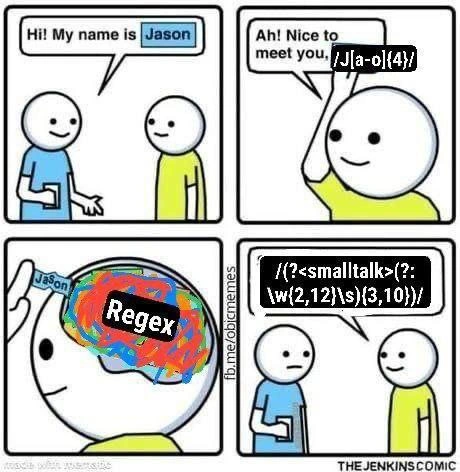
Imagine you’re just saying hello to someone, but instead of saying hello back, they reply with a bunch of secret code that makes no sense to you. This comic is funny because the person in yellow is treating a normal conversation like a complicated puzzle or math problem. The guy in blue says, “Hi! My name is Jason.” That’s a very simple, friendly thing to say. But the yellow-shirt guy’s brain is so stuck in “computer mode” that he hears “Jason” and immediately thinks of a pattern or formula instead of the actual name. It’s as if you told your friend your name, and they responded by trying to spell it in a super weird way or turn it into a riddle. In the last part, the yellow-shirt friend even tries to capture the whole conversation in a fancy code pattern (like he’s catching words in a net). The blue-shirt friend is left speechless, because… how do you even reply to that?

So basically, it’s showing someone who’s so used to thinking like a computer that they forget how to act normally for a second. It’s like asking, “How are you?” and your friend starts solving it like a math equation – totally missing the point of just saying “I’m fine.” We find it funny and a bit cute because it’s a silly mix-up: human talk turned into computer talk! The comic exaggerates this to make us laugh, reminding us that no matter how much we work with computers, we should remember to be human when we’re just chatting with friends.

Level 2: Regex in Real Life Situations

Let’s unpack the joke in simpler technical terms. We have two stick-figure characters meeting each other. One says: “Hi! My name is Jason.” The other one, instead of responding normally, replies with what looks like gibberish at first glance: /J[a-o]{4}/. What is that? It’s a regular expression (regex for short) pattern. Regex is like a mini programming language used specifically for finding patterns in text. For example, you can write a regex to check if a string looks like an email address, or to find all words that start with “cat”. In code, regex patterns are often written between slashes /like this/.

So, J[a-o]{4} is a pattern that our yellow-shirted listener’s brain came up with upon hearing the name “Jason.” Let’s interpret it step by step:

  • J – the pattern must start with the capital letter "J".
  • [a-o] – then it expects a letter in the range a through o. (In regex, square brackets define a set or range of allowed characters. So [a-o] means any single lowercase letter from a up to o in the alphabet).
  • {4} – the curly braces mean “repeat the previous item 4 times.” Here it applies to [a-o]. So {4} after [a-o] means we need four letters, each of which is between 'a' and 'o'.

Put together, J[a-o]{4} would match a 5-letter word that starts with "J" and has four more letters between 'a' and 'o'. The pattern is clearly intended to match the name “Jason” (J-a-s-o-n). Now, a funny detail: the letter "s" in "Jason" actually falls outside the range a–o (since 's' comes after 'o' in the alphabet). Oops! So strictly speaking, this regex wouldn’t match “Jason” correctly unless we tweaked it (perhaps [a-z] would have been safer). But the gist is that the developer’s brain heard "Jason" and immediately thought of a rule to match any similar name. It’s like he didn’t care about the actual name, only the pattern it fits. That’s already a bit odd and humorous – treating a person’s name like data to be parsed rather than just remembering it. It’s a nod to how developers sometimes abstract things; instead of hearing the unique name, this guy’s brain reduces it to a generic formula.

Now look at the next part. The listener’s brain (in panel 3) is drawn as a chaotic rainbow scribble labeled “Regex,” with the actual name "Jason" just floating tiny in a corner. This illustrates regex_brain_overload: the brain is so busy analyzing patterns (the colorful mess representing complicated regex logic) that the actual meaningful content ("Jason" as a person, a name) is sidelined. It’s telling us the listener is overthinking the introduction – turning a simple “Hello, I’m Jason” into a complicated parsing problem. Developers find this funny because it’s a dramatization of something we experience: sometimes we catch ourselves over-engineering or using unnecessarily complex thinking for a simple task.

In the final panel, the socially awkward response goes even further. The listener says: /(?<smalltalk>(?:\w{2,12}\s){3,10})/. This is a much more complex regex pattern. Let’s break this one down too in simpler terms:

  • First, notice it’s wrapped in /.../ just like the other regex, meaning it’s a pattern delimiter.
  • ?<smalltalk> – This part, within parentheses, is naming a group "smalltalk". In many regex flavors (including PCRE and modern JavaScript/Python regex), (?<name> ... ) lets you label a part of the match with a name. So the listener’s regex is creating a named capture group called "smalltalk". Essentially, they’re programmatically labeling whatever casual conversation comes next as small talk.
  • (?: ... ) – Inside, we see ?:. This denotes a non-capturing group, which is a group that we don’t need to capture as a separate chunk; it’s often used just to apply repetition or apply an or-condition without creating a numbered group. Think of it as grouping things together for the regex engine’s purposes, but telling it “I don’t need to save this part by itself.”
  • \w{2,12} – The \w means any “word character” (letters, digits, or underscore in regex shorthand). {2,12} means we expect between 2 and 12 of those in a row. So this will match a word that’s 2 to 12 characters long. That sounds like a reasonable length for a word in a sentence (e.g., "nice" is 4 letters, "everyone" is 8 letters, etc.).
  • \s – This is the whitespace character (space, tab, or newline). So \w{2,12}\s matches a word of 2-12 characters followed by a space. Essentially one typical word and the space after it.
  • {3,10} – Finally, this curly braces outside the non-capturing group means the pattern of “word + space” should repeat 3 to 10 times. In other words, it’s expecting a phrase of 3 to 10 words.

When you put it all together, (?<smalltalk>(?:\w{2,12}\s){3,10}) is a pattern that would match something like a sentence of between 3 and 10 words (each word reasonably sized), and label that whole thing as "smalltalk". For example, it could match "Nice to meet you" (which is 4 words) or "The weather is really lovely today" (which is 6 words). The developer’s brain is, absurdly, treating the upcoming polite conversation as input that needs to match this pattern! Instead of just listening and responding naturally, he’s anticipating a certain format of reply – like he’s writing a program to capture whatever generic small talk the other person might say. This is hilariously robotic. It highlights a communication gap: the developer is stuck in “code mode,” expecting human interaction to be as structured as code. Meanwhile, the normal person (blue shirt) is just standing there, likely thinking "...What did he just say?". The blue shirt doesn’t respond in the last panel, suggesting the conversation froze because the regex-speaking friend basically output nonsense from a human perspective.

In simpler developer experience terms, this meme is relatable because many new coders and veterans alike have moments where thinking in code interferes with regular life. Maybe you’ve tried to formulate a grocery list like an array in your head, or caught yourself saying something too literally because you were in a logical mindset. RegularExpressions are a specific tool we use in programming that can be very dense and confusing to the uninitiated. So having a character speak in regex is a perfect example of a domain_specific_language_in_head causing a real-world misunderstanding. It’s developer humor because we find it both funny and a bit endearing that someone could be so into their craft that they momentarily treat a person’s name and small talk like lines of code. We know not to do this in real life – it would be super weird – but the exaggeration makes us laugh and perhaps reminds us to toggle off our “code parser” when engaging with actual humans.

Level 3: Pattern Matching People

For seasoned developers, the scenario is a comically exaggerated case of “when all you have is a regex, everything looks like a string to parse.” The meme combines elements of DeveloperHumor and a communication gap we sometimes feel after deep dives into code. The blue-shirt character says, “Hi! My name is Jason,” a straightforward introduction. But the listener, depicted in the yellow shirt, responds with Ah! Nice to meet you, **/J[a-o]{4}/, instead of “Nice to meet you, Jason.” This is funny (and a bit cringey) because he’s literally addressing the person as a regex pattern. It’s as if his brain auto-translated “Jason” into a pattern matching rule: “starts with J and has 4 more letters from a to o.” It’s a highly literal and technical way to perceive a name. Seasoned devs recognize this as poking fun at how we sometimes abstract real things into code or patterns out of habit. Maybe you’ve caught yourself mentally tokenizing a word or applying syntax rules from programming in a totally non-code context – it’s a nerdy reflex!

The core of the humor is the misapplication of a developer’s mindset to a basic social interaction. We have a shared understanding that regex – especially PCRE – is a powerful but often overly elaborate tool for parsing text. Seeing it pop up in chit-chat is hilariously out-of-place. It lampoons those moments when a developer might be so absorbed in their work that they inadvertently apply programming logic to human conversation (cue the relatable groans). It’s the ultimate regex_brain_overload: the poor dev can’t turn off the pattern-matching mechanism even during a handshake greeting. In the third panel, inside the listener’s brain, “Regex” has completely taken over, reducing the actual name “Jason” to a tiny blip. Every experienced coder knows that feeling when you’ve worked with a complex pattern or bug all day – you start seeing it everywhere. The scribble shows that instead of remembering the name or engaging in small talk, the brain is running wild constructing and analyzing patterns. It’s a playful visualization of being in the zone of coding to the detriment of normal social processing.

By the fourth panel, the dev’s response escalates absurdly: /(?<smalltalk>(?:\w{2,12}\s){3,10})/. This is an even more convoluted regex, attempting to capture an entire chunk of small talk as a named group. Let’s break down that pattern in plain terms to see just how overboard it is:

  • (?<smalltalk> ... ) is a named capture group labeling whatever matches as “smalltalk.” The dev’s brain is literally labeling the polite chit-chat as data to be captured.
  • Inside that, (?:\w{2,12}\s){3,10} is a non-capturing group (?: ... ) repeated 3 to 10 times. It’s saying “match between 3 and 10 occurrences of a word followed by a space.” In regex tokens, \w{2,12} matches a word of 2 to 12 characters (letters or digits), and \s matches a whitespace. So the entire thing is aiming to match a typical sentence of 3–10 words!

In other words, instead of genuinely engaging in pleasantries, the regex-obsessed listener’s brain is chunking the other person’s speech into a structured pattern. RelatableDeveloperExperience? Absolutely – many of us have experienced a smaller-scale version of this when we mentally format things as code or think in pseudo-logic during everyday life. The meme exaggerates it to the point where the dev actually speaks in regex out loud, highlighting a communication gap: one person is chatting normally, and the other replies in what sounds like gibberish unless you’re fluent in regex. It’s a hyperbole of the stereotype that programmers are socially awkward or too literal. The blue-shirt character’s silence in the final panel says it all – the conversation has derailed because one party essentially spoke a different language (a domain-specific language in head made it out of the head and into the conversation!).

For a senior developer, there’s an extra layer of knowing chuckles: we recognize the specific regex flavor and complexity. PCRE (Perl-style regex) is notorious for being both incredibly handy and insanely nuanced. We’ve spent hours debugging a single regex pattern or optimizing it to avoid performance pitfalls. Seeing (?<smalltalk>(?:\w{2,12}\s){3,10}) as a joking representation of “casual conversation” tickles that part of our brain that remembers writing something similarly gnarly – albeit for parsing logs or data, not a hello at a party! It satirizes how a simple task (like greeting someone or doing basic input parsing) can become overly complicated when approached with the wrong mindset or tool. The meme’s author even watermarked it with “The Jenkins Comic,” adding a bit of meta tongue-in-cheek: Jenkins (a CI tool) is unrelated to regex, but the name nods to developer culture. All told, this panel resonates with devs by combining coding culture with everyday human moments – we laugh because we see a piece of ourselves in that regex-fueled overanalysis, and we’re reminded not to let our engineering brain completely steamroll our human interactions.

Level 4: Catastrophic Backtracking at Hello

At the deepest technical level, this meme highlights a clash between formal language processing and everyday human communication. The second character’s brain is essentially running a PCRE engine (Perl Compatible Regular Expressions) on a simple greeting. Regular expressions, in theoretical computer science, represent regular languages – those patterns of text that can be recognized by finite automata. The humor is that a finite state machine (or more accurately here, a backtracking NFA as used by PCRE) is being unnecessarily invoked to parse the sound of someone’s name. In formal language terms, natural human conversation isn’t even a regular language; it’s far more complex (in the Chomsky hierarchy, everyday language sits above the Type-3 category that regex covers). So the developer’s brain is over-engineering the situation by treating a friendly “Hi, my name is Jason” as if it were a string to match against a formal pattern.

The PCRE engine in their head isn’t just a simple DFA (Deterministic Finite Automaton) marching through characters – it’s a full-on backtracking regex engine. PCRE is known for its power and complexity: it supports advanced features like lookaround assertions, non-capturing groups, and named capture groups – some of which appear in the comic’s speech bubbles. These features actually push PCRE beyond strict regular language territory (for example, PCRE’s support for backreferences means it can recognize some context-free patterns). We see a named capture group (?<smalltalk>...) in the fourth panel, something not possible in old primitive regex engines. The brain is employing a domain-specific language (the regex syntax) to interpret a domain that’s inherently unstructured and nuanced (human small talk). It’s a bit like using a compiler’s lexical analyzer on poetry – overkill and likely to miss the point entirely.

There’s an easter egg for the regex-savvy in the first reply: /J[a-o]{4}/ is intended to match the name “Jason,” but if you scrutinize it, you’ll find it doesn’t actually match “Jason” perfectly since the letter “s” isn’t in the range a–o. This might be an intentional joke: even the internal regex is slightly buggy or over-constrained – a nod to how easy it is to get patterns wrong. The chaotic, multicolored scribble labeled “Regex” in the brain (Panel 3) is a visual metaphor for catastrophic backtracking or the overall cognitive overload. In regex engines, catastrophic backtracking happens when a complex pattern causes the engine to try a huge number of possibilities (often leading to extreme slowdown). Here, the brain’s "regex engine" is burning CPU cycles trying to categorize a simple name and parse casual phrases. It’s humorously suggesting that the developer’s mental regex machine is thrashing about, backtracking over letters of “Jason” and the structure of small talk, when in reality such social input doesn’t neatly fit into machine-parseable rules. Fundamentally, the meme is riffing on the idea that the brilliant precision of formal parsing can become absurd when pointed at the fuzzy, free-form data of human interaction. The laws of computing theory (like what regex can and can’t do) collide with the laws of socializing, producing a regex runtime error in the conversation.

Description

A four-panel comic strip meme from 'THE JENKINS COMIC' that satirizes a developer's mind being completely consumed by regular expressions. In the first panel, a character in a blue shirt introduces himself, saying, "Hi! My name is Jason". In the second panel, the character he's speaking to, wearing a yellow shirt, replies, "Ah! Nice to meet you, /J[a-o]{4}/", which is a regex pattern that matches the name 'Jason'. The third panel provides a look inside the yellow-shirted character's head, where a hand is inserting a 'Jason' label into a brain depicted as a chaotic scribble labeled 'Regex', illustrating that all input is processed through this filter. In the final panel, the regex-brained character continues the conversation with another complex regex, "/(?<smalltalk>(?:\w{2,12}\s){3,10})/", leaving the original character looking on with a confused and concerned expression. The meme humorously captures the tendency for developers to apply technical, pattern-matching logic to everyday situations where it's hilariously inappropriate, showing how a powerful tool like regex can warp one's perception of the world

Comments

21
Anonymous ★ Top Pick His brain isn't just running regex, it's compiling it on the fly. The conversational latency must be terrible, and I bet there's zero caching for common greetings
  1. Anonymous ★ Top Pick

    His brain isn't just running regex, it's compiling it on the fly. The conversational latency must be terrible, and I bet there's zero caching for common greetings

  2. Anonymous

    Catastrophic backtracking isn’t just for your log parser - try explaining eye contact to the engine in your head running with the /social|casual/ flags disabled

  3. Anonymous

    After 20 years in tech, you know you've made it when your brain automatically parses 'Jason' as a data format and responds with a regex that would make even Perl developers weep

  4. Anonymous

    This perfectly captures the moment when a senior engineer realizes their new teammate treats every conversation like a parsing problem. The progression from '/J[a-o]{4}/' to a named capture group with nested quantifiers is the social equivalent of refactoring 'Hello World' into a microservices architecture. We've all met this developer - the one who can't just say 'nice weather' without mentally constructing a state machine to validate meteorological small talk. The real tragedy? That second regex would actually match 'Jason' zero times, which is somehow the most accurate part of this entire interaction

  5. Anonymous

    Treating introductions as untrusted input is great - until ‘Jasón’ shows up and your social parser fails Unicode support and the postmortem blames the character class

  6. Anonymous

    When small talk requires possessive quantifiers and your brain NPEs on catastrophic backtracking

  7. Anonymous

    Only a senior would name the smalltalk group and still greet “Jason” with /J[a-o]{4}/ - a production DFA that rejects the handshake via an off-by-one character class and zero i18n

  8. @drbogar 1y

    I don't know what is wrong with me, but I actually like Regex.

  9. @drbogar 1y

    Btw... What's an easy to understand "clean" alternative to Regex? What do you use for validation and parsing?

    1. @metametamoon 1y

      For example, one might use regex dsl. It provides cleaner syntax, although more verbose. The catch is, sometimes shorter is better for readability, but definitely not always, so there are probably no ideal solution

    2. @metametamoon 1y

      Parser-combinators are sometimes good, but their clarity depends significantly on the language you implement them in

    3. Sure Not 1y

      regex101.com is good for visual learning

  10. @ner0xt 1y

    [a-o] doesnt include "s" so it would parse Jaon?) (likely not parse at all)

    1. @SamsonovAnton 1y

      Why do you make assumptions regarding symbol ranges, if you don't know the encoding being used? 🤓

      1. @ner0xt 1y

        how is that gonna change a thing?🤓

        1. @SamsonovAnton 1y

          If the encoding is not ASCII-based, for example, the letter order is asdfghjkqzwxecrvtbynumiop then the range [a-o] will include "s". (And, yes, encodings may not follow alphabet order.)

          1. Sure Not 1y

            If you want real explanation: Forced Holoperidol injection makes it hard to think.

  11. Sure Not 1y

    I wish there was PCRE3

  12. Sure Not 1y

    Or PCRE++ 🤣

  13. Sure Not 1y

    You wont believe where this pattern ended up connecting xd

  14. Sure Not 1y

    Answer to this is in http protocol. Not cringe french history, btw.

Use J and K for navigation