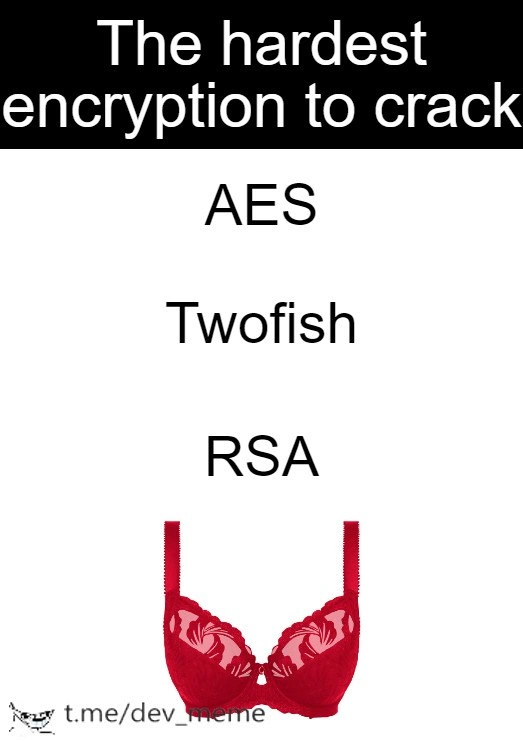
When AES, Twofish, and RSA are easier than that last clasp cipher
Why is this Cryptography meme funny?
Level 1: Harder Than It Looks
At its core, this meme is joking about how someone can be really smart and capable in one way, but still struggle with something simple in another way. Think about a friend who’s a whiz at solving really hard puzzles or beating the toughest levels in a video game, but then they get a new kind of bottle or jar and they just can’t open it because the cap is tricky. It’s funny and a bit cute to see, right? In this case, the super-hard “puzzles” are those secret computer codes (with big names like AES or RSA) that our tech-savvy person can handle with ease. But the “simple” task – taking off a bra by unhooking its clasp – turns out to be the one that trips them up. It’s the classic idea that something that seems easy can actually be hard if you’ve never done it before or you’re nervous. We laugh because it’s a surprise: you’d expect the big brain challenges to be the difficult ones and the everyday thing to be easy, but here it’s the opposite! It’s also a bit of a relief and very human – it shows that no matter how talented someone is in one area, they can still have funny little difficulties in another. In other words, even the geniuses have their moments of “How the heck do I do this?!” Everyone can relate to that feeling, so the meme makes people smile. It reminds us that we’re all learning different things in life, and occasionally the smallest task can feel like a huge mystery until you figure it out. And that gap between what looks simple and what feels hard to someone is exactly why this is so amusing and endearing.
Level 2: Ciphers vs Clasps
Let’s break down the elements of this meme in simpler terms. Encryption is basically a way to take a message or data and scramble it up so that only someone with the secret key can unscramble it and read it. It’s like writing a letter in a special code language that only your friend (who knows the code) can understand. When people talk about “cracking” encryption, they mean trying to figure out that secret code without being told – like solving a really hard puzzle or guessing the combination to a lock. Now, the meme lists three well-known encryption methods: AES, Twofish, and RSA. These are all names of algorithms (step-by-step formulas) that computers use to lock up information so it stays secret. AES (Advanced Encryption Standard) is one of the most widely used encryption algorithms in the world – for example, when your phone stores data securely or when you connect to a website and see the little padlock icon, AES might be one of the tools doing the work behind the scenes. It’s a symmetric cipher, which means it uses the same key (basically a password) to encrypt and decrypt the data. Twofish is another encryption algorithm (with a fun name) that was created by security experts as well. It’s also a symmetric cipher and was one of the big competitors when the world was choosing a new standard (AES eventually won that contest, but Twofish was a finalist, which tells you it was really good too). RSA is a different kind of cipher – it’s an asymmetric cipher, meaning it uses a pair of keys: one to lock (encrypt) and another to unlock (decrypt). RSA is commonly used for things like securely sending data over the internet (for instance, when establishing a secure connection, RSA might help exchange keys safely). All three – AES, Twofish, and RSA – are considered extremely strong cryptography algorithms. In other words, if you encrypt something with any of these, it’s virtually impossible for someone to crack it without the key, given current technology. When tech folks hear “AES” or “RSA,” they immediately think “oh, that’s secure.” These are the kind of encryption methods that security professionals trust to protect sensitive information.
Now on to the funny part: the meme calls a bra clasp the “hardest encryption to crack.” The picture shows a red bra, hinting at its clasp (the little hooks in the back that keep it fastened) as if that’s an encryption mechanism. Of course, a bra clasp isn’t actually a code or cipher at all – it’s a simple clothing fastener. The joke here is a play on words and context. It’s comparing those super serious computer security measures to a lighthearted, real-life scenario. Why a bra clasp? Well, undoing a bra clasp is a task that, in pop culture and jokes, is notoriously used to poke fun at someone’s dexterity or experience. The stereotype (especially in nerd humor) is that a person might be able to hack into computers or solve high-level math problems, but get completely flustered when trying to unhook a bra. So the meme exaggerates this by implying the bra clasp is like some kind of ultimate cipher – jokingly calling it something like a “clasp cipher” that even experts can’t figure out. It’s a form of a security pun. They took the language from the world of encryption (“hardest encryption to crack”) and applied it to an everyday life moment. If you’re new to this joke, think of it this way: imagine listing the world’s hardest puzzles or challenges, and after naming a bunch of big scary ones, the final boss on the list is “opening a bra.” It’s an unexpected twist that’s meant to make you laugh. The phrase “the hardest encryption to crack” is deliberately over-the-top for comedic effect. It suggests that after all these insanely tough computer algorithms (AES, Twofish, RSA) that only the best hackers in the world might break, the thing that really stumps our code hero is a bra’s little hooked clasp. 😅 In reality, undoing a bra just takes a bit of practice (and hey, fewer people practice that than, say, typing out code). The humor lands because it’s comparing apples to oranges in a cheeky way: super complex digital security vs. a slightly tricky everyday task. It’s relatable and goofy – even if you don’t know the specifics of AES or RSA, you can understand that the meme is saying “this simple personal task feels harder than all those high-tech tasks” and that’s a funny thing to admit.
Level 3: NP-hard Romance
For seasoned developers and security engineers, this meme hits a special kind of funny bone. We pride ourselves on tackling insanely complex problems – optimizing algorithms, securing systems, knowing our way around fancy encryption like AES and RSA. Many of us have stayed up late conquering tough code challenges or debugging a cryptographic protocol. So when someone lists those heavyweight ciphers and then throws in a bra strap as “the hardest encryption to crack,” it’s a wink at the idea that all our technical prowess can be hilariously useless in certain real-life situations. It’s an inside joke about the stereotype of the brilliant but slightly socially (or shall we say, dexterity?) awkward tech geek. You know the caricature: the cryptography wizard who can implement a Twofish cipher from memory or break down RSA’s math, yet might turn tomato-red and fumble inexplicably when faced with unhooking a bra in an intimate moment. We laugh, perhaps a bit self-consciously, because some of us have been that person or know that person. The juxtaposition of industry-grade encryption and an everyday clothing fastener highlights a universal truth in tech circles: being a genius in one domain doesn’t automatically grant you skills in another. It’s funny and a tad comforting to realize that even the folks who can solve NP-hard problems in their code can struggle with what looks like a simple 3-inch clasp. In other words, the meme is playfully saying, “Sure, you can crack the hardest codes, but here’s a puzzle from real life that might still get you!” – a classic bit of self-deprecating developer humor.
The specific choice of AES, Twofish, and RSA in the meme isn’t random; it’s actually part of the joke’s charm for the tech-savvy audience. These names are legendary in the security community. AES is basically the gold standard of encryption today. Twofish is a nod to the connoisseurs – it’s not as commonly referenced as AES or RSA in everyday developer talk, but those deep into cryptography know it as one of the advanced ciphers that vied for the AES throne (designed by renowned cryptographer Bruce Schneier). By including Twofish, the meme signals, “we’re talking about seriously strong stuff here.” And RSA is the classic asymmetric cipher that every computer science student learns about – it’s practically synonymous with the idea of uncrackable codes (unless you have the key). Listing these three in ascending order is setting up a hierarchy of “tough encryption to crack.” The experienced reader subconsciously goes, “Yup, AES is tough… Twofish, also tough… RSA, yep that’s a big one…” and then bam! – the red lace bra image appears as the final boss. It’s the perfect punchline: an unexpected, cheeky twist after a series of very expected (even dry) cryptography terms. The aes_vs_twofish_vs_rsa comparison gets subverted by a curveball from outside the tech world entirely, which is why it lands as a joke. It’s like a comedian building a nerdy story and then tossing in a zinger from left field. The inclusion of that bra image is a visual punchline that says, “And you thought those were hard to crack…”
The phrasing “hardest encryption to crack” ties it all together as a security pun. In computing, we talk about “cracking” encryption - picturing intense hours at a computer, running algorithms to find a key. In everyday language, “crack” can also mean to open something (cracking a safe, or figuratively cracking a tough problem). The meme plays on both meanings. Cracking a cipher like AES means defeating its security, and cracking a bra strap just means, well, opening it up. By phrasing it the same way, the meme bridges the nerdy and the ordinary. It humorously elevates the bra strap to the status of an encryption challenge. This is a quintessential bra encryption joke – taking something mundane and describing it in over-the-top technical terms. For many of us, that’s hilarious because it’s both absurd and a tiny bit true. Absurd because obviously a bra clasp isn’t a coded cipher at all, and true because, honestly, in the heat of the moment that little contraption can feel like a cryptographic puzzle! It’s the kind of joke you might hear at a programmer’s meetup when conversations drift from tech triumphs to awkward personal anecdotes: “I can pentest a network’s security, but that bra hook was my undoing.” Everyone nods and laughs, not just at the literal scenario, but at the bigger idea that expertise has its blind spots.
In a broader sense, the meme is poking fun at how domain-specific our skills can be. It reminds seasoned devs and security experts not to get too cocky. Sure, you might have conquered advanced math and built systems that are hardened against cyber attacks, but that doesn’t mean you won’t faceplant dealing with a basic hands-on task that someone else considers trivial. It’s a gentle humbling reminder wrapped in humor. From an engineering perspective, one could even frame it as a “user experience problem” – the bra clasp has a non-intuitive interface for the uninitiated user! If this were a software UI issue, we’d log a bug or request better onboarding documentation. 😄 In reality, the only fix is practice (or perhaps a bra with a front clasp – an alternate design!). The trade-off of spending years honing programming and cryptography skills might be a little less practice in the fine-motor department. And that’s okay – it’s human. The reason this meme resonates, especially with the senior crowd, is because it’s effectively saying we’re all geniuses at something and rookies at something else. It bonds the community through a shared chuckle at an archetype we recognize. After all, laughing at our own occasional clumsiness is far healthier than pretending we’re masters of the universe. In the end, the hardest_encryption_meme isn’t really about encryption at all – it’s about humility and humor. We’ve taken the almighty “unbreakable code” metaphor and applied it to an everyday scenario to get a good-natured laugh. And if you’ve ever been there, you laugh because it’s true.
Level 4: Factorization vs Fasteners
At the highest levels of cryptography, algorithms like AES, Twofish, and RSA are renowned for their near-unbreakable security. Each of these ciphers is backed by serious mathematics and years of cryptanalysis. AES (Advanced Encryption Standard) is a symmetric block cipher standardized by NIST; it uses intricate substitution-permutation networks on 128-bit blocks of data to create a scramble that looks like pure randomness. Twofish is another symmetric cipher (designed by Bruce Schneier’s team) which was a finalist in the competition to become AES – it employs a Feistel network, precomputed S-boxes, and a clever key schedule. Both AES and Twofish rely on large secret keys (128 bits or more) and complex transformations to ensure that without the correct key, deciphering the encrypted data is astronomically difficult. RSA, on the other hand, is an asymmetric algorithm based on number theory. It hinges on the fact that multiplying two large prime numbers is easy, but factoring the resulting huge composite number (the product) back into those primes is extremely hard. With RSA, you have a public key (for encrypting) and a private key (for decrypting), and the security comes from the assumed intractability of factoring a big number (like 2048 bits long) into its prime factors. In essence, these algorithms are designed so that cracking them – discovering the secret key or decrypting the data without authorization – would take an impractical amount of time (far longer than the age of the universe in many cases) or some fundamentally new mathematical breakthrough. Even advanced methods of attack (like differential cryptanalysis on AES or attempts at algebraic attacks on RSA) haven’t found a feasible way to undermine them when they’re properly implemented. They are the heavyweight champions of encryption – the kind of codes that even supercomputers and clandestine agencies struggle with.
In security terms, to “crack” a cipher typically means to defeat its encryption by finding a weakness or by brute force trying every possible key. For robust algorithms like AES-256 or RSA-4096, a brute-force attack would mean trying an absurd number of combinations (on the order of $2^{256}$ for AES with a 256-bit key, which is $1.16 \times 10^{77}$ possibilities!). That’s such a staggering number that even if you had millions of powerful computers all guessing keys billions of times per second, you’d still be nowhere close to checking all the possibilities by the time the sun burns out. Likewise, RSA’s security for a 2048-bit key relies on the fact that no efficient algorithm is known to factor such large numbers; the best known methods would take on the order of $10^{-impossibly-large}$ operations – effectively unachievable. (Quantum computing does threaten RSA by using Shor’s algorithm to factor numbers faster, but even then, adjusting key sizes or switching to quantum-resistant algorithms counters that.) The point is: these traditional cryptography algorithms are legendary for their difficulty. Security professionals trust AES and RSA to safeguard everything from top-secret files to your bank transactions, precisely because without the key, breaking them is considered infeasible.
Now, the meme mischievously extends this concept of “tough to crack” beyond the digital realm by introducing a bra clasp as the ultimate challenge. The image literally lists AES, Twofish, RSA – and then shows a red lace bra as if it’s the next encryption item in an escalating difficulty ranking. Of course, a bra’s clasp isn’t an algorithm at all, but treating it like a cipher is the whole joke. It’s implying that, despite all the arcane complexity of AES or the hardcore math behind RSA, the truly hardest encryption to crack is this everyday little fastener. Why would that be? In a tongue-in-cheek way, the meme suggests that a bra clasp presents a kind of problem for which all that computer science training doesn’t directly help. There’s no published RFC or textbook for the "last clasp cipher". Its entropy isn’t in bits of a key but in the fiddliness of a tiny hook-and-eye mechanism, especially when one is under a bit of... performance pressure. From a theoretical perspective, you could say the bra clasp has a human-interface complexity rather than a computational complexity. The cryptographer’s brain, which is used to logical steps and binary states, suddenly faces a task requiring tactile finesse and perhaps a dash of social grace. In that moment, the well-defined rules of algorithm design fly out the window, and the bra clasp might as well be an undocumented encryption protocol that defies your usual debugging methods.
This playful comparison shines light on an interesting truth: in security engineering we often consider the weakest link to be human factors, not the algorithms. Here, the human (perhaps a very nervous human) is trying to execute a simple unlock procedure and finding it unexpectedly challenging. There’s an ironic symmetry in calling it a “cipher” – after all, encryption analogies often borrow from physical locks and keys. With AES or RSA, you calculate the right key; with a bra clasp, you fumble for the right motion. You might joke that the bra clasp remains uncracked due to a lack of documentation and an extremely limited time window for trial and error. 😄 In classic cryptanalysis, one might attempt a brute-force attack (trying all possibilities) on an encryption scheme, but brute-forcing a bra clasp by random tugging and yanking is not exactly advisable – you’ll either break the clasp or earn a swift reprimand from your partner! In other words, the “cost” of failure is much more immediate and personally embarrassing than any program throwing a runtime exception. So in a wonderfully nerdy way, the meme is saying: We have mastered some of the most complex codes in existence, but this simple-looking thing still manages to outwit us. It’s a lighthearted reminder that not all hard problems are about math and machines – some are about coordination, context, and the quirky gap between theoretical knowledge and real-world skill.
Description
Accessibility description: A vertically-oriented meme. At the top, white text on a black background reads, "The hardest encryption to crack". Below, on a plain white background, three lines of centered black text list well-known ciphers: "AES", then "Twofish", then "RSA". Under the word "RSA" is an isolated image of a red lace bra, implying it is an even tougher "encryption" to break. A small watermark in the lower left corner says "t.me/dev_meme". Technical context: The meme juxtaposes formidable real-world cryptographic algorithms (AES, Twofish, RSA) with the everyday challenge of unclasping a bra, poking fun at security professionals and developers who pride themselves on defeating complex encryption while struggling with mundane physical 'locks'. The humor relies on knowledge of symmetric (AES, Twofish) and asymmetric (RSA) encryption standards and the jargon "crack" meaning both breaking ciphers and undoing fasteners
Comments
6Comment deleted
I can brute-force 2048-bit RSA with enough GPUs, but the bra-clasp protocol still beats me - zero docs, non-deterministic state machine, and a single-handed handshake with catastrophic retry backoff
After 20 years of implementing AES-256, managing RSA key pairs, and arguing about post-quantum cryptography, I can confirm that the real challenge isn't breaking encryption - it's explaining to the C-suite why their 'password123' undermines our entire $2M security infrastructure
After years of implementing AES-256, RSA-4096, and Twofish in production systems, senior security engineers have concluded that the most computationally intractable problem remains understanding the clasp mechanism on women's undergarments - a challenge that no amount of side-channel analysis, differential cryptanalysis, or brute-force attacks can solve, and one that somehow gets exponentially harder after a few drinks at the company holiday party
AES, Twofish, RSA - solid, but the only truly uncrackable cipher is corporate PKI: nobody can find the root CA, nobody can rotate it, and yet every service still trusts it
AES and RSA have specs and proofs; the clasp protocol is an undocumented, non-idempotent handshake with zero observability and a one-shot rollback - still the strongest crypto in production
Shor's algorithm cracks RSA in polynomial time, but the bra clasp? Still requires exponential trial-and-error in zero visibility