Skip to content
DevMeme
3675 of 7435
Different outages, different panic: social apps vs dev-tool servers down
OnCall ProductionIssues Post #4014, on Dec 10, 2021 in TG

Different outages, different panic: social apps vs dev-tool servers down

Why is this OnCall ProductionIssues meme funny?

Level 1: Different Panic Buttons

Imagine two kids, each with something they really care about. One kid loves watching cartoons every day. The other kid helps their family run a little ice cream stand. Now, if the TV stops working and the cartoons won’t play, the first kid freaks out – “Oh no, I can’t watch my favorite show!” It’s a big deal to them and they might cry or panic because their fun time is gone.

For the second kid, a broken TV isn’t a huge deal, but if the power in the whole neighborhood goes out – the freezer at the ice cream stand stops working and all the ice cream might melt – that kid will definitely panic. “Oh no, we can’t keep the ice cream cold and our shop can’t open!” That’s a serious problem for them.

This meme is like that. For most people, when social media apps go offline, it’s like the cartoons disappearing – very upsetting and scary in the moment. For a developer, when the coding tools or the big cloud servers go offline, it’s like the power going out for the ice cream stand – a huge problem that stops them from doing what they need to do.

In simple terms: different folks have different “panic buttons.” We all get scared when something we rely on suddenly isn’t there. The meme jokes that if you want to really scare a young person, you take away their social apps. If you want to scare a developer, you take away the fundamental tools and platforms they use to build and run everything. It’s the same kind of panic, just triggered by different outages. Everyone is terrified of losing what keeps their world running, whether it’s a favorite app or the entire engine behind the scenes.

Level 2: Know Your Dependencies

Let’s step back and explain why each set of services causes such distress, especially if you’re newer to the developer world. The meme contrasts two scenarios with the phrase “SERVERS DOWN,” meaning the services on those screens are unavailable or offline. “Servers down” implies that the computers (servers) that run those apps or websites aren’t working properly, so users can’t access them. Now, the two groups of services listed are:

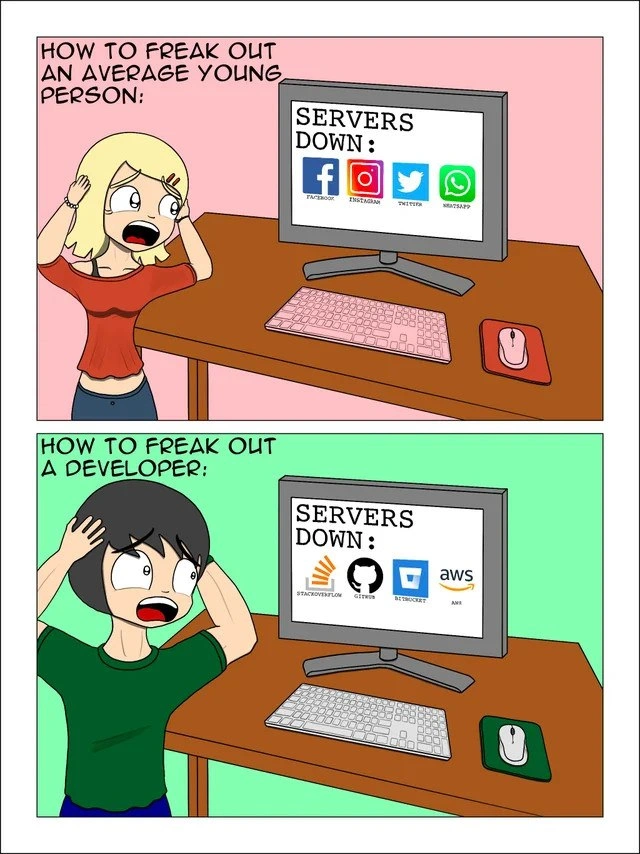
  • Facebook, Instagram, Twitter, WhatsApp: These are popular social media and communication platforms. Most people (especially younger folks) use these daily to connect with friends, get news, share updates, and chat. If these go down, the average person suddenly can’t do their routine online activities: no refreshing the feed for new posts, no sending DMs or messages, no scrolling through funny memes. It’s like the digital social life is put on pause. This can be genuinely upsetting or at least anxiety-inducing for someone who’s used to constant communication or entertainment through these apps. For example, if WhatsApp (a messaging app) is down, you can’t send or receive messages – imagine if that happens when you’re trying to coordinate with friends or family. Or if Instagram/Facebook are down, people might feel cut off from news and social updates. So a social media outage is very noticeable to the general public. In recent times, we’ve seen incidents where one of these big platforms went down and it made headlines, with lots of people jokingly saying “go outside!” or flocking to a working platform (like everyone runs to Twitter to complain when another service is offline). The top panel shows a young woman freaking out at the sight of those logos under “servers down” – which is a humorous exaggeration of that reaction.

  • Stack Overflow, GitHub, AWS: These are developer tools and platforms (very crucial in software development and IT work). Let’s define each:

    • Stack Overflow: This is a Q&A website where programmers ask questions and get answers about coding problems. Imagine it as a giant help forum for every programming error or tricky scenario you can think of. If you’re a developer and you run into an error message or you’re not sure how to do something, you likely type the question into Google, and often a Stack Overflow page with the answer appears. It’s so common that many coders half-joke that they “code by copy-pasting from StackOverflow.” So if Stack Overflow is down, developers lose a fast and trusted way to get help. It’s like suddenly your reference book or tutor is unavailable when you’re stuck on a problem.
    • GitHub: This is an online service for hosting code using the git version control system. Developers and companies store their source code in repositories on GitHub. They also use it for collaboration (reviewing code changes, tracking issues, etc.). If you’ve heard of Git (a tool to track changes in code), GitHub is like a cloud hub that integrates Git and makes it easy for teams to work together on code. Now, if GitHub is down, developers can’t access code that isn’t already on their local machine, can’t push new changes, and generally a lot of software development activities halt. Picture trying to submit your homework, but Google Classroom or your school’s submission portal is down – you have your work ready but no way to turn it in or get feedback. Similarly, a dev might have a fix for a bug ready, but if GitHub’s offline, they can’t integrate it or deploy it. It’s a big deal in workplaces because most modern development relies on these centralized git servers. Everyone kind of freezes and waits when GitHub has problems.
    • AWS (Amazon Web Services): This is a cloud computing platform provided by Amazon. It offers all sorts of services: servers to run applications (EC2), storage for files (S3), databases, networking, and much more – all over the internet. Instead of running their own physical servers, many companies rent resources from AWS to power their websites and apps. So AWS is like an incredible utility provider for the internet. When you use an app or visit a website, there’s a good chance some part of it is hosted on AWS. If AWS has an outage, it means the infrastructure for a lot of online services is failing in some region. For a developer, if their application is hosted on AWS, a downtime means their application might be offline or parts of it (like the database or file storage) aren’t working. Even if you’re not directly a system administrator, as a developer you’ll feel it — your app’s users might be complaining, or you can’t access the server to debug, etc. AWS going down is rare, but when it happens it’s serious: think of it like the power grid going out for the internet. In fact, an AWS outage can cause some of those social media sites to go down too, because they might rely on AWS behind the scenes! (Many popular online services use AWS in some capacity.)

So, in summary for the bottom panel: these three (Stack Overflow, GitHub, AWS) being down would strike fear in a developer because they’re essential for coding, collaboration, and running the software itself. This is heavily tied to DevOps/SRE culture — developers and Site Reliability Engineers are often on-call, meaning they have to respond if something in production breaks. “On-call” typically means you carry a pager or phone that will alert you at 3 AM if your service is down so you can fix it. Now imagine being on-call and discovering the problem isn’t even in your code but because AWS (your host) is having an outage – it’s a helpless feeling. And if Stack Overflow is down during a crisis, you lose a tool that might help you find a fix quickly. That’s why the developer in the meme is panicking: these are like the worst-case scenarios for things going wrong in a developer’s world.

It’s worth noting how the meme uses the same wording “SERVERS DOWN:” but just swaps the icons. It emphasizes dependency on platforms: one group depends on social platforms for daily life, the other depends on developer platforms for their work (and sanity). The identical desks and poses show that downtime is downtime, whether it’s a social or technical service. But the reason it’s funny is because of contrast: an average person might not even know what GitHub or AWS are, while a developer might be less impacted by a WhatsApp outage. Each group has its own “critical services.”

For a junior developer or someone new to IT, this meme is also a gentle introduction to the idea that developers rely on a lot of external services every day:

  • We use online resources (like documentation sites or Q&A sites such as Stack Overflow) to solve problems quickly.
  • We host our code and projects on platforms like GitHub for convenience and collaboration.
  • We deploy our applications to cloud providers like AWS for scalability and ease, rather than owning physical servers.

These are great until they’re not available. When they go offline (even if just for a few minutes), it can feel like you can’t do your job or your project is stuck. Many new developers experience their first big GitHub or cloud outage with surprise: “Wow, I never thought about what would happen if GitHub was down – I can’t even pull the latest code!” It highlights why older-school programmers sometimes insist on having local copies of documentation, or why companies might invest in backup systems. But generally, we trust these big platforms to be up 24/7 – and that’s why when they hiccup, it’s a big deal.

In contrast, the average young person doesn’t think about any of that background stuff. They just know their app isn’t loading. Which is why they panic: their user experience is disrupted. Meanwhile, the developer’s panic is about their developer experience and operational responsibilities being disrupted.

One more term from the categories: DX (Developer Experience) refers to the overall experience of developers while building software (the tools, processes, etc.). A good DX means things are smooth and efficient. When services like GitHub or Stack Overflow are down, DX takes a nose-dive. It’s frustrating and stressful – hence the panic.

So, the meme’s contrast teaches us in a humorous way: everyone has critical services they rely on. For some it’s social media for staying connected, for others it’s technical infrastructure for doing their work. When those critical services go down, it’s panic time appropriate to your world.

Level 3: When Tools Go 404

The meme brilliantly captures an inside joke in tech culture: what triggers panic for a typical social media user versus what triggers panic for a developer. In the top panel, an average young person is losing their mind because their lifeline to friends and entertainment – Facebook, Instagram, Twitter, WhatsApp – went down. We’ve all seen those moments: Instagram stops refreshing and suddenly there’s a Twitter storm (assuming Twitter isn’t the one that’s down) of people freaking out about it. To most people, a “servers down” situation is synonymous with “I can’t post, I can’t scroll, I can’t chat!” It’s inconvenient and maybe even scary if you’re glued to those apps. There’s a collective FOMO and anxiety when social apps go dark unexpectedly. (Remember the memes about people checking their Wi-Fi or rebooting their phone frantically, only to realize the app itself is offline? That’s the vibe of the top panel.)

Now, the bottom panel is where developers and DevOps engineers chuckle with painful recognition. It shows the exact same panic posture, but this time the screen announces downtime for Stack Overflow, GitHub, and AWS – three pillars of a developer’s daily life. This is a nod to the dependency on platforms that every coder and on-call engineer understands. Let’s break down why each of these being down is a nightmare scenario:

  • Stack Overflow down: This is like the collective brain of the developer community going offline. Need to remember how to invert a binary tree or fix that NullPointerException? Stack Overflow is usually step 1 of debugging for many devs. When it’s unavailable, there’s a mix of humor and horror – humor because we joke that developers might forget how to code if they can’t copy-paste from StackOverflow, horror because in a crunch you’ve lost a crucial knowledge-sharing service. It’s the dev equivalent of a library burning down right when you need a reference book. Junior devs and even senior devs rely on quickly searching error messages and copying proven code snippets. No Stack Overflow means you’d better hope your problem has an answer in official documentation or that you actually remember those arcane syntax details from memory. Cue the sweat and feelings of being utterly alone with your bug. The meme exaggerates it by lumping it with other outages, but honestly, a StackOverflow outage during a production incident would freak out even a calm developer because it removes a safety net.

  • GitHub down: Now this is a developer productivity killer. GitHub is where code lives. Companies host repositories there, CI/CD pipelines fetch code from it, deployments might depend on packages from it, and developers collaborate through pull requests on it. If GitHub goes down in the middle of the workday (yes, it has happened), it’s pandemonium in engineering teams. You can’t push your latest code changes, can’t review others’ code, maybe your build pipelines are failing because they can’t download dependencies or source code. For open source projects, it’s like the town square is closed – no contributions, no issue tracking. There’s a famous tongue-in-cheek line, “GitHub is down, so it looks like I’m not working today,” often accompanied by a GIF of developers kicking back. But beneath the jokes, if this happens during crunch time, developers panic because everything grinds to a halt. It’s an unscheduled downtime for your entire dev team. If you’re responsible for release or on-call for a service that needs a hotfix, a GitHub outage is a nightmare: you have the fix ready but no way to deploy it if you can't access the repo or your CI system. (Picture an on-call dev muttering “Of course this happens now…” as they realize they can’t even pull the code to troubleshoot an outage because GitHub itself is having an outage!). It’s downtime squared: your app might be fine, but the tools to work on the app are offline.

  • AWS down: This is the mother of all developer freak-outs in the meme. AWS being down is not just a dev tool outage; it is very often a production outage for countless businesses. Amazon Web Services is the backbone for a huge chunk of the internet. When AWS has a major regional outage, it can take down or severely impair thousands of websites and applications – from tiny personal blog sites to giant services like Netflix or Slack. Many developers have PTSD from AWS incidents: it’s usually on-call panic time. If you’re the DevOps/SRE person on call when AWS goes down, you’re basically watching your entire production infrastructure fail outside your control. It’s the kind of event where everyone’s PagerDuty alarms are blaring. You and your team might be furiously refreshing the AWS Status page (those little colored boxes that hopefully stay green), watching Twitter for the hashtag #AWSoutage, and scrambling to initiate your disaster recovery plan (if you have one). Even if your systems are theoretically multi-region, some AWS outages have historically been so bad (e.g., an S3 outage in us-east-1 or an EC2 issue) that they ripple across regions or affect core services all regions depend on. The meme’s dev in the bottom panel holding his head is basically every developer who has lived through a day when “AWS is down” and realized with dread: our servers, deployments, databases – everything is effectively frozen. It’s the ultimate “not my code’s fault, but my problem anyway” scenario. And because AWS is so central, a big outage means the support forums light up, bosses start asking for ETAs to resolution (as if you can do anything but wait), and customers start emailing. In short, an AWS outage turns developers into anxious messes frantically trying to mitigate damage and reassure users, all while watching the clock. It’s a special kind of helpless terror – you can’t fix AWS; you can only adapt or wait.

So, the humor is a bit dark but very real: different outages trigger different people. Non-tech folks freak out when their social lifelines are cut; developers freak out when their technical lifelines are cut. The environments are different, but the panic is the same. This meme resonates especially with DevOps and SRE professionals because it underscores the on-call nightmare scenario: the tools you rely on to solve problems (or the platform your product runs on) are themselves down. It’s like a surgeon finding out the hospital’s power is out – time to hit the backup generators or operate by flashlight. And nicely, the desks and poses in the panels are identical, which dramatizes that panic is universal. The only difference is the icons on the screen. It’s a tongue-in-cheek reminder that while everyone fears downtime, what’s “critical” depends on your role. Developers don’t break a sweat if Instagram’s offline for an hour, but if GitHub is offline? Oh boy. It taps into that collective memory of every developer who’s typed git push and seen an error because GitHub wasn’t reachable, or tried to load StackOverflow only to get a blank page, or woke up to Slack messages saying “AWS is having issues, our site is down.” The meme format exaggerates it a bit (all three dev services down at once would be a day of infamy), but that’s what makes it funny – it’s the ultimate freak-out cocktail for a dev.

In essence, this is developer humor about downtime: the top half might be a casual meme you’d share with friends when Facebook or WhatsApp has an outage (“OMG I can’t send messages!”). The bottom half is more niche: it’s the one you share in your engineering Slack channel or subreddit, where everyone upvotes because “yep, that’s exactly how I feel when StackOverflow is down while I’m debugging.” It’s also reflecting on the modern Developer Experience (DX): we’re so dependent on online tools and cloud platforms that our productivity and sanity hinge on them. In the old days, a developer might have all documentation offline and servers they control; today we often outsource these needs to external services for convenience. So when those go down, we collectively lose our minds. And the final wink of the meme is: each group doesn’t necessarily understand the other’s panic. An average young person might not even know what AWS is, and a developer might roll their eyes at someone losing it over a temporary Instagram outage – but put each in their own nightmare scenario, and they react the same way. That shared pose of horror is a little piece of comic unity between the two worlds.

# The on-call developer's quick check when something seems off:
$ ping stackoverflow.com
PING stackoverflow.com (151.101.1.69): 56 data bytes
Request timeout for icmp_seq 0
Request timeout for icmp_seq 1
# ... yup, it's not just you. Time to panic (and find a workaround).

(Above, even a simple ping to StackOverflow fails — a sure sign the outage is real. Developer panic intensifies.)

Level 4: Cascading Outage Overflow

At the deepest level, this meme hints at how massive distributed systems can fail in spectacular ways, causing widespread panic for different audiences. Each icon on those screens represents a complex network of servers across data centers. When social media apps (like Facebook or Twitter) all go dark, it often points to a fundamental internet glitch – think of a BGP misconfiguration or DNS meltdown that knocks entire domains off the map. BGP (Border Gateway Protocol) is essentially the postal service of the internet, routing traffic globally. One bad update to BGP can make Facebook’s servers effectively vanish from the internet, as actually happened in 2021 when Facebook, Instagram, and WhatsApp disappeared for hours due to a single faulty routing change. For the average person, it felt like the sky fell because all their social hangouts went 404 at once. But beneath that panic was some seriously intricate failure: internal data centers couldn’t even talk to each other, proving that even the biggest social networks have an Achilles’ heel in their infrastructure.

On the developer side, seeing Stack Overflow, GitHub, and AWS all listed under “Servers Down” is basically an SRE (Site Reliability Engineering) apocalypse scenario. Each of those services is built on layers of distributed computing. Consider AWS (Amazon Web Services): it’s a cloud empire running on thousands of interconnected microservices, physical servers, and networking gear. AWS promises high availability through redundant regions and availability zones, yet history has shown that cascading failures can happen. For example, a minor hiccup in an AWS subsystem (like an overloaded internal messaging service or a power outage in one region) can ripple outward, overwhelming other components – a classic cascading failure. The joke here is that developers understand these chain reactions: they know how one misconfigured load balancer or a single-point-of-failure can bring down a complex system (CAP theorem in action – you can’t have perfect Consistency, Availability, and Partition tolerance all at once). So when AWS has a major outage (as occurred in December 2021 with us-east-1), it’s not just one website that blinks off – it’s hundreds of services and apps (possibly even those social media platforms) that suddenly vanish. The meme’s humor hides a hard truth: our modern internet is a house of cards built on a few giant platforms, where a subtle bug or a fat-fingered config change can send shockwaves everywhere. This is why veteran engineers jest darkly about “the cloud” – it’s just other people’s computers, and sometimes those computers fail in concert. In fact, seasoned DevOps folks employ tools like Netflix’s Chaos Monkey to intentionally break parts of their system in testing, preparing for the inevitable day something big goes down. From a high-level perspective, the top panel’s social app outage and the bottom panel’s dev-tool outage are two sides of the same coin: complex systems failing due to underlying technical fragility. The difference is whose world is on fire as a result.

Description

Two-panel cartoon meme. Top panel captioned "HOW TO FREAK OUT AN AVERAGE YOUNG PERSON:" shows a blonde woman in a red crop-top, hands on her head, mouth open in horror. Her desktop monitor displays bold text "SERVERS DOWN:" followed by large icons for Facebook, Instagram, Twitter, and WhatsApp; the background is a pink wall. Bottom panel captioned "HOW TO FREAK OUT A DEVELOPER:" shows a dark-haired man in a green T-shirt mirroring the same panic pose. His screen also reads "SERVERS DOWN:" but lists icons for StackOverflow, GitHub, and AWS instead. Desks, keyboard, and mouse are identical, emphasizing the situational contrast. Technically, the joke highlights how developers rely on infrastructure and knowledge-sharing services (StackOverflow, GitHub, AWS) far more than consumer social platforms, underlining on-call anxiety and production-outage fears familiar to DevOps and SRE professionals
Comments

32
Anonymous ★ Top Pick If Stack Overflow, GitHub, and AWS all vanish at once, relax - it’s just the annual DR exercise where we pretend it’s 2004, deploy via scp, and rediscover that “tribal knowledge” isn’t in source control
  1. Anonymous ★ Top Pick

    If Stack Overflow, GitHub, and AWS all vanish at once, relax - it’s just the annual DR exercise where we pretend it’s 2004, deploy via scp, and rediscover that “tribal knowledge” isn’t in source control

  2. Anonymous

    The real horror isn't when social media goes down - it's when Stack Overflow is unreachable and you suddenly realize you've been outsourcing your memory to a distributed system with no local cache or fallback strategy

  3. Anonymous

    When Stack Overflow is down, the industry's true bus factor reveals itself: one CDN

  4. Anonymous

    The real difference? When social media goes down, people complain on other social media. When Stack Overflow goes down, developers suddenly realize they've been copy-pasting solutions for 15 years and have no idea how anything actually works. AWS outage? That's when you discover your 'highly available multi-region architecture' was really just us-east-1 with extra steps and a prayer

  5. Anonymous

    Our HA plan is simple: if AWS, GitHub, and Stack Overflow go down, we fail over to institutional memory and that one 2011 blog post

  6. Anonymous

    Our BCP is just “refresh StatusPage” - when StackOverflow, GitHub, Bitbucket and us-east-1 go dark, even the runbook lives in a private repo in the affected region

  7. Anonymous

    Social media down? Time for coffee. AWS down? Time to dust off that secondary region we swore we'd implement last quarter

  8. @realVitShadyTV 4y

    Fuck bitbucket.

  9. @paul_thunder 4y

    Oh no! Looks like I have no other option but to do the job.

  10. @pixelsex 4y

    Rajesh, sir, please do the needful

  11. @mpolovnev 4y

    When AWS is down, the rest of internet is down as well (

    1. @dsmagikswsa 4y

      True 😂

  12. @QutePoet 4y

    Why do he like Bitbucket and don't use GitHub instead? Because of CI/CD?

  13. Ievgen 4y

    Self-hosted masterrace 🎩

  14. @BotMike 4y

    You don't need all of them down to freak out a developer

    1. @LionElJonson 4y

      Agreed

  15. @AmirhosseinDotZip 4y

    What was this

    1. dev_meme 4y

      gitlab 😎

  16. @karumsenjoyer 4y

    This is native Bitbucket ad No one really uses it, and no one will give a fuck when it will be down ;)

    1. @kirkbones 4y

      You are wrong, it is nice)

    2. @RiedleroD 4y

      I don't even know what it does - is it like pastebin? I feel like it might be.

      1. dev_meme 4y

        Github competitor for git repos, with good integration with JIRA and the rest of atlassian tools

  17. Deleted Account 4y

    stackoverflow is the most important here

    1. @Agent1378 4y

      You're sad because u use so

      1. @dsmagikswsa 4y

        Yes….if you need to check SO.. you probably stuck something long….

        1. @Agent1378 4y

          Or it's a bad habit that leads to incompetence, doubt, imposter syndrome and suffering. Only the official docs/reference for the language, tool or framework should be used for keeping the mental health and good mood.

  18. ẞonny 4y

    Julien assange can get extradited.

  19. @cptnBoku 4y

    Why was the AWS down message was not conveyed immediately ?? Was it hosted on AWS itself so the last status on it would be working ???

  20. @x24R3 4y

    AWS down day is good

  21. @cringy_frog 4y

    > young person > facebook and whatsapp, no tiktok 👵

  22. @callofvoid0 4y

    never used AWS and bitbucket

  23. @mksmbrtsh 4y

    Come to rus chebunet! It'n down

Use J and K for navigation