GPT Confidently Claims Nonexistent Seahorse Emoji Exists
Why is this AI ML meme funny?
Level 1: Hide and Seek
Imagine you have a favorite sticker in your sticker book – let’s say a shiny seahorse sticker 🐠 – and you know it’s in there somewhere. One day you want to show it to your friends. You flip through the pages, but you just can’t find it. You remember it so clearly that you start wondering, “Did I dream it up?” This is exactly how the developer in the meme feels. He’s playing a game of hide-and-seek with a tiny picture (emoji) of a seahorse on his computer. He’s sure it exists (because he’s seen it before), but no matter where he looks, it stays hidden. It’s funny because he’s as serious about finding that little seahorse as if it were a big important problem. In simple terms, it shows how even grown-up computer experts can get frustrated when they can’t find something they strongly believe is real. It’s like when you have a word on the tip of your tongue but can’t remember it – super annoying in the moment, but a bit funny when you realize it was just a little thing all along!
Level 2: Slack Emoji Hunt
For a newer developer (or someone not as familiar with these systems), let’s break down what’s happening. Emoji are those little icons (😄👍🎉 and the like) used in messages. Under the hood, every emoji is defined by a Unicode code point, basically a number that the computer recognizes as “this should be a 😀 or a 🐡”. Different platforms (like iPhones, Android, or Slack on your computer) have to know about that code point and have art to display it. If your system isn’t up-to-date with the latest emoji library, it won’t recognize some of the newer emojis – kind of like having an old dictionary that’s missing new words.
Now, Slack is a popular team chat app developers use a lot for communication. In Slack, you can add emoji “reactions” to messages or include emoji in your text by typing codes like :smile: which turn into 😄. Slack usually has an emoji search: you press a little icon or type a colon and some letters, and it shows a list of matching emoji you can pick. The meme is about someone trying to find the “seahorse” emoji in Slack. They know it exists (maybe they’ve seen it on their phone or on Twitter), so they start a mini hunting expedition. They try the Slack search (:seahorse: or typing “sea...”), and nothing comes up. Then they try the OS emoji picker (each operating system has a built-in emoji menu – for example, on Windows you press Win + . and on Mac Cmd + Ctrl + Space to open it). Still nothing! At this point, our developer is frustrated and confused – this seahorse emoji that they’re sure is real isn’t showing up.
Why might that happen? One reason is version mismatch: Slack (or the computer) might not have the latest emoji set installed. Emoji are standardized by Unicode, which updates every so often with new entries. If the seahorse was added in a newer Unicode version and, say, your Slack hasn’t been updated to include it, the emoji won’t appear in the list. Another reason could be naming. Emoji have official names (the seahorse’s official Unicode name might be something like “seahorse” or a specific term). Slack’s search might only match that exact name or keywords. If you typo or think it’s categorized differently (for example, expecting it under “fish” category), you might not see it. This scenario is super relatable humor among developers because it usually happens at the worst time – like when you want to react to a coworker’s long message with a quick funny emoji, and you know the perfect one (a seahorse, for some inside joke maybe) but you can’t find it. Your brain’s “memory cache” insists it’s there, but the computer says “Nope, not found.” It’s a bit like searching for a file you swear you saved, but it isn’t coming up – you start doubting whether you ever saved it at all!
So in summary, the meme shows a dev looking very intense and serious (like they’re debugging a critical bug in production) just because they can’t find a certain emoji in Slack. It pokes fun at our developer obsession with little details. It falls under Developer Experience (DX) and Communication because it’s about a small glitch in the tools we use to communicate at work. Even small inconveniences like this can drive a dev a bit nuts, precisely because we expect our tools to work seamlessly. And honestly, when you finally do find that emoji (or confirm it exists), it feels like a victorious bug fix! 🎉
Level 3: Memory Cache Miss
At a senior developer level, this meme triggers a very real and relatable developer experience. It captures that moment of developer frustration when you’re utterly convinced about something in tech – an API method that should exist, a config that you swear you set, or in this case a specific emoji – yet all the evidence has vanished. You’re left second-guessing your mental cache. We’ve all been there: “I know I’ve seen a seahorse icon before!” 😤. But try proving it under pressure... The humor strikes a chord because engineers pride themselves on precise recall of obscure details (be it a regex flag or a niche emoji). Not finding the seahorse emoji in Slack feels like a personal mini-failure: am I misremembering, or has the system gone crazy?
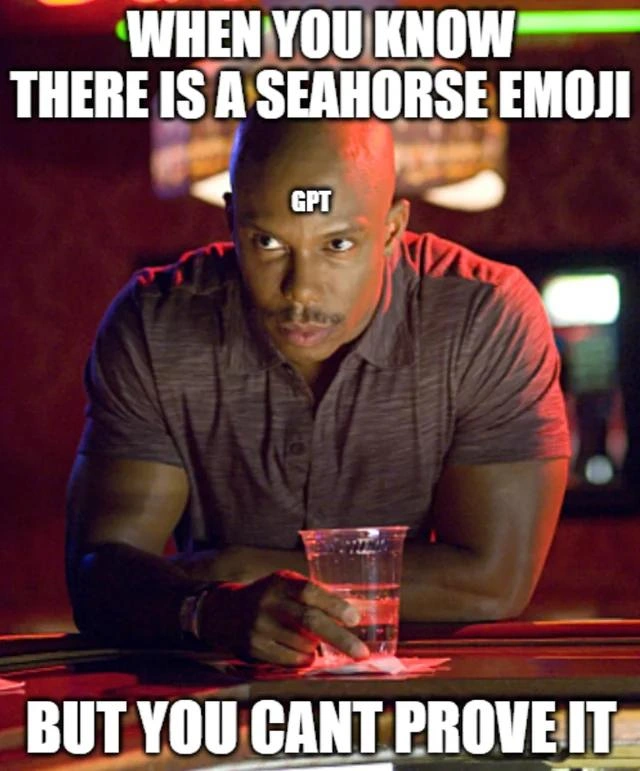
In the meme image, the dev is dead serious at the bar, clutching a water cup like it’s a tense production incident. That over-the-top intensity about a missing emoji is funny because it parodies how we sometimes react to minor tech hiccups with major concern. It’s a classic case of a trivial problem made dramatic – something only fellow devs would understand and find hilarious. Communication tools like Slack are part of a developer’s daily life, and when they don’t behave as expected (like not finding an emoji for a perfect reaction), it disrupts our flow. There’s a subtle nod to the idea of debugging non-code issues in our work chat: you might actually find yourself performing an emoji_search or a unicode codepoint lookup on Google in the middle of a conversation, just to prove you haven’t lost it. It's analogous to a Slack reaction hunt, frantically typing :sea...: and scrolling, only to come up empty and then trying the OS-level picker (Cmd+Ctrl+Space on Mac, Windows+.; on Windows) which is similarly mute on the matter. Each failed attempt is like a failed unit test against your memory.
What really makes seasoned devs smirk here is how this situation echoes classic tech problems in absurd miniature. The mental cache miss (when your brain’s “autocomplete” fails) is reminiscent of actual cache misses in software where the data you assumed would be readily available isn’t, causing a costly trip to main memory (or in our case, a trip to Google or Emojipedia documentation). It’s a playful jab at how even with all our advanced tools, something as tiny as an emoji can send us down a troubleshooting rabbit hole. There’s even a whiff of the “Mandela Effect” – a bunch of us confidently remember an icon that apparently doesn’t exist in the current reality. In a team Slack, this often leads to half your coworkers insisting “Yeah, I’m pretty sure it exists 🤔” while others shrug. Suddenly the whole chat is invested in confirming the existence of 🐙 or 🐡 (what was it again?). The meme nails that communal, slightly absurd investigative vibe. And of course, as experienced devs, we find it extra funny because we’ve solved production bugs with less intensity than we apply to finding this rogue emoji. It’s a lighthearted reminder that in software, no detail is too small to become an epic quest.
Level 4: Beneath the Unicode Sea
Deep under the hood of our everyday text lurks Unicode, the universal standard that assigns a unique number (a code point) to every character and emoji 🙌. The seahorse emoji is indeed real – it's defined in Unicode (complete with an official code point in the massive numbering space of characters). In theory, that means any modern system could display it. But here’s the catch: just because an emoji exists in the Unicode spec doesn’t guarantee your environment has caught up. Each platform (Slack, your OS, etc.) needs updated emoji fonts and data to actually show that cute little seahorse. If your app hasn’t updated to Unicode’s latest version, typing the seahorse’s code point might yield a mysterious empty box (the infamous “tofu” placeholder □). It’s like referencing a new library API that your project hasn’t imported – the definition exists out in the world, but your local system shrugs 🤷. Under the covers, an emoji is really just a sequence of bytes (in UTF-8 encoding, the seahorse might be a multi-byte sequence starting with 0xF0 0x9F...). When you hit that OS emoji picker and search "seahorse", the picker is scanning a database of known emoji names on your machine. If that database is out-of-date or if the emoji’s keyword isn’t indexed, you get nothing – a search miss. At a protocol level, sending a seahorse emoji in Slack is just sending its Unicode code point. If Slack (or the receiving system) doesn't have the glyph, you'll see a placeholder or hidden character. This is essentially a distributed systems consistency issue in the most whimsical form: your brain’s mental cache says “Yes, U+1FXYZ is a seahorse!” but Slack’s actual cache (emoji dataset) hasn’t invalidated and refreshed since that emoji was added. As a result, your personal knowledge and the system’s knowledge diverge. In technical terms, it’s almost like a cache invalidation problem – one of the two hard things in computer science (along with naming things and off-by-one errors 😉). The Unicode Consortium might have approved our tiny aquatic friend, but until the Slack app updates its emoji list (and your OS updates its fonts), the seahorse lives in a sort of Schrödinger’s emoji state: defined but not yet deployable in your environment. The humor here is that a developer is essentially “debugging” a production issue involving an obscure Unicode codepoint – treating an emoji appearance (or lack thereof) with the same gravitas as a missing semicolon in production code. It’s a deep dive under the text surface, revealing how modern communication relies on a stack of standards and updates. Who knew that finding Nemo’s tiny horse cousin could turn into an encoding spelunking adventure? 🐙🔍 (Yes, dear reader, the seahorse emoji is real – if you see one here 🐡, your platform supports it! If not… well, now you share the meme’s pain.)
Description
A meme showing a man (labeled 'GPT') sitting at a bar looking frustrated, with top text 'WHEN YOU KNOW THERE IS A SEAHORSE EMOJI' and bottom text 'BUT YOU CANT PROVE IT'. The meme references GPT/ChatGPT's well-known hallucination problem where the model confidently asserts false information -- in this case, insisting a seahorse emoji exists when it does not. There is no seahorse emoji in any Unicode standard. The bar setting conveys the existential frustration of being convinced of something you cannot verify
Comments
24Comment deleted
GPT doesn't just hallucinate emojis -- it'll write you a 500-word essay on the seahorse emoji's Unicode history, complete with a fake codepoint and a citation to a W3C draft that never existed
This is the LLM equivalent of knowing a pointer's memory address but being unable to dereference it to see the actual value. The information is there in principle, but the capability is missing
Nothing like a late-night prod deployment to remind you that your brain’s L1 cache evicts rare Unicode glyphs first
It's like when you ask GPT about a specific npm package vulnerability from 2022 and it confidently explains why that exact CVE 'theoretically could exist' while describing it in perfect detail - we all know you've seen the GitHub issue, just admit you were trained on it
The classic LLM paradox: confidently uncertain about seahorse emojis while simultaneously writing production code
Feels like debugging a split-brain cluster: I’m sure :seahorse: exists, every picker disagrees, and consensus never reaches quorum
GPT's parametric ocean: seahorses everywhere in latent space, but render to Unicode and it's a 404
They too have Mandela effect Comment deleted
LLM oriented psyops are real Comment deleted
Seriously tho, its actually one of recent Antrophic research results Focused on how few documents are capable to perform poisoning Comment deleted
Are we still using Dexter-memes in 2025? Comment deleted
people are retarded Comment deleted
Just checked Comment deleted
54s jesus Comment deleted
It was thinking really hard 😁 Comment deleted
mistrel was almost correct in less than a second :P Comment deleted
Have you seen my screenshots for GPT-5-Pro memes classification? Comment deleted
I wasn't looking at the response times 👀 Comment deleted
8-9-10 and more minutes Per single meme Comment deleted
And jokes (those that I checked) inferior to gpt5 and sonnet lol Comment deleted
boomer AI I guess Comment deleted
wdym boomer AI, its 10 days old in public 🥲 https://openrouter.ai/openai/gpt-5-pro Comment deleted
When you know there's 'o' in 'strawberry' but cannot prove it Comment deleted
Gemini is probably the only LLM which can tell you the actual answer in a few seconds with no deep research or deep thinking mode. And that's because it googles about your prompt so it knows about this meme Comment deleted