A Visual Explanation of Why 'goto' is Considered Harmful
Why is this CodeQuality meme funny?
Level 1: Door to Nowhere
Imagine you’re reading a choose-your-own-adventure story, and suddenly one page says, “Go to page 77 right now,” without any explanation. You flip to page 77, and you find yourself in the middle of a scene that doesn’t quite connect to what you were just reading. You’re confused, right? Using a goto in code is a bit like doing that jump in a story. It makes the story (or program) hard to follow.
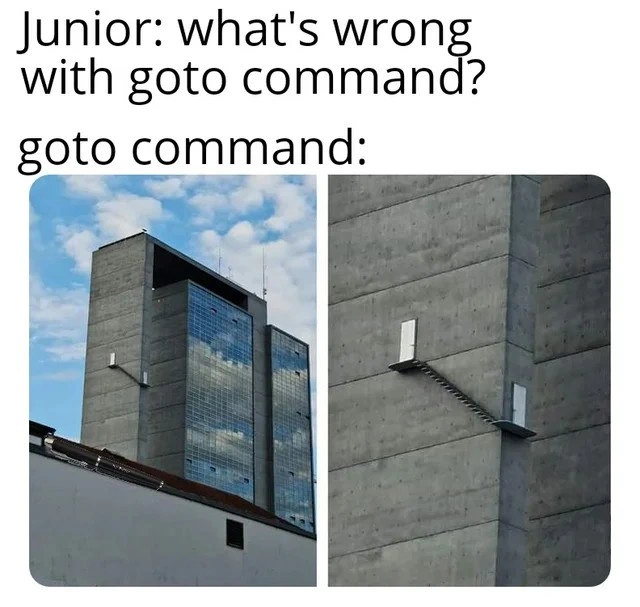
An even simpler way: think about a house or a school building. Normally, every door in the building leads somewhere sensible – a hallway, another room, maybe outside to the ground where there are steps or a ramp. Now picture a door built on the second floor that opens to thin air, with a little staircase that doesn’t reach the ground. If someone opened that door, they’d just step out and be stuck on a tiny stairway hanging high up – a really dangerous dead end! That’s what the meme’s picture is showing, and it’s making a joke that a goto in a program is like that crazy door. It doesn’t follow the normal safe design (where doors stay inside or have proper exits). Instead, it drops you into an unexpected spot with no easy way back. It might have seemed like a handy shortcut, but really it's a trap.
In plain terms, telling a program to "goto" somewhere else is usually not a good idea because it makes the program’s path unpredictable – just like a door to nowhere confuses anyone who tries to use it. It’s funny to see a door and stairs leading nowhere in a photo, but if you actually had to use that door in real life, it would be scary and confusing. In the same way, other programmers (or your future self) will find it scary and confusing to work with code that jumps around unpredictably. That’s why, in modern coding, we build clear and safe pathways for the program to follow (step by step, like normal stairs inside a building) instead of using magic jump doors.
Level 2: Dead-End Jump
The goto statement is a command that tells the program, "Stop what you're doing and go to another part of the code." Literally, it jumps to a label elsewhere in your function or program. This kind of jump is called an unconditional branch in ControlFlow terms. To a newcomer, goto might sound convenient – like a teleportation shortcut in your code. But let's break down why it’s usually a bad idea using simpler terms and the meme’s imagery.
In the meme, the text asks: "Junior: what's wrong with goto command?" and answers with pictures of a concrete building that has a door high up in the wall and a little staircase leading out of it that just ends in mid-air. Imagine a person opening that door: they'd step out and immediately be stuck on a tiny ledge with nowhere to go. There's no connection to the ground or the rest of the building’s floors. This is exactly what happens with a careless goto: you jump into a part of the code that isn't properly connected to the normal flow. It’s an unreachable_code scenario or at least a very context-free location in the program. In everyday coding, we expect the flow to follow a structured path (step 1, then step 2, loops, if-this-then-that, etc.), kind of like hallways and stairs inside a building connecting all the rooms. A goto bypasses all those nice connections. Suddenly, you're executing code that might not know how you got there or what came before it, just like a door to nowhere on the building.
Let's look at a small example. Consider this C code snippet:
#include <stdio.h>
int main() {
printf("Start\n");
goto skip;
printf("This never runs.\n"); // This line is skipped due to the goto
skip:
printf("End\n");
return 0;
}
Here’s what happens: when the program runs, it prints “Start”, then the goto skip; tells it to jump to the label skip:. That means the line printf("This never runs.\n"); is literally skipped over. The program goes straight to printing “End”. The middle line might as well not exist, because there's no way to reach it. In other words, our goto created a little "dead zone" in the code (the same way the door in the meme opens into a dead-end). If this were a bigger program, you can imagine how confusing it would be to figure out why certain code never executes or why things happen out of order.
Now, why do people frown upon this? In structured programming (a key lesson in CSFundamentals courses), we learn to use clear control structures: loops (for, while), conditionals (if/else), and functions to organize code flow. These structures make it obvious how you get from the start of a program to the end, kind of like well-designed stairs and hallways in a building. Every if has a matching else or an obvious block of code, every loop has a clear start and end. With goto, you tear a hole in those structures. It’s like saying, "Actually, just jump over to this other point in the program now." It becomes really hard for someone reading the code to follow what's going on, just as it would be hard for a person in that building to navigate if doors randomly led to floating staircases.
Spaghetti code is a term you’ll hear seniors use to describe code with a tangled control flow, often caused by too many jumps like goto (or overly complex nested logic). Picture a bunch of spaghetti on a plate – strands going every which way. Spaghetti code is similar: you try to follow one thread of execution, and you end up looping and jumping around in a confusing way. This is a big CodeQuality issue because such code is difficult to maintain, debug, and extend. A code smell like multiple goto statements basically tells you "this code might break if you touch it."
Historically, older languages (like early versions of BASIC) didn’t have modern loop constructs, so goto was how you made things repeat or jumped to reuse logic. Those old programs often had lines like GOTO 120 (line numbers as labels), which made sense to the computer but gave people headaches. LegacySystems from the 70s or 80s that haven’t been refactored could still contain this style of code, and engineers today dread working on them. It’s not that programmers back then were clueless – they just didn’t have better tools at the time. But by now, we do have better approaches, and we’ve learned from those decades of experience. For example, languages like Java outright banned goto (the word is reserved but you can’t use it) to force developers towards structured flow. Python also has no goto (aside from a wild third-party library as a joke). In C and C++, goto does exist, but good C/C++ developers use it sparingly. You might see it used to jump to a common cleanup section at the end of a function for error handling (to avoid duplicating cleanup code). That's a controlled use-case and even then, many C programmers will comment it with "/* yes, we're using goto for a good reason here */" to assure readers that it's intentional and safe.
So for a junior asking "what's wrong with goto?", the answer is: nothing is technically wrong in terms of it still works as a command, but it makes your code much harder to understand and maintain. It’s like having random teleport doors in a building – sure, you can technically get from one room to another instantly, but you leave everyone else totally confused about how you ended up there. And when you or someone else comes back later to fix or update the code, those teleports (the goto jumps) can lead you into dead-ends or weird places that take a ton of time to figure out. In short, goto often creates more problems than it solves in modern code. Better to use the structured tools we have (loops, functions, exceptions for errors, etc.) which keep the flow controlled and obvious. Your future self and your teammates will thank you!
Level 3: Goto Considered Harmful
Even in 2025, the mere mention of the goto statement can make a senior engineer cringe. It's a classic CS_Fundamentals lesson in what not to do if you care about CodeQuality. Why? Because goto is an unconditional jump that can send your program's execution wandering off to a label elsewhere, with no regard for structured order. The meme nails this with the absurd image of a door high up on a concrete building wall, accessible by a tiny staircase that leads nowhere. That's basically what a wild goto does: it drops you into some part of the code out of the blue, like stepping through a midair_door onto impossible_stairs that dangle in isolation. This is the recipe for SpaghettiCode – logic so tangled and non-linear that trying to trace it feels like unraveling a bowl of pasta.
There’s a famous saying from computer science lore: “Goto Statement Considered Harmful.” Back in 1968, Edsger Dijkstra wrote an influential letter arguing that unrestrained use of goto devastates program structure. He wasn’t being melodramatic – anyone who’s maintained a LegacyCode module filled with random jumps can attest that it’s a nightmare. Each goto is like a teleporter: one moment you’re stepping through code normally, the next moment bam! you’re somewhere completely unrelated. The result is CodeComplexity through the roof – your code’s flowchart looks less like a neat hierarchy and more like a plate of spaghetti someone threw against a wall. Good Structured_Programming practices (using loops, functions, and conditionals) were basically invented as an antidote to this chaos.
In real projects, a stray goto is a glaring CodeSmell. It hints that the original coder either came from the 1970s or was desperately hacking around a problem without refactoring properly. Maintaining such code is perilous: imagine trying to debug an issue and finding that halfway through the function, execution suddenly jumps to some label 200 lines above. It's like climbing a normal staircase and then discovering a random trap door that teleports you onto that lonely little staircase in the sky – now you have no idea how to get back or what state anything is in. Senior engineers share war stories about inheriting decades-old modules with labyrinthine goto chains, where adding a simple feature feels like diffusing a bomb. And guess when that janky jump will cause a serious production bug? Of course, at 3 AM on a weekend, because the universe has a sense of humor.
Now, to be fair, goto can be used in disciplined ways (kernel hackers and embedded C developers will grumble here). In very low-level programming or performance-critical C code, you might see a goto for error handling or to break out of deeply nested loops. But those cases are rare and done with extreme caution. In modern high-level application code, if you spot a random goto usage, it’s often a red flag – maybe a junior thought it was a clever shortcut, or some old snippet survived a refactor. In either case, every seasoned dev who encounters it will raise an eyebrow and reach for the nearest refactoring tool. As a community, we've learned that structured_programming (using clear control structures and functions) keeps our code sane. We avoid the door-to-nowhere jumps because we've lived through the maintenance hell they cause. In short: a goto_statement in a 2025 codebase is about as welcome as a surprise staircase bolted to a skyscraper wall – it’s bizarre, dangerous, and sooner or later someone’s going to get hurt trying to deal with it. (Translation for juniors: just don't goto there 😉.)
Description
This is a two-part meme that visually critiques the 'goto' command in programming. The top text sets up the scenario: 'Junior: what's wrong with goto command?'. The bottom text, 'goto command:', is followed by two photos of a modern concrete building with a bizarre and dangerous architectural feature. On the building's windowless facade, high above the ground, are several doors. A close-up reveals two of these doors are connected by a steep, ladder-like bridge, leading from one nonsensical exit to another. The meme uses this absurd and unsafe design as a perfect metaphor for the 'goto' statement. In programming, 'goto' allows for unstructured jumps in the code's execution flow, which can create 'spaghetti code' - a tangled, unreadable, and unmaintainable mess, much like the pointless and perilous path on the side of the building
Comments
14Comment deleted
The architect must have been a C programmer from the 70s. That's not a fire escape; it's an unhandled exception path
Every time someone drops a goto into a 50-module service, an SRE has to build a Grafana dashboard just to find where that door in mid-air actually lands
The same architect who designed these buildings later became a senior engineer and now maintains our authentication service - explains why every login attempt somehow ends up in the billing module
The goto statement: because sometimes you need to explain to a junior why Dijkstra wrote 'Go To Statement Considered Harmful' in 1968, and why we're still having this conversation 55 years later. It's the architectural equivalent of building a staircase that connects two doors at completely different elevations on perpendicular walls - technically functional, but a maintenance nightmare that makes every code reviewer question your life choices and the structural integrity of your entire codebase
goto turns your control‑flow graph into a fire escape that ends mid‑air; the kernel calls it “goto out” for cleanup - everyone else calls it Friday pager duty
goto is the architectural equivalent of welding a fire escape mid‑air - the compiler accepts the edge, but your control‑flow graph and your on‑call won’t
Goto: 100% reliable jumps, 0% refactor survival rate - like a monolith's fire escape straight to legacy hell
Ouch. Comment deleted
RIP safety. Comment deleted
this is wierdly accurate Comment deleted
😂😂😂😂😂😂 Comment deleted
That's a real photo? Comment deleted
From https://vorpus.org/blog/notes-on-structured-concurrency-or-go-statement-considered-harmful/ Comment deleted
Goto is better than writing long ass function that will be called only once Comment deleted