Expert-Level Guide to Compiler Terminology
Why is this Compilers meme funny?
Level 1: Cute but Confused
Imagine your friend is super confident about something complicated, but when they explain it, they get all the names hilariously wrong. It’s like hearing someone say, “Oh, I know all about music!” and then they go on: “BTW stands for Big Tuba Whistle, and piano is called a key-noise machine.” You’d probably giggle because they’re saying it with a straight face, but wow is it off the mark. This meme does the same thing, but with programming tools. The person in the joke acts like they’re an expert in making computer programs (compiling), yet they’re giving all the tools little goofy nicknames that sound logical only if you have no idea what they really are. It’s funny in the way a kid might call a stethoscope a “heart-listener” – kind of cute and you get what they mean, but it’s totally not the real name. We laugh because the person is so sure about these made-up definitions, and anyone who’s “in on the secret” (knows the real names) finds the mix-up adorable. In simple terms, the meme is funny because it’s showing the difference between thinking you know something and actually knowing it, in the most lighthearted, silly way possible. It turns very serious, hard-to-understand computer terms into childlike phrases, and that playful contrast is what makes us smile.
Level 2: Meet the Toolchain Squad
Let’s break down what these terms really mean in a friendly way, as if we’re meeting a team of superheroes behind the scenes of compiling code. When you write a program in C (a classic low-level programming language), you usually save your code in a file ending with *.c. That .c is indeed a source code file – you can think of it as the script or recipe that a computer can’t directly understand yet. Now, to compile means to transform that human-readable C code into machine code (binary instructions the computer can execute). Enter our first hero: GCC. Despite the meme calling it “good code compiler,” GCC actually stands for GNU Compiler Collection. GNU is a long-running open-source project, and GCC is their suite of compilers. It’s not just one compiler: GCC can compile C, C++, and other languages. For example, a junior developer on their first week of a systems programming course might type gcc program.c -o program to compile a C file into an executable. GCC will take program.c, process it, and if all goes well, output an actual program you can run. It does a lot: it parses your C code into an internal structure (an AST – Abstract Syntax Tree), optimizes it, and translates it into machine-specific instructions. In simple terms, GCC is the toolchain’s workhorse that converts code into raw software. The meme’s guess of “good code compiler” is funny because GCC does aim to produce good (efficient) code, but it doesn’t stand for that literally. It’s like greeting a doctor by “Dr. FixGood” – half understanding their role, half messing up their name.
Next up is Clang. Clang is another C/C++ compiler, part of the LLVM ecosystem (more on LLVM in a second). If we introduced Clang to a new developer, we’d say: Clang is a modern compiler that does the same job as GCC (turning C code to machine code) but was built with a focus on better error messages, modular design, and easy integration with tools. The meme calls Clang “compiler language,” which is a bit mixed-up. In truth, the name Clang sounds like “C-lang” (for C language) combined with the clang of metal to imply speed. Clang is beloved by many for its clear diagnostics (for instance, if you forget a semicolon, Clang might kindly point to the exact character and suggest what’s wrong). Early-career devs might encounter Clang especially on macOS (where it’s the default compiler) or when using tools like LLVM for projects. The key idea is Clang = C/C++ compiler, just like GCC, but from a different team.
Now, on to ld and lld – the linkers. If you compile multiple .c files, GCC or Clang will first make .o files (object files) for each source file. But a bunch of .o files aren’t useful on their own; they need to be linked together into a final program. This is where the linker comes in. ld is the classic linker on Unix-like systems. You normally don’t run ld by itself as a beginner – instead, the compiler calls it for you. For example, when you do gcc main.c helper.c -o myapp, GCC internally might call ld to combine main.o and helper.o into myapp. The linker’s job is to take all the compiled pieces (object files and maybe library files) and glue them together, resolving references between them. If one file has a function callHelper() and another file defines callHelper(), the linker makes sure that when callHelper is called in the final program, it jumps to the right place. A junior dev might first hear of the linker when something goes wrong – say, if you forget to compile or include one of the source files, you’ll get an error like “undefined reference to function X,” which basically means the linker couldn’t find the definition of something. That’s ld waving a red flag. In our friendly “team” analogy, if GCC/Clang are the builders converting code to bricks (object files), then ld is the architect assembling the house (the final executable) from those bricks. The meme’s nickname “linker dude” imagines ld as a laid-back guy who just says “Don’t worry, bro, I’ll put everything together for you!” – a funny image, but remember, in reality ld is just a command-line program with no personality (sorry ld!).
What about lld? That’s essentially LLVM’s linker. It does the same kind of job as ld (gluing together code), but it’s part of the newer LLVM toolchain. It’s designed to be fast and easily integrated with Clang and other LLVM tools. Early on, a junior might not encounter lld specifically unless they’re playing with custom toolchains or using a build system that explicitly opts into it, since traditional ld usually does the job. But if you dive deeper or work on cross-platform projects, you might see lld as an option for faster linking times. The meme branding it “little linker dude” is just them being cheeky – maybe because lld feels like the smaller sibling of ld, or perhaps they think the extra “l” stands for little. In truth, the extra “l” just stands for LLVM, as in “the LLVM linker.” So it’s like ld’s cousin in the toolchain team.
Next, we meet LLVM itself. LLVM is a big deal in modern compiled languages. Officially it began as Low Level Virtual Machine, and while it still deals with low-level code, it’s less a virtual machine in the user-facing sense and more a framework for building compilers. Think of LLVM as a highly extensible factory for compilers: Clang uses LLVM to do a lot of the heavy lifting (like optimizing the machine code, generating the final binary code for different CPU architectures, etc.). New languages (like Rust, or Swift) also use parts of LLVM so they didn’t have to reinvent the wheel for optimization and code generation. If you’re a beginner, you might not directly “use” LLVM like you use GCC or Clang, but it’s working behind the scenes in many tools. It’s like the powerhouse library that many compilers draw on. The meme’s take – “little linker virtual machine” – squishes the letters into recognizability, but it’s off the mark. LLVM isn’t specifically about linking (though it has a linker, lld, as we saw) and it isn’t a tiny VM—if anything, it’s quite a massive project! But we can forgive the meme-maker; to them LLVM might just sound like some fancy term with no obvious meaning, so they improvised.
Finally, let’s clarify the file extensions: .c, .o, and .a. A file ending in .c is a C source file as mentioned – you can open it in a text editor and read the code. After compiling, you get .o files. An .o file (commonly called object file) contains machine code for that one source file, but it’s not a complete program. It’s like a single jigsaw puzzle piece that still needs to be joined with others. If you peek into an .o file (which is not meant to be human-readable), you’d find binary data, symbol names, and relocation info that the linker uses. Now, a file ending in .a is called a static archive or static library. It’s basically a bunch of .o files packaged together (imagine zipping a bunch of puzzle pieces into one package). We create a .a usually when we want to distribute library code in compiled form; others can use the library by linking against the .a file. The standard Unix tool to create an archive is ar (short for archiver), which is why the file extension is .a. To a newcomer, .a might be the first time they see a library that isn’t a .dll or .so (dynamic libraries) – it’s used at compile/link time rather than run time. The meme jokingly calls .a a “screaming file” because of the letter “a” standing alone (imagine a cartoon scream “Aaaaa!”). While .o files look like a surprised “Oh!”, .a might look like someone just opened their mouth to scream “Ah!”. It’s a cute personification, but really, .a files are quiet containers of code. You include them during linking by specifying something like -lmyLibrary (which would look for a libmyLibrary.a) when compiling. For a junior dev encountering these, it helps to remember: .c = source code, .o = compiled object, .a = archive of objects (library). Each has a specific role in the build process.
Putting it all together, a typical journey (say in a university systems programming class or a CI build script) might be: you write code in a .c file, compile it with GCC or Clang, which produces .o files, then use a linker (automatically via the compiler driver or manually via ld) to combine those .o (and any .a libraries if you’re using static libraries) into one final program (an executable file, often with no extension on Linux or a .exe on Windows). The build tools or build system (like Make, CMake, or other CI pipelines) orchestrate these steps so you don’t run each manually all the time. Each acronym and extension in the meme is one piece of this toolchain puzzle. What’s funny is how the meme’s definitions are so wrong about the names, yet each wrong definition weirdly hints at the tool’s job in an over-simplified way. A newbie reading it might chuckle, but also learn that, okay, gcc and clang are compilers (they both compile code), and ld/lld are linkers (they link things together), which is actually true. They’d just have to later replace those jokey phrases with the real meanings. In summary, the toolchain squad is: the Compiler team (GCC, Clang) that turns code into objects, the Linker team (ld, lld) that assembles the final program, and the supporting cast like LLVM (the powerful framework many compilers use) and file types (.c, .o, .a) that are the inputs and outputs along the way. Once you meet them for real, you won’t forget who does what – and you might even fondly remember these silly nicknames as a mnemonic (who could forget “linker dude”?).
Level 3: Phonetic Facepalm
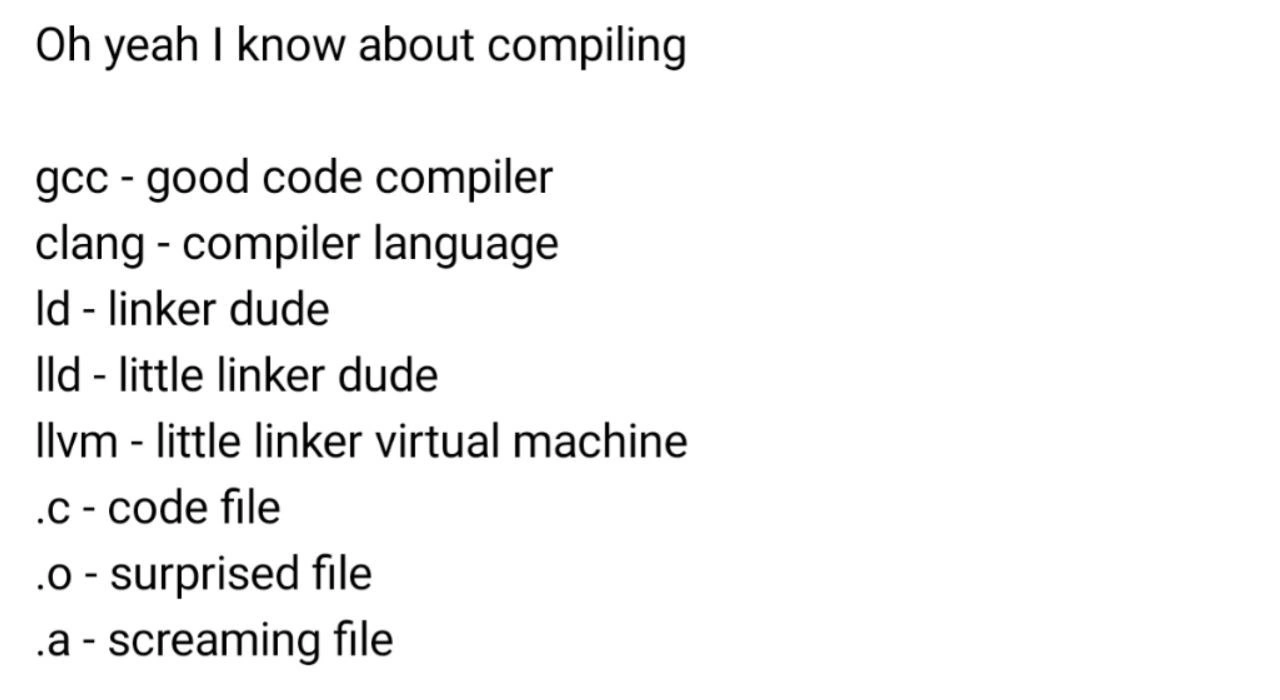
For experienced developers, this meme is a textbook facepalm moment wrapped in humor. It pokes fun at the kind of confident misunderstanding we’ve all seen (or committed) early in our careers. The quote “Oh yeah I know about compiling” sets the tone: a bravado-laden proclamation typically heard just before someone reveals they have no idea what’s really going on. Each bullet point then gleefully showcases how a beginner might interpret complex toolchain acronyms if they just trust their ears and a pinch of imagination. The result is equal parts ridiculous and adorable. A senior engineer reading “gcc – good code compiler” is likely smirking because GCC is so fundamental to C/C++ programming that messing up its name that badly is unthinkable after your first year of programming. It’s as if someone said the FBI is the “Federal Belly Investigator” – so wrong it’s funny. The humor lands because the newbie’s explanations aren’t random gibberish; they’re phonetically plausible. Clang does sound like it could expand to “C-lang” (C language) or maybe “compiler language” as the meme suggests. In reality Clang is known for being LLVM’s C/C++ compiler front-end, but hey, if you squint, “compiler language” has the letters and a dash of naive charm. Seasoned devs recognize this pattern instantly: the meme is highlighting how our beloved tools can look totally cryptic to the uninitiated.
Another layer to the joke is how it anthropomorphizes the build tools, turning them into a cast of cartoonish characters. ld as “linker dude” is especially chuckle-worthy: every experienced programmer knows ld as the stoic, silent linker that typically works behind the scenes. It’s rarely personified, but here we imagine ld as this friendly “dude” bro-ing out while gluing binaries together. Seeing “lld – little linker dude” right after that is a one-two punch of puns for anyone familiar with LLVM’s toolchain. The meme deconstructs LLVM’s naming convention (often everything in LLVM has an extra L to denote it’s part of LLVM, like lld for the linker, llc for the compiler backend, etc.) and twists it into a whimsical image of a mini sidekick linker. A senior dev gets the double joke: first, that LLD is indeed a smaller, newer linker (so calling it little is a kind of tongue-in-cheek accuracy), and second, that no one in their right mind would actually call it that in documentation. It highlights a shared experience: the first time you encounter these acronyms, you might actually wonder “what do these letters stand for?” and sometimes the real answers (like “GNU Compiler Collection” or “Low Level Virtual Machine”) are themselves non-intuitive until you learn the history. So hearing blatantly wrong answers with a straight face is comedic gold – it’s laughing with our past selves who might have been just as clueless once.
The file extension jokes (.c, .o, .a) drive the point home by venturing into pure silliness, which any developer who’s slogged through build logs can appreciate. In a real build process, you compile file.c into file.o and then archive or link it into an executable or .a library. By the time you’re a senior, you’ve perhaps written a custom Makefile or debugged a linking error at least once, so you have a healthy respect for these suffixes. Seeing someone call a .o an "oh, surprised file" is a lighthearted reminder of how opaque our tools can seem. It’s a phonetic pun – .o as in “oh!” – that doubles as commentary: raise your hand if you’ve been surprised by an object file error or an unresolved symbol at 2 AM. And .a as a "screaming file"? That one’s a sly wink to those of us who have dealt with static libraries and version mismatches – a static .a library usually just sits there, but when it’s missing or mismatched, you might indeed scream “Aaaa!” at the linker errors. The meme exaggerates a newbie’s innocent perspective to the point of absurdity, and that absurdity tickles seasoned engineers because it juxtaposes our deep knowledge with comedic ignorance. In a field where acronyms and jargon run rampant (from CI/CD pipelines to YAML configs), this post is a palate cleanser, reminding us how our tools might look through the eyes of a total outsider. It’s both a subtle nod to the complexities we take for granted and a communal laugh at how silly those complexities sound when misinterpreted. Seasoned devs love this kind of humor because it's inside baseball – if you know, you know, and if you don’t, well... you end up thinking a .o file is making an “O-face”!
Beyond the chuckles, there’s a bit of shared relief and camaraderie in this meme. It pokes fun at the insularity of low-level programming knowledge. Topics like compilers and linkers are often considered advanced, almost arcane subjects in software development. Many engineers recall struggling with their first makefile or their first linker error (undefined reference to ___) with no idea what ld even was. This post compresses that enormous gap in understanding into a tiny list of “definitions” a clueless braggart might give. The senior perspective implicitly recalls the journey from ignorance to enlightenment: “Yep, I remember when I had no idea what LLVM meant either, though I never thought it was a little linker VM!”. It’s a humorously safe way to acknowledge that everyone starts somewhere, and no matter how much of a hot-shot we become with -O3 optimizations or tuning compiler flags, we all had that learning phase. In essence, experienced developers laugh because they see both their younger self and the utter absurdity of the misnomers – a combination that is both humbling and hilarious.
Level 4: Arcane Acronyms Unveiled
At the deepest technical levels, the humor of this meme comes from how profoundly wrong yet phonetically plausible these expansions are, given the historical context of compiler toolchains. In reality, GCC stands for the GNU Compiler Collection – a flagship project of the Free Software Foundation dating back to the 1980s. It originally meant the GNU C Compiler, but over time GCC grew to support many languages (C++, Fortran, Ada, etc.), hence "Compiler Collection." There’s nothing inherently “good” or “bad” in its name – GNU itself is a recursive acronym ("GNU's Not Unix"), a far cry from Good Code Compiler. Similarly, Clang isn’t literally "compiler language" – the name Clang was chosen as a playful contraction of “C language” (since it’s a C family compiler) and to evoke the sharp sound of metal (reflecting its goal to be a fast, sharp compiler). Clang is part of the LLVM project, which originally stood for Low Level Virtual Machine. LLVM began as a research project for a retargetable compiler infrastructure with a virtual instruction set – the "virtual machine" in its name is more about an intermediate representation (IR) than a VMware-style VM. Over time, LLVM became an umbrella for a whole suite of compiler components (optimizers, backends, linkers), and the project leads eventually stopped treating LLVM as an acronym at all – it's just LLVM now, a name unto itself. That nuance is lost on our meme’s enthusiastic novice, who adorably reinterprets it as "little linker virtual machine," preserving the letters but accidentally conjuring an image of a tiny linking robot. It’s a case of compiler abbreviation misinterpretation meets childhood imagination.
Delving into the linker side, ld is the traditional Unix linker (historically short for “Link Editor,” not "Linker Dude" 😄). In low-level programming and OS toolchains, ld is an essential tool that combines multiple .o object files and static libraries into a single executable or library. Its name is terse because early Unix tools favored two-letter names (cp, ls, ed, etc.) due to command-line brevity and teletype era limitations. The meme’s author jokingly personifies ld as a “dude” – perhaps imagining it as a friendly bro who hooks your code together – and then doubles down with LLD, calling it "little linker dude." In reality, LLD is the LLVM project’s own linker, meant to be a modern, faster replacement for the system ld. The double LL in lld doesn’t actually stand for "little" (it’s just LLVM Linker), but in the meme’s twisted logic, lld sounds like ld’s kid brother – a little linker dude. This playful anthropomorphism continues the toolchain lore: it’s as if each tool is a character in a low-level build systems saga, where even the all-powerful LLVM is imagined as a cute mini virtual machine helping out the linkers.
On the file extension front, the meme ventures into file extension personification. In real compiler workflows, a .c file is a C source code file, a human-written text file containing C language code. When you compile code.c with GCC or Clang, you typically invoke something like gcc -c code.c -o code.o, which produces a .o file. That .o is an object file – not an object in OOP sense, but a binary file containing machine code and relocation info, essentially the machine-readable translation of the source, waiting to be linked. The meme jokes that .o is a "surprised file," likely because the single o could be seen as a cartoon surprised mouth (:O). Amusingly, one could say the object file is surprised – after all, it’s incomplete, wondering where all the other parts of the program are until the linker dude comes along. Finally, a .a file is a static archive (basically a bunch of .o files collected into one library, created by the ar archiver tool). The .a extension stands for “archive,” but our meme-maker hears it as a lone letter “a” and imagines a scream: "AAAA!" – hence a "screaming file." It’s an absurd rebranding of static libraries, which in reality sit quietly in your filesystem until the linker needs them. There’s an inside joke here: dealing with static .a libraries (especially missing ones or linking them in the wrong order) can indeed make a programmer want to scream in frustration. So calling it a “screaming file” is accidentally poetic. Under the hood, the linker (dude or not) treats .a files by pulling out the needed .o modules to satisfy undefined symbols in your program. This process involves some deep system-level concepts – symbol tables, relocation entries, and the ELF format on Unix-like systems – but none of that is apparent from the cutesy definitions in the meme. The toolchain humor here arises from the dissonance between those arcane linking mechanics and the delightful, almost kindergarten-level reinterpretation of what each suffix or acronym might mean if you had zero context but a lot of confidence.
In summary, this top-tier analysis reveals that the meme’s charm is rooted in gnarly technical reality being reframed as innocent gibberish. To a senior engineer or a compiler enthusiast, terms like GCC, Clang, LLVM, .o and .a carry decades of design decisions, historical naming baggage, and low-level programming knowledge. Seeing them misexplained in such a blatantly wrong yet endearingly naive way triggers a mix of laughter and near-academic appreciation. It’s like a small linguistic experiment: if someone uninformed tried to reverse-engineer acronyms from sound alone, they might land on these hilariously misguided expansions. The joke underscores the gap between the precise, pedantic world of compilers and the playful creativity of a newbie mind. It also highlights why programmers often use jargon – without context, our tool names sound like alphabet soup, ripe for adorably confused reinterpretation.
Description
This image is a simple text-based meme on a white background that humorously presents a list of incorrect definitions for common compiler and linker tools and file extensions. The title reads, 'Oh yeah I know about compiling', followed by a list of fabricated meanings: 'gcc - good code compiler', 'clang - compiler language', 'ld - linker dude', 'lld - little linker dude', 'llvm - little linker virtual machine', '.c - code file', '.o - surprised file', and '.a - screaming file'. The joke is aimed at developers familiar with the C/C++ build process, who would recognize that these definitions are comically wrong. For example, GCC is the GNU Compiler Collection and LLVM is the Low Level Virtual Machine. The humor lies in the confident ignorance, personifying file extensions and tools in a way that perfectly captures the feeling of a junior developer trying - and failing - to sound knowledgeable
Comments
10Comment deleted
They forgot the most important one: `a.out`, which clearly stands for 'another one bites the dust'
Sure, call it “little linker dude” all you want - just remember he’ll segfault in protest the moment you forget -Wl,--whole-archive
After 20 years of explaining to junior devs that LLVM doesn't actually stand for 'Low Level Virtual Machine' anymore, I'm starting to think 'little linker virtual machine' might be easier to sell to management when justifying our 3-hour build times
The progression from 'linker dude' to 'little linker dude' to 'little linker virtual machine' perfectly captures the existential journey of LLVM's architecture - where each abstraction layer adds another diminutive qualifier until you're debugging IR passes at 3 AM, wondering if the 'little' refers to the toolchain or your remaining sanity. And yes, .o files are indeed surprised - surprised they compiled at all given the template metaprogramming horrors they contain
.a equals screaming file is the only accurate line - it's the noise ld makes when the archive was built without -fPIC and you’re linking into a PIE at 3am
GCC: 'Good Code Compiler' in memes, 'Gruesome Crashes Constantly' when ld linker dude ghosts your symbols
Call it “linker dude” until ThinLTO nails you with an undefined reference from a mismatched -fPIC build - then you’re negotiating ABI treaties at 3am
Lol Comment deleted
lmao Comment deleted
hi from September 2022 Comment deleted