Skip to content
DevMeme
1428 of 7435
A 'C' for Effort: A Literal Hello World
Interviews Post #1601, on May 17, 2020 in TG

A 'C' for Effort: A Literal Hello World

Why is this Interviews meme funny?

Level 1: Followed to the Letter

Imagine you ask someone to write a message using a specific thing, and they take your request super literally. For example, suppose a teacher says, “Please write the word HELLO using apples.” The normal idea would be to maybe write the letters H-E-L-L-O on paper and maybe draw an apple, or at least write it in apple-themed colors. But instead, the student goes and gets a bunch of real apples. Then they carefully arrange all those apples on the floor in the shape of a big “H”, then “E”, then “L”, spelling out the word HELLO in giant letters made of apples. They technically did what was asked (they used apples to write “HELLO”), but not in the way the teacher expected (the teacher probably just meant to use apple drawings or something simple). It’s such an overly literal and unexpected way to follow the instruction that it becomes silly and funny.

This meme is joking in the same way. The interviewer said to write "Hello World" using C. The interviewer meant “use the C programming language to print out Hello World.” But the person took it to mean “use the letter C itself to make the words.” So they made a big artful text of HELLO WORLD out of many, many little c letters. It’s as if you told someone to spell “Hello” with the letter C, and they went ahead and built the entire word out of C’s like building blocks. It’s funny because the person followed the request exactly word for word, but in doing so, completely ignored what was really wanted. It’s a goofy misunderstanding — the kind that makes us laugh because we can see how the mix-up happened and how absurd the result is. In simple terms, the joke shows how taking words too literally can lead to a result that’s technically right but totally not the right answer to the real question.

Level 2: Using 'C' Literally

Let’s break down what’s happening in this meme. The setting is a technical interview. The dialogue goes:

  • Candidate (Me): “I am good in C language.”
  • Interviewer: “Then write ‘Hello World’ using C.”
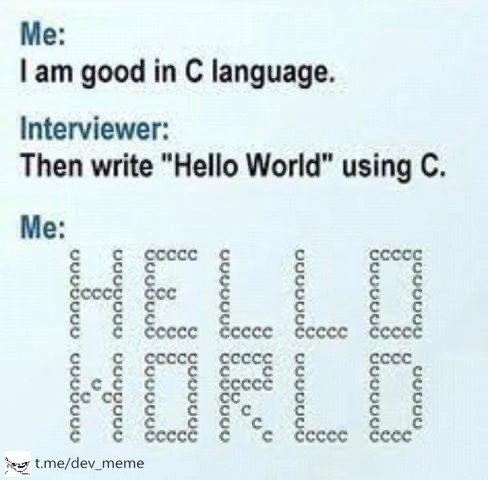
  • Me: (reveals a result where the words HELLO WORLD are made up of the letter “c” repeated many times)

Normally, “write ‘Hello World’ in C” means write a small program in the C programming language that outputs the text “Hello World”. C is a popular programming language (part of the C family languages like C, C++, C#) known for its efficiency and low-level power. When someone says they are "good in C," it implies they can write programs in the C language. A classic first task in learning any language, especially C, is to write a program that prints “Hello World” to the screen. In C, that program is only a few lines of code. For example, a simple C program to do this might look like:

#include <stdio.h>

int main() {
    printf("Hello World");
    return 0;
}

In an interview, asking someone to write this is usually a gentle warm-up or a way to verify that the candidate actually knows the basics (like how to structure a program and use printf in C). It’s such a fundamental exercise that it’s almost synonymous with starting programming. HelloWorld is basically the first thing you learn to do when exploring a new programming language.

Now, here’s where the meme gets funny. The interviewer said “using C.” The intended meaning was “using the C programming language.” But the candidate in the meme interprets “using C” in the most literal way possible – as in, using the character 'C'. Instead of writing a C program, the candidate writes out the phrase "HELLO WORLD" by assembling it from many letter 'c's. The image shows each big letter (H, E, L, L, O, etc.) composed of a bunch of small lowercase c characters arranged carefully in rows and columns. This kind of picture made from text characters is known as ASCII art. ASCII art has been around since the early days of computers, when graphics were limited, and people created images or stylized text using regular keyboard characters. Here, the ASCII art is used to spell "HELLO WORLD" with the letter c repeating to form each letter shape. It’s as if the candidate treated the letter 'c' like a Lego brick and built the words out of that brick.

So, the joke is a form of literal interpretation humor. The interviewer expected a C language program, but the candidate delivered an ASCII art sign built out of the letter C. It’s a pun because the word “C” can mean the programming language or just the letter. The candidate followed the words of the request exactly, but in the wrong context. They used 'C' (the letter) to write "Hello World," instead of using C (the language) to print "Hello World." It’s like a goofy misunderstanding. In reality, no one in an interview would do this – if they did, the interviewer would probably be very confused! But as a meme, it’s playing on how a simple phrase can be interpreted in a completely unintended way. It highlights a bit of CodingHumor and LanguageQuirks: the language named C is just a single character, which makes this kind of wordplay possible.

For a new developer or someone learning to code, the meme also subtly teaches a couple of things: First, what Hello World in C normally looks like (as shown above with printf). Second, what ASCII art is (here it’s used creatively to make a point). And third, it emphasizes careful reading of instructions. In programming (and especially in a technical interview), understanding what is being asked is crucial. If you take something too literally without confirming the meaning, you might end up doing a lot of work that doesn’t actually solve the real problem. This meme exaggerates that to an absurd degree for comedic effect. It’s a memorable little joke that combines InterviewHumor with a nerdy pun on the C language. Even if you’re just starting out, you can appreciate that the candidate’s answer is not “correct” in the expected sense, but it’s funny because they did use C… just not in the right way. Think of it as a light-hearted reminder: in tech, always make sure you and the other person are talking about the same thing — sometimes one letter can make all the difference!

Level 3: The Letter vs The Language

This meme stages a classic technical interview scenario with a twist of literal interpretation. A candidate boasts, “I am good in C language.” The interviewer responds with the standard request: “Then write 'Hello World' using C.” Now, any experienced developer knows that “Hello World” in C is the most basic of programs – typically just a quick printf statement in a short C program. It’s a staple exercise found in the first chapter of K&R’s C programming book and a rite of passage in the TechnicalInterviewProcess for many languages. The humor here comes from the candidate completely misinterpreting the instruction. Instead of writing a C program, they literally write “HELLO WORLD” out of the letter ‘c’ characters. The image shows the phrase “HELLO WORLD” rendered as chunky ASCII art, with dozens of tiny c letters arranged to shape each big letter. In effect, the candidate “used C” not as in the programming language, but as in the actual letter C to construct the output. It’s a perfect storm of wordplay and nerdy wit: the phrase “using C” had two possible meanings, and the candidate chose the wrong one in a very creative way.

For seasoned developers, this joke lands because it rides on our expectation versus reality. We expect the candidate to whip out a quick #include <stdio.h> and call printf("Hello World"); — something any programmer claiming CFamilyLanguages proficiency should do in seconds. Instead, the candidate delivers an absurdly over-engineered result, painstakingly arranging c letters to form words. It’s funny because it’s overkill and utterly misses the point. This is the kind of humor where an overly eager junior might solve the wrong problem very thoroughly. The interviewer meant “use C (the language) to print Hello World”, but the candidate followed the words to the letter (quite literally the letter c). Every experienced dev has seen situations where someone misunderstood specs or took requirements too literally, leading to results that are technically what was asked for, but not what was actually wanted. This meme exaggerates that phenomenon in a harmless context. It highlights a common language quirk in tech interviews: sometimes the way a task is phrased can be interpreted in an unexpected way, especially if the key word (like “C”) has multiple meanings.

Beyond the wordplay, there’s an inside joke here about “Hello World” itself. It’s traditionally the simplest program to demonstrate a language’s syntax. In C, it’s minimal and straightforward – a litmus test for basic competency. By showing a candidate who claims to be good at C but then avoids writing even this simplest code, the meme pokes fun at the idea of talking big but performing poorly. It’s as if the candidate either doesn’t actually know C and attempted a clever dodge, or they’re being facetious. Either way, it taps into InterviewHumor – that mix of stress and absurdity candidates and interviewers alike sometimes experience. Senior engineers reading this might chuckle and think, “Well, that’s one way to meet the requirements… technically!” It resonates because in real software development, a misunderstanding of one word in a spec can lead to wildly off-target implementations. Here it’s harmless and humorous: no production bug or failed system, just a goofy misunderstanding. The interviewer got exactly what they asked for, but not what they meant, echoing that old programmer adage: “Be careful what you ask for, because you just might get it (in the most literal way).”

Another layer to this joke is the absurd effort-to-result ratio. Constructing HELLO WORLD out of many tiny cs is actually much more work than writing the correct C code. It’s a tongue-in-cheek nod to how developers sometimes overcomplicate things when a simple solution would do. Seasoned devs have all seen cases of unnecessary complexity or fancy “clever” solutions that miss the mark — this meme is a lighthearted depiction of that. And of course, there’s the meta pun of a language named after a single letter. Only in a language quirk like C (or maybe Go, R, etc.) could you even make this joke. It reminds us of the importance of clear communication: in an interview (and in specs), saying exactly what you mean is crucial. Otherwise, you might end up with an answer that is technically correct but completely unhelpful. The meme’s punchline is a harmless example of that kind of mix-up, and it makes developers laugh because we’ve all been on one side or the other of a misunderstanding and can appreciate the ridiculousness when instructions are followed to the letter.

Description

A text-based meme on a light blue, slightly pixelated background, presented as a dialogue from a technical interview. The exchange begins with 'Me: I am good in C language.' The 'Interviewer:' responds with a classic screening task: 'Then write "Hello World" using C.' In the final section, 'Me:', the response is not a block of code but the phrase 'HELLO WORLD' meticulously constructed as ASCII art using only the lowercase letter 'c'. The joke hinges on the candidate's comically literal interpretation of 'using C,' taking it to mean using the character 'c' rather than the C programming language. It's a simple pun that highlights the amusing gap between ambiguous human language and the precise nature of code

Comments

7
Anonymous ★ Top Pick This is malicious compliance at its finest. The same candidate, when asked by the manager to 'push to master,' would probably try to physically shove the lead developer
  1. Anonymous ★ Top Pick

    This is malicious compliance at its finest. The same candidate, when asked by the manager to 'push to master,' would probably try to physically shove the lead developer

  2. Anonymous

    Interviewer: “Print Hello World in C.” Candidate: drops a 2-KB banner built from 0x63 literals. Me (architect hat on): give them the offer - anyone who weaponizes requirement ambiguity into constant-time ASCII art already speaks fluent legacy spec

  3. Anonymous

    After 20 years in the industry, I've learned that the correlation between 'I'm good at C' and actually remembering to include <stdio.h> is about as reliable as a pointer arithmetic calculation after three beers at the company happy hour

  4. Anonymous

    Claiming C proficiency in an interview is like saying you're fluent in Latin - until they ask you to conjugate a verb and you realize you've been accidentally writing Perl this whole time. The interviewer asks for 'Hello World' and you deliver a pointer-to-pointer-to-pointer masterpiece that would make Dennis Ritchie weep, proving that the shortest distance between two points in C is actually a segfault

  5. Anonymous

    The ultimate C Hello World: zero mallocs, no segfaults, just a buffer overflow of self-referential chars

  6. Anonymous

    Meets the spec by maximal reuse of the 'c' primitive; shame GCC still throws 'undefined reference to main' on ASCII art deliverables

  7. Anonymous

    Asked for “Hello World in C,” they drew it with C’s - the only C program that’s portable, thread-safe, and guaranteed not to invoke undefined behavior

Use J and K for navigation