The Infinite Free Trial Loop
Why is this Marketing meme funny?
Level 1: Fake Mustache Trick
Imagine you’re at an ice cream shop that says: “First sample spoon is free for each customer.” You really want more free tastes of different flavors. What do you do? You might put on a fake mustache, change your hat, or even come back speaking in a silly voice to pretend to be a “new customer” every time. Each disguise fools the ice cream lady, and she gives you another free sample because she thinks it’s your first time.
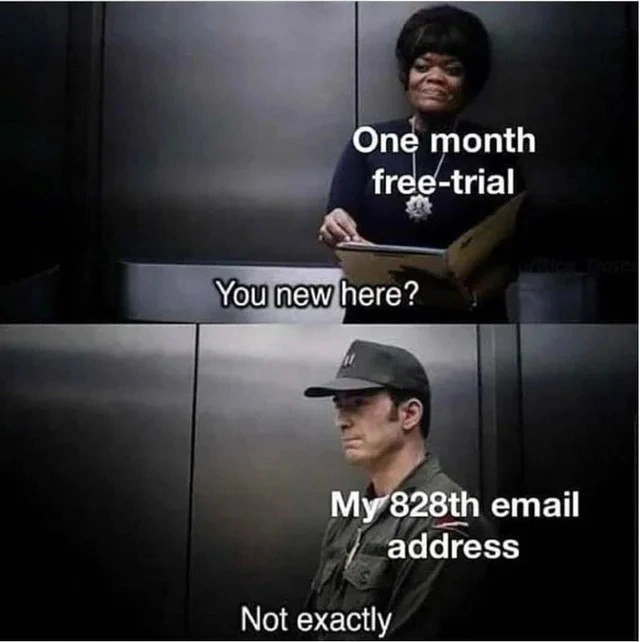
In this meme’s story, the software’s free trial is like that free sample, and creating a new email address is the disguise. The SaaS app asks, “You new here?” just like the ice cream lady does. And our developer hero, holding his 828th email address, is basically wearing his 828th fake mustache, saying “Not exactly.” He’s done this over and over to get that “first-timer” freebie.
It’s funny because we all know it’s a bit cheeky – kind of like a kid going through the sample line again and again with different hats. The joke highlights the playful sneakiness: the service hopes to find new people to pay for ice cream (or software), but the sneaky customer keeps coming back for freebies infinite times by pretending to be brand new each visit. It’s a goofy high-tech version of “I’m totally a different person, I swear!” The humor hits home because it’s about getting around rules with a wink – something even non-tech people can relate to (who hasn’t tried to snag an extra free sample?). In simple terms: the meme is saying sometimes, when a system tries to limit you, people will find a silly way to get a little more for free, and that’s both clever and comical.
Level 2: Throwaway Emails 101
Let’s break down the technical references and why this scenario is so relatable to developers. SaaS free trials usually let you try a service for a short period (say a month) using just an email to sign up. “Are you new here?” in the meme is what a trial signup flow might as well be asking every time you create an account. They expect new users to maybe sign up once, or at most a few times if they forgot a password. But developers know how to bend these rules.
Email aliases and throwaway addresses are the star tools here. If you’ve ever used Gmail, you might know about the plus + trick: Gmail ignores anything after a plus in your email name. So [email protected] is the same inbox as [email protected] or [email protected]. This is called subaddressing or plus-addressing. Developers use it to filter mail (e.g., seeing who sold your address by checking the suffix) and, relevant to our meme, to create multiple accounts on the same service. For the SaaS system, these look like brand new emails – they’re different strings – but you as the user still get all the messages in one place. In the meme, when the guy says “My 828th email address,” he might be exaggerating, but he’s hinting that he’s used hundreds of alias emails in this manner to continually get “new” free trials. It could be literally unique addresses (perhaps using a service like TempMail for quick one-offs, or a custom domain to generate unique emails), or using a base email with 827 different +aliases appended!
Why would someone do this? Because after the free month ends, the service typically requires payment to continue. Many developers either can’t justify the cost, or only needed the service briefly, or just enjoy the challenge of getting something for free a bit longer. It’s a classic developer mindset: if a rule is enforced by software, find a software-driven way around it. Creating another email address is usually easier than, say, stealing a credit card – and it’s legally harmless, if a bit against the service’s terms. Some devs even have domains of their own (like mytrial.dev) where they can catch-all any address ([email protected], [email protected], … up to [email protected]!). This way they can generate practically unlimited accounts and receive all confirmation emails.
This meme also touches on developer humor around devs vs. product limitations. It highlights a relatable pain point: the friction of signup processes. For example, if you’re a junior dev trying out a cloud service or an API that says “30-day free trial, then pay,” you might create a second account with your school email once the first trial runs out. Next thing you know, you’ve got a personal Gmail, a school email, maybe a work email, plus a few +aliases – an arsenal to stretch that trial period out. Each time, the SaaS greets you like a stranger, “Welcome, new user!”, and you smirk because you know you’ve been here before under different guises. The meme exaggerates it to an absurd degree (828 emails! 😅) for comic effect, but any dev who’s juggled even a handful of throwaway accounts immediately gets the joke.
Let’s clarify some terms from the tags:
- Temporary_emails: services or techniques to create an email address that lasts just long enough to receive a signup confirmation. Example:
10minutemail.comliterally gives you an email for 10 minutes. - Plus_alias_trick: The Gmail (and some other providers’) feature we discussed, where adding
+somethingstill delivers to your base email. It’s a trick to make “new” addresses on the fly. - Trial_period_resets: Essentially what our meme hero is doing – resetting the clock on a trial by appearing to be a new user each time.
- Subscription_workaround: any method that circumvents the normal subscription process. Using new emails is one of the simplest.
- Account_abuse: what SaaS companies might call this behavior internally. One person having multiple free accounts is technically “abusing” the free trial system (it’s against the spirit if not the letter of the rules).
For a junior dev, this might be eye-opening because it reveals an unintended feature of how signups work. It’s also a lighthearted introduction to the idea that users don’t always behave the way services expect. Companies might assume “one person, one account,” but in practice, people find loopholes. This is the same energy as using a friend-referral link on yourself by making another account, or using the incognito mode in a browser to get past a one-per-user limit. It’s all about understanding the system’s checks and then finding a clever bypass. And developers, being system-thinkers, love finding bypasses!
Level 3: Infinite Trial Loop
At the highest level, this meme pokes fun at a cat-and-mouse dynamic between SaaS free-trial limits and a resourceful developer. The top panel’s character (holding a folder in an elevator) represents a SaaS application cheerfully offering a “One month free-trial” and asking “You new here?” as if greeting a first-time user. The bottom panel’s character (with the baseball cap) deadpans back with “My 828th email address – Not exactly.” This exchange is dripping with sarcasm familiar to senior devs: it’s the ritual dance of exploiting free trial periods by cycling through throwaway accounts.
Consider what’s happening behind the scenes. Many SaaS platforms use email addresses as unique identifiers for accounts. They assume one person = one email. Seasoned devs know this is a soft barrier at best. There’s an entire arsenal of tactics to manufacture “new” email addresses that still forward to you. The meme’s hero has done it 828 times, highlighting the absurd extreme. It’s exaggeration, but not by much – some developers maintain dozens or hundreds of accounts across services to exploit free tiers or avoid paywalls.
One common trick is the plus-addressing exploit. Many email providers (like Gmail) allow adding a +suffix to your address ([email protected], [email protected], etc.) which still delivers to the same inbox. SaaS signup forms often treat each unique string as a different user email, so [email protected] and [email protected] look like two distinct people even though Alice receives all the confirmation emails. If the SaaS isn’t scrubbing or detecting these aliases, a single person can register unlimited “new” accounts. Temporary email services (like Mailinator) are another tool of the trade – spin up a quick inbox, verify the account, and abandon it when the trial ends. The goal is clear: continuously reset the trial period ad infinitum without paying.
From a senior developer’s perspective, the humor also touches on Developer Experience (DX) friction. Free trials are meant to entice users, but overly restrictive or short trials push tech-savvy users to play whack-a-mole with accounts. It’s a commentary on how power users will go to great lengths – even automating signups – to bypass what they see as unnecessary roadblocks. This can indicate a disconnect between SaaS product strategy and how developers actually behave. We’ve all seen it: the corporate policy says “one per customer,” but the dev community treats it like a challenge to be engineered around.
There’s a subtext of battle-hardened experience here too. The phrase “You new here?” gets answered by “Not exactly,” implying the user has been through this loop so many times that it’s basically a running joke. For veteran developers, it’s a knowing nod to repeatedly testing or demoing services under different emails – perhaps to evaluate updates, or just to keep using a tool without hitting a paywall. It’s also a wink at how email itself is an archaic identity system that’s easily gamed; yet so many modern services lean on it. A senior might even recall internal meetings about curbing trial abuse, implementing checks like credit card verification or CAPTCHAs. Of course, every countermeasure spawns a new counter-countermeasure (e.g. using virtual credit card numbers to get around CC requirements). It’s an arms race between growth-hacking users and revenue-protecting product teams.
In short, this level of analysis reveals the meme as a commentary on subscription workarounds in the software industry. It reflects an insider understanding: the moment a SaaS prompt assumes innocence (“you new?”), the cynical veteran user has already donned their 800+ disguises. The humor resonates because it’s too real – practically a rite of passage in modern developer culture.
Description
A two-panel meme based on the 'Captain America in an Elevator' scene from 'Captain America: The Winter Soldier'. In the top panel, a smiling woman in a dark suit, labeled 'One month free-trial', looks at Captain America and asks, 'You new here?'. In the bottom panel, a stoic, suspicious-looking Captain America in a cap and uniform, labeled 'My 828th email address', replies grimly, 'Not exactly'. The meme humorously depicts the common tech-savvy practice of using numerous disposable or aliased email addresses to repeatedly sign up for free trials of software, SaaS products, or other online services. It captures the cat-and-mouse game between companies offering trials to attract new users and the resourceful individuals who find ways to remain a 'new user' indefinitely
Comments
7Comment deleted
The fastest way to validate a startup's user verification logic is to see how many times you can sign up for their 'one-time' free trial with variations of your Gmail address using the '+' symbol
If your “first-month free” gate is literally `if (!db.contains(email))`, don’t act surprised when my cron spits out address #829 before your metrics dashboard even ETLs
We spent three sprints building sophisticated user analytics and churn prediction models, meanwhile our entire conversion funnel is just competing against a regex that blocks '+' signs in email addresses
After 828 email addresses, you're not just avoiding payment - you're essentially running a distributed identity management system with better uptime than most enterprise SSO implementations. At this point, the real technical debt isn't the unpaid subscriptions, it's maintaining the mental hash table mapping which email you used for which service. Senior engineers know the true cost of 'free' isn't the $9.99/month - it's the cognitive overhead of your homegrown email orchestration platform and the inevitable 'forgot password' spiral when you actually need to access something six months later
When identity is modeled as unique(lower(email)), you’re not stopping abuse - you’re benchmarking your CRM against my catch‑all domain and Gmail+ aliases
SaaS free trials: compute scales to zero, but email queues hit infinite cardinality
One trial per email? If your anti-abuse logic is UNIQUE(email), my catch-all domain is your chaos monkey