When Git Puns Hit a Little Too Close to Home
Why is this VersionControl meme funny?
Level 1: If Only Life Had Undo
Imagine you wake up to find a big tree branch fell on your favorite toy car and broke it. You’d feel pretty upset, right? Now, your friend comes by and says, “Hey, let’s just press the undo button and put that branch back on the tree!” Of course, in real life there’s no magic undo button to fix the car instantly, so it sounds silly. Your friend quickly adds, “I’m sorry, I know that’s not actually possible. That really stinks, and I feel bad for you.”
What’s happening here is a simple joke: the word “branch” means a tree branch, but for computer programmers, “branch” also means a copy of their work they can play with without ruining the original. And programmers have a tool that can undo mistakes in their code. So when the friend sees a branch on the car, their nerdy brain goes, “Haha, what if we could just undo this like a computer mistake?” It’s a goofy way to try to make the car’s owner smile for a second. The reason it’s funny is because it mixes something very real (a broken car windshield) with something from the computer world (an undo command). It’s like saying, “I wish fixing this was as easy as pressing Ctrl+Z (the undo keys) on a keyboard!” Both friends know you can’t actually do that, but sharing that little joke is a way to show, “I care about what happened and I wish I could make it right, even if I can only do it in our imagination.”
So, the core of the humor is this: when bad stuff happens, friends sometimes make gentle jokes to help you feel a tiny bit better. Here, the joke is wrapped in programmer talk, because that’s the language they share. Even though the car’s windshield has a real crack and not a “bug in the code,” thinking about it like a computer problem for a moment makes everyone chuckle. It’s a funny and caring reminder that wouldn’t it be nice if real-life problems were as easy to fix as hitting the undo key on your computer?
Level 2: Git Branch Crash Course
Let’s unpack the technical terms and in-jokes for those newer to Git and developer chat culture. This meme plays on several version control concepts, primarily from Git, and uses them as puns for a real-world event. If you’re a junior dev or just learning Git, here’s a quick primer to understand why this joke is funny:
Git and Branches: Git is a tool developers use to track changes in code. Think of it like a timeline of code where you can create alternate timelines (called branches) to try out new things. A branch in Git is basically a pointer to a series of commits (changes) that diverges from the main line of development. Teams often create feature branches to work on new features independently, then later merge them back into the main line once they’re ready. The default main line is usually named main (it used to be called master in older repositories). In a project repository, main is like the primary highway of code, and branches are side roads where you can experiment.
Now, in real life, a branch is, of course, a part of a tree – literally a limb growing off the trunk. In the photo, a tree branch fell off (possibly due to heavy ice or wind) and landed on our poor developer’s car. So, when the friend says “revert that branch back to main,” they’re mixing the two meanings:
- They treat the tree branch as if it were a Git branch that mistakenly “diverged” from the tree (the tree’s trunk is like the main in nature).
- To revert in Git means to undo changes or roll back to a previous state. So the friend jokingly suggests “undoing” the fallen branch by somehow putting it back on the tree (as if the tree were a code repository and the broken-off branch could just be merged back to the main trunk).
Let’s map these terms from the coding world to the real world scenario:
| Term from the Meme | Real-Life Meaning | Git Meaning |
|---|---|---|
| Branch | A tree limb (like the one on the car) | A parallel line of code changes in a repository |
| Main (branch/trunk) | The main part of a tree (the trunk) | The primary/default code branch (main code line) |
| Merge Conflict | Two branches (tree limbs) crashing into something (the car) causing damage | A situation where two sets of code changes clash and Git needs human help to sort it out |
| Revert | Put something back the way it was (e.g. remove the branch and fix the car) | Undo a change by creating a new commit that reverses an earlier commit |
In the chat message, the friend essentially says: “Quick, undo that branch and put it back on the main trunk of the tree!” — as if the whole icy accident were a mistaken code change that could be fixed with a simple Git command. Of course, in reality you can’t magically revert a fallen tree limb; you’ll be dealing with insurance and cleanup, not git revert. 😅 But the joke lands because developers are so used to controlling software with commands that our first reaction to a real-world problem is to reach for a metaphorical “undo” button.
Merge Conflict on the Windshield: The title and imagery call this event a “merge conflict on your windshield.” To explain, a merge in Git is when you combine changes from one branch into another (usually bringing a feature branch into main). A merge conflict happens when Git can’t automatically reconcile differences between branches – for example, if two people edited the same line of code differently. When that happens, developers have to manually decide what the final code should be, kind of like a referee resolving a dispute. In the meme, the car’s windshield is the unlucky “file” that two tree branches tried to occupy at the same time – clearly incompatible changes! The result was destruction (shattered glass) because those branches “merged” in a disastrous way. It’s a visual gag: the broken windshield represents the mess of a merge conflict that wasn’t resolved properly (with the car as the code base that got wrecked by the collision of changes). For a junior dev, it highlights why merge conflicts are to be avoided – things can break when stuff from different branches doesn’t align! In code you’d fix a merge conflict by editing the code and committing the resolution; in real life, fixing this windshield_merge_conflict means a trip to the auto-shop.
Revert Joke and Chat Culture: The friend’s comment shows a common form of developer communication: using technical lingo in everyday contexts. New engineers quickly learn that chats in workplaces like Slack or Microsoft Teams are full of inside jokes and references. Here’s what happened in this scenario: the car owner likely shared the photo or news of the accident in a chat channel (maybe to explain why they’ll be late to work or just to vent). A teammate responded with the Git joke almost reflexively. Then, realizing it might be taken as insensitive (since the car owner is probably upset and dealing with a real problem), they immediately added “...sorry too early for jokes. Sorry man that sucks.” This is a good example of balancing humor with empathy in team communication. Developers often use humor to bond and defuse stress, but they also watch out for each other’s feelings. The laughing-with-tears emoji reaction from others (shown with a count of 5 in the screenshot) means multiple people found the joke funny and reacted to it, which is how people in chat show appreciation for a clever quip. In a team chat, it’s common for someone to crack a pun like this and the rest to pile on with emoji reactions or follow-up jokes, all in good fun.
So if you’re new to this kind of humor: don’t worry, no one actually thinks a Git command could fix a busted car! 😜 It’s just an example of wordplay that ties our coding world to real life. As a newcomer, you might not get the joke at first if you haven’t experienced a painful Git merge or needed to revert a bad commit. But once you’ve wrestled with a few messy merges, you’ll appreciate why the idea of a “quick revert” is both wishful and comical. This meme is basically saying: “Wouldn’t it be nice if real-life problems had an easy undo like in code?” — delivered in the nerdiest way possible. And it shows that in developer culture, even a lousy day (like finding your car under a pile of ice and wood) can prompt a bit of light-hearted banter. It’s how we remind each other: hang in there, we’ve all been there; at least we can laugh about it together.
Level 3: Literal Merge Conflict
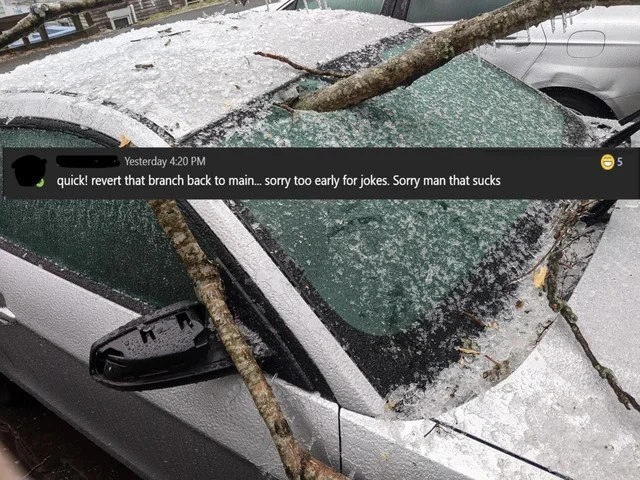
The photo captures a scene that any seasoned developer would smirk at: a literal tree branch crashed onto a car’s windshield during an ice storm, and immediately a teammate in a Slack-like chat seizes the opportunity for some dark developer humor. The chat message (timestamped Yesterday 4:20 PM) reads:
Teammate: quick! revert that branch back to main… sorry too early for jokes. Sorry man that sucks
In one line, this coworker manages to mash up Git version control jargon with the unfortunate reality of a fallen tree branch. It’s a perfect example of VersionControlHumor colliding with real life. Let's break down why this quip is making engineers chuckle and facepalm simultaneously:
“Branch” Double Meaning: In Git (the popular distributed version control system), a branch is a parallel line of development, a way to work on new features without disturbing the
maincode line. Here, a real tree branch has broken off and landed on the car. The pun is irresistible: a branch caused damage, so a dev’s brain instantly goes to “bad branch – we should revert it!” We’re witnessing a classic git pun in real life where the word branch bridges two worlds. A senior dev can't help but grin at this branch_back_to_main_pun.“Revert back to main” Joke: In Git, reverting means undoing changes (often via
git revertor resetting a branch to a previous state). And pushing “back to main” suggests returning to the primary code line (the default branch, formerly called master, now often named main). So when the friend says “quick! revert that branch back to main”, they’re cheekily treating the fallen tree limb like a rogue code branch that should be undone and merged back to the tree’s trunk (the tree’s main branch!). It’s an absurd mental image — as if you could fix the shattered windshield by running a Git command to yank the branch off and reattach it to the tree. This wordplay is exactly the kind of inside joke developers live for. In fact, the use of “main” instead of “master” is a subtle nod to current Git terminology circa 2020, showing the joke is up-to-date with industry changes.Merge Conflict on the Windshield: The meme’s title jokes about a “merge conflict” on the car’s windshield. In coding, a merge conflict happens when two branches (say, feature branch and
main) have changes that collide in the same part of a file – Git gets confused and asks the developer to resolve the conflict manually. It’s one of the most notorious headaches in collaborative coding. Here that concept is hilariously mapped onto the physical world: two tree branches + one car = a very messy conflict that definitely needs manual intervention (probably from a chainsaw and an insurance agent!). The windshield_merge_conflict comparison is exaggeration humor – the car’s poor shattered windshield visually resembles how a codebase feels when a merge goes horribly wrong. A senior engineer might quip, “Looks like production deploys didn’t go as planned – we’ve got to roll back.”SlackCommunication and Developer Reactions: The dark-themed chat overlay with a laughing-with-tears 😂 emoji reaction (5 people reacted) is a snapshot of typical dev team culture. This is how engineers often communicate: a mix of empathy and irreverence. The teammate’s immediate instinct is to drop a repository joke to lighten the mood – a form of camaraderie through nerdy humor. But notice they immediately follow up with “...sorry too early for jokes. Sorry man that sucks.” They recognized the timing might be off – the car owner is probably upset about the damage (a shattered windshield and hood dimpled by hail is no small hassle). This quick self-correction shows emotional intelligence in tech communications: we love our developer humor, but we also take care of our teammates. The laughing emoji reactions from others indicate the joke landed well in the group chat – everyone gets the Git reference and appreciates the pun, even as they sympathize with their colleague’s bad day. It’s a very relatable developer experience: something bad happens (in this case a tree branch through your car), and your techie friends can’t resist dropping a one-liner like it’s a code review comment.
From Technical Trauma to Humor: Seasoned devs have plenty of war stories with actual Git branches causing chaos – merges gone wrong, Friday deploys that break production, revert missions at 4:30 PM to undo a bad push. That shared pain is what makes this joke land so well. The wordplay here is cathartic: it takes an annoying real-world event and filters it through our familiar Git problem-solution lens. The situation is absurd (you can’t fix a car with Git commands!), which produces that “it’s funny because it’s true (but also not true)” reaction. To an experienced developer, the phrase “revert that branch” triggers muscle memory of frantic fixes, and hearing it about an actual tree branch is so ridiculous it works. In the daily world of on-call issues and bizarre bugs, humor like this is a coping mechanism. We turn “a tree fell on my car” into “have you tried turning it off and on again?” or in this case, “let’s revert that commit (tree) and pretend it never happened.” It’s both a joke and a subtle way of saying “I feel your pain.”
In short, this meme strikes at the heart of developer culture: using our technical toolbox of metaphors (branches, merges, reverts) to communicate and commiserate. It’s a snapshot of how engineers mix work and life in conversation. Even a hailstorm’s damage to a car gets reframed as a goofy Git problem in the blink of an eye. And true to dev team form, it’s followed by an apology and genuine sympathy. The humor doesn’t diminish the suckiness of the situation, but it momentarily turns a real-life problem into a joke that only those versed in Git and Slack banter would fully appreciate. It’s a merge of empathy and nerdy wit – the kind of moment where you realize your coworkers are not just colleagues but fellow travelers in this quirky, branch-off reality we call software development.
Description
The image displays a silver car that has sustained significant damage from a large tree branch falling onto its windshield during what appears to be an ice storm, as the car and branch are covered in a layer of ice. The windshield is shattered. Overlaid on the image is a screenshot of a comment, which reads, 'quick! revert that branch back to main... sorry too early for jokes. Sorry man that sucks'. This meme creates a clever pun by juxtaposing a real-world destructive 'branch' with a 'branch' in the Git version control system. In software development, a branch is a separate line of code development, and 'main' is the primary, stable version. When a branch introduces critical errors, a developer might need to 'revert' it to fix the main codebase. The joke humorously applies this technical jargon to a disastrous physical situation, resonating with developers who understand the urgency and stress of undoing a 'breaking' change
Comments
11Comment deleted
The difference between a git branch and a tree branch is that you can't blame the intern for the tree branch. Usually
Mother Nature just demoed why we prefer trunk-based development: leave a branch unmerged long enough and it’ll eventually smash into prod without a code review - right through the windshield
This is what happens when you force push to production during a storm - even nature's branches can't handle the merge conflicts and decide to crash the system literally
When your feature branch causes so much damage that even `git revert` can't fix it - you need actual insurance. At least with code, you don't have to explain to your manager why you force-pushed a tree into production. This is what happens when you forget to run the linter before merging to main
Branch protection failed - an actual branch force-pushed to trunk, skipped CI, and shipped a breaking windshield to prod; guess we’re fixing forward with a chainsaw
Merging jokes to main before the team's caffeinated? That's not a feature, it's a force-push felony - revert and repent
Trunk‑based development was fine until the trunk shipped a breaking change to Main - at least this revert needs a chainsaw, not a 300‑comment PR
толерастия в мемах отстой Comment deleted
master Comment deleted
revert to master, достали уже Comment deleted
Ого комментаторы такие эджи Comment deleted