Skip to content
DevMeme
2214 of 7435
The Recursive Logic of Unnecessary Meetings
Meetings Post #2468, on Dec 18, 2020 in TG

The Recursive Logic of Unnecessary Meetings

Why is this Meetings meme funny?

Level 1: No Reply, They Drop By

Imagine your friend keeps texting you to ask how you’re doing on a school project, but you never text back. You just ignore all their messages. After a while, your friend gets worried or impatient and decides to come over to your house to talk to you in person. Now you’re annoyed and say, “You didn’t have to come all the way here, you could have just texted me!” Then your friend says, “But I did text you – you never replied!” Suddenly, you feel your face get hot and you start sweating because you realize it’s actually your fault they had to come. It’s a funny situation because you were blaming your friend for showing up, but really you caused it by not answering. In the same way, the comic is joking that if we ignore the easy way (like answering an email or text), we might end up dealing with the harder way (a big meeting or someone coming in person) and feel pretty silly about it.

Level 2: Inbox to In-Person

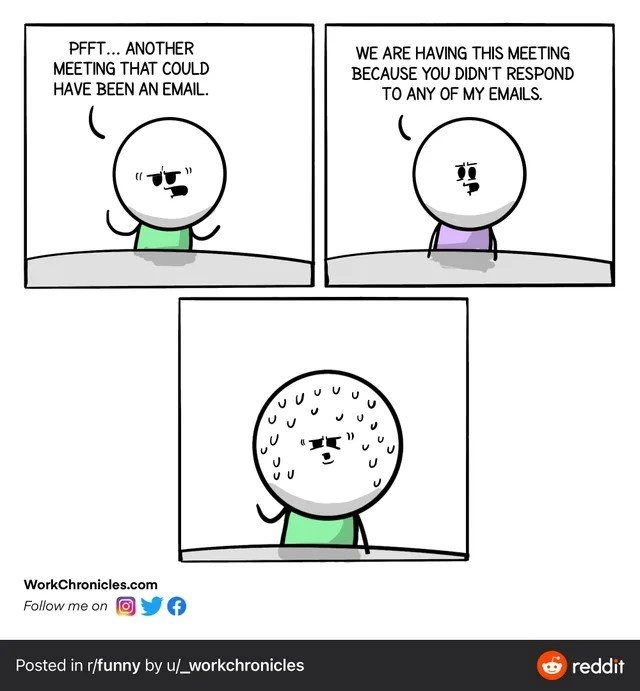
Let’s break down what’s happening in this meeting meme in straightforward terms. In the first panel of the comic, the developer in the green shirt rolls his eyes and says something like, “Ugh, another meeting that could have been an email.” This is a common complaint in offices – it means he thinks the meeting is a waste of time and the information could have just been sent around as an email. Meetings require everyone to stop what they’re doing and talk at the same time, which we call synchronous communication (like a live conversation). An email, on the other hand, is asynchronous communication – you send it, and people can read and respond on their own schedule without everyone having to be present together. Developers often prefer asynchronous updates for routine things (like status reports) because it lets them stay focused on coding and reply when they’re between tasks, instead of interrupting their work with a meeting.

Now, in the second panel, a coworker in the purple shirt responds, “We are having this meeting because you didn’t respond to any of my emails.” Oops! Here we learn that the colleague did try to handle this asynchronously by sending status emails (probably asking the team to share what they’re working on or if there are any blockers). The guy in green – the one complaining – ignored those emails completely (this is the “ghosting” behavior: not replying at all, as if he vanished like a ghost). Because he never replied with his status, the colleague had no choice but to call a face-to-face status meeting to get the information. Essentially, the meeting exists as a backup plan. If a team member doesn’t communicate through the intended channel (email), then the team lead or manager will escalate the issue to a meeting so nothing falls through the cracks.

So the funny (and embarrassing) part comes in the third panel: the green-shirted developer is shown zoomed-in with sweat drops on his face and a stunned, guilty expression. He’s speechless because he just got called out. He was complaining the meeting was pointless, but it turns out he was the reason the meeting had to happen! The phrase “this could have been an email” completely backfires on him. The comic by WorkChronicles is using that sweating reaction face to show he’s now uncomfortable and realizes he messed up.

For a junior developer or someone new to office life, there are a couple of takeaways here. First, when people say a meeting “could have been an email,” they’re talking about meeting overload – the feeling that there are too many unnecessary meetings eating up time. It’s a big part of tech WorkplaceHumor because developers value their coding time. Every meeting means stopping progress on writing code. You might have heard of being “in the zone” or in a flow while coding; that’s the concentration state that meetings tend to break. Emails and chat messages are nicer for updates because you can answer them during a natural break in your work. However, the second takeaway is that ignoring those asynchronous communications (like not replying to emails or Slack messages) can cause a CommunicationGap. If the team doesn’t hear from you, they might worry you’re stuck or not working, and eventually they’ll schedule a synchronous check-in (like a meeting or a call) to find out what’s going on. That’s exactly what happened in this comic: the dev skipped all the emails about project status, so the team lead said essentially, “Alright, since we haven’t heard from Bob, let’s all meet at 3 PM and get updates.” And boom – everyone’s dragged into a meeting.

In simpler terms, the comic is highlighting a bit of CorporateCulture irony: the very thing developers often complain about (pointless meetings) will still happen if we don’t do our part with the alternatives like responding to status emails. It’s a lighthearted reminder. If you’re a new dev, it’s good to know that keeping on top of your status updates asynchronously can actually help avoid extra meetings. And if you ever catch yourself about to say “this meeting could have been an email,” double-check that you didn’t miss an email first! Ultimately, good communication and a little personal responsibility go a long way in a team setting – plus they keep your calendar freer for coding. The meme is funny because it turns the tables: the complainer becomes the culprit, which is a relatable little twist for anyone who’s seen how teamwork and communication mishaps can play out in real life.

Level 3: Synchronous Summons

This WorkChronicles comic perfectly skewers a classic MeetingCulture paradox. A developer grumbles "Pfft... another meeting that could have been an email", echoing the eternal developer gripe about pointless status meetings. But the twist is brutal: the colleague in purple snaps back that the only reason they’re stuck in this meeting is because the grumbler ghosted all the status update emails. In other words, the asynchronous communication channel failed because someone never hit “Reply All,” forcing a synchronous solution. The punchline lands when the first dev’s smug face turns to a sweating uh-oh expression. We’re laughing because the complainer created the very problem they’re complaining about. It’s office irony at its finest, a collision of CommunicationGap and DeveloperProductivity realities that senior devs know all too well.

On a deeper level, this scenario highlights the friction between asynchronous communication (emails, Slack messages) and synchronous communication (meetings, calls) in tech teams. Developers fiercely guard their flow state – those precious hours of uninterrupted coding – and every meeting is seen as an interruption that shatters concentration. That’s why we often hear the phrase “this meeting could have been an email” in engineering circles. An email lets devs respond in their own time, preserving focus. But asynchronous methods only work if everyone actually responds. Ignored emails are like lost packets in a network: eventually, the system has to retry or choose a more aggressive fallback. Here, the “system” is a project manager or lead who hasn’t heard from the dev after multiple email pings. When the dev effectively DDOSes the status thread by not replying, the manager escalates to a real-time status meeting, pulling everyone into a conference room (or Zoom call) to finally get an answer. It’s a bit like a failed handshake in network protocols triggering a more drastic retransmit. In pseudo-code, the manager’s logic might look like this:

# Manager's asynchronous status check
emails_sent = 3
responses_received = team.send_status_request()  # returns dict of responses by person

if responses_received.get("GreenShirtDev") is None:
    schedule_meeting(topic="Project Status - URGENT") 
    # Fallback to synchronous meeting since "GreenShirtDev" ghosted the email.

Everyone in the room knows this whole meeting is happening due to one silent teammate. The humor stings because it’s MeetingOverload by self-sabotage: the very developer rolling their eyes at the meeting is the one who made async updates impossible. Seasoned developers have seen this pattern repeatedly. Maybe a teammate ignores a Jira ticket update or doesn’t read crucial documentation, and then an all-hands meeting gets called “to get on the same page.” The CollaborationChallenges are real – when one cog in the asynchronous machine jams up, the team falls back to the clunkier gear of a meeting. And meetings have a well-known context switching cost: you yank developers out of their coding zone, possibly for a trivial status check that would have taken 2 minutes to type out in an email. It’s a lose-lose for productivity.

From a senior perspective, there’s also an implied lesson in accountability. The meme calls out a form of corporate culture dysfunction with a knowing grin. We love to complain about pointless meetings, but this comic reminds us: if you don’t want the dreaded meeting, don’t ignore the preliminary email! It’s a gentle roast of that one team member who habitually misses every email until they’re dragged into a meeting – a scenario that veterans recognize with a chuckle (and maybe a wince). The sweating face in the final panel says it all: the realization that “Oops, this one’s on me.” The comic’s minimalist style drives the point home without mercy. In essence, the meme is poking fun at the WorkplaceHumor trope “could have been an email” by flipping it: sometimes it couldn’t be an email, because someone never bothered to read or respond. The experienced devs reading this are nodding and smirking, because they know the real root cause of many pointless meetings isn’t always clueless management – sometimes it’s a colleague hitting the snooze button on async communication. Collaboration is a two-way street: if one lane’s closed, traffic gets diverted to the slower road. This comic captures that truth in a way that’s painfully relatable and darkly funny.

Description

This is a three-panel comic strip from WorkChronicles.com featuring simple, round-headed characters. In the first panel, a character in a green shirt sits at a table and complains, 'PFFT... ANOTHER MEETING THAT COULD HAVE BEEN AN EMAIL.' In the second panel, another character in a purple shirt retorts, 'WE ARE HAVING THIS MEETING BECAUSE YOU DIDN'T RESPOND TO ANY OF MY EMAILS.' The third panel shows a close-up of the first character, now silent, with a strained expression and covered in sweat droplets, making their head resemble a golf ball. The humor stems from the classic workplace complaint about excessive meetings being turned on its head. It highlights a common communication failure where the person complaining about synchronous meetings is the bottleneck in asynchronous communication, a situation universally understood in corporate and tech environments. The final panel's visual gag of the character sweating bullets perfectly captures the feeling of being called out
Comments

7
Anonymous ★ Top Pick The fastest way to convert an async operation (email) into a synchronous, blocking call with mandatory attendance is to ignore the initial request
  1. Anonymous ★ Top Pick

    The fastest way to convert an async operation (email) into a synchronous, blocking call with mandatory attendance is to ignore the initial request

  2. Anonymous

    I treated email like UDP - fire-and-forget - so product escalated to a weekly TCP meeting where I have to ACK every single sentence in real time

  3. Anonymous

    After 20 years in tech, I've discovered the universal constant: the probability of someone complaining about unnecessary meetings is inversely proportional to their email response rate, yet directly proportional to their unread Slack notifications sitting at 9,999+

  4. Anonymous

    This perfectly captures the distributed systems problem of asynchronous communication failure leading to expensive synchronous fallback mechanisms - except the latency issue here is caused by a lazy ACK implementation on the receiving end, not network partitions

  5. Anonymous

    Email is the team's at-least-once message queue; when the consumer stops ACKing, leadership fails over to a blocking RPC called 'meeting'

  6. Anonymous

    Emails are UDP for teams - no ACK forces a TCP handshake meeting. Classic network stack tragedy in human distributed systems

  7. Anonymous

    Meetings are just the dead-letter queue for emails - when the human consumer never sends an ACK, we route the message to an hour-long synchronous retry and call it “alignment.”

Use J and K for navigation