Skip to content
DevMeme
2216 of 7435
Explaining the 'Deep' Changes Made to the Codebase
LegacySystems Post #2470, on Dec 18, 2020 in TG

Explaining the 'Deep' Changes Made to the Codebase

Why is this LegacySystems meme funny?

Level 1: Big Talk, Small Change

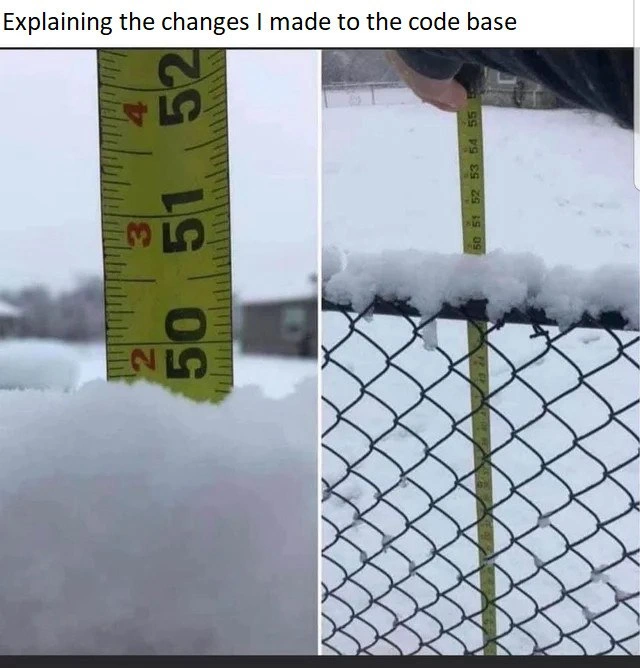
Imagine your friend tells you a wild story about how they built the tallest snowman ever. They even show you a close-up photo of a measuring tape in snow showing a really big number, like 50 centimeters of snow. Wow, that sounds huge! But then you go outside and see the whole scene: there’s just a tiny bit of snow sitting on a fence, and they stuck the measuring tape through the fence to make it look like a deep snow pile. In reality, it barely snowed at all – just a little layer!

This meme is using that idea to make us laugh. It’s basically about someone bragging that they did something big when actually they only did something small. The close-up picture (or the big talk) made it seem like a big deal, but the zoomed-out picture (the reality) showed the truth. It’s funny in the same way it’s funny when a kid says, “I cleaned my entire room,” but really they just shoved a few toys under the bed. We find it amusing because we’ve all seen someone make a small thing sound huge, and when the truth comes out, it’s obvious and a little silly. This meme just uses a snow measuring trick to tell that story in a single snapshot. It’s a playful reminder: sometimes people make a mountain out of a molehill (or a blizzard out of a dusting of snow!), and that gap between the story and the truth is what makes us smile.

Level 2: Whitespace Avalanche

On a more straightforward level, this meme is about code reviews and how developers talk about the changes they make. Imagine you’re a junior dev who has to explain your code change to the team. You might say, “I made a lot of improvements, touched 50 files!” That sounds like a huge deal. But then your tech lead opens the code diff (the list of changes) and finds out most of those changes are trivial – like you fixed indentation and added some curly braces, but you only actually changed how one tiny thing works. It’s like saying you built a massive snow fort, but really you just spread out a thin layer of snow on top of a fence rail.

Let’s break down some terms and concepts here:

  • Code base – this is the entire collection of source code for a project. When you make changes to the code base, you’re modifying files in that project.
  • Explaining the changes – in a team, when you push updates, you often have to describe what you did. For example, in a pull request (PR) on GitHub or GitLab, you write a description so others understand your work before merging it.
  • Pull Request diffs – a PR shows a diff, which is essentially the before-and-after of your code. Lines with - are removed, lines with + are added. Tools also show you how many files and lines were changed. This is where the “50 cm of snow” effect happens: those numbers can seem large.
  • Whitespace changes – these are changes that don’t affect how the code runs at all, just how it looks. For instance, adding spaces or newlines, or reformatting code according to style guidelines. Many version control systems (like Git) will count these as changes. If you re-indent a whole file (say, add 4 spaces to the start of each line), it might report 100 lines changed even though the logic is identical.
  • Refactor – a refactor means restructuring or cleaning up code without changing its external behavior. It often involves renaming things, moving code into helper functions, etc. A refactor can cause a lot of tiny edits across many places. So the diff might show lots of modifications, but the app still works the same — you just organized things better.

Now, the meme’s left image (tape measure close-up) represents a developer’s explanation or initial impression of their changes. They’re basically pointing to the number of lines or files changed as if it’s something impressive. “Look, 52 units of change!” 😄 This often happens when someone is proud of working hard on a commit and maybe tries to emphasize its impact with stats.

The right image (tape measure through the fence, thin snow on top) is like the perspective of the code reviewer or teammate who actually checks the code. They zoom out and see the full context. Perhaps they click “view diff” on the pull request and notice that beneath the surface, most of those “changes” were the tape measure going past the fence – meaning:

  • Many changes were just cosmetic (e.g., adding a newline at end of files, or fixing some indentation).
  • A bunch of lines changed were because you rearranged functions or moved a file to a new folder. The code moved, but didn’t really change how things work.
  • Only a tiny part of the diff (like the snow on top of the fence) is actual new logic or a real fix/feature. That’s the real change.

For someone early in their career, this is a relatable scenario. You might do a cleanup effort on the codebase – say, remove extra spaces and organize imports. When you push it, the diff shows a scary number of lines changed. Then you find yourself writing a comment on the PR: “Don’t worry, most of it is just whitespace!” This meme pokes fun at that exact moment. The humor comes from the misalignment of expectations: the developer (possibly unintentionally) made it seem like they had a huge contribution, while the reviewer is a bit underwhelmed to find out it’s mostly superficial changes. It’s a lighthearted take on how communication in software teams can sometimes exaggerate reality, often unintentionally.

A practical tip that this scenario teaches: when making code changes, especially if they involve a lot of automatic reformatting or moving code around, communicate that clearly. For example, “I ran the linter, so 500 lines are just reformatting; the actual fix is 5 lines in app.js.” This manages expectations and avoids your teammates feeling like they’re digging through a snow pile to find a pebble of meaningful change. It keeps code reviews focused on the important parts and maintains goodwill on the team. After all, no one loves combing through a whitespace avalanche in a code review!


Level 3: Diff vs Reality

At first glance, a huge code change can look massive — hundreds of lines added or removed, files shuffled around, maybe a whopping "+500 −480" in the pull request. This meme humorously exposes how those numbers can be misleading without context. In the left panel’s close-up (like a developer’s pull request description zooming in on metrics), we see a 50+ cm deep “snow” of changes. That’s the developer enthusiastically claiming, “I overhauled the code base, 500 lines of improvements!” 🚀. But the right panel (the zoomed-out truth) reveals a reality every seasoned reviewer knows: most of that depth was an illusion — the measuring tape (our diff stats) went through a gap in the fence. In coding terms, the visual diff vs real change is like when a PR’s line count is bloated by trivial edits. The developer might be overselling a tiny refactor as a massive overhaul, but a savvy reviewer digs into the code and realizes, “Wait, this is mostly whitespace and moved code!”. This scenario is a CodeReviewPainPoint that triggers knowing groans and laughs in any team meeting. It’s classic DeveloperHumor born from CommunicationGap and MisalignedExpectations in code reviews.

In real projects, large diffs that turn out to be minor changes are surprisingly common. Maybe a function got indented one level deeper, shifting dozens of lines to the right (each counts as “changed”). Or perhaps the developer ran an auto-formatter or renamed a variable throughout the code base. To the version control system, those look like hundreds of changed lines, but the app behavior didn’t change at all. This leads to awkward explanations: “I know it looks like 2000 lines, but I swear, I only added a small null check!”. Reviewers have to sift through a blizzard of superficial changes to find the real code_change_exaggeration. No wonder many code review tools provide a “hide whitespace changes” option — the equivalent of noticing the measuring tape is mostly poking through empty space!

This meme nails the developer experience (DX) of explaining such diffs. It satirizes the disconnect between what metrics say and what the code quality gain really is. The developer in the meme, like many of us, might be trying to impress the team or justify time spent, focusing on the quantity of changes. But experienced devs (the grizzled reviewers on the other side of that PullRequest) value quality and context. A 50 cm reading of snow with a fence trick is analogous to boasting about “50 files changed” when maybe 48 of them are just moving one function around. Everyone involved feels that pang of “Really? All that fuss for this?”. It’s a little embarrassing for the author and a bit funny for the reviewer: a classic case of relatable humor in software teams.

Let’s break down why this is funny from a senior dev perspective: it highlights an industry anti-pattern of measuring progress by raw numbers. Old-school managers might have once tracked lines of code (LOC) written as a productivity metric. Developers quickly learned to game that system — just like plunging a tape measure through a fence to impress with snow depth, one could pad a commit with useless line breaks or comments to hit a quota. The meme hints at that absurdity: focusing on numbers without context leads to misaligned expectations. The real work might be much smaller (or at least different) than the impressive stats suggest. Every seasoned coder remembers a code review where a jaw-dropping diff turned out to be mostly noise. This shared experience is what makes the joke land. It’s a gentle poke at our tendency to sometimes oversell a refactor or panic at a scary diff until we zoom out and see it for what it is.

Common culprits behind “huge” diffs that aren’t huge changes:

  • Whitespace changes – e.g. re-indenting code or adjusting formatting can mark every line as changed without altering logic. It’s a snow drift of spaces and tabs.
  • File moves/renames – moving code to a different file or folder often shows as a big deletion and addition. Like measuring through a fence, the diff tool counts the entire file removed here and re-added there.
  • Line-ending and encoding tweaks – ever change CRLF to LF line endings? Version control sees that as every line modified. A thin layer of actual change with a giant stat.
  • One-line changes in many places – e.g. renaming a function or variable can touch lots of files. The effect is small (just a name change), but the diff is long, giving an illusion of a huge overhaul.

These nuances are well-understood in the senior developer community, which is why this meme draws nods and chuckles. It’s capturing a tiny drama of the dev world: the code review communication where one side exclaims “Look at this big improvement!” and the other sighs, “It’s mostly fluff, isn’t it?” The humor lives in that contrast.


Description

A two-panel meme captioned at the top with 'Explaining the changes I made to the code base'. The left panel shows a close-up of a yellow tape measure plunged into what appears to be very deep snow, with the measurement indicating over 50 inches. This creates the impression of a significant depth. The right panel provides a wider context, revealing that the snow is only a few inches deep and is sitting on top of a tall chain-link fence. The tape measure goes all the way to the ground, showing the initial measurement was mostly the fence, not the snow. The meme humorously illustrates a common developer scenario: a programmer proudly explains their complex and 'deep' changes, while in reality, they've only added a small layer on top of a massive, pre-existing legacy system or framework (the fence). It's a visual metaphor for overstating the impact of one's work without acknowledging the vast infrastructure it relies on, a humbling experience every senior developer recognizes
Comments

9
Anonymous ★ Top Pick Explaining my changes during a code review: 'I refactored the entire data layer.' The principal engineer: 'So you changed a variable name in the config file that sits on top of three layers of abstraction from 1998?'
  1. Anonymous ★ Top Pick

    Explaining my changes during a code review: 'I refactored the entire data layer.' The principal engineer: 'So you changed a variable name in the config file that sits on top of three layers of abstraction from 1998?'

  2. Anonymous

    Git shows +8,003/-7,999, but once you collapse whitespace, auto-formatter churn, and the “let’s finally move everything into /src” rename, it’s basically me deleting one semicolon

  3. Anonymous

    "Just a simple refactor" I said, not mentioning the seventeen dependency injection frameworks I had to traverse, three legacy stored procedures I rewrote, and the fact that our entire caching layer was actually built on top of a message queue someone implemented as a singleton in 2009

  4. Anonymous

    When you explain your 'minor refactoring' by measuring from the new abstraction layer you introduced, but the tech lead measures from the original codebase and suddenly your three-line change has a 47-file diff. It's not about how much snow fell - it's about whether you're measuring from the ground or from the fence you built on top of it

  5. Anonymous

    Only ~50 LOC changed, I say. Zoom out: those lines skewer six microservices, two API contracts, and the prod schema - git diff measures height, not blast radius

  6. Anonymous

    Diff size: 2 lines in a 2MLOC monolith - statistically insignificant, but the retrospective rant is O(n²)

  7. Anonymous

    Line-count KPIs are like this tape measure: zoom in on a tidy five‑line refactor, zoom out and it’s Prettier, a folder rename, and an auto‑generated client inflating the diffstat

  8. @zherud 5y

    explain pls

    1. @LionElJonson 5y

      In short: im fucking awesome

Use J and K for navigation