A Data Type Crime So Severe It Requires the FBI
Why is this Databases meme funny?
Level 1: Call a Grown-Up
Storing dates as floats is like using a wobbly, unreliable clock to schedule something important. Imagine you have a clock that sometimes skips a few seconds or goes a bit fast or slow without you noticing. If you planned your bedtime or a party using that clock, you’d probably end up all confused — maybe you’d arrive late or too early because the time was off. In the comic, the programmer finds a mistake so alarming (dates being kept with a sloppy method) that it’s as if someone used a broken clock for a schedule. It’s a really bad idea, and they’re so shocked that they run to the police. The police officer, upon hearing it, basically says, “Wow, this is beyond me… I need to call in the big guns!” It’s like a kid realizing something is very wrong and calling a teacher or parent for help. That’s the joke: the coding mistake is shown as so serious that even an officer says, “We need a higher authority (the FBI) to deal with this!” It’s funny because we don’t literally call the FBI for coding errors, but it shows just how ridiculous and severe this error feels to programmers. In simple terms, the meme is telling us: using the wrong tool for an important job (like the wrong kind of number for dates) can cause such a mess that you’d want to call an expert to fix it. And that mix of panic and exaggeration is what makes it humorous and easy to relate to, even if you’re not a coding expert.
Level 2: DateTime Disaster
Let’s unpack the joke in simpler terms. The comic shows a programmer telling a police officer about a serious bug: someone used a float to store a date. The police officer at first questions why this is a police issue, but then realizes just how bad it is and says they need to call the FBI. This is obviously an exaggeration for humor, but it’s based on a real programming truth: storing dates or time values as floating-point numbers is a really, really bad idea in software.
What’s a float? In programming, a float (floating-point number) is a type of number that can have a fractional part (decimals) – like 3.14 or 2.71828. Floats are used when you need to represent non-integer values, especially in scientific calculations or graphics. They are kind of like a flexible measuring tape: they can cover a large range of values (very large or very small numbers) by adjusting their “scale,” but they aren’t perfectly precise. A float might only precisely keep maybe 6–7 decimal digits (for a 32-bit float) or around 15–16 decimal digits (for a 64-bit double precision float). That sounds like a lot, but here’s the catch: they can’t represent every number exactly. For example, in many programming languages if you do 0.1 + 0.2, you might get something like 0.30000000000000004 instead of a neat 0.3. Weird, right? That tiny ...004 at the end is a floating point precision error – the computer is storing the number in binary (ones and zeros), and 0.1 and 0.2 don’t have exact representations in binary, so you get a tiny rounding error. Usually, we don’t notice or we round it off for display.
Why not use floats for dates? Think about what a date/time is in a program. Often we represent a date/time internally as a number of seconds or milliseconds since a fixed reference point (like Unix time which starts at Jan 1, 1970 UTC). For example, "September 20, 2019, at 00:00 UTC" corresponds to an integer timestamp 1568937600 (number of seconds since 1970). That is a pretty large number. If you use an integer type (which can represent whole numbers exactly) to store that, you get the exact value, no problem. But if you use a float, that large number might not stay exact. A 32-bit float doesn’t have enough precision to keep all the digits of a number that big. It will round it to the nearest representable value. So 1568937600 might turn into something like 1568937500-and-some-change in the float — basically a few seconds off. And if you add a fraction for the time of day (say .5 to indicate half a second or something), that could shift when stored and retrieved. This means the float could be off by a few seconds or more from the real intended time. In many applications, a few seconds matter! Imagine a security system where a few seconds’ difference could say someone logged in on one day vs the next day — that’s a serious error. Or a scheduler for meetings where a rounding bug causes a meeting at 09:00 to become 08:59:59 — suddenly it might show up on the wrong side of a timezone conversion and you miss it. These are date storage errors that can happen when using the wrong datatype.
There’s also the issue of time zones and daylight savings. Date and time handling isn’t just one number; there’s context like “this time is in EST” or “this date considers leap seconds.” Proper date libraries or date/time types carry that information or at least consistently treat the value as absolute time (usually in UTC under the hood). A raw float doesn’t carry any of that. It’s just a number. If a developer tries to adjust the float for timezone differences by adding or subtracting, they might introduce more rounding errors. Or they might forget to handle something like Daylight Saving Time shifts, because a float won’t alert them to “hey, this date doesn’t exist at 2 AM on this day” (which happens in DST transitions). So using a float is like throwing away all the built-in safety and clarity that comes with dedicated date handling. It’s a wrong datatype situation: the kind that every programming textbook warns against.
Why is the cop calling the FBI? That’s the humor punchline. Obviously, in real life we don’t call the FBI for bad code (please don’t 😅). But among developers, we often joke about a “code police” or say something like “that code is a crime” when someone does something particularly awful in a codebase. Using floats for timestamps is one of those legendary bad moves. It’s the kind of bug that causes very sneaky problems and usually indicates the programmer didn’t understand how to handle dates properly. So in the comic, the police officer treats it as a crime so serious that even he, a mere local officer, can’t handle it – he needs to escalate to the highest authority. In our world, that might be like saying “I need a senior architect or database expert to fix this” because it’s beyond a junior developer’s ability to clean up easily. The phrase “way above my pay grade” is something you say when a problem is so big or complex that it should be handled by someone with more expertise/responsibility. It’s funny here because it implies even a cop (who deals with serious crimes) thinks this coding mistake is too much for him.
For a junior developer (or anyone new to coding), the takeaway is: data formats matter. Picking the wrong type for your data can introduce bugs that are super hard to find. It might work at first, and then months later all your timestamps start drifting or comparing incorrectly. That’s why most languages have specific classes or types for dates (like JavaScript’s Date, Python’s datetime, Java’s LocalDateTime, etc.) or they use integer timestamps (number of milliseconds, for example) for precision. Floats are fine for many things (like scientific calculations or game physics), but for dates/times (and money values), we avoid them to prevent precision errors. This comic just dramatizes that principle in a hilarious way. It’s developer humor: we’re poking fun at how obviously terrible that choice is by pretending it’s a literal crime scene. And the style being a simple cartoon (two yellow characters in a green interrogation room) makes it absurdly funny — a mix of a serious setting (police precinct) with a ridiculous report (“someone used floats for dates!”). It’s the contrast that makes it work. Even if you’re new to coding, you can sense the officer’s shock and realize, “Whoa, that must be a really bad mistake!”
So, remember: if you ever feel tempted to do something like float myDate = 2023.0921; in code (perhaps thinking you can encode a date as a number with a decimal), just don’t. Seasoned developers might jokingly say, “That’s an arrestable offense!” Use the right data types and libraries — it’ll save you from serious trouble (and FBI intervention 😉).
Level 3: Floating-Point Felony
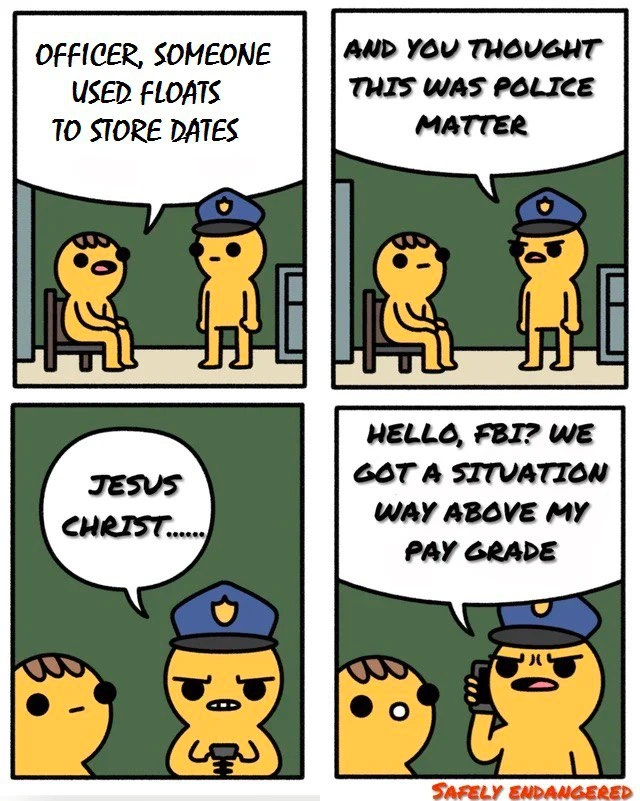
In this Safely Endangered–style comic, a developer runs into a police station to report an outrageous coding crime: “Officer, someone used floats to store dates.” The cop’s initial skepticism (“And you thought this was a police matter?”) instantly turns into horror when he realizes the severity. His reaction — “JESUS CHRIST...” followed by “Hello, FBI? We got a situation way above my pay grade” — escalates the joke. For seasoned engineers, this scenario hits a nerve: using a floating-point number to represent a date/time is such an egregious bad practice that it's treated like a federal offense. This meme brilliantly exaggerates a common software bug to highlight just how severe rounding and timezone bugs can be when dates are mishandled.
From a senior developer’s perspective, the humor comes from shared trauma. Storing dates as floats is a textbook data format disaster. We’ve all seen code where the wrong datatype causes chaos, but dates are a particularly sensitive case. Time is notoriously tricky in software (time zones, leap seconds, daylight savings—oh my!), so choosing the wrong format can unleash a cascade of problems. A float (especially a 32-bit float) simply cannot precisely represent large integer values like Unix timestamp seconds, or fractional days, without losing information. It’s the digital equivalent of writing important calendar events in disappearing ink. Experienced devs have been burned by this before: perhaps a system started skipping dates, or an appointment scheduling app drifted by a few minutes every day because of floating point precision loss. These kinds of bugs in software are so vexing that we half-jokingly talk about them as if they were crimes against computing. Hence the meme’s premise: this isn’t just a minor coding misdemeanor; it’s a full-on floating-point felony.
Why is it so bad? Let’s break down the “scene of the crime”: using a float to store a date/time value. A float (floating-point number) is great for scientific calculations or graphics where a tiny error margin is acceptable, but it’s the wrong data type for exact values like dates or currency. Dates need to be exact and consistent. Float representations, following the IEEE 754 standard, can’t exactly represent many decimal values and lose precision as the numbers grow. For example, if you try to represent a large timestamp like 1568995200 (seconds since 1970-01-01, which is around September 20, 2019) in a 32-bit float, it might become something like 1568995072 in memory – the nearest representable value – because a float at that magnitude rounds off to the nearest 64. This means our timestamp could shift by 128 seconds just by being stored as a float! Now imagine what that does to a system: events might log with times off by a couple of minutes, or sorting by time fails because two records collapse to the same timestamp. If that float stores a date with a fractional part (say, days with decimals for time of day), the rounding might cause the date to flip to the previous or next day after some operations. It’s a nightmare waiting to happen.
Additionally, floats carry no contextual information. A proper DateTime type or even an integer timestamp at least makes it clear you’re dealing with a point in time (often in UTC). But a float is ambiguous – it’s just a number. Without clear conventions, one developer might assume that float 43789.75 means “days since some epoch,” another might think it’s a Unix timestamp in seconds, and a third might consider it “year.monthday” format (e.g., 20210920.0 for 2019-09-20, which is a terrible idea but we’ve seen things). This misunderstanding can lead to date storage errors where a date is interpreted incorrectly. And when time zone differences enter the mix, it gets even uglier: a float doesn’t know if it’s 10:30 UTC or 10:30 local time. If someone naively adjusts a float by adding or subtracting hours for time zones, the lack of precision could push the time just enough to fall on the wrong side of a DST (Daylight Saving Time) switch or shift the date by a day. Boom: now you have users seeing events on “the wrong day” or missing appointments because of a few decimal rounding issues – truly the stuff of production nightmares.
Seasoned developers also know that these bugs are infamously hard to detect and fix. A tiny rounding error might slip through tests and only manifest after months in production (like an alarm that never triggers because 0.0f != 0.0f due to binary drift—yes, it happens). By the time you catch it, you’re dealing with corrupted data or angry users. Reproducing and patching it feels like a high-stakes investigation, fitting the meme’s police interrogation motif. The cop’s line, “way above my pay grade,” wryly mirrors what a junior dev might say upon discovering such a mess in the code base — “I need backup, call the principal engineer, or maybe the FBI!” It underscores a truth: certain bugs are so gnarly that handling them goes beyond routine duty. Some companies literally have a “war room” for production issues this nasty, akin to bringing in a special task force.
The joke lands because any experienced programmer recognizes the utter horror of floats for timestamps. It’s so bad that calling the FBI (the Federal Bureau of Investigation) is only half-kidding; in regulated industries (finance, healthcare), messing up dates/times can get legal involved! Think about systems that track financial transactions or patient records: a rounding error in a timestamp could mean records appear out of order or an audit trail is wrong. That’s a compliance disaster. In a playful way, the meme combines our industry’s internal lingo about “code crimes” with an exaggerated real-world consequence (law enforcement). It’s cathartic humor. We laugh because on some days it really feels like writing poor code should be a crime. And honestly, if any coding mistake deserved a perp walk, saving dates as floats might just qualify. Bad practices like this are the stuff of legend in developer communities — cautionary tales passed around so others don’t repeat them. When the officer grabs the phone to “call the FBI,” every senior dev reading this comic is nodding and chuckling, thinking, “Yep, been there. That developer is gonna need witness protection...”
Description
A four-panel comic strip from 'Safely Endangered' depicting a programming crime of epic proportions. In the first panel, a character reports to a police officer, "Officer, someone used floats to store dates." In the second panel, the unimpressed officer replies, "And you thought this was police matter". The third panel shows the officer looking at his phone, his expression shifting to shock and disgust, uttering, "Jesus Christ......". In the final panel, the officer is on the phone, escalating the issue: "Hello, FBI? We got a situation way above my pay grade." The humor lies in the extreme overreaction to a seemingly obscure technical decision. For experienced developers, using floating-point numbers to represent dates is a cardinal sin because floats have precision issues and are ill-suited for the exactness required for timestamps, leading to subtle and infuriating bugs. The meme elevates this poor coding practice to a federal crime, a relatable exaggeration for any engineer who has inherited a nightmarish legacy codebase

Comments
7Comment deleted
Using a float for a date is like performing brain surgery with a hammer. You might get the general area right, but the rounding errors will cause a slow, painful, and untraceable death for your application's logic
New incident policy: if you find a float in a timestamp column, skip git blame and dial law enforcement - it’s cheaper than replaying the entire event stream to fix the time-travel bugs
The real crime here isn't using floats for dates - it's that somewhere, in production, there's a system calculating interest rates where February 30.999999 is a valid date and nobody knows why the quarterly reports are off by 0.0000001 cents
The real crime isn't using floats for dates - it's that moment six months into production when you discover your financial transactions are off by microseconds because someone thought 'close enough' was acceptable for temporal precision. At least with proper datetime types, your audit trail doesn't require a forensics team to explain why February 30th exists in your database
Using floats for dates: where leap seconds are “rounding errors” and the audit trail becomes “UTC-ish” - the kind of bug that escalates from SRE to Legal
Using floats for time is how 1970-01-01 and payroll day become “approximately equal” - that’s not a bug, that’s a multi-agency incident
Float dates: Where leap days vanish into 28.999999999, turning every cron job into a time-travel bug hunt