When Your Code Walkthrough Becomes an Epic Saga
Why is this Communication meme funny?
Level 1: Keep Your Secrets
Imagine your friend spent two hours excitedly telling you the rules and story of a very complicated game (maybe a new video game or a tricky board game). They talk and talk — but by the end, you still have absolutely no idea how to play. You just smile and nod, a little confused. Maybe you even say something like, "Alright then, keep your secrets," as a joke, because it feels like they told you everything except the part that makes it make sense. That's basically what this meme is about, but with someone explaining a complex piece of computer code. One person tried really hard to share something complicated, and the other person ended up just as confused as before. It's funny in a friendly way: the situation is exaggerated, and the confused person responds with a playful line instead of getting angry. We laugh because we've all felt that way at some point — when someone explains something for a long time and we still don't get it. Even if we miss the point, at least we can share a little laugh about how confusing it all was.
Level 2: Lost in Translation
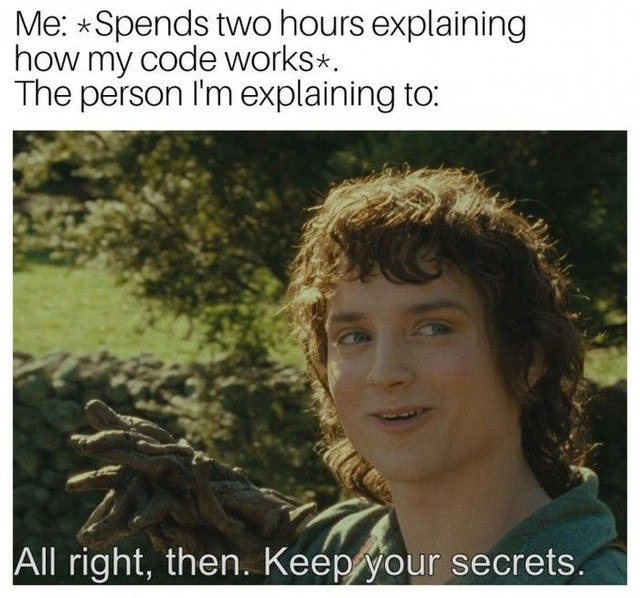
At its core, this meme is illustrating a communication gap between two developers in a lighthearted way. One developer has spent a long time (two whole hours!) explaining how their code works, likely going into a lot of detail. The other developer is the one listening, and as the meme shows, they still don't understand what's been explained. The image used is Frodo Baggins from The Lord of the Rings with a caption that says, "All right, then. Keep your secrets." In this context, Frodo’s famous line is used to represent the confused colleague’s reaction. It's as if the colleague is saying, "Okay, fine — I guess the code will stay a mystery to me," but in a joking manner.
What’s happening here is a common situation in software teams. Explaining a complex codebase or a tricky piece of logic to someone new is part of knowledge sharing on a dev team. For example, when a new developer joins a project, there's an onboarding process where experienced team members walk them through how things work. This meme highlights that sometimes those explanations don’t land as expected. The phrase "keep your secrets" signals that the listener feels like the information went over their head. Even though the first person tried to explain everything, the second person is left feeling like the code’s workings are still secret. In other words, the knowledge didn't actually transfer.
There are a few reasons why the colleague might still be confused after a two-hour explanation. First, the code itself might be really complicated. If the project has a lot of interconnected parts or uses advanced concepts that the listener hasn't seen before, it can be overwhelming. It's like trying to drink from a firehose of information — too much, too fast. Second, the person explaining might have assumed the listener knows certain basics or background. Developers often have a lot of tribal knowledge (unwritten tips, history, or context that only long-time team members know). If the explainer skips over that context, the listener can get lost quickly. They might be hearing terms like "service mesh," "factory pattern," or "CI pipeline" without any frame of reference. Imagine someone using acronyms or jargon you’ve never heard — you’d be nodding along but not really understanding.
Another factor is how the information is delivered. Talking for two hours straight is tough for anyone to follow. Usually, people need breaks and chances to ask questions. If the listener is junior or just shy, they might not want to interrupt to say "I don't get it." So they sit through the whole explanation quietly. By the end, they’re overloaded and confused about multiple points, but it feels too late to ask. This leads to that awkward moment captured in the meme: the explainer has finished their grand tour of the code, and the listener basically responds with Frodo’s smirk saying, "Alright, then. Keep your secrets." It's a bit of relatable humor in the developer world, because many of us have been in the listener’s shoes — smiling and pretending we understood when we really didn't.
From a team’s perspective, this scenario highlights why good communication is such an important part of developer experience (DX). If knowledge isn't shared effectively, it slows everyone down and leads to frustration on both sides. In simpler terms, the meme is pointing out a real developer pain point: sometimes explaining code is really hard, and even a lengthy explanation can fail to make things clear. It's almost a rite of passage in tech to sit through a meeting or walkthrough where you come out more confused than when you went in. The shared laughter comes from recognizing that feeling. The next time someone spends two hours spouting technical details and you feel totally lost, you might remember Frodo’s smirk and think, "Alright, keep your secrets" — at least you know you're not alone!
Level 3: Communication Timeout
This meme nails a scenario many senior developers find painfully familiar: you spend a marathon session explaining a complex piece of code, only to realize at the end that your colleague still looks utterly lost. The top caption sets the scene: Me: spends two hours explaining how my code works. After all that exhaustive detail, the bottom panel — a frame from The Lord of the Rings with Frodo smirking (the well-known "keep your secrets" meme template) — delivers the punchline: Colleague: "All right, then. Keep your secrets." It's a comedic way to say the knowledge transfer has effectively failed. The person listening essentially gives up, humorously implying that the code might as well remain a secret since they didn't catch on.
For seasoned engineers, this hits close to home. It highlights a classic communication gap in the tech world. On paper, two hours should be plenty of time for knowledge sharing, but real life isn't so simple. Often the tribal knowledge and intricate logic behind a codebase are so dense that even a detailed walkthrough feels like a firehose of information. The explainer (often the code's author or an experienced team member) might dive deep into specifics, assuming some context or familiarity that the other person just doesn't have. This is a textbook case of the curse of knowledge – when experts unknowingly speak over the heads of less experienced folks. The result? The listener's eyes glaze over, and despite the explainer's best intentions, nothing truly clicks for the person trying to learn.
There are usually structural reasons behind this kind of knowledge transfer failure. Perhaps the code itself is overly complex or riddled with technical debt, making it hard to explain in a linear, sensible way. Maybe the project lacks proper documentation, so all that context lives only in the explainer's head. In such a state, transferring that information in one go is almost impossible – like trying to copy an entire database by hand in one sitting. The meme humorously captures the frustration of these moments. The line "Keep your secrets" isn’t just Frodo being cheeky – it’s every developer who has sat through a convoluted explanation and thought, "I still have no idea what you're talking about, but I'll pretend everything's fine." It's a mix of developer frustration and resigned humor wrapped in a movie quote.
In practice, explaining code effectively is as much an art as it is a technical skill. An experienced dev might leave out "obvious" steps or use jargon like dependency injection, observer pattern, or microservice orchestration without realizing the other person isn’t fluent in that dialect. Meanwhile, the listener is too intimidated to keep interrupting with "Sorry, I don't follow," so eventually they just nod along in silence. By the end of the two-hour monologue, their brain has hit a stack overflow of its own (essentially a peer brain shutdown from information overload). We can imagine the pseudocode for this situation:
try:
explain(codebase)
except BrainOverflowError:
print("All right, then. Keep your secrets.")
Here the made-up BrainOverflowError represents the colleague's mental buffer overflowing with too much input at once. The humorous print line mimics the meme's subtitle, indicating that the explanation effectively "crashed" and the code's secrets remain safely un-understood.
The reason this meme resonates so strongly in developer culture is because it's a shared pain. Whether during an intense onboarding session, a marathon code review, or a late-night debug hand-off, most devs have witnessed knowledge that just does not transfer despite everyone's best efforts. There's a solidarity in recognizing that even brilliant engineers sometimes struggle to communicate complexity in a digestible way. It's not that the explainer is intentionally withholding (though it feels that way to the confused listener); it's that bridging two different knowledge levels under pressure is genuinely hard. And in fast-paced teams, there's rarely enough time to break things down properly or verify understanding step-by-step. So instead, we end up with these awkward, comical outcomes. The meme takes that exasperating scenario and turns it into tech humor. We laugh, a bit ruefully, because we've been on at least one side of this exchange before. "All right, then. Keep your secrets" perfectly captures the awkward yet relatable conclusion: after all the talking, the code might as well still be magic hidden in a mountain, and everyone involved is left shaking their head with a wry smile.
Description
This is a two-part meme featuring a well-known screenshot of Frodo Baggins from 'The Lord of the Rings: The Fellowship of the Ring'. The top section has white background with black text that reads: 'Me: *Spends two hours explaining how my code works*. The person I'm explaining to:'. Below this text is the image of Frodo, looking slightly amused and suspicious, with the caption from the movie subtitled at the bottom: 'All right, then. Keep your secrets.'. The humor comes from the juxtaposition of a developer's earnest, lengthy explanation with the listener's complete failure to comprehend it, to the point where they jokingly accuse the explainer of obfuscation. For senior developers, this is a deeply relatable scenario reflecting the challenges of explaining complex, poorly documented, or highly abstract systems, and the communication breakdown that often occurs during knowledge transfer or code reviews
Comments
9Comment deleted
Some codebases are like the Rings of Power: their full, dark history can only be recounted in a three-hour council meeting, and by the end, everyone just wants to throw it into a volcano
Just spent two hours mapping how ‘CreateUser’ pings the API gateway, flows through GraphQL, spawns a Kafka saga across seven microservices, writes to an outbox, and hydrates a read model - new hire smiles and asks, “So which line actually inserts into the table?”
After 20 years in tech, I've learned that the optimal code explanation duration follows an inverse exponential curve: the more complex your distributed system's eventual consistency model, the faster your stakeholder's eyes glaze over - usually right around the time you mention 'Byzantine fault tolerance.'
After two hours explaining your elegant event-sourcing implementation with CQRS, eventual consistency guarantees, and saga orchestration patterns, you realize they were just wondering why the button takes 200ms to respond. Sometimes the gap between 'how it works' and 'why should I care' is wider than the CAP theorem allows
Two-hour walkthrough ends with “keep your secrets” - fair; most behavior is in invariants the type system can’t express and a prod-only feature flag named please_work
Code explanations follow CAP theorem: you get Consistency or Availability from your audience, but never both - partition tolerance is just disinterest
If a two‑hour walkthrough ends with “keep your secrets,” you didn’t write code - you shipped SPoF‑as‑a‑Service
😂 Comment deleted
Thanks:) Comment deleted