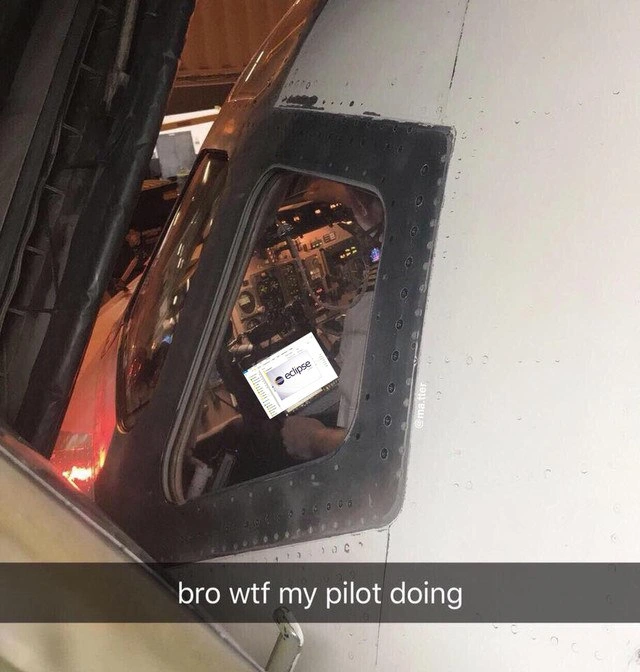
In-Flight Entertainment, Brought to You by Eclipse IDE
Why is this IDEs Editors meme funny?
Level 1: Focus on Flying
Imagine you’re riding in a car, and you see the driver pull out a laptop to fix something while cruising on the highway. You’d probably freak out, right? That’s the basic idea of this meme. It shows a pilot who should be concentrating on flying the plane, but instead he’s busy doing some complicated computer work during the flight. It’s funny in a crazy way because that’s obviously not what a pilot is supposed to do at that moment. It’s as if the pilot is trying to repair the plane or its software in mid-air. Even if you don’t know anything about coding, you know instinctively that the pilot’s job is to fly the plane and keep everyone safe. If he’s fiddling with a laptop, anyone would think, “Wait, shouldn’t he be focusing on flying?!” The joke comes from that shock: the person who’s in charge of our safety is multitasking in a way that seems very dangerous and out of place. It makes us laugh because it’s so absurd and obviously wrong. In simple terms, the meme is saying: this is as ridiculous as it gets — of course we want our pilot to just fly the plane, not start fixing computer problems during the flight!
Level 2: No Preflight Testing
At a glance, this image shows something very out-of-place: a pilot in a commercial airplane cockpit has a laptop open to a programming screen. Specifically, the display is running Eclipse IDE – we can tell from the familiar layout with a project explorer panel on the left and code editor on the right, plus the word “Eclipse” on the title bar. An IDE (Integrated Development Environment) like Eclipse is a software application developers use to write and debug code. It typically includes a text editor for writing code, tools to compile or run the code, and a debugger to test and find errors. Eclipse is commonly used for writing Java programs and other languages. Seeing it open in the cockpit is extremely odd because normally a pilot’s workplace is filled only with flight instruments, controls, and navigation screens, not general-purpose coding tools!
In software terms, the airplane flying with passengers is analogous to a production environment – that’s the live, real-world system where everything has to work correctly because real users are being affected. By contrast, a testing or development environment is where you try out code changes safely. Here, the “system” in question would be the plane’s onboard computers (autopilot, navigation, etc.), and the passengers are the end-users who just expect it all to work. Debugging means trying to find and fix a bug (an error or problem in the code). Normally, developers do debugging on a test system or on their own machines, before the software is deployed to production. Debugging in production is a tongue-in-cheek way of saying you’re having to troubleshoot an issue in the live system itself, which is risky because any mistakes immediately impact real users. It’s a bit like trying to fix a bus’s engine while the bus is already speeding down the road – definitely not the ideal time to do maintenance.
The caption on the meme, in casual internet slang, reads “bro wtf my pilot doing”. Translated, that’s basically someone saying, “Dude, what on earth is my pilot doing?!” The person who took the photo is clearly shocked. And it’s understandable: if you glanced into the cockpit and saw your pilot running a programming application instead of focusing on takeoff or flight duties, you’d be alarmed too. In aviation, pilots perform thorough preflight checks to make sure all systems are working correctly before they depart. They go through checklists, test the controls, verify navigation settings — all to avoid surprises in the air. By the time a plane is taxiing out or flying, there shouldn’t be any need for tinkering; everything should have been set on the ground. So if our pilot is messing with code now, it implies something wasn’t caught earlier. It’s akin to a developer skipping some tests and only discovering a big bug once the app is already live for users. The meme humorously highlights this “uh-oh” moment. It’s basically saying: if you skip proper testing, you might end up scrambling to fix things at the worst possible time. In software, that’s a lesson every newbie learns quickly — and here we see a hyperbolic version of it involving a plane.
Another thing to note is how Eclipse itself underscores the craziness of the situation. Eclipse is a powerful but somewhat heavy-duty program. It provides a lot of functionality and can be slow to start up or run on an average laptop. It’s not the kind of quick, lightweight tool you’d use for a tiny tweak; it’s more like the full toolbox. The fact that the pilot opened Eclipse suggests he’s not just changing a setting — he might be viewing or editing actual code, which is a complex task. For a junior developer, imagine an emergency where something in your project is broken and, instead of having time to calmly diagnose it, you’re rushed into using a big development program to dig into the guts of the system right on the spot. It’d be pretty stressful! The pilot using a full IDE in mid-flight drives home just how unplanned and desperate this scenario is. It’s both funny and a bit scary, and it teaches why we usually do plenty of testing (or preflight trials) before the real thing is happening.
Level 3: On-The-Fly Fix
This meme hits the sweet spot of developer humor by portraying the ultimate "fixing it live" scenario. The passenger’s blunt caption, “bro wtf my pilot doing”, says it all: something is happening in production (the flight) that absolutely shouldn’t be, and now the person responsible (the pilot) is desperately trying to remedy it in real time. Every seasoned engineer knows that mix of panic and focus when a critical system breaks at the worst possible moment. Seeing it translated literally to a pilot mid-flight gives us that “too real” chuckle — you can almost feel his stress through the cockpit window.
Think about what’s being satirized: the pilot should be flying the plane, but instead he’s heads-down in an IDE, presumably troubleshooting a software issue on the aircraft. This is a parody of the dreaded moment when a service is on fire in production and the dev who wrote it has to dive in with a debugger while users (or passengers!) are actively depending on it. It’s a classic Production nightmare dressed up as a sight gag. The humor lands because it exaggerates a real IT anti-pattern (emergency patching on the fly) into a life-and-death context. It's as if an on-call engineer got paged, except the engineer is also the pilot and the pager is a blinking cockpit alarm.
Now, the choice of Eclipse IDE as the tool on screen adds an extra layer for the initiated. Eclipse is one of those long-standing Java IDEs that many senior devs have used (and perhaps cursed at) in their career. It’s powerful, but let’s just say it’s not known for being nimble. It has a reputation for slow startup times, heavy memory usage, and the occasional freeze right when you hit “Run”. The fact that our pilot is using Eclipse of all things — in the split-second environment of a cockpit — is both absurd and savagely funny. It's the equivalent of a firefighter trying to read a thick instruction manual while the building is burning. Seasoned devs smirk at this because they recall endless build times and IDE lag at critical moments. (Oh, the number of times we've whispered “please compile faster” at 3 AM during an outage.) The idea of a pilot waiting on a progress bar or a garbage collection pause while he’s supposed to be navigating turbulence... that’s dark comedy gold. (We’ve joked about cloud computing, but here we have code literally running in the clouds — Java in the air!)
We’ve also got the whole “testing in prod” trope here. Best practices say you should catch bugs in a QA environment or simulator before real users are involved. In aviation, that’s like using a flight simulator or doing thorough preflight checks to catch any system issues on the ground. But in the software world, we joke that no matter how much you test, some bugs only rear their heads in the real world. Maybe the plane’s navigation software passed every lab test, but as soon as actual sensor data and chaotic real conditions came into play, something crashed. This meme winks at that reality: sometimes you don’t discover a critical flaw until everything is already live. The pilot frantically coding is basically the on-call developer rushing out a hotfix with customers actively on the system. It's simultaneously hilarious and nerve-wracking because any experienced dev has been in a less-lethal version of that situation.
There's an undercurrent of technical debt and last-resort fixes here too. You can almost imagine the backstory: perhaps the airline pushed a software update to the autopilot or navigation system without enough testing (deadline pressure, anyone?), and management waved it off with a “it’ll be fine.” Now, in the cockpit, something's clearly not fine, and the pilot is left holding the bag. It’s the same logic that leads to 3 AM deploys and “we’ll patch it in production” — just taken to an extreme. In a well-run project, you’d never let things get to this point, but veteran developers know that reality often laughs in the face of best-laid plans. The meme exaggerates it to make a point: if you think deploying a quick fix directly on a live server is risky, imagine doing it on a literal airplane mid-flight! It’s a comical warning about what can happen when proper testing or process is skipped.
Notice also how this situation turns the pilot into a one-man DevOps team at 35,000 feet. He’s simultaneously operating the system (flying the plane) and debugging it. It’s a full-on "you build it, you run it" moment — literally in this case. A senior dev can relate to that frantic dual-role feeling when things hit the fan. It's funny because it’s true: in crunch time, developers often have to become temporary sysadmins, support engineers, and bug fixers all at once. Here the poor pilot has to be both aviator and software troubleshooter in real time. Let’s just hope the plane’s Wi-Fi is stable enough if he’s Googling error messages on Stack Overflow mid-flight! That image alone — a pilot typing furiously, searching “NullPointerException in altitudeControl.java” while the engines roar — is both absurd and oddly relatable to anyone who’s been knee-deep in a production incident.
In essence, this meme resonates with those of us who have been responsible for a system when it misbehaved. The stakes are exaggerated for comedic effect, but the core situation is painfully familiar. It’s poking fun at that shared industry experience where critical fixes happen not in a calm, planned environment, but in high-stress production with people’s well-being on the line. It's a nod to the war stories every veteran engineer collects: “Remember that time the server went down during the big demo and I had to live-patch it?” Only here, the “server” is an airplane and the “big demo” is a flight full of passengers. The absurdity makes us laugh — and maybe sends a shiver down our spine — because deep down we’re thinking, “Let’s hope our real pilots aren’t having to do this!”
Level 4: Not Exactly FAA-Approved
Safety-critical software in aviation is governed by incredibly strict standards for a reason. In real life, any code running on an aircraft—especially flight control or autopilot code—must go through rigorous certification (think FAA regulations and docs like DO-178C). This means every line is scrutinized, tested in simulators, often even proven correct with formal methods, and thoroughly validated long before a plane ever leaves the ground. The idea of a pilot casually whipping out Eclipse IDE at 30,000 feet to tweak or debug flight software is pretty much a violation of all those protocols. It's like a surgeon pulling out a laptop to rewrite pacemaker firmware mid-surgery—unthinkable in a properly regulated environment.
Under the hood, real avionics systems run on specialized, locked-down hardware. The autopilot or flight management system likely uses an embedded real-time OS (e.g. something like Green Hills INTEGRITY or a certified version of Linux) or even hard-coded logic in a language like Ada or C. These systems don't exactly have a friendly “attach debugger” port waiting for an IDE to connect. They are often air-gapped from any generic computer. If a fault occurs, pilots rely on redundant systems or manual control, not a quick code patch. In fact, to even imagine debugging in production on a plane ignores the extreme redundancy built into these systems: airliners have multiple redundant flight computers precisely so that no single software glitch forces a programmer’s intervention mid-flight. The usual solution is to swap to a backup system, not break out a Java editor!
The humor here comes from flipping that serious reality on its head. Eclipse is a heavyweight Java development tool from the enterprise world, not something you'd ever find on a certified avionics display. Its presence in the cockpit is jarring technically: an IDE isn't real-time, isn't certified, and frankly might hog resources or freeze up—exactly what you don't want distracting the captain. (I mean, Eclipse taking a minute to index a project while you’re in a critical descent? No thanks.) It's definitely not FAA-approved cockpit software. In fact, in aerospace software design, engineers do everything to avoid on-the-fly changes. Critical algorithms are often tested to the point of exhaustion or even verified with mathematics. It’s the polar opposite of the typical "ship now, patch later" approach in consumer software.
So this scene is a tech paradox: a production environment (an in-flight plane with real passengers) that, by every rule and bit of common sense, should never be "under development" in real time, is now literally being fiddled with using an IDE. It highlights the absurdity of debugging in production taken to an extreme. In a world where aerospace engineers strive to never have unscheduled mid-air surprises, our pilot here seems to be doing the ultimate on-the-fly hotfix. It’s equal parts hilarious and horrifying to anyone who knows how these systems are supposed to work.
Description
This meme captures a passenger's perspective looking through an airplane cockpit window. Inside the dimly lit cockpit, filled with complex controls and instruments, a laptop is open, and its screen clearly displays the splash screen for the Eclipse IDE. A Snapchat-style caption at the bottom of the image expresses alarm: 'bro wtf my pilot doing'. The humor is rooted in the niche frustrations of the software development community. Eclipse, a once-popular Integrated Development Environment, is infamous among developers for being notoriously slow, resource-intensive, and prone to crashing. The terrifying implication is that the pilot is not flying the plane but is instead preoccupied with a task that could lead to immense frustration, distraction, or a system freeze, which is the last thing you want to see happen in a cockpit

Comments
11Comment deleted
I'm not worried about turbulence, I'm worried about the pilot trying to index a multi-million line codebase with Eclipse during final approach
It’s fine - he’s just running “mvn clean install” on the 2006-era Java flight-control monolith; in aviation, blue-green deployment just means whichever runway is open
When the production hotfix is so critical that even at 35,000 feet you're still debugging that legacy Java monolith - because apparently the NullPointerException follows you even above the clouds, and someone has to maintain that 15-year-old flight management system written in Java 6
Looks like someone took 'continuous deployment' a bit too literally - though I'm not sure FAA regulations cover merge conflicts at cruising altitude. At least if the code crashes, it's just a segfault... right? This is what happens when your sprint deadline coincides with your flight schedule, and you realize the production hotfix can't wait until landing. The real question: is he running unit tests or pre-flight checks?
Eclipse in the cockpit: because nothing tests 'works on my machine' like reindexing during final approach
Staging was overbooked, so we’re shipping the autopilot hotfix from Eclipse - our CI/CD is now check‑in, cabin, deploy
Seeing Eclipse on the flight deck is how you know the autopilot’s a legacy Java monolith - preflight now includes GC tuning so we don’t hit a stop-the-world at V1
fixes bugs on the fly Comment deleted
trying to install javascript Comment deleted
Windows update Comment deleted
three billion devices run java. what, you thought those planes ran themselves? Comment deleted