Skip to content
DevMeme
1339 of 7435
Finally, a Naming Convention We Can All Understand
CodeQuality Post #1501, on May 6, 2020 in TG

Finally, a Naming Convention We Can All Understand

Why is this CodeQuality meme funny?

Level 1: The Name Game

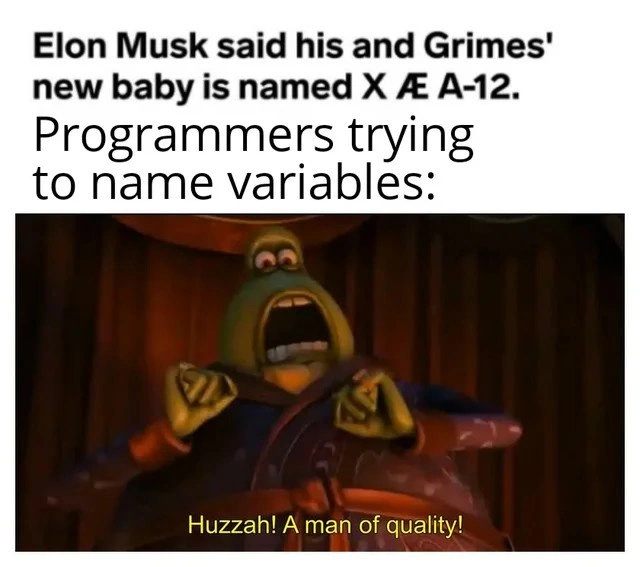
Imagine you have a bunch of toys and you’re trying to give each toy a special name. You’d want names that help you remember which toy is which, right? If you have a teddy bear, you might call it “Fuzzy” so you know it’s the fuzzy bear. Now, what if you decided to name your teddy bear something like “X Æ A-12”? That would be a pretty wild name – your friends might scratch their heads and say, “What does that even mean?” This meme is joking about that idea. Elon Musk gave his baby a very unusual name with letters and symbols that look kind of random. Programmers (people who write code) often have to name things in their code, and it’s surprisingly hard to pick good names. Sometimes they come up with names that seem like gibberish too! So when programmers saw Elon’s baby name, they found it funny and felt like, “Hey, he’s doing the same thing we do when we can’t think of a good name!” The picture of the excited frog shouting “Huzzah! A man of quality!” is like a silly way of saying, “Wow, great job on that super complicated name!” even though usually a simpler name would be better. In simple terms, it’s funny because giving something a confusing name is usually a bad idea, but here everyone is cheering about it as a joke.

Level 2: The Naming Struggle

For newer developers, let’s break down why this meme strikes a chord. In programming, a variable is like a container that holds data (numbers, text, etc.), and we give each container a name so we can refer to it. VariableNaming is the act of choosing those names. The goal is usually to pick a name that describes what the variable holds or what it’s used for. That’s part of CodeQuality and many teams enforce naming conventions – agreed-upon rules for names – so that code is consistent and easy to understand. For example, a convention might be “use camelCase for variable names,” meaning you write userAge or rocketSpeed instead of user_age or Rocket_Speed. More importantly, conventions encourage descriptive names: launchCodes is clearer than x or data1.

Why does the meme connect Elon Musk’s baby name to programmers naming variables? Elon’s baby was famously named “X Æ A-12” which is unusual and hard to read, just like a poorly named variable in code. The meme jokingly imagines programmers seeing that name and getting excited, because it looks like one of those obscure, hard-to-decipher variable names that we sometimes come up with (often by accident or frustration). The bottom image with the frog yelling “Huzzah! A man of quality!” suggests that programmers are applauding Elon, as if he set a new high bar for creative variable names. It’s funny because in reality, naming a baby “X Æ A-12” is as perplexing as naming a variable XÆA12 in code – most people would say, “Huh? What does that even mean?”

In real development, picking a variable name can genuinely be tricky. You might have a piece of code and struggle to summarize its purpose in one short word or phrase. Many beginners start by using simplistic or non-descriptive names: e.g. using x or test everywhere. This soon becomes a problem – imagine a function with five variables all named data or value. How do you remember which is which? Renaming value to userScore or levelCompleteFlag can instantly make the code clearer. That’s why NamingConventions exist, to help guide us towards clarity. A big part of DeveloperExperience_DX (a developer’s day-to-day happiness and productivity) is being able to quickly understand what the code is doing, and good names are key to that. If you stumble upon a weird identifier like XZ42_Workflow in someone’s code, you’ll probably spend extra time figuring out what it is. Was it the 42nd attempt at naming that variable? Does XZ stand for something? It’s frustrating!

Let’s look at a quick illustration. Elon’s baby name “X Æ A-12” might have special meaning to him, but to us it’s not obvious. Similarly, consider these two snippets of code:

# Cryptic variable name example (reminiscent of X Æ A-12):
XAEA12 = computeTrajectory(launch_angle, velocity)  # What is XAEA12? Hard to tell at a glance.

# Improved variable name example:
rocket_distance = computeTrajectory(launch_angle, velocity)  # Clear: this is the rocket's distance traveled.

In the first line, XAEA12 doesn’t give other programmers any clue. Is it an obscure identifier for some calculation? Only the original author (like Elon naming his baby) knows for sure. In the second line, rocket_distance immediately tells us what the value represents, making the code more readable. This demonstrates the concept of self-documenting code: code that is understandable largely thanks to good naming, rather than needing lots of comments.

The meme also touches on developer humor and relatability. Every programmer has felt the struggle of staring at the screen trying to think of a name that isn’t already used and accurately describes the thing. Sometimes we joke that we end up with names that look like random gibberish. Elon Musk’s use of symbols and numbers in a name is like a programmer throwing up their hands and naming a variable `$X_AE_A12$ because everything else was taken or just to be quirky. It’s over-the-top in real life, which is why it’s funny in a coding context. We laugh because we see a bit of ourselves in that situation — the naming_is_hard dilemma — and the meme exaggerates it perfectly.

Level 3: A Name of Quality

Elon Musk’s choice to name his baby X Æ A-12 immediately resonated with developers who live in the trenches of code naming. In software, picking a variable name sometimes feels as daunting as naming a human — and we often end up with something just as cryptic. The top half of the meme reads like a news headline about Musk’s baby, and the bottom half shows an overjoyed frog aristocrat exclaiming “Huzzah! A man of quality!” (a scene from an animated movie). The humor here is rich with irony: programmers, notorious for struggling with NamingConventions, are applauding Elon’s bizarre baby name as if it’s the gold standard of variable naming. It’s a wink to the fact that we’ve all written code with variables like x or tempVal or the infamous fooBarBaz, and then half-jokingly defended those names.

Underneath the laughter is a well-known truth in the developer community: naming things is hard. There’s an old joke in computer science, “There are only two hard things: cache invalidation and naming things.” Here, Musk unintentionally tackled one of those hard things in a spectacular way. When a developer sees X Æ A-12, they recognize a kindred spirit who also wrestled with a name and ended up with something that looks like it came straight out of source code. The meme’s frog character declaring “A man of quality!” sarcastically suggests that an obscure identifier (like a variable named XÆA12) must be high-class stuff. It’s poking fun at our industry’s occasional backward pride: we lament code full of indistinguishable variable names, yet there’s a twisted camaraderie in seeing someone else (even a billionaire) embrace the absurdity of a complex name.

From a senior developer perspective, this meme highlights a painful reality of CodeQuality and DeveloperExperience_DX: naming variables is often a bikeshedding battleground. Teams can spend more time arguing over what to name a function than implementing it. Why? Because good names make code readable and maintainable, while bad (or just overly clever) names cause confusion down the line. We’ve all inherited code where the original author chose names meaningful only to them — perhaps an inside joke or a reference only they get (like Musk and Grimes’s personal reasoning behind X Æ A-12). To everyone else, it’s gibberish. In a code review, seeing a variable called XAEA12 might elicit that same mix of horror and admiration: “Who wrote this? And why do I strangely respect their commitment to weird naming?” The meme perfectly captures that dark humor. It exaggerates a common programmer habit of glorifying complexity (or at least coping with it) by mock-praising an outrageous example. When the frog in ornate clothes shouts “Huzzah! A man of quality!”, we laugh because we recognize ourselves — celebrating a ridiculously named variable (or baby) as if it were an achievement in fine craftsmanship, all while knowing it’s actually a bit of a mess.

In summary, at this deep level, the meme uses Elon’s headline-grabbing baby name to comment on the variable_naming_struggle every coder faces. It’s a sardonic cheer for those of us who have ever stared at our code at 3 AM, agonizing over what to call the tenth helper function, and ended up with something like doTheThing_v2_final. Naming things in code is a delicate art, and when someone throws convention out the window with a name like X Æ A-12, programmers can’t help but laugh and say, “Finally, some quality!” (with a wry grin, of course).

Description

A two-part meme comparing Elon Musk's choice of baby name to programmers' variable naming habits. The top section contains black text on a white background that reads: 'Elon Musk said his and Grimes' new baby is named X Æ A-12. Programmers trying to name variables:'. The bottom section is a screenshot of the character Toad from the animated movie 'Flushed Away'. He is a large, green toad in a regal-looking outfit, with his mouth wide open in a shout of approval. Yellow subtitles at the bottom read, 'Huzzah! A man of quality!'. The meme humorously and sarcastically suggests that programmers, who are notorious for using short, cryptic, and often meaningless variable names (like i, j, x, temp, data), would see a kindred spirit in Musk's unconventional and unreadable name choice. It's a self-deprecating joke about the common bad practice of poor naming in software development, which hinders code readability and maintainability
Comments

7
Anonymous ★ Top Pick Some programmers spend hours debating BEM vs. SMACSS for CSS naming. The rest of us just name our variables like we're trying to win a game of Scrabble with a bunch of hexadecimal characters
  1. Anonymous ★ Top Pick

    Some programmers spend hours debating BEM vs. SMACSS for CSS naming. The rest of us just name our variables like we're trying to win a game of Scrabble with a bunch of hexadecimal characters

  2. Anonymous

    Code review: someone named the feature flag XÆA_12 - fine, except 14 microservices, a cronjob, and a Terraform module had already cargo-culted it before the PR even finished loading

  3. Anonymous

    After 20 years in the industry, I've seen teams spend more time in meetings debating whether to use 'customerList' vs 'customers' than Elon spent naming his actual child - and at least his choice passes the uniqueness constraint check

  4. Anonymous

    Every senior engineer knows the two hardest problems in computer science: cache invalidation, naming things, and off-by-one errors. Elon just proved that naming things doesn't get easier even outside of code - 'X Æ A-12' would fail every linter, violate PEP 8, trigger compiler errors in most languages, and definitely wouldn't pass code review. At least he didn't try to use it as a Kubernetes pod name

  5. Anonymous

    Huzzah - the rare variable name that survives minification, linting, and a 20-year refactor without becoming 'temp1'

  6. Anonymous

    Enable Unicode identifiers and someone ships x_æ_a12; ESLint smiles, grep and PromQL cry, and your DDD ‘ubiquitous language’ reads like a birth certificate

  7. Anonymous

    Tempted to name the field XÆA-12 - JSON would accept it, grep wouldn’t, TypeScript forces bracket notation, and the retro lesson was that ASCII is an availability strategy

Use J and K for navigation