The High-Stakes Game of Developer Easter Eggs
Why is this Stakeholders Clients meme funny?
Level 1: Prank Backfires
Imagine you’re at school and you decide to play a small prank. You draw a silly, inappropriate doodle in the corner of a project that you hand in to your teacher – something you think is just goofy and that maybe no one will notice. You’re kind of giggling to yourself because it’s your little secret joke. Now, your teacher does find it while grading your work. Suddenly, they are very shocked and upset. They call your parents and the principal because of what they found. Now you’re in big trouble – way more trouble than you ever expected for a tiny joke.
In this story, you’re like the developer who hid a surprise in the app, and the teacher is like the client who discovered it. The prank (the hidden doodle) completely backfired because the person who found it didn’t find it funny at all. In fact, they’re alarmed and angry. So what seemed like a fun secret ended up causing a serious problem. The feeling of the meme is just like that: a little joke turns into a big issue because the wrong person discovered it. The lesson is simple – sometimes a joke that seems funny to you can really upset someone else, especially in a place where it doesn’t belong.
Level 2: Hidden Feature Exposed
Let’s break down what’s happening in this meme in simpler terms. It’s referencing a situation where a programmer adds a hidden feature (often called an easter egg) to an application. An easter egg in software is like a little secret or surprise that isn’t documented in the official features. For example, maybe if you press a certain key combination or type a secret phrase, something special happens – like an animation, a joke message, or a hidden game. Developers sometimes do this for fun or to leave their personal mark. It’s similar to how game developers hide secret levels or how DVD menus in the early 2000s had hidden clips if you knew where to click. It’s not part of the main functionality, just a playful extra.
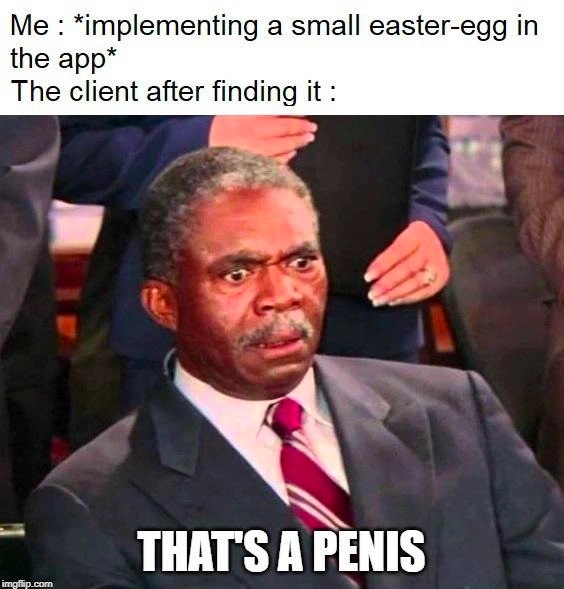
Now, in a professional app or a client’s project, adding something like this is risky. The meme shows the developer thinking it’s a “small easter egg”, implying they believe it’s harmless and maybe even cool. But the client in the next panel is completely shocked and upset, which tells us the hidden surprise was not appropriate. The client’s reaction text is “THAT’S A PENIS”, indicating that the easter egg might have been something risqué or offensive – perhaps an image or reference to male genitalia. In any formal business software, you can imagine how inappropriate that would be! The client responds by making it a serious issue, a Sev-1 escalation.
Let’s decode Sev-1: this stands for Severity 1, which is a term used in IT and software support to indicate the highest level of problem severity. Issues are often ranked from Sev-4 (minor) up to Sev-1 (critical). A Sev-1 usually means a critical problem that needs immediate fixing – like the system is down for all users, or there’s a major security breach, something really urgent. So if a client labels something a Sev-1, they’re saying “this is as bad as it gets, drop everything and fix it now.” It’s a bit darkly funny here because the cause isn’t a server crash or data loss, but a developer’s hidden joke. Essentially, the client is treating this easter egg as seriously as a major bug or outage. That shows how upset and urgent they feel it is to remove it.
Client escalation means the client didn’t just shrug it off – they likely called the project manager, the company bosses, maybe even wrote an angry email to upper management. To “escalate” an issue is to push it up the chain of command seeking immediate action. So the developer’s little secret turned into a top-priority problem. This kind of escalation can have big consequences: urgent meetings, emergency patch releases, and uncomfortable conversations. In terms of StakeholderExpectations: stakeholders (like clients, managers, anyone invested in the project) expect the product to meet certain standards and not contain surprises. When those expectations are broken, they lose trust.
Let’s talk about compliance and brand guidelines. These are formal rules about what can or cannot be in the product. For example, if you’re writing a banking app or a healthcare app, there are compliance standards ensuring everything is professional, secure, and appropriate. Compliance could include legal requirements (like no hidden data collection, accessibility rules, etc.) and also content rules (for instance, an app’s content must be suitable for its audience rating – no adult content in a children’s app, obviously). Brand guidelines mean the company has rules for tone, style, and imagery – basically what aligns with their brand’s image. A cartoon eggplant emoji or a phallic joke, for example, would violate pretty much any serious brand guideline unless the app is some sort of very edgy product. So a hidden penis image or joke in a normal app blows right past those rules. That’s what we call a compliance nightmare – it’s a nightmare scenario for the compliance officers and legal team, because it means something went out that absolutely shouldn’t be there. They’d worry about things like: could this offend users? Could it cause lawsuits? Could it get the app pulled from the App Store for inappropriate content? These are big deals.
From a junior developer perspective, this meme is a lesson in professionalism. When you’re new, adding a secret joke in the code might seem harmless (“who’s gonna find it, right?”). But experienced folks know Murphy’s Law: anything that can be found, will be found (and usually at the worst time). The tag production_surprise refers to exactly that: a surprise that pops up in the live product (production) unexpectedly. No one likes production surprises in a client-facing app. Early in your career you learn that even small changes or hidden things can have outsized consequences. It might not always be as dramatic as this meme, but even a tiny bug or an offhand comment can cause issues once the software is in the real world.
Let’s clarify what likely happened in a more concrete way. Perhaps the developer coded in a hidden response so that if someone typed a certain phrase into the app, an image would pop up – maybe something silly from the internet. The developer thinks it’s like a prank or a fun Easter egg for anyone tech-savvy enough to find it. But now imagine the client (the person or company paying for the app, or their representative) accidentally stumbles on this. Maybe they were clicking around or someone showed them. All of a sudden, they see something utterly baffling and offensive in what’s supposed to be their polished application. They’re probably thinking: What else did this developer hide? And also How could they be so unprofessional?
For a junior dev, it’s important to realize how different the developer’s mindset and the client’s mindset can be. The developer might be focused on creativity, personal expression, or jokes that other devs would get. But the client is focused on business value, user experience, and risk avoidance. What’s funny to a programmer (who might chuckle at a silly reference or an inside joke in the code) could be seen as a serious problem by a client. They expect the team to be working on promised features and fixes, not spending time on hidden gimmicks – especially not ones that could embarrass the company. This is tied to the idea of Scope Creep: adding things outside the agreed-upon plan. If a client finds something they never approved (and worse, find it objectionable), they’ll assume the developers were off doing “unimportant stuff” instead of their actual tasks. That’s a fast way to get a very angry phone call.
Another term to know here is stakeholder. A stakeholder is anyone who has a stake (interest) in the project – clients, managers, end-users, etc. Stakeholders, particularly clients, have expectations. One of those expectations is that the product will be professional and on-point. An easter egg, especially one with potentially inappropriate content, completely breaks that expectation. In corporate settings, usually every piece of content in an app is vetted and approved. A secret content bypasses all that vetting. It’s like sneaking a whoopee cushion into a formal dinner – if it goes off, the hosts will be mortified even if some guests giggle.
Finally, let’s mention how such things are usually prevented: Code reviews and testing. In a code review, other developers (or maybe an auditor) inspect the code changes. They should catch something like a weird image file or a strange conditional that triggers a hidden feature. Quality Assurance (QA) testing might not catch an easter egg if it’s truly hidden (since testers follow test plans and won’t know the secret trigger unless told). So an easter egg might slip through unless someone is specifically looking for oddities. After incidents like the one in this meme, companies often tighten processes: for example, scanning the codebase for banned keywords or images, or explicitly forbidding any undocumented features on principle. It’s a trust thing – clients need to trust that what they get is exactly what was agreed and nothing more.
In essence, the meme is a funny exaggeration to teach a simple lesson: keep the jokes out of the production code (unless you have explicit permission and it’s appropriate for the product’s style). Developers can absolutely have fun, but it should never put the client or end-users in an awkward position. What seems like a tiny, clever trick to you could become a big problem for your product and team. And if you ever find yourself thinking about hiding an easter egg in your work project – remember this meme and think twice!
Level 3: Sev-1 Surprise
At the highest level, this meme lampoons the classic risk vs reward of sneaking a hidden feature into production software. In the top panel, the developer proudly notes implementing a small easter egg in the app. To seasoned engineers, this immediately raises red flags. An easter egg is an undocumented surprise in code – often a playful secret like a hidden message, animation, or cheat code that only appears if you know a special trigger. The practice has a long tradition in software (from hidden games in Excel to secret levels in video games), but it’s generally a code quality anti-pattern in serious enterprise apps. Why? Because any undocumented feature can become a ticking time bomb: if discovered by the wrong person, it can blow up into exactly what we see here – a Sev-1 client escalation. In other words, a critical incident.
In the meme’s bottom half, the client reacts with shock: "THAT'S A PENIS". This over-the-top reaction text humorously captures how a client or stakeholder might respond upon finding something wildly off-brand or inappropriate hidden in their app. What makes developers smirk knowingly is the shared pain and compliance nightmare unfolding. We’ve all seen minor production surprises spiral into major crises when they violate expectations or rules. The humor comes from the contrast: the developer thought this secret would be harmless fun, but from the client’s perspective it’s a breach of trust, professionalism, and possibly even policies (e.g. content guidelines or legal compliance). It underscores the stakeholder expectations we often live under – clients expect zero surprises in delivered software, especially not an R-rated one! The phrase "Sev-1 client escalation" implies the client immediately rang all the alarm bells, treating this like a top-priority incident as if the entire system went down. And in a sense, for them, it did – the discovery is a direct hit to their confidence in the product.
Why is this scenario so relatable in DeveloperHumor circles? Because it plays on real-world dynamics of software development culture:
- Undocumented Landmines: A hidden easter egg is essentially a landmine in your codebase – everything is fine until someone steps on it. Here the trigger was stepped on by the worst possible person (the client), and it exploded in the developer’s face. Seasoned devs swap war stories of the one time an innocent hack or leftover debug route was accidentally shipped and then found by users or managers. It’s always hilarious in hindsight and horrifying in the moment.
- Compliance & Reputation Risk: Modern software, especially for business clients, goes through compliance reviews and must adhere to brand guidelines. A hidden joke that might be mildly inappropriate can become a PR disaster. Think about an app for a bank or a hospital suddenly showing a phallic symbol because a bored programmer hid it as a joke — that’s front-page embarrassment. In many industries, even benign easter eggs are forbidden after past incidents. (Microsoft, for example, famously stopped including easter eggs in Office citing security and trust concerns.) So a developer who adds one today is either brave, foolish, or ignorant of these standards. This meme exaggerates it to an extreme: the easter egg turned out to be something so out-of-line that the client’s response is essentially, “We found obscene content in our app!” No wonder it’s a Sev-1.
- The "We Didn’t Ask for This" Factor: Notice the context tag scope_creep_reaction – the client likely feels this was entirely out of scope. In software projects, scope creep refers to unauthorized additions. Here the developer introduced a feature nobody signed off on (and for good reason!). Stakeholders hate surprises; they paid for X and got X + a side of “what on earth is this?!” So beyond being offended, they’re also thinking about wasted effort and potential impact on the project timeline. An experienced engineer chuckles because we know how a small joke can prompt very large meetings with stern faces. It’s a scenario where the line between playful creativity and unprofessionalism was crossed in spectacular fashion.
- On-Call PTSD: The term Sev-1 gives senior devs a bit of on-call anxiety just hearing it. It means drop everything, join the war room, this is urgent. The meme implies that what began as a cheeky easter egg now has the team scrambling like it’s a major outage. There’s dark humor in that – imagine getting a 3 AM page not because the servers are down, but because your hidden joke got discovered by an executive. One can picture an incident report reading: “Root cause: unauthorized easter egg displaying phallic image. Impact: client outrage, potential contract risk. Resolution: hotfix to remove image and apology issued.” It’s funny because it’s absurd, yet entirely plausible to anyone who’s worked in a high-stakes production environment.
From an architectural and process perspective, this meme highlights how process gaps can lead to surprises in production. Proper code reviews, QA testing, and compliance checks are supposed to catch anything that’s not in the requirements. So the presence of this easter egg hints at either a very sneaky developer or a lax review process. Perhaps the dev stashed the easter egg in a part of the code nobody double-checked (like an innocuous-sounding image file or an if(debug) block that accidentally made it to production). The seasoned cynic in us is thinking: “Either nobody did a code review on that commit, or someone did and thought ‘eh, what’s the harm.’ Both are pretty bad.”
In summary, the meme strikes a chord because it’s a cautionary tale wrapped in comedy. It exaggerates a developer’s innocent fun turning into professional catastrophe. Seasoned engineers laugh (perhaps with a wince) because they appreciate how easily this can happen. We know that **what feels like a tiny, harmless addition in code can have outsized consequences in the real world – especially when it clashes with client expectations or public decency. The text “THAT’S A PENIS” being emblazoned as the client’s reaction is so blunt and exaggerated that it drives the point home: your little secret wasn’t as subtle or harmless as you thought. This resonates as shared pain: it’s the collective “oh no” moment we’ve all had when a bug or unintended feature sees the light of day at the worst possible time. The meme’s punchline might be crude, but it perfectly captures the fallout of an easter egg gone wrong. And as every battle-hardened developer knows, when a joke in code misfires, the results are anything but funny to the people signing the checks.
Description
This is a reaction meme that captures the potential misunderstanding between developers and clients. The top text sets up the scenario: 'Me : *implementing a small easter-egg in the app*' followed by 'The client after finding it :'. The image below is a well-known still of actor Glynn Turman looking utterly shocked and disgusted. The punchline is delivered in bold white text at the bottom: 'THAT'S A PENIS'. The meme humorously illustrates the risk developers take when adding unauthorized hidden features. What the developer sees as a harmless, clever joke can be completely misinterpreted by a client, leading to an awkward or professionally damaging situation. For senior developers, it's a commentary on the importance of communication and understanding that corporate clients may not share the same insider humor as the engineering team
Comments
7Comment deleted
A junior dev's easter egg is the Konami code. A senior dev's easter egg is a feature flag that accidentally exposes the entire staging database to the public internet
Hidden features are fun right up until the VP of Risk asks which Jira ticket approved the anatomy lesson
The only thing worse than explaining why your microservice needs 16GB of RAM is explaining why your enterprise SaaS platform's Konami code displays ASCII art of questionable anatomy. At least the penetration testers will appreciate the irony
The eternal dilemma: you add a Konami code that spawns confetti, and suddenly you're in a compliance meeting explaining why your 'unauthorized feature' wasn't in the acceptance criteria. Pro tip: easter eggs are only fun until they appear in the client's screen recording during their board presentation - then they become 'undocumented functionality requiring immediate remediation and a post-incident review.'
Call it an Easter egg if you want - Legal, Marketing, and the on-call rotation call it a P0; ship it in a debug-only build behind a kill switch next time
Devs craft bezier-curved easter eggs with flair; clients bezier-damn them as HR violations
Enterprise lesson: the moment your “fun” needs a feature flag, Legal’s blessing, and a hidden rollout, it’s not an easter egg - it’s a Sev-1 waiting for an audit