Skip to content
DevMeme
4990 of 7435
What Truly Scares a Developer
Stakeholders Clients Post #5457, on Sep 15, 2023 in TG

What Truly Scares a Developer

Why is this Stakeholders Clients meme funny?

Level 1: Show-and-Tell Scare

Imagine you built a really cool LEGO castle at home. You used all your advanced Lego techniques – hidden rooms, moving drawbridge, the works. You’re proud and you had a lot of fun building it. Now, a little ghost pops up and says “BOO!” to try to scare you. But you’re not scared at all, maybe you even giggle, because you know ghosts (especially a cute cartoon ghost) aren’t real or you’ve seen them in stories before. No big deal, right?

Now picture this: the next day at school, your teacher calls you in front of the whole class and says, “Wow, that LEGO castle is amazing! Can you explain to everyone how you made it, step by step?” Suddenly, you feel your heart jump. You get butterflies in your stomach. Explaining this in front of all your classmates is scary! You’re thinking, “Where do I even start? What if they don’t understand? What if I mess up my words?” That feeling of nervousness is way stronger than how you felt about the little ghost. In fact, you might wish you could just run away to avoid doing the presentation.

This is exactly what the meme is joking about. The programmer in the picture isn’t afraid of the ghost at all, just like you weren’t afraid of the “BOO!”. But when someone tells him he has to explain his complicated work (his “code”) to clients (kind of like an audience that doesn’t know how his code works), he gets super scared and wants to run away screaming. It’s a funny way to say sometimes the everyday things like talking to people or explaining something complicated in simple terms can be more frightening to us than typical “scary” things. In short, for a coder: ghosts = not scary, having to do show-and-tell about code = VERY scary. It’s a silly comparison that makes us laugh because we all have things that we find spooky, and they’re not always the ones you’d expect!

Level 2: The Communication Gap

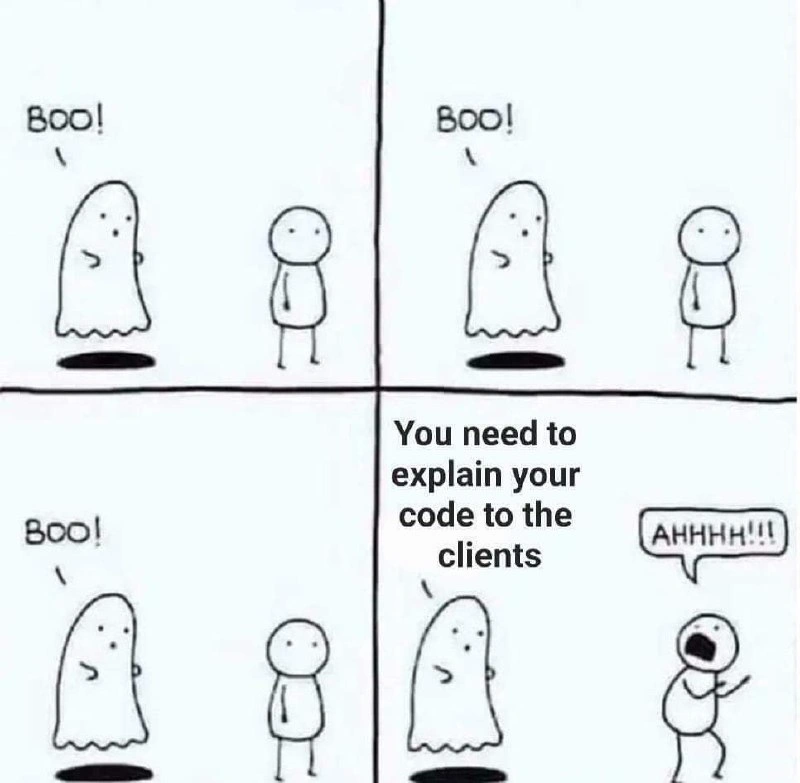
For a less experienced developer (or someone new to the industry), let’s break down what’s happening in the meme. We have four simple cartoon panels in black-and-white. In the first three panels, a ghost is trying to scare a stick-figure developer by shouting “BOO!”. But our developer stands there, expressionless and unimpressed – no reaction at all. Ghosts and spooky stuff just aren’t fazing this coder. This represents how developers often handle typical technical crises calmly. Dealing with errors or scary-sounding tech problems is basically part of the job, so it doesn’t make them flinch.

Now, the punchline comes in the fourth panel. Instead of the ghost saying something, we see a bold text between the ghost and the developer that says, “You need to explain your code to the clients.” The moment our developer reads that, he runs away screaming “AHHHH!!!” in absolute fear. In other words, the thing that finally scares the developer isn’t a Halloween ghost – it’s the idea of having to explain his code to clients (people who don’t write code but have commissioned or use the software).

Why is this so scary to the poor developer? It comes down to a communication gap between technical folks and non-technical folks. Here are the key parts:

  • Clients/Stakeholders: These are usually non-technical people who care about the project from a business or user perspective. They might be paying for the software or relying on it for their work. They often ask questions like “What does this feature do?” or “Why is this taking so long?” without knowing the under-the-hood details.
  • Explaining your code: This means describing how your program or system works in a way that someone who isn’t a programmer can understand. It’s trickier than it sounds! Code is very detailed and full of jargon (imagine talking about functions, loops, or a microservice architecture). If you directly show a client a screen full of code or a sprawling diagram of services and databases, they might get confused or bored. So you have to translate that into everyday language or simple concepts.
  • Developer Anxiety: Many developers feel nervous about this translation job. It’s a common pain point in a programmer’s career. You’re used to thinking in very precise, technical terms. Suddenly you have to be a teacher or storyteller, simplifying without being inaccurate. You might worry about saying too much (and confusing the client) or saying too little (and not doing justice to the work you did). It can feel like a lot of pressure, especially if the client’s approval or money is on the line.

Think of a scenario: say you helped build a web app using ten different interconnected services (microservices). If one tiny part fails, it affects the others – it’s like a spider web of dependencies. Now the app had a glitch, and a client asks, “What went wrong?” To answer, you’d have to describe that whole “tangled microservice dependency graph” (basically the complex way those ten services talk to each other) in simple terms. You can’t just firehose them with technical jargon like, “Service A’s REST API threw a 500 because the message queue was overwhelmed by an unexpected surge in JSON payload size.” 😅 That would only lead to miscommunication and blank stares. Instead, you need to say something like, “One piece of the system got overloaded and caused a chain reaction. We fixed it and added checks so it won’t happen again.” Finding that right level of explanation is tough, and doing it live in front of an audience (especially if you’re not used to public speaking) can indeed feel scarier than a ghost saying “boo.”

The meme is developer humor illustrating that exact feeling. It’s exaggerating to make a point: developers might handle tricky code or scary server problems every day without fear, but ask them to do a client presentation or a code walkthrough for non-tech folks, and they might inwardly panic. It’s a relatable dev experience for many in the field. If you’re early in your career, don’t worry – feeling anxious about explaining technical stuff is normal and gets easier with practice. In fact, understanding this gap in communication is a key part of growing as a developer. The ability to explain complex things simply is super valuable (even though it can be uncomfortable at first). The meme just puts a lighthearted spin on it: making us laugh and say, “Haha, yep, I feel that!”

Level 3: Poltergeist vs PowerPoint

At a senior engineering level, this meme is poking fun at a developer’s real nightmare: not ghosts or goblins, but stakeholder meetings. The ghost’s “BOO!” is child’s play compared to a product manager casually saying, “You need to explain your code to the clients.” The humor lands because experienced devs know that bridging the communication gap between a complex codebase and a non-technical audience is often more terrifying than debugging a midnight server crash. We’ve all stared down plenty of spooky things in code – from a haunting 3AM production bug to 7000-line legacy modules~~ – and kept our cool. But ask us to present that tangled microservice architecture to a room of clients and suddenly we break into a cold sweat.

Why exactly is this scenario so relatable? For one, it highlights the gulf between deep implementation details and business-level explanations. The meme’s developer stands unphased by the ghost (representing any generic horror), implying that technical problems don’t scare an engineer who’s battle-hardened by on-call emergencies and technical debt. Ghost in the server room? Meh, that’s just another day handling ClientExpectations for version updates or refactoring nightmares. But in the final panel when confronted with explaining code to clients, the developer flees in terror. This punchline resonates because it flips the script: devs aren’t afraid of the dark, they’re afraid of PowerPoint slides in front of stakeholders.

Let’s be honest – translating a complex system into plain language without losing accuracy is hard. Imagine trying to rationalize a tangled microservice dependency graph or an obtuse algorithm to a non-technical client who just cares about features and deadlines. You might as well be speaking in tongues. Every senior developer has a war story about that one demo or code walkthrough where eyes glazed over and miscommunication abounded. Maybe you were asked by a stakeholder why a “simple change” is taking so long, and you had to somehow condense months of architecture decisions, API quirks, and bug fixes into a 2-minute explanation. You can practically feel the anxiety – the client’s expecting a clear story, but describing asynchronous queue processing or memory leaks without jargon is like explaining quantum physics at a children’s party. As the meme jokingly illustrates, even a ghost going “BOO!” can’t spook a developer who’s survived production outages, but a calendar invite titled “Client Code Presentation” sure can. It’s the ultimate ironic horror for the seasoned engineer: facing the specter of stakeholder expectations.

To put it in perspective, here’s a tongue-in-cheek “code snippet” for the situation:

ghost.scare(developer, "BOO!");
// Developer unfazed by ghostly "BOO!" (he's seen scarier bugs)

client.askToExplain(developer.codebase);
// Developer panics and flees: explaining code to clients is the real nightmare

In the snippet above, the ghost.scare event does nothing – our stoic dev has probably handled far worse (like rogue null pointers or a database going down) without batting an eye. But the moment client.askToExplain is invoked, all bets are off. The comment says it all: explaining a complex codebase in simple terms to clients is the true horror scenario. This playful pseudo-code mirrors the meme’s logic and draws a smile from anyone who’s been in those shoes. It’s funny because it’s true – the DeveloperExperience of coding often feels safer than the experience of having to justify that code to outsiders. Seasoned devs nod knowingly here, because we’ve learned the hard way that communication skills can haunt you if you ignore them. The meme is a wry nod to that shared pain: we can conquer algorithmic ghosts and server goblins all day, but put us in front of a client and suddenly we’re the ones saying “AHHHH!!!”.

Description

A four-panel, black-and-white line-drawing comic strip. In the first three panels, a simple, friendly-looking ghost says 'Boo!' to a stick-figure-like person, who stands there completely unimpressed and motionless. The panels establish a classic 'scare' attempt with no effect. In the fourth and final panel, the ghost changes its approach and says, 'You need to explain your code to the clients'. In response, the person is now shown screaming in terror, with their mouth wide open, shouting 'AHHHH!!!' and flailing their arms. The joke contrasts a stereotypical scary figure (a ghost) with a real-world source of anxiety for many software developers. The humor lies in the shared experience that communicating complex technical details to a non-technical audience can be far more terrifying than any supernatural encounter, highlighting the stress of stakeholder management
Comments

10
Anonymous ★ Top Pick A ghost is just an unhandled exception in the mortal coil, which is scary. But explaining your code to clients? That's a full production outage in your social skills, with no SRE on call to save you
  1. Anonymous ★ Top Pick

    A ghost is just an unhandled exception in the mortal coil, which is scary. But explaining your code to clients? That's a full production outage in your social skills, with no SRE on call to save you

  2. Anonymous

    Sure, I can survive an outage in a five-nines cluster, but try summarising our eventual-consistency saga to someone who thinks "the cloud" is just a blue icon in Outlook

  3. Anonymous

    After 20 years of explaining why the O(n²) algorithm needs refactoring, you realize the real horror isn't in production - it's watching a client's eyes glaze over when you mention 'eventual consistency' while they just wanted to know why the button is blue

  4. Anonymous

    The ghost represents production outages, merge conflicts, and legacy code - all things senior engineers have seen so many times they've become immune. But asking them to explain why they chose a particular design pattern to a stakeholder who just wants to know 'why can't we just add a button?' - that's the real horror story that keeps architects up at night

  5. Anonymous

    Explaining code to clients is the meeting where I translate cyclomatic complexity into ROI and justify why our “temporary strangler facade” has a five‑year lease

  6. Anonymous

    Ghosts yell 'Boo!'; clients whisper 'Walk me through the architecture' - instant cold sweat, no caffeine required

  7. Anonymous

    Sev‑1s are manageable; explaining eventual consistency, schema migrations, and why the “simple change” needs three feature flags to a client - now that’s a jump scare

  8. Ølеґsîū 🪬🕍🪬 2y

    No jokes, it's really scary

  9. @symptom9 2y

    Doing that right now

  10. @callofvoid0 2y

    fuck youuuu

Use J and K for navigation