The Real Reason for Relocating to Mexico
Why is this RemoteWork meme funny?
Level 1: Fancy Name Trick
Imagine you really, really want to be called something important, like being called “sir” or “boss,” to feel more grown-up or respected. But earning that kind of respect for real can be hard or take a long time. So instead, you do something silly: you go to a place where people automatically use that fancy word when they talk to you. For example, suppose there’s a land where everyone calls any man “Señor,” which is Spanish for “Sir/Mister.” You aren’t suddenly a superhero or a real boss there – but hey, people do call you that special word just because of the local language. This meme’s joke is just like that. The person says he wants to work from Mexico so he’ll be called “Señor Developer,” which sounds like “Senior Developer,” a higher job title. It’s a goofy shortcut: instead of actually becoming a senior (experienced) developer by working hard over years, he’s joking he could simply move to a new place to get a cooler-sounding name. It’s funny because we know changing what people call you doesn’t really make you better at your job – it’s just a cheeky trick to sound important. In plain terms, it’s like a kid thinking, “If I go somewhere where everyone calls me Captain, I’ll magically be a captain!” – a silly idea that makes us laugh.
Level 2: From Junior to Señor
At its core, this joke plays on the similarity between the English word “senior” and the Spanish word “señor.” A senior developer is typically an experienced programmer – someone who’s been coding for years, can design systems, mentor others, and handle bigger responsibilities. Many companies rank developers as Junior, Mid-level, and Senior (and beyond), kind of like leveling up in a game. A junior developer is newer to the field (think of a beginner on a team), while a senior developer is a seasoned pro who’s seen a lot of projects. Naturally, a lot of ambitious juniors can’t wait to become “senior” for the prestige and pay bump. That’s where the humor kicks in: the tweet imagines an interview scenario where the candidate is asked why he wants a remote developer job based in Mexico. In real life, someone might work remotely from Mexico because maybe they live there, or they love the culture, or they’re taking advantage of remote work to travel. But this jokester’s answer is purely a pun: “I want to be a señor developer.”
Now, “señor” in Spanish means “Mr.” or a polite way to address a man (like “sir”). It’s pronounced almost the same as “senior” in English (seh-nyor vs seen-yor). So the candidate is quipping that by working in a Spanish-speaking environment (Mexico), he will literally be called “señor developer” – which to English ears sounds like “Senior Developer.” It’s a classic case of a pun, where a word sounds like another word. This is a bit of bilingual wordplay: mixing languages to make a joke. The interviewer asked a serious question, but got a goofy answer that’s more about language than about the job. It’s as if the candidate pretended the question was about what title he’ll have, not about his reason for relocating. In other words, he’s jokingly saying, “I want this job in Mexico so that I can literally call myself Señor (Senior) Developer.” It’s a silly literal answer to an interview question – something you’d probably never actually say in a real interview, but it paints the candidate as witty (and maybe a little title-obsessed!). 🔍
This joke also touches on the idea of remote work and how developers can now work from anywhere in the world. A remote developer is someone who works for a company but not from the company’s office – maybe from home or another country. Companies might hire remote devs in places like Mexico because of convenient time zones and a strong talent pool. The tweet’s scenario suggests the company is open to hiring from Mexico and asks “Why Mexico?” as a routine question. Usually, you’d answer with something personal or practical (like “I plan to move there” or “I prefer that location”). But here the answer is humorously off-track. It’s highlighting a fun fact: just by being in a Spanish-speaking country, an English word on your business card (Senior) magically looks Spanish (Señor) even though it means something entirely different. It doesn’t mean the person actually gains any new rank or ability – it’s just a language coincidence.
For a newer developer or someone not familiar with the joke: the funny part is that “señor developer” sounds like “senior developer,” which is a higher job title, but literally it’s just saying “Mr. Developer.” It’s like a play on wanting a promotion. In tech, there’s sometimes talk about title inflation – that’s when job titles get fancier without a real change in responsibility or skill. This meme exaggerates that idea to the extreme: a developer tries to “inflate” his title from junior to senior merely by switching languages/location. And because developers often deal with text, characters, and even Unicode (the standard by which letters like ñ are recognized by computers), there’s an extra nerdy layer: one tiny character change can completely alter a word. In summary, the tweet is a lighthearted mix of InterviewHumor (joking in response to an interview question), DeveloperHumor (it’s about a dev wanting a cooler title), and a pun that requires knowing a pinch of Spanish. It’s very relatable to tech folks who joke about climbing the career ladder – sometimes we laugh to cope with the pressure of always trying to reach that next level!
Level 3: One-Tilde Promotion
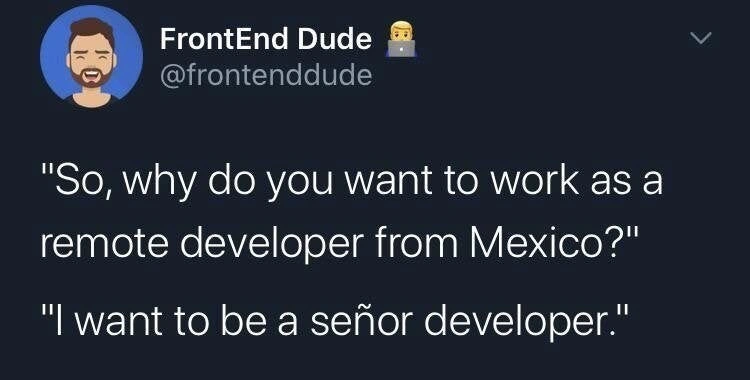
Interviewer: “So, why do you want to work as a remote developer from Mexico?”
Candidate: “I want to be a señor developer.”
This meme riffs on bilingual wordplay and tech career humor to deliver a one-liner that’s equal parts pun and industry satire. At face value, the candidate in this imaginary interview quip responds with a Spanish twist: he wants to be a señor developer. It sounds just like senior developer, the coveted title many programmers aspire to. By adding a tiny tilde over the “n”, Senior becomes Señor – turning a routine career question into a clever multilingual joke. The humor hides in that small Unicode character ñ (U+00F1) which completely flips the meaning: in Spanish, señor simply means “Mr.” or a respectful sir. So this ambitious dev isn’t literally talking about leveling up his coding skills – he’s joking that by working in Mexico (a Spanish-speaking locale), he can call himself a “Señor Developer.” It’s a playful encoding hack for a title upgrade, like a nerdy cheat code for career progression.
Seasoned engineers smirk at this because it pokes fun at our industry’s obsession with title inflation and résumé-enhancing prefixes. In tech, everyone’s chasing that next label: Senior Developer, Lead Developer, Staff Engineer, Principal Engineer. The jump from Junior to Senior often feels like the golden goal – it promises more respect, higher pay, and bragging rights. This meme exaggerates that chase: maybe you’re a mid-level dev today, but hey, move to Mexico and overnight you’re “Señor Developer” (wink, wink). It’s satirizing the idea that a mere word change – not new responsibilities or experience – could magically confer seniority. The absurdity is clear to veterans: if only earning a senior title were as easy as relocating or copy-pasting a special character! In code we can increment variables (e.g. level++), but in real careers you can’t just increment your title by moving abroad. The candidate’s answer is a humorous shortcut to senior status, playing on language to highlight how superficial titles can sometimes be.
Beyond the pun, there’s an undercurrent of real-world developer life here: remote work and global hiring. Post-pandemic, tech companies often ask in interviews, “Why do you want to work remotely (or from [country])?” expecting answers about flexibility, lifestyle, or lower cost of living. But our jokester candidate tosses a curveball. By saying he wants to work from Mexico to become a “señor developer,” he’s also riffing on the trend of companies hiring in Latin America and other regions. Mexico, in particular, has become a tech talent hub in the same time zones as the US, so it’s plausible to interview for a remote dev job based there. The interviewer’s very question, “Why Mexico?” hints at modern HR considerations: maybe verifying the motive for relocation or remote setup. The punchline flips it into pure humor – the reason is not family or culture or cost, but a tongue-in-cheek title change. It’s a joke that lands especially well with developers who deal with internationalization (i18n) or who have seen how one character (like ñ) can break a system if not handled – here it “breaks” the seriousness of the interview with a laugh.
There’s also a sly nod to how English-centric tech job titles are. In many Spanish-speaking countries, the job is still called “Desarrollador Senior” (literally “Senior Developer” mixing Spanish and English), not “Desarrollador Señor.” So the meme’s scenario is purposely ridiculous: no one really calls themselves Señor Developer on a CV. It underscores the insider joke that “Senior” is just a label – sometimes slapped on rather arbitrarily. A developer with a couple years under their belt at a startup might get the Senior title simply because the team is small or to make the role sound attractive. This tweet winks at that reality: the title senior has weight in tech, but it can also become a semantic game. The señor/senior swap is a reminder that titles don’t always equal talent; sometimes they’re just words we pad our résumé with. Experienced devs chuckle because they recall the awkward transition from being the new “Junior Dev” to insisting on that “Senior” tag – and how, in truth, the difference between the two is more than just an enye (ñ) or a fancy prefix. In essence, the meme combines InterviewHumor with a dash of linguistic geekiness: it’s funny in a groan-worthy way (“dad joke” alert!), but it also satirizes the way we think about career progression in the software industry.
Description
A screenshot of a tweet from the user "FrontEnd Dude" (@frontenddude). The tweet displays a conversation. The first line asks, "So, why do you want to work as a remote developer from Mexico?". The second line replies, "I want to be a señor developer.". The background is dark blue, and the text is white. The user's avatar is a cartoon of a smiling man with a beard. The meme is a pun playing on the similarity between the English word "senior" (a high-level job title in tech) and the Spanish word "señor" (a title of respect, like "Mr." or "sir"). The joke implies a developer is moving to Mexico not just for the remote work opportunity but to literally become a "señor" developer, humorously conflating job title ambition with a cultural and linguistic title. It's a lighthearted joke about career goals and the globalization of tech work
Comments
11Comment deleted
The fastest way to get a promotion from 'Senior' to 'Señor' isn't mastering Kubernetes, it's updating your location on LinkedIn
At this rate, HR’s career matrix will need UTF-8 support just to fit the next level after staff - señor-plus-plus
The real senior developer move is negotiating your salary in pesos but billing your AWS costs in dollars - that's how you achieve true currency-agnostic architecture with built-in exchange rate arbitrage as a microservice
The real senior move here is optimizing for both career progression AND cost-of-living arbitrage - turns out the best architecture decision is sometimes just picking the right timezone with better tacos
Nearshoring hack: Skip a decade of tech debt by ñ-ing your title to señor - no system design interview required
At this company, “senior” is basically a locale string - set locale=es_MX and get promoted via U+00F1
Our leveling framework treats 'senior' and 'señor' the same: L5 responsibilities, L4 comp band, and the same on-call rotation; only the timezone shifts
In many Spanish speaking countries, senior level is still named as senior Comment deleted
I can confirm Comment deleted
Or because he wants to be with aliens 👽 Comment deleted
So true, but not Mexico, Paraguay:) Comment deleted