The Post-Debugging Stare Down
Why is this Bugs meme funny?
Level 1: The Never-Ending Puzzle
Imagine you have a really big jigsaw puzzle that you need to finish, but there’s something wrong: a few pieces are hidden or stuck, and the picture isn’t coming out right. You spend all day trying piece after piece, looking under the couch for missing bits, and fixing the puzzle. It takes 15 hours, and by the end you finally make the picture look correct. You’re super tired because it was so hard and took so long. Now, just as you’re wiping your brow and hoping for a rest, a teacher or a parent walks in and asks with a serious face, “Why did it take you so long to finish that puzzle?” You just stand there, blank stare, feeling speechless. How can you even begin to explain all the little tricky parts that were wrong with the puzzle? You know how much effort it took, but to them it just looks like an ordinary completed puzzle.
That’s exactly what’s happening in this meme. The developer (like the person solving the puzzle) worked so hard to fix a hidden problem in a computer program. It took a very long time and a lot of effort. When they’re finally done, the project manager (like the parent/teacher) comes and silently expects an explanation for why it took so much time. The developer is so exhausted and amazed that the problem is finally fixed that they don’t even know what to say. They feel a bit frustrated too, because the manager wasn’t there to see how messy and complicated everything was. It’s funny because we can all imagine that feeling: working really hard on something difficult, then being asked to justify it when all you want to do is slump over and sleep. The meme uses a silly cartoon image – a character standing there with a dull, tired expression – to show that exact emotion. Even if you’re not a programmer, you know what it’s like to be completely worn out by a hard task and then have someone question you about it. It’s both relatable and a little absurd, which is why it makes people laugh. In simple terms, the meme is saying: “I spent forever fixing the problem, and now I have to explain myself? I’ve got nothing left – just look at my face!”
Level 2: Debugging Detective Work
Let’s break down what’s happening here in simpler terms. In software, a “bug” is a mistake or error in the code that makes a program act in unexpected (often bad) ways. Fixing a bug, or debugging, is the process of finding that mistake and correcting it. Sometimes you get an obvious error (like a clear error message or the app crashes in a predictable spot), but other times bugs are like little mysteries. You have to play detective: follow clues in error logs, test different parts of the program, and slowly narrow down where things are going wrong. It’s not always straightforward – a bug that seems small can be hiding deep in the code, and finding it can take a lot of time and patience.
In the meme’s scenario, the developer spent 15 hours straight trying to fix a particularly complex bug. That’s almost two full workdays, or maybe one really long overnight session fueled by caffeine. 😫 Why would it take that long? Imagine your program is thousands of lines of code spread across many files and even multiple systems (like a front-end, a back-end, a database, etc.). The bug could be anywhere. For example, maybe a variable wasn’t getting updated correctly, or two systems weren’t talking to each other the way they should. The developer likely tried many things: reading through code, adding print statements or using a debugger tool to see what’s happening at each step, checking logs (files that record what a program is doing behind the scenes), and even searching the internet for clues (because chances are someone else has had a similar issue). It’s a slow, methodical process. Sometimes you fix one thing only to discover the problem is actually elsewhere. Or you think you found the bug, but when you test the app again, the problem still happens, meaning your “fix” didn’t actually fix anything. This back-and-forth can eat up hours. Debugging and troubleshooting often involve a lot of trial and error.
Now, who is asking for an explanation after all that work? That would be the Project Manager (PM), a person in charge of making sure the project is on schedule and things get done. A project manager doesn’t usually code themselves; their job is to coordinate tasks, track progress, and communicate with stakeholders (clients, bosses, or anyone with a stake in the project’s success). In an ideal world, if a developer spends 15 hours on something, there’s a very clear reason and a deliverable result. But here, at the end of those 15 hours, the result is just that the bug is finally fixed. The software might not look any different – it just stops doing the wrong thing and goes back to working correctly. That’s great for the product, but it can be hard for a non-developer to appreciate how much effort went into making that invisible problem go away.
From the project manager’s perspective, they might be concerned or confused: How did one bug fix take almost two days? They might worry that the developer got stuck or wasn’t working efficiently, or they simply need details to update their own bosses or clients about why a feature was delayed. It’s part of the PM’s job to ask, “Hey, we planned for this task to be done in a few hours. What happened?” They aren’t necessarily trying to be mean – they might genuinely need to know if something bigger is wrong (like, is our codebase very buggy? Do we need more tests? Will future tasks also be delayed?). However, to the exhausted developer who just emerged from their coding war, that question can feel like an interrogation or an accusation, even if it’s asked innocently. The developer is likely physically tired, mentally drained, and maybe a bit frustrated that the bug was so troublesome. Being asked to justify those hours or to explain the time spent can be tough when you’re running on fumes.
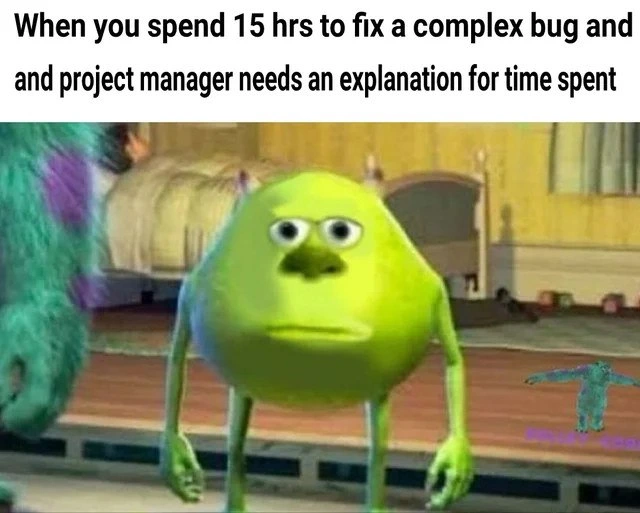
The meme uses a funny image to communicate the developer’s reaction. It’s from the Pixar movie Monsters, Inc. – specifically, it’s the character Mike Wazowski (the one-eyed green monster) standing with a very blank, tired expression. In the image, Mike’s face looks weird because the face of his friend Sulley (the big furry blue monster) has been pasted onto Mike’s round green body. This distorted Mike Wazowski blank stare has become a popular meme template on the internet. People use it to show moments when they feel completely done or have no response. Here, it perfectly represents the developer’s empty stare when the PM asks for an explanation. You can almost hear crickets in the background. The dev is so exhausted and over it that they have no energy to even speak. It’s a face that says, “I have nothing left to say or do.” It’s both funny and a little sad, because you can empathize with how tired they must be.
Why is this funny to other developers? Well, it’s very relatable. Almost every programmer, even those just starting out, has experienced a situation where they thought something would be quick but it ended up taking way longer. Maybe you’ve had a school assignment or a personal coding project where you spent hours trying to find a typo or figure out why your code wasn’t working, and when you finally fixed it, the actual change was tiny. For example, you might spend all evening debugging only to realize you misspelled a variable name somewhere. It’s happened to all of us! 😅 And then imagine someone who isn’t familiar with coding, like a friend or a family member, asks why you were at the computer so long. It’s hard to explain without diving into technical details that might just confuse them. So the easiest response is sometimes just a blank look or a sigh: “Trust me, it was complicated.”
There’s also an interesting little meta-joke: in the meme’s caption text at the top, the word “and” appears twice in a row by accident (“fix a complex bug and and project manager needs an explanation...”). That’s probably just a typo, but it’s ironic because it’s like a tiny bug in the text itself. In a way, that duplicated word is a harmless mistake (we still understand the sentence). But think about it: if a programmer accidentally duplicated a word or a symbol in code, it could break the program and cause a real bug! For instance, writing the same command twice could crash a system or cause an error. So even a small typo can have big consequences in coding. The fact that the meme’s text has a minor error kind of echoes the idea that small errors are what programmers spend a lot of time looking for.
In simpler terms, this meme is about invisible work and the gap in understanding between developers and non-developers. The developer did a lot of behind-the-scenes problem solving (nothing viewers or users would see directly), and the project manager, who deals more with schedules and people, understandably wants to know what happened. The humor comes from the look on the developer’s face — that silent, exhausted stare — which says more than words ever could. It tells the whole story: “I just fought a boss-level bug for 15 hours straight… please don’t make me relive it by explaining everything.”
So if you’re new to coding, take this as a peek into software life: debugging can be a rollercoaster. Some bugs you fix in 5 minutes, and you feel like a hero. Others, like the one in this meme, can swallow days. And when you finally conquer one of those, you might not have the heart to detail every twist and turn to someone else. You’re just happy (and relieved) that it’s solved! The meme gives a humorous nod to that reality, and that’s why so many developers find it funny and painfully true.
Level 3: Between a Bug and a Blank Stare
This meme nails a classic software development scenario: spending an entire day (or night) wrestling with a complex bug, only to face your project manager’s unblinking "what exactly were you doing?" look afterward. It’s a perfect slice of DeveloperHumor born out of real DeveloperFrustration – the clash between the unpredictable world of BugFixing and the structured expectations of project planning. In this darkly comic scene, the developer has slogged through a marathon debugging session (imagine combing through logs at 3 AM, stepping through code line by line, chugging coffee like water), and now management wants an accounting of that time. It’s the classic standoff between BugsInSoftware (which can devour whole days with no guarantee of a fix) and ManagerExpectations (that every hour of work can be neatly justified).
To the non-technical eye, 15 hours for "just a bug fix" might sound outrageous. But in complex systems, one stubborn bug can absolutely justify an all-day (and night) battle. Why did it take so long? Seasoned engineers know all too well that certain bugs are basically debugging black holes – once you’re in, time behaves strangely. Here are a few reasons a “simple” fix can turn into a 15-hour odyssey:
- Elusive Conditions: The bug might only occur under very specific circumstances or timing (the kind of issue sometimes nicknamed a Heisenbug because looking into it can make it seem to disappear). Reproducing those exact conditions in a dev or test environment can take hours. It’s like a glitch that happens only when the stars align just wrong – perhaps only with a certain dataset at 2:07 AM when the server is under heavy load. Finding that pattern is needle-in-haystack work.
- Spaghetti Code: If the codebase is tangled or legacy code with little documentation, a simple symptom can have a deeply buried cause. Tracing a problem through convoluted functions and modules is like navigating a maze. You fix one thing, only to discover it’s tangled with another module or an outdated API. Untangling that mess is painstaking.
- Multiple Systems at Play: Modern apps aren’t monolithic – they might have a dozen microservices talking to each other, plus databases, caches, etc. A bug could be in the integration points, meaning the developer has to investigate logs across several systems or services. It’s a detective mission across distributed components (and of course, each team initially insists it’s not their system’s fault). Coordinating and debugging across system boundaries (network calls, data formats, auth tokens, you name it) eats up time.
- False Leads: Debugging is trial and error. You form a hypothesis ("Maybe the user ID is null here? Maybe the config didn’t load?"), then test it. Often those theories don’t pan out. A developer might spend hours chasing what turns out to be a red herring, then have to start over with a new approach. It’s mentally exhausting, and progress isn’t linear.
- One-Line Fix: Here’s the cruel joke: after 15 hours of effort, the actual code change might be literally one line or one character. Perhaps a missing
awaitin an async function, or a misused==instead of===, or a forgotten config flag. Tiny bugs can have huge ripple effects. A small oversight like that can crash an entire app, but spotting that single character difference in thousands of lines… that’s what took 15 hours. (Ironically, the meme’s caption itself has a tiny typo – it says "and and project manager". A duplicated word is trivial here, but if that kind of slip were in code, it could indeed cause a head-scratching bug! 🐛)
After such a grueling DebuggingAndTroubleshooting marathon, the developer is left drained and maybe a bit delirious. Enter the project manager (PM), who likely only knows that a whole day’s worth of development time went up in smoke on this bug. The PM is under DeadlinePressure to keep the project on schedule and probably faces StakeholderPressure from higher-ups or clients expecting features to be delivered. So when a task intended to take, say, 2 hours ends up consuming 15, alarms go off on the management side. This is the kind of surprise that can wreck a carefully planned sprint or timeline; a supposed "quick fix" ticket morphs into an all-day fiasco. The burn-down chart for the sprint looks all wrong, and the PM now has to explain to their boss or client why a one-line change took the whole day. In other words, the PM needs a story to justify the time – hence that silent interrogation stare: “Explain yourself.”
From the developer’s perspective, this moment is almost comically absurd. How do you even begin to explain the time spent? Where to start? “Well, I spent the first three hours just figuring out where the bug actually was, because our error logs might as well be written in ancient hieroglyphs. Then I realized it only happens when the server restarts, which led me down a rabbit hole into the deployment scripts…” By this point, the PM’s eyes would glaze over. The truth is, explaining a 15-hour bug hunt in simple terms is nearly impossible without a mini computer science lecture. It’s deeply technical invisible work. The PM is essentially asking for a summary of an incredibly intricate detective story that unfolded in the codebase. But the developer, running on fumes, has zero energy (and maybe zero willingness) to translate that saga into plain English. The result? That blank, exhausted Mike Wazowski stare from the meme – the face of a dev who’s mentally saying, “You wouldn’t understand even if I tried.”
There’s also an undercurrent of ManagementHumor here, in that the PM’s job is to ask these questions. They have to account for every lost hour. Yet from the dev’s side it feels like an inquisition: the silent office (or Zoom call) where the manager waits for an answer, and the engineer is just speechless, perhaps imagining banging their head against the wall. It’s a tension many in the industry know: engineers value solving the problem correctly, managers value knowing when it will be solved and why it took so long. Both sides actually have good reasons – the dev was doing necessary troubleshooting, and the PM needs to keep the project on track – but their priorities clash in this moment.
The choice of the image — the famous distorted Monsters Inc. frame with Mike Wazowski’s small green body and Sulley’s big weary face pasted on — brilliantly conveys that feeling of being utterly spent and not at home in your own skin. Mike (the green character) usually has a silly, energetic demeanor, but here with Sulley’s tired face he looks done-with-life. That’s the developer: a bit disoriented, perhaps looking like they aged a few years after a bug war. The blank stare is pure exhaustion. It’s also a little bit of defiance or deadpan humor: “Go on, ask me why it took so long. I dare you.” The meme format itself is popular for any scenario where someone is just standing there, defeated and speechless. In our context, it visually encapsulates the post-debugging thousand-yard stare.
In summary, this meme resonates because it highlights a universal truth in development: invisible work is real work. A programmer can pour 15 hours into fixing a troublesome bug and have almost nothing tangible to show except a commit that reads “Fixed crash on load” or a one-line code change. From the outside, it looks like nothing changed — the software behaves the same as it should, no new features, no new UI — so non-engineers sometimes genuinely ask, “Why did that take so long?” It’s a valid question from their perspective, but one that’s painfully hard to answer. The humor (tinged with pain) comes from that disconnect. The developer is thinking, “You want an explanation? I just journeyed to Mordor and back in our codebase,” while the PM is thinking, “It was just one bug, what’s the big deal?” The deadlines don’t care about the truth that sometimes debugging is an art, not an exact science.
So there you have it: a bug fix became an epic quest, and the final boss isn’t even the bug — it’s explaining that quest to someone who wasn’t there. The meme perfectly captures that awkward, exhausted moment of silence, where all you can do is stare blankly and wish the code could speak for itself. It’s funny because it’s true: every developer has been Mike Wazowski in that image at some point, caught between a nasty bug and a hard place (the boss’s stare). This is everyday life in software development, condensed into a single image and one painfully relatable caption.
Description
This meme uses the 'Mike Wazowski-Sulley Face Swap' format, which features the character Mike Wazowski from 'Monsters, Inc.' with his friend Sulley's face photoshopped onto his, resulting in a blank, emotionless stare. The text at the top reads: 'When you spend 15 hrs to fix a complex bug and project manager needs an explanation for time spent'. The image captures the developer's stunned silence and exhaustion after a long and arduous debugging session, now faced with the daunting task of justifying their time to a non-technical project manager. The humor lies in the communication gap between technical and non-technical roles; explaining a 15-hour deep dive into legacy code, race conditions, or obscure dependency issues can be nearly impossible to summarize in a simple status update. The deadpan expression perfectly encapsulates the feeling of 'you wouldn't understand even if I explained it.' In the background, a small, T-posing Sulley is visible, a surreal addition common to this meme template
Comments
7Comment deleted
The explanation for the PM is simple: 'The bug was a quantum state of both 'won't fix' and 'trivial change' until observed for 15 hours, at which point it collapsed into a single-line fix.'
Breakdown of the 15 hours? 1 writing the patch, 14 reproducing the race condition that only triggers when the feature flag expires during a GC pause on a leap-second boundary - just book that as “knowledge transfer” on the timesheet
The real bug was thinking you could explain distributed race conditions, memory corruption across microservices, and why bisecting 10,000 commits took 15 hours to someone who thinks 'clearing the cache' is advanced troubleshooting
After 15 hours of debugging - bisecting commits, analyzing heap dumps, instrumenting production traces, and finally discovering a subtle race condition in a third-party library's connection pool - the PM asks: 'So why didn't you just add a print statement?' The gap between 'it works now' and 'I understand why it failed, prevented future occurrences, and documented the root cause' is where senior engineers live... and where project timelines go to die
PM: “15 hours for a one-line fix?” Me: “Convincing six microservices with NTP drift and overly optimistic caches to agree on causality is 99% archaeology, 1% typing.”
15 hours chasing a Heisenbug across microservices, fixed - until the PM's 'why?' observation collapses the wavefunction and respawns it
The PR shows a one-character change; the 15 hours were convincing a prod-only race hidden behind a stale feature flag, warm caches, and a DST rollback to actually happen