Project Estimation Driven by Dungeons & Dragons
Why is this ProjectManagement meme funny?
Level 1: Dice Decides
Imagine you’re playing a board game at home when your mom suddenly asks, “How long will it take you to finish your homework?” You have no idea since you haven’t even looked at it yet. So, as a joke, you pick up a die from your game, roll it, and confidently say, “It’ll take seven days!” It’s funny because you’re clearly just making up an answer using the die. In real life, chores or homework can be hard to predict, and this comic is joking that sometimes grown-ups in offices also end up guessing in silly ways when put on the spot. The humor comes from how silly it is to use a game of chance to answer a serious question – whether it’s a kid giving a random time to their parent or developers giving a random timeline to a client.
Level 2: Gamified Guesswork
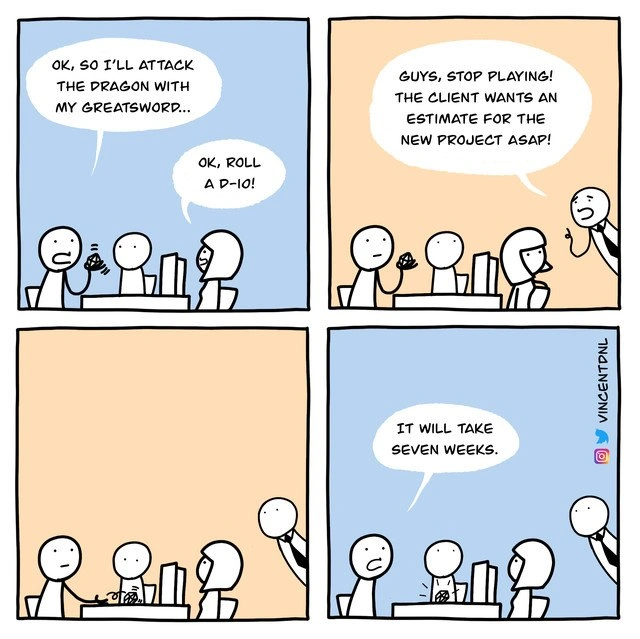
The meme shows a funny mash-up of work and play that a junior developer can easily understand. In the first panel (blue background), the developers are actually acting out a fantasy role-playing game scenario. One says something like, “I’ll attack the dragon with my greatsword,” and another responds, “OK, roll a D-10!” For clarity, a D-10 is a ten-sided die (one of those polyhedral dice used in games like Dungeons & Dragons). Rolling a D-10 will give a random number between 1 and 10. So initially, the devs are goofing around with a game and a die right at their desks.
In the second panel (peach background), reality barges in. A manager leans in and scolds them: “Guys, stop playing! The client wants an estimate for the new project ASAP!” Here ASAP stands for “as soon as possible,” meaning the client is impatient and needs a timeline immediately. The manager is essentially saying the fun is over and it’s time to get serious. They want an estimate – basically, a prediction of how long the project will take. Stakeholders (like clients or bosses) often ask for a timeline early on so they can plan and set expectations. The contrast is stark: the developers move from a playful RPG moment to suddenly facing a serious deadline question from the higher-up.
Panel 3 shows the developers pausing awkwardly, with the manager hovering over them. One dev is still literally holding the D-10 die in the air, since he was just about to roll it for the game. This moment captures them processing the demand. They’re probably thinking, “Uh oh, we need to give a number now, and we have no idea yet.” There’s deadpan humor here: they’ve been caught playing, and now, under pressure to answer immediately, they might actually use the very die from their game to decide their answer.
In Panel 4 (blue background again), the developer actually goes through with it – he rolls the die and declares with a straight face, “It will take seven weeks.” Essentially, the devs treat the time estimation as part of their game. The number seven wasn’t derived from any real calculation or detailed planning; it was simply the outcome of the die roll (7 out of 10). This is funny because normally you’d expect an estimate to come from analyzing the project, breaking down tasks, and considering potential obstacles. Instead, they literally left it to chance. The manager needed a number fast, so the team gave a random timeline that just sounds confident and specific.
For a new developer, it helps to know why this scenario feels relatable in tech. Software project estimates are notoriously tricky – it’s hard to predict exactly how long coding, debugging, and testing will take, especially early on. Teams do try various methods to forecast timelines. For example, in Agile development there’s a practice called planning poker where each team member privately picks a card with a number (representing story points or days) for how long a task might take, and then everyone reveals their cards at once. This helps the team discuss and reach a reasonable estimate together. The key point is that even with such methods, coming up with estimates involves a lot of guessing based on experience. The comic exaggerates this by showing the developers rolling a die instead of using any formal method at all. It pokes fun at the idea that giving an exact timeline can sometimes feel as random as a die roll anyway.
The phrase “the client wants it ASAP” is something you’ll likely hear in real projects. Clients or bosses often push for the fastest possible delivery, even when details aren’t clear. That pressure can corner developers into giving a quick answer. In this meme, the team basically says, “We need X weeks,” where X came from a D-10 roll. They turned a stressful estimation request into a joke by using their game die to pick the number. It highlights the awkward position devs are put in: asked to guarantee a deadline on the spot, they might as well be guessing. The humor comes from mixing something as serious as a project timeline with something as random and playful as a dice roll. It’s a lighthearted reminder that while we try to plan carefully, sometimes estimates are just best guesses – and when you’re pressed for an answer, those guesses can feel pretty arbitrary.
Level 3: Dice-Driven Deadlines
At first glance, this comic merges RPG culture with the grim reality of software ProjectManagement. The team of developers literally gamifies their timeline forecast by rolling a 10-sided die (a D-10) to decide the fate of a new project's deadline. This isn’t just nerdy humor – it’s a tongue-in-cheek jab at how TimeEstimation in our industry can feel basically random. An experienced developer has likely survived their share of scheduling fiascos where timeline promises were about as scientific as an RPG dice roll. The phrase “Guys, stop playing! The client wants an estimate ASAP!” triggers an almost Pavlovian eye-roll in any senior engineer: we’ve all had a stakeholder barge in with StakeholderPressure demanding a deadline ASAP (as soon as possible) before the team can even catch its breath or clarify requirements. The humor lands because, under such DeadlinePressure, giving an estimate is often a trivial shot in the dark – or in this case, a shot in the dark with polyhedral dice.
The dev holding the die in Panel 1 was narrating a fantasy battle (“I’ll attack the dragon with my greatsword...”), totally in make-believe mode. When the manager interrupts in Panel 2 with “Guys, stop playing! The client wants an estimate for the new project ASAP!”, the meme shifts from a playful Dungeons & Dragons vibe to the harsh realm of Stakeholders demanding answers. There’s an abrupt tonal whiplash here: one moment it's a fun RPG scene, the next moment it's big-boss urgency. Every senior dev knows that feeling – you’re deep in thought (or maybe even taking a brief mental break) when a manager suddenly pops up asking for an instant timeline commitment. In Panel 3 the devs freeze like deer in headlights, die still in hand, caught off guard by this urgent request. We can practically feel them thinking, “You want a precise ProjectDeadline right now, out of thin air? Sure... we can conjure one for you.”
By Panel 4, the team sarcastically goes through with the dice-based planning. The developer announces with deadpan seriousness, “IT WILL TAKE SEVEN WEEKS.” Why seven? Because the polyhedral dice – presumably a ten-sided die they were playing with – must have landed on a 7. This punchline hits home for battle-scarred devs: we suspect that often those confident-sounding estimates we give are no more reliable than a lucky die roll. The absurdity is that the manager seems to accept this random timeline as if it were a carefully calculated schedule. It’s a comedic exaggeration, but not far from truth. In real projects, when forced to answer on the spot, developers sometimes blurt out a number that "feels" right (or won’t get them yelled at) – essentially an educated guess with a lot of guess and very little education. The comic dramatizes that by making it literally a game of chance, highlighting the arbitrary nature of these promises.
This meme resonates with senior engineers because it satirizes a known anti-pattern: deadline setting by gut feeling (or pure chance). In a well-run process, you’d gather requirements, assess complexity, maybe use Agile estimation techniques (like planning poker or story points) to forecast effort. But in reality, high-pressure situations lead to what I half-jokingly call Dice-Driven Development™. DeadlinePressure can reduce even the best teams to making a wild guess just to get the boss off their back. The humor also masks a bit of trauma: once that arbitrary seven weeks is uttered, it magically transforms into a binding commitment in the manager’s mind. Seasoned devs have seen how a casually tossed-out estimate can haunt them: “You promised seven weeks, why is it week eight and we’re not done?!” Never mind that the “promise” was basically a roll of the dice – the date gets etched in stone. Those of us with scars know to be wary of giving a number too quickly; many intentionally pad their estimates or use ranges to avoid an unrealistic commitment. Here the team just went full random right in front of the manager, which is hilarious because it’s an exaggerated version of what often happens behind the scenes anyway.
One subtle layer of this joke is the parallel between slaying a dragon and tackling a project. Large software projects can indeed feel like boss battles, full of unknowns and deadly risks for timelines. The D-10 roll is akin to saying “our chances are up to fate.” In game terms, rolling a 7 on a D-10 might be a moderate outcome – not a critical success but not a critical failure either. If that die had come up 1, the developer might have declared “one week,” and we can imagine the sheer panic that would cause (and the team pulling insane hours to avoid a Critical Fail with the client). If it was 10 weeks, the client or manager might balk (“That long?!”) and push back. Seven weeks feels comically arbitrary yet oddly plausible, which is why it’s funny – it’s exactly the kind of confidently specific number managers often get in these situations. As a grizzled engineer, you laugh because you know the real game: estimation is often a negotiation shaped by wishful thinking and fear of disappointment. Might as well break out the Gantt charts dice and hope for a critical hit on the schedule.
In short, this meme uses the absurdity of role-playing game mechanics to lampoon real ProjectManagementHumor. It highlights the thin line between genuine project planning and random timelines conjured under duress. Any senior developer or project manager chuckles (perhaps nervously) because they recognize that yes, ProjectDeadlines sometimes do come out of meetings exactly like this – minus the literal dice. The devs’ D&D session in the office morphs seamlessly into a parody of an estimation meeting. It’s a comedic coping mechanism for a DeveloperHumor truth: when cornered for an immediate estimate, even pros feel like they’re just rolling the dice.
Description
A four-panel comic strip featuring stick-figure office workers. In the first panel, three developers are playing a tabletop role-playing game, likely Dungeons & Dragons. One says, 'OK, so I'll attack the dragon with my greatsword...', and another replies, 'OK, roll a D-10!'. In the second panel, a manager figure interrupts, saying 'Guys, stop playing! The client wants an estimate for the new project ASAP!'. The third panel is silent as the developers look at the manager. In the final panel, one of the developers, having just rolled the D-10 die, declares, 'It will take seven weeks.' The comic humorously critiques the often arbitrary and speculative nature of software project estimation, equating it to a random roll of the dice in a fantasy game. It resonates with experienced developers who have seen estimates pulled from thin air to satisfy stakeholder demands

Comments
7Comment deleted
Agile estimation poker is just D&D for people who pretend their imaginary numbers are based on science
Rebranded the D10 as our “Monte Carlo hardware accelerator” - now the seven-week guess is a 95th-percentile forecast and finance calls it data-driven
The only difference between rolling a D10 and our estimation process is that the dice doesn't add a 40% buffer after consulting three different project management frameworks that all somehow arrive at the same arbitrary number
The real joke here is that rolling a D-10 for dragon damage is actually more rigorous than most enterprise estimation processes. At least with dice you get a uniform distribution and can calculate expected values - most project estimates are just vibes-driven development with a Fibonacci sequence thrown in to look scientific. Seven weeks? That's suspiciously close to a sprint boundary. This developer clearly rolled high on their Wisdom stat and knows that any number between 'two weeks' and 'three months' is equally defensible when you haven't even seen the requirements yet
We replaced planning poker with a d10: same accuracy, higher throughput, and the PMO calls it ‘Monte Carlo’ if we roll it three times
P-10 dragon in D&D? That's rookie hour. In enterprise Jira, it crits with legendary actions from stakeholders and still demands delivery yesterday
Estimation is just D&D for executives: roll a D10, call it planning poker, and pray the dragon isn’t named “dependencies.”