Skip to content
DevMeme
3234 of 7435
The GitHub Paradox: Who Deploys the Deployer?
DevOps SRE Post #3556, on Aug 19, 2021 in TG

The GitHub Paradox: Who Deploys the Deployer?

Why is this DevOps SRE meme funny?

Level 1: Who Fixes the Fixer?

Imagine you locked your only set of keys inside your house. Now, the only way to unlock the house is... with those very keys. Uh-oh! You’re stuck because the tool you need is trapped in the place you can’t reach. This GitHub meme is funny for the same reason: it’s like saying the tool needed to fix a problem is locked inside the problem itself. People find it amusing because it’s a catch-22 situation – a loop that makes no sense. It’s a bit frustrating and a bit silly, like a mechanic who accidentally left all his tools inside a broken car. We laugh at the scenario because we can picture how absurd it is: “How can you use GitHub to fix GitHub when GitHub is down?” It’s highlighting that goofy, head-scratching moment when the fixer needs fixing.

Level 2: Chicken and Egg Deploys

For a newer developer or someone outside the DevOps world, let’s break down the joke. GitHub is a hugely popular website where developers store and share code using a system called Git (a version control tool). Many companies, possibly including GitHub itself, use GitHub to host the code for their products. They also often use GitHub’s features or related tools to automatically test and deploy updates – this is the CI/CD pipeline, which stands for Continuous Integration/Continuous Deployment. Now, the tweet is basically asking: “Does GitHub use its own platform (GitHub) to build and deploy the GitHub website? And if so, what happens if GitHub is down – how would they rollback (undo) changes to fix it?”

Think of “rollback” as hitting an undo button. When a new software update causes trouble, engineers might roll back to an earlier, stable version of the code. Usually, to do that on a platform like GitHub, you’d push a revert commit or trigger a deployment workflow – actions that typically require GitHub to be up and running. The funny (and concerning) scenario here is the idea that if the platform is down, the usual way to fix it (which relies on the platform) might also be down. It’s a circular dependency, often called a “chicken and egg” problem: which comes first, the fix or the functioning platform to deliver the fix?

In a well-designed system, there’s always some backup method. The tweet playfully questions whether GitHub has such a plan. If GitHub “uses GitHub to build GitHub,” one would hope they have a second way to deploy code when the main site is offline. For example, developers might have a copy of the code on their own computers (a local Git clone) and some manual way to deploy it to servers in an emergency. Big companies usually store critical code in multiple places and might have an internal deployment tool or at least scripts they can run if the fancy automated pipeline isn’t available. The humor comes through because if you take the question at face value, it sounds like an obvious oversight: “Wait, if their only way to fix GitHub is through GitHub itself, they’d be stuck!” That idea is both ironic and a little bit scary, and that’s why developers find it funny. It highlights the importance of redundancy — having another route to do important tasks if the primary route is broken. In simpler terms, always keep a spare key hidden somewhere safe in case you lock yourself out!

Level 3: CI/CD Catch-22

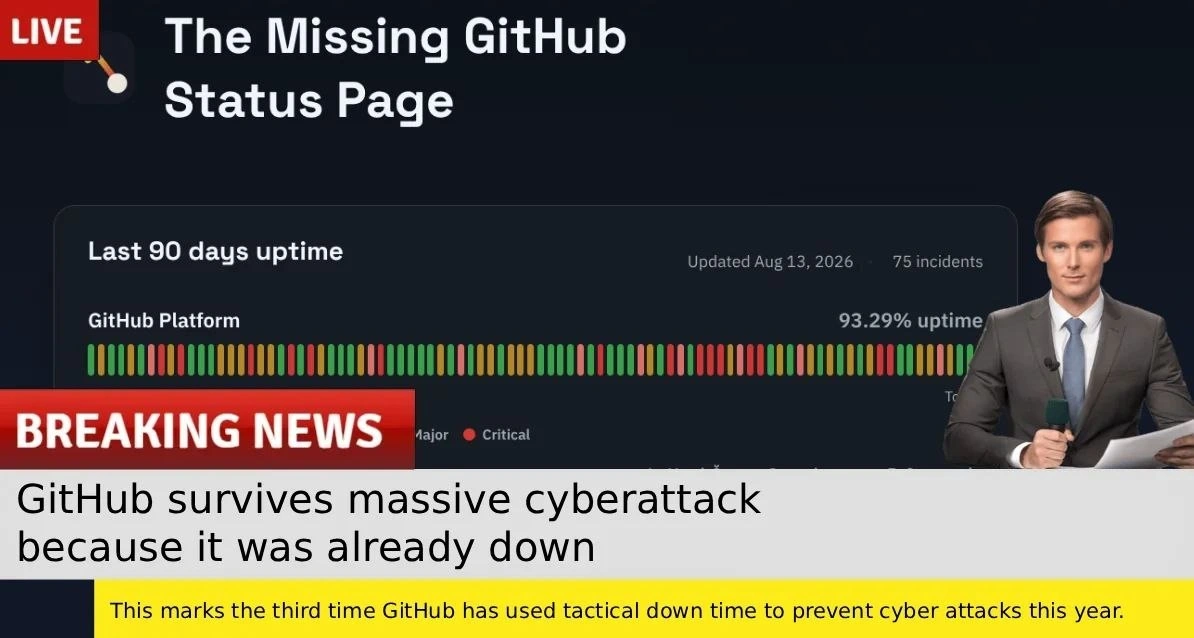
In more practical terms, this meme nails a very real DevOps/SRE nightmare in a witty way. Imagine being on the SRE (Site Reliability Engineering) team responsible for GitHub’s uptime. If GitHub truly relied on itself for deployments, an outage would create a vicious circle: you need to deploy a fix because GitHub is down, but you can’t deploy via GitHub because... GitHub is down! This is the quintessential Catch-22 of a poorly planned deployment pipeline. It’s a blend of VersionControlHumor and DeploymentHumor that makes anyone who’s maintained production systems smirk (or shudder). Many seasoned engineers have experienced something similar on a smaller scale: for example, your code is stored on GitHub and uses GitHub Actions (GitHub’s CI/CD) to deploy. Then GitHub has an outage or a network issue, and suddenly you’re stuck — you can’t push a fix or roll back a bad update because the platform that runs your tests and deploys is unavailable. It’s a feeling of helplessness that is all too real: “Our usual automation is offline... now what?”

The tweet’s popularity (hundreds of retweets and thousands of likes) shows that it struck a chord. It pokes fun at what every DevOps engineer knows: always have a Plan B. There’s a reason reliability folks talk about avoiding single points of failure. Here GitHub itself could be a single point of failure for its own operations if not architected carefully. The meme exaggerates it to be humorous – picturing a scenario where the only way to fix the plane is by using the plane’s own controls while it’s mid-flight and those controls aren’t responding. It’s absurd, but not entirely far-fetched in poorly designed systems.

In reality, GitHub (the company) almost certainly has safeguards. Large SaaS companies host their code in multiple forms. For instance, even if their main Git repository is on the GitHub service, the engineers likely have offline clones, backups, or an internal deployment system that can operate independently. Many organizations practice “break-glass procedures” for exactly this kind of situation – e.g., a manual script or an alternate CI server that can apply a critical fix when the normal pipeline is unavailable. It might be as crude as an engineer SSH’ing directly into servers to run a hotfix (every ops veteran has done that at least once, albeit reluctantly). Ideally, it’s a read-only mirror of the repo or a separate Jenkins instance ready to take over deployments. The tweet implicitly asks “can GitHub rollback GitHub to fix GitHub when GitHub is down?” and any battle-scarred ops person will chuckle and answer: “It better have a way, or someone’s getting paged at 3 AM with a major headache.” In other words, the humor comes from imagining that they didn’t plan for this outage rollback scenario – a rookie mistake for a company that big – and the ensuing chaos if that were true.

This kind of self-referential dependency is also a commentary on self-hosting your tools. GitHub using GitHub to deploy GitHub is an example of eating your own dogfood (using your product to build your product). It’s generally considered good — you find bugs and understand user experience that way. But it can bite back during disasters. It’s a fine line between efficient integration and dangerous coupling. The meme has us picturing a hapless engineer staring at an unresponsive GitHub interface, knowing the fix is just a git push away on... the very site that’s offline. It’s funny because it’s scary – we laugh at the absurdity, and perhaps out of relief that in well-run systems, there are usually safeguards to prevent this exact predicament. Anyone who’s been on an on-call rotation can relate to the slight panic of, “What do we do if our tools for fixing problems become the problem?” This tweet distilled that anxiety into a neatly worded paradox that the developer community finds both amusing and relatable.

Level 4: The Ouroboros Pipeline

At the most fundamental level, this meme raises a classic bootstrapping paradox in computing: a scenario where a system must build or repair itself. The question “Does GitHub use GitHub to build GitHub?” hints at an Ouroboros-like situation (think of the mythical snake eating its own tail – a symbol for self-reference). In software history, we've seen this before: for example, compilers that are written in the very language they compile. How did the first C++ compiler get built? Bootstrapping – an earlier, simpler version (or another language’s compiler) had to compile the initial C++ compiler. Only after that initial jump-start could C++ effectively “compile itself” in subsequent iterations. This is akin to pulling oneself up by one’s bootstraps – an almost paradoxical loop that requires a clever break in the circle to get started.

From a theoretical standpoint, any build or deployment process can be modeled as a dependency graph. To avoid impossible loops, this graph should be a DAG (Directed Acyclic Graph) – no cycles. A fully self-hosting system (“GitHub deploys new GitHub via GitHub”) introduces a cycle: GitHub depends on itself. In mathematics and computer science, cycles without an external base case lead to infinite regress or unresolvable recursion. In practice, engineers break the cycle by introducing an external anchor or base step. For instance, a cloud service might have an out-of-band deployment mechanism – a way to deploy code that doesn’t rely on the main product itself. This is similar to how a computer’s BIOS exists separately to bootstrap the operating system. The BIOS doesn’t rely on the OS (in fact it runs when the OS is absent or broken), and that separation is what lets the machine start from scratch. In the context of GitHub, one would hope there’s a “mini-GitHub” or manual deployment script living outside of GitHub’s normal infrastructure, used only in emergencies to recover the platform. Essentially, an external bootloader for GitHub itself.

It’s fascinating to consider the self-hosting conundrum highlighted by this tweet as a tongue-in-cheek thought experiment. It touches on deep concepts of trust and dependency in systems design. Ken Thompson’s famous paper “Reflections on Trusting Trust” comes to mind – though about compilers and security, it similarly pondered the idea of a system implicitly trusting itself. While not exactly about outages, the underlying principle is that a system (or code) cannot fully verify or fix itself without some initially trusted component. In the GitHub paradox, if everything needed to fix GitHub resides on GitHub, you have a circular dependency with no clear ground truth. Physically, of course, GitHub’s code lives on servers, and those servers have consoles and backups. But the meme humorously oversimplifies things to expose a kernel of truth: at scale, you must design for breaking the cycle. Whether through read-only mirrors of repositories, separate deployment pipelines, or cross-regional failovers, large platforms avoid a pure catch-22. The tweet exaggerates a scenario where that planning didn’t exist, giving us a brain-teaser that merges philosophy with DevOps. In summary, the “GitHub fixing GitHub” idea is funny because it hints at an infinite regress in software deployment – a reminder of the fundamental need for a base case whenever you have a self-referential loop.

Description

A screenshot of a tweet by Nacho Iacovino that poses a classic philosophical question for software engineers. The tweet asks, 'Does GitHub uses GitHub to build GitHub? And most importantly, can GitHub rollback GitHub to fix GitHub when GitHub is down?'. The image captures a humorous but very real concern in the world of DevOps and SRE: the problem of circular dependencies in critical infrastructure. For senior engineers, this is a well-known thought experiment that touches on topics like bootstrap problems, disaster recovery, and the importance of avoiding a single point of failure in deployment pipelines

Comments

17
Anonymous ★ Top Pick This is why the emergency 'break glass' procedure for GitHub's SRE team probably involves a carrier pigeon with a USB stick
  1. Anonymous ★ Top Pick

    This is why the emergency 'break glass' procedure for GitHub's SRE team probably involves a carrier pigeon with a USB stick

  2. Anonymous

    GitHub building GitHub on GitHub is the cloud-native remake of compiling GCC with GCC - perfect right up until the outage turns your incident runbook into an unmergeable pull request

  3. Anonymous

    The real question is: when GitHub's status page goes down, do they update the status of the status page on the status page? It's turtles all the way down, except the turtles are git commits and they're all force-pushed to main during an outage

  4. Anonymous

    This is the distributed systems equivalent of 'who watches the watchmen?' - except the watchmen are also the infrastructure, the deployment pipeline, AND the rollback mechanism. It's a beautiful illustration of why you need out-of-band recovery paths and why 'eating your own dog food' becomes significantly less appetizing when the dog food factory catches fire and the fire extinguisher blueprints are stored inside the burning factory. Senior engineers know this isn't just philosophical humor - it's a 3 AM incident waiting to happen when your GitOps pipeline depends on the very Git service that just went down

  5. Anonymous

    GitHub can roll back GitHub - until your control plane is a GitHub Action and the rollback runbook lives in a repo behind GitHub SSO; suddenly “out-of-band” isn’t optional

  6. Anonymous

    Dogfooding Actions is awesome until your control plane shares the blast radius - then ‘rollback’ is whoever still has a laptop with a stale clone and the break‑glass deploy key

  7. Anonymous

    GitHub outages: the rare case where self-dogfooding exposes your entire build pipeline as a single point of failure

  8. @Odbjorn 4y

    Well Gitlab does

  9. @declonter 4y

    Having one GitHub you can build anything except GitHub. Having two GitHubs you can build abdolutely anything.

  10. @AaronDewes 4y

    They do, the repository is GitHub.com/GitHub/GitHub (It exists, their developers referenced it multiple time in public issues.

    1. @biskwiq 4y

      can't find enough proofs

      1. @AaronDewes 4y

        https://github.com/primer/css/search?q=https%3A%2F%2Fgithub.com%2Fgithub%2Fgithub&type=code

  11. @asm3r 4y

    Расскажите ему откуда берутся скомпилированные компиляторы

    1. @sylfn 4y

      Please use English in this chat. Other langs are allowed while you provide a translation.

    2. @Dark_Embrace 4y

      ENG "Can somebody tell, where the compiled compilers come from?"

      1. @asm3r 4y

        Please tell him, how compiled compilers built

      2. @Darkangeel_hd 4y

        https://en.m.wikipedia.org/wiki/Bootstrapping_(compilers) And https://stackoverflow.com/a/9429536

Use J and K for navigation