Skip to content
DevMeme
2884 of 7435
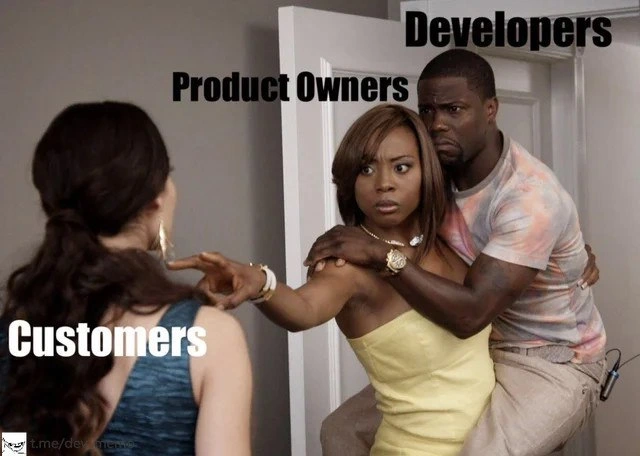
Product owners acting as human firewall between demanding customers and weary developers
Agile Post #3189, on Jun 4, 2021 in TG

Product owners acting as human firewall between demanding customers and weary developers

Why is this Agile meme funny?

Level 1: The Chef and the Waiter

Imagine a busy restaurant. The customers at a table are really hungry and getting impatient for their food. In the kitchen, the chef is working hard cooking the meals. Now, who interacts with the angry customers? The waiter does – not the chef directly. If a customer is upset that their soup is cold or taking too long, the waiter will step in, apologize, and promise to fix it. The waiter might rush into the kitchen and calmly tell the chef, “Table 5 is a bit unhappy, let’s warm up that soup quickly.” The chef remains in the kitchen focused on cooking, and doesn’t have to face the yelling directly. In this simple story, the waiter is like the product owner, the chef is like the developer, and the customers at the table are, well, the customers in our meme scenario. The waiter stands between the angry diners and the busy chef, just like a product owner stands between demanding customers and busy developers.

Why is this setup important? Well, if every hungry customer barged into the kitchen to yell at the chef for their food, the kitchen would be chaos! The chef might get upset or distracted and might even start messing up other orders. By having the waiter be the go-between, the chef can concentrate on making a great meal, while the customers still get updates or apologies through the waiter. In the same way, a developer (the chef) needs to concentrate on writing good code, and the product owner (the waiter) makes sure the developer knows what the customers need, but also makes sure the customers don’t overwhelm the developer with too many requests all at once. The meme is funny because it shows this idea in a dramatic, over-the-top way – the product owner is practically holding the customers back at the door! It’s like the waiter physically stopping a hungry customer from storming into the kitchen. It exaggerates a real feeling: sometimes the person in the middle really does have to stretch out their arms and say, “Please, let them work, I’ll handle this!” so that everything doesn’t turn into a big mess.

Level 2: Buffering Customer Demands

In a typical Scrum Agile team, there are distinct roles meant to streamline work and communication. Here we have three key players: Customers, Product Owners, and Developers. Let’s break down who they are in simpler terms:

  • Customers (or stakeholders/clients) are the people who want the software built and have requests, ideas, or complaints. They might be paying clients or internal business folks. In the meme, the woman on the left in blue represents the customers, and she looks frustrated and demanding. That’s a common scenario: customers often have urgent needs or high expectations (like “I need this new feature ASAP!”).
  • Developers are the people who actually build the product. They write the code, fix the bugs, and turn ideas into a working application. In the meme, the man in tie-dye (Kevin Hart’s character) represents the developers. They’re described as “weary” – which is how developers feel when they’re overworked or bombarded with last-minute requests. Developers usually prefer to work in a focused, planned way (for example, following a sprint plan where work for the next 2 weeks is already decided). Surprise requests flying in from left field can disrupt their workflow and cause stress.
  • Product Owners (PO) act as the bridge or go-between. In Scrum, the product owner’s job is to understand what the customers or stakeholders want and then translate those wants into a prioritized list of tasks for the developers (this list is called the product backlog). The product owner is the lady in yellow in the meme, literally positioned between the customer and the dev. She’s stretched out her arm to hold the customer at bay – a visual metaphor for how POs buffer the team from direct client pressures.

So what exactly is happening? The product owner is acting as a shield or mediator. In Agile terms, you might hear that the PO (or sometimes a Scrum Master) “protects the team from interruptions.” This means if a customer suddenly asks for a big change or is upset about a delay, the product owner will handle that conversation first, instead of letting the issue hit the developers head-on. They’ll say something like, “I hear you need this quickly; let’s see what we can do by next sprint,” rather than having the customer barge over to a developer’s desk to demand it immediately. This prevents chaos and context-switching. Developers work best when they can concentrate on the tasks they’ve committed to for the current sprint. Constantly changing those tasks or adding new ones on the fly (often called scope change or scope creep) can ruin the schedule and quality.

However, having one person in the middle can also create a communication gap if not handled well. Imagine the children’s “telephone game” – if the customer says one thing, and the product owner misunderstands or rephrases it poorly, the developers might implement something different than what was really wanted. This is why good communication skills are crucial for a product owner. They need to speak both languages: “business/customer language” (e.g., “We need the app to be super easy for first-time users”) and “developer/technical language” (e.g., “We should simplify the onboarding flow and perhaps add a guided tutorial overlay”). In ideal team dynamics, the product owner frequently chats with customers to gather feedback and then regularly meets with developers to clarify what’s needed. They are effectively a translator and a buffer.

The meme dramatizes this role in a humorous way: it’s as if the product owner is physically blocking the door so the angry customers can’t run in and overwhelm the developers. Sometimes, it really can feel like that in a company! For a junior developer, this image might also resonate with the feeling of "Why can’t the users talk directly to me?". Early on, it might seem strange that clients or non-technical stakeholders don’t just give tasks straight to developers. But as you gain experience, you learn that this separation has benefits: it manages expectations and keeps everyone sane. The product owner will gather all the input, prioritize what’s truly important, and then feed it to the dev team in digestible chunks. It’s like getting your work through a controlled channel instead of being bombarded from all sides. This way, the team can maintain focus and the customers still feel heard (since the product owner is responding to them). The trade-off is that if the channel isn’t crystal-clear, things can slow down or get lost (which is why sometimes developers joke about meetings or miscommunications when they only get second-hand info).

In Agile environments, this setup is part of the corporate culture to improve efficiency. The product owner essentially says to the developers, “You focus on coding; I’ll handle the shouting.” Meanwhile, they reassure the customer, “The team is on it, but let’s do this properly.” It’s both a communication strategy and a way to guard the developers’ time. The meme nails the imagery: one layer (the PO) stands between an onslaught of changes and the makers of the product. By understanding each role – customer, PO, developer – you can appreciate why this separation exists and also chuckle at how the poor product owner sometimes literally feels like a human shield in the process!

Level 3: The Human Load Balancer

In the Agile world of Scrum teams, the Product Owner often acts like a human load balancer or firewall between incoming feature requests and the development team’s limited capacity. In this meme, the woman in yellow (the Product Owner) is literally blocking the frustrated Customers from reaching the weary Developers behind her. It’s a funny visualization of a common team dynamic: the product owner filters and throttles the flow of requests so the dev team isn’t overwhelmed. Just as a network firewall prevents an onslaught of unwanted traffic (or a load balancer spreads out requests to protect servers), a product owner shields the team from a DDoS of demands. They absorb the brunt of stakeholder pressure, sparing developers from constant interruptions and unrealistic scope creep.

For seasoned developers, this scene is painfully relatable. We’ve all been on projects where a passionate client or high-level stakeholder wants everything yesterday. The product owner stands in that doorway (sometimes literally, often figuratively during meetings) saying “Let’s discuss this” or “We’ll prioritize that for next sprint,” effectively acting as a buffer. This prevents the “always-on” communication from turning into chaos. It’s humorous because it exaggerates what POs do every day – they’re the proxy for the customers’ voice but also the team’s gatekeeper. That tension can feel like a standoff: customers hurling demands, devs clinging to the PO to please not promise anything crazy, and the PO caught in the middle with an outstretched arm saying “Hold on!”.

This meme also hints at the communication gap and potential bottleneck. By design, Scrum funnels all feature requests and feedback through one person (the PO) to maintain order. But as any cynical veteran knows, this single choke point can lead to misunderstandings or delays – much like a firewall that sometimes blocks legitimate traffic by accident. Requirements might get “translated” along the way: what the customer angrily demands (“I need this feature NOW or we cancel!”) becomes a calmer backlog item (“High priority: deliver new report feature in Q3”) by the time it reaches developers. This protects the team’s focus (no one wants a developer getting direct yelled-at phone calls in the middle of coding), but it also means developers rely on the PO’s interpretation. The humor emerges from that truth: the product owner has to diplomatically take heat from clients and then turn around to the dev team with a totally-not-panicking smile to keep morale steady.

From a corporate culture perspective, this scenario is both a best practice and a source of dark comedy. It’s best practice because separating concerns (customers vs. implementation) allows each role to do what they do best – an architectural pattern applied to people. Developers can focus on quality code, while POs handle stakeholder management (much like an API shielding internal modules from external users). But it’s comedic because in reality this “human firewall” often gets burnt out or becomes a single point of failure. If the product owner slips (or decides to let every random feature request through), the developers could get overloaded and the whole sprint goes up in flames. Seasoned devs chuckle (or cringe) at this image because we’ve seen that panicked PO face and the “Don’t let them near us!” grip of a dev team protecting their time. It’s an AgileHumor snapshot of what happens when stakeholder expectations meet team capacity: without a strong intermediary, it’s a recipe for mayhem. The meme nails this truth with one dramatic doorway standoff.

Description

The meme shows a three-person standoff inside a doorway. At the left, a woman in a blue dress (labelled “Customers” in bold white text) reaches forward, looking frustrated. In the center, another woman wearing a yellow dress (labelled “Product Owners”) stretches an arm toward the customer while being physically restrained. Behind her, a man in a pastel tie-dye shirt and khaki pants (labelled “Developers”) lifts and holds the product owner around the waist, preventing direct contact. The scene visually jokes about Scrum dynamics: product owners absorb customer pressure while developers stay one layer removed, highlighting communication bottlenecks and role mediation in agile teams

Comments

13
Anonymous ★ Top Pick Our PO has basically evolved into a human API Gateway - authenticates customers, rate-limits feature requests, and sends a 429 “Try next sprint” whenever the payload says “ASAP.”
  1. Anonymous ★ Top Pick

    Our PO has basically evolved into a human API Gateway - authenticates customers, rate-limits feature requests, and sends a 429 “Try next sprint” whenever the payload says “ASAP.”

  2. Anonymous

    The real MVP is the senior dev who changed their Slack status to 'In a meeting' three sprints ago and hasn't updated it since, successfully avoiding all direct customer 'quick questions' about why the button isn't centered properly in IE11

  3. Anonymous

    The eternal triangle: Customers want everything yesterday, Product Owners translate 'simple request' into 47 acceptance criteria, and Developers just want to be left alone to refactor that God-awful service layer from 2019. This meme perfectly captures the Product Owner's most underappreciated skill - being a human firewall between 'Can you just add one small button?' and the three-sprint architectural overhaul it actually requires

  4. Anonymous

    In our org the Product Owner is an API gateway - dev→customer calls are rate-limited to 0 RPS and always return 202 Accepted: “Added to backlog.”

  5. Anonymous

    Nothing says "Agile" like a three-hop proxy between code and the human who uses it - latency two sprints, packet loss 60%

  6. Anonymous

    Product Owners: the API gateway rate-limiting dev access to raw customer payloads, lest scope creep DDoS the sprint

  7. @b4work 5y

    Why white girl have white text color, black have black text color, RACIST!!!)))))

    1. Deleted Account 5y

      The white text is on a dark background while the black text is on a light background

      1. @b4work 5y

        I know, lol) it's a joke

  8. Deleted Account 5y

    Customers and Developers should be replaced.

    1. @LionElJonson 5y

      true

    2. @prirai 5y

      +1

    3. @callofvoid0 5y

      ++

Use J and K for navigation