Skip to content
DevMeme
2885 of 7435
JS and Python reach 80-char wall, discover Java’s verbose wasteland
CodeQuality Post #3190, on Jun 4, 2021 in TG

JS and Python reach 80-char wall, discover Java’s verbose wasteland

Why is this CodeQuality meme funny?

Level 1: When Words Attack

Imagine you’re writing a sentence, and a teacher tells you, “Try to keep your sentences short, say under 80 characters long, so they are easy to read.” Now picture Python and JavaScript as two kids who follow this rule – they speak in short, clear sentences that fit on one line of the notebook. Python, being a bit wiser, warns JavaScript: “Never write a sentence longer than this line on the page.” JavaScript innocently asks, “What happens if I do?” And here comes the funny part: the comic pretends that if you cross that line, you tumble into a crazy world where a kid named Java is babbling an extra-long, run-on sentence full of big, complicated words. Java’s sentence goes on and on – so long that it overwhelms him! In the drawing, poor Java (the coffee mug character) is getting pelted by gigantic words like “implements” and “ArrayIndexOutOfBoundsException” (which is just a ridiculously long word for an error). The joke is like a teacher saying “See, that’s what happens when you use too many words – chaos!” It’s funny because it exaggerates a simple rule (keep things short and tidy) into a wild scenario where one friend’s over-the-top wordiness becomes a chaotic storm. In simple terms, the meme is laughing about how Java tends to “talk” a lot more in code than Python or JavaScript do – and if you’re not careful, you’ll get lost in all those words!

Level 2: The Long and Short of Code

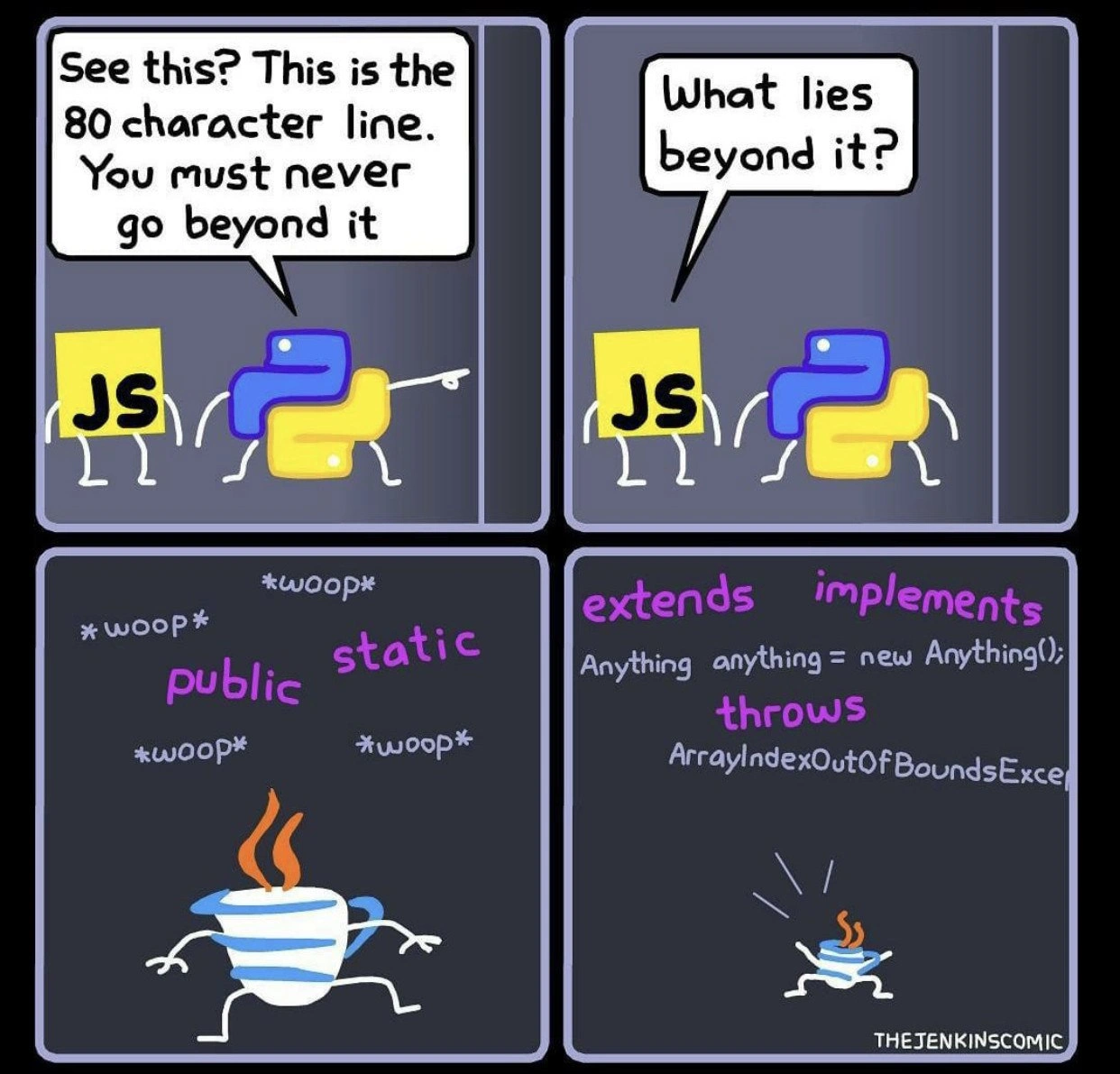
This four-panel comic is highlighting a code style guide rule in a funny way. In the first panel, the blue-yellow snake character is Python (a nod to Python’s logo and name), and the yellow square labeled “JS” is JavaScript. Python is pointing to a vertical line on the background that represents the 80-character line length limit. In many programming teams, there’s a rule that a single line of code shouldn’t be longer than 80 characters (letters, numbers, symbols). This rule comes from older times and is meant to keep code easy to read. For example, Python’s official style guide, PEP 8 (Python Enhancement Proposal #8), explicitly says “limit all lines to a maximum of 79 characters.” Similarly, JavaScript projects often use linters (tools that check code style) like ESLint or formatters like Prettier which default to 80 or 100 characters per line for readability. These are part of coding standards or code guidelines that help maintain CodeQuality by making sure code isn’t too cramped or too hard to read in one line.

So in Panel 1, Python says, “You must never go beyond it.” It’s like a strict teacher or an elder programmer guiding a newbie: “Don’t write code lines longer than this line here.” JavaScript (JS) looks on curiously and asks in Panel 2, “What lies beyond it?” – basically, “What happens if we have a line longer than 80 characters?” This sets up the joke. The comic then answers that question with an exaggerated scenario: Panels 3 and 4 show what’s beyond the 80-char boundary – the realm of Java.

Java is represented by its iconic coffee cup mascot (Java’s logo is a steaming coffee cup). In the comic, when JS and Python look past the boundary, they see a swirling portal full of Java code. There are “woop” sound effects, implying a whooshing portal or perhaps the disorienting noise of being sucked into a code vortex. We see purple words like public and static floating around – these are Java keywords. In Java, you often start method definitions with public static (for example, public static void main(String[] args) is the standard main method declaration). Those keywords alone are quite a few characters and have to appear on the same line as the method name, contributing to long lines.

In Panel 4, the humor goes into overdrive with a storm of Java-specific words attacking the poor Java coffee cup character. Words like extends and implements appear – in Java, when defining a class, you might write something like class MyClass extends ParentClass implements SomeInterface. Those keywords and the long class/interface names can quickly make a line lengthy. There’s also the snippet Anything anything = new Anything(); – this is a joking example of Java’s tendency to be wordy. In Java, to create a new object, you often repeat the type name on both sides of the assignment. For example, Car car = new Car();. If the class name is long, that one line could be, say, ComplexObjectFactory complexObjectFactory = new ComplexObjectFactory(); – easily shooting past 80 characters! Meanwhile, in Python you might just write factory = ComplexObjectFactory() without repetition, and in JavaScript let factory = new ComplexObjectFactory(); – shorter on the left side at least. Lastly, we see throws ArrayIndexOutOfBoundsExce… trailing off. This refers to Java’s ArrayIndexOutOfBoundsException, a very long exception class name. In Java, methods can declare the exceptions they might throw, so you might see something like public void read() throws FileNotFoundException, ArrayIndexOutOfBoundsException. Just including that in a method signature can make the line super long. So the comic is illustrating java_verbosity – Java’s habit of using a lot of keywords and long class names that often break the 80-character limit.

The contrast here is key to the joke: Python (and often JavaScript) code is usually succinct – you typically don’t need many extra words to do something. Python, for instance, emphasizes readability and brevity (one of its mottos is “Readability counts”). JavaScript can be written in many ways, but it doesn’t enforce writing out public/private or type names for variables, so its lines can stay shorter. Java, on the other hand, is a verbose language by design – it’s strongly typed and requires explicit class structures, so you end up writing more text. Seasoned developers sometimes tease that Java code is “boilerplate-heavy,” meaning you write a lot of repetitive or ceremonial code that doesn’t exist in shorter form in other languages. This is exactly what the swirling “verbose wasteland” beyond the 80-char line represents – it’s full of verbose_code that would give a code style linter a heart attack!

The signature “THEJENKINSCOMIC” in the corner tells us who made the comic. It’s drawn by The Jenkins Comic, a cartoonist known for DeveloperHumor and jokes about programmer life. So the whole strip is a lighthearted take on LanguageComparison and CodeStyleGuides. It imagines that Python is dutifully teaching JavaScript about a common code guideline (keeping lines short for clarity), and suggests that if you break that rule, you’ll end up in a chaotic place dominated by Java’s ultra-verbose coding style. Of course, in real life nothing magical happens if you go beyond 80 characters – maybe your linter (style-checking tool) just gives you a warning or your teammates playfully scold you in a code review. But the comic dramatizes it as if it’s a forbidden wall you shall not pass, which is what makes it funny. It also gently ribs Java for being the odd one out in this scenario: Java developers often have to either ignore the 80-char guideline or use lots of line breaks, whereas in Python and JavaScript, staying under 80 is usually easy. This difference in DeveloperExperience_DX (developer experience) is something many coders have experienced when working with multiple languages, so it gets a knowing laugh.

Level 3: Beyond the 80-Column Event Horizon

In this comic, a Python snake sternly tells a JavaScript block, “See this? This is the 80 character line. You must never go beyond it.” Seasoned developers immediately recognize this as a reference to strict code style guidelines – specifically the classic 80-column rule from style guides like Python’s PEP 8 and many eslint configurations. Why 80 characters? Historically, terminals and editors (and even old punch cards) were about 80 columns wide, so keeping code within that length was a standard of good CodeQuality and readability. Experienced devs have seen countless style wars over this line_length_limit: some teams treat it as gospel, while others argue modern wide monitors make it obsolete.

The humor kicks in when JavaScript innocently asks, “What lies beyond it?” – a question any curious junior might ask about an arbitrary-seeming rule. To an old-timer, it’s an invitation to recall every painful code review where a line was 81 characters and the linter or a senior reviewer flagged it as a mortal sin. The Python character’s grave warning hints at those strict linting_rules (like flake8 or ESLint with a max-len setting) that will loudly complain if you dare cross column 80. It’s a playful dramatization of coding standards culture, where breaking the eighty_character_rule is portrayed almost like stepping off a safe map into dangerous territory.

What’s in that dangerous territory? The comic reveals a swirling vortex of Java code – the proverbial verbose wasteland beyond the 80-char wall. Seasoned devs chuckle here because Java is famously verbose. In the third panel, as Python and JS peer into the purple void, we see Java’s coffee-mug mascot flailing amid floating words: public static woop, woop. These are Java keywords echoing from the abyss. In the final panel, a barrage of long Java-specific terms bombards the poor Java cup: extends, implements, and a half-spelled "ArrayIndexOutOfBoundsExce…" (surely ArrayIndexOutOfBoundsException, one of Java’s notoriously lengthy exception names!). There’s even the classic Java snippet Anything anything = new Anything(); flying by – a tongue-in-cheek example of Java’s boilerplate where you often repeat the type name and keyword new. Each of these words is so long or redundant that a single Java statement can easily overflow that tidy 80-character boundary that Python/JS try to respect. Senior developers recognize this verbose_code nightmare: method signatures with public static synchronized void doStuff() extending beyond the margin, class declarations with implements SomeRidiculouslyLongInterfaceName, or lines throwing multiple exceptions… it’s all too easy for Java code to sprawl past column 80. Hence, beyond the limit lies Java’s “verbose wasteland” – a land where code formatting rules are routinely broken by necessity.

This juxtaposition is classic CodingHumor: Python and JavaScript are concise scripting languages that typically encourage brevity (Python’s Zen: “Simple is better than complex.”), whereas Java is an enterprise language notorious for ceremony and wordiness. The comic exaggerates that contrast for comedic effect. It’s poking fun at LanguageComparison in a visual way: two succinct languages treating the 80-char mark as an inviolable wall, versus Java thrashing in a cyclone of its own verbosity. Experienced engineers find this hilarious because it captures a real DeveloperExperience_DX issue – the frustration of adhering to code style rules in a language that practically forces long lines. Many of us have been in code reviews where someone sighs, “This Java line is 120 chars, but how else can we write it?” We’ve seen CodeFormatting tools either mercilessly wrap Java code into jarring broken lines or teams raising the limit to 100 or 120 for Java projects because 80 just isn’t practical. So the meme resonates: it’s a gentle roast of Java’s wordiness and a nod to the almost mythical reverence of the 80-character threshold. In the lore of programming, crossing that line feels like crossing into chaos – and here that chaos is humorously personified by Java drowning in its own verbosity. This is DeveloperHumor at its finest: anyone who’s fought with a linter or maintained a Java codebase can laugh (perhaps a bit cynically) at how accurately this cartoon portrays the situation.

Description

Four - panel comic with a dark grey backdrop and a vertical guideline marking 80 characters.
Panel 1: a yellow block figure labeled "JS" and a blue-and-yellow Python snake with arms; Python points to the line while saying, “See this? This is the 80 character line. You must never go beyond it.”
Panel 2: JS replies, “What lies beyond it?” as both characters stare at the boundary.
Panel 3: inside a purple vortex of text - “*woop* public static *woop*” - a coffee-cup Java mascot scuttles around.
Panel 4: the cup tumbles beneath a barrage of long pink keywords: “extends”, “implements”, “Anything anything = new Anything();”, “throws ArrayIndexOutOfBoundsExce…”. Signature “THEJENKINSCOMIC” sits bottom-right. The strip jokes about style guides like PEP 8 or ESLint that cap lines at 80 columns and how Java’s verbosity regularly spills past that limit, contrasting succinct scripting languages with Java’s boilerplate


Comments

22
Anonymous ★ Top Pick The 80-column limit isn’t about readability - it’s a rate-limiter so one Java constructor can’t DoS your entire pull-request diff
  1. Anonymous ★ Top Pick

    The 80-column limit isn’t about readability - it’s a rate-limiter so one Java constructor can’t DoS your entire pull-request diff

  2. Anonymous

    After 15 years of arguing about line limits, we've discovered the real horror beyond 80 characters isn't readability - it's the Java developer who needs 200 characters just to declare a factory for a builder that creates a singleton to manage the line counter

  3. Anonymous

    The 80-character line limit: where Python developers draw a hard boundary, JavaScript developers see a suggestion, and Java developers can't even fit their class declaration. It's the perfect metaphor for language philosophy - Python's 'explicit is better than implicit' meets Java's 'explicit is mandatory, verbose, and requires three design patterns just to instantiate an object.' Meanwhile, JS is off doing whatever it wants because type safety is more of a guideline than a rule

  4. Anonymous

    Event horizon of verbosity: cross it, and your prototype escapes velocity drops to public static void infinity

  5. Anonymous

    The 80‑column line isn’t a style guide; it’s border control. Cross it and you’re in Java, where “public static final” is just the warm‑up before generics, interfaces, and a checked exception

  6. Anonymous

    That 80-column ruler isn’t for readability - it’s a containment field; step past it and you’re instantiating public static final AbstractFactory<T> implements Serializable while your side-by-side diff grows a horizontal scrollbar

  7. @rostopiradv 5y

    Should be Swift instead of Java func application(_ application: UIApplication, didFinishLaunchingWithOptions launchOptions: [UIApplication.LaunchOptionsKey: Any]?) -> Bool

    1. @illia_sahaidak 5y

      sounds more like objective C’ish to me, as it’s basically extension over it

  8. @gDanix 5y

    main :: IO ()

    1. Deleted Account 5y

      I see you're a man of culture

      1. @gDanix 5y

        😂😂😂 I'm in the process

    2. Deleted Account 5y

      based

  9. @GTRst 5y

    answer is easy

    1. @p4vook 5y

      Damn so many patches

  10. @RiedleroD 5y

    Are you a whore? Here, get fucked.

  11. @azizhakberdiev 5y

    emm... does sb know what is... { { { { { { { ...

    1. @feskow 5y

      Scope? Indentation?

      1. @azizhakberdiev 5y

        No, it's callback hell You can see it in shitty js code

        1. @CoolyFooly 5y

          wait until you see callback hell with promise hell

          1. @azizhakberdiev 5y

            Promises not so bad You call only then, then and so on as simple chain, but callback hell is blockchain

  12. @azizhakberdiev 5y

    JS more horrible than java

  13. @misesOnWheels 5y

    * laughs in unity3d api *

Use J and K for navigation