Skip to content
DevMeme
5725 of 7435
The CVE Panic-to-Apathy Pipeline for Irrelevant Services
Security Post #6278, on Sep 26, 2024 in TG

The CVE Panic-to-Apathy Pipeline for Irrelevant Services

Why is this Security meme funny?

Level 1: False Alarm

Imagine you’re at home and you hear the smoke alarm start blaring. 🚨 You’d probably get really scared, right? You might jump up thinking there’s a big fire and you need to run outside or call for help. It’s a very loud, urgent warning — super scary! But then, a moment later, someone checks and says, “Oh, don’t worry, it was just burnt toast in the kitchen.” Suddenly, you feel relieved. There’s no real fire after all. You might also feel a little annoyed or silly that you got so worried. It turned out to be a false alarm.

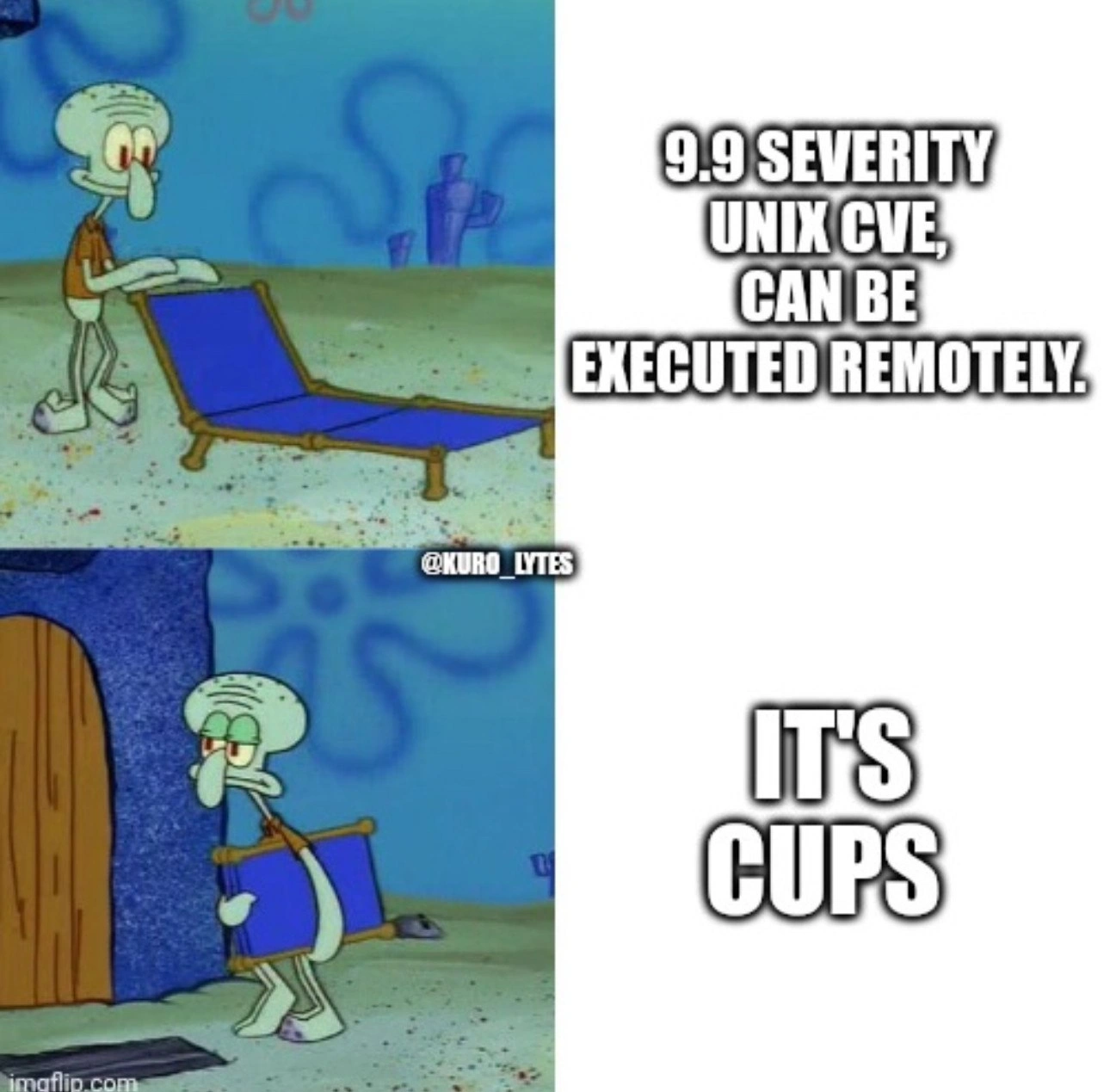
This meme is like that. The first part is the loud alarm: “Something really bad is happening!” Everyone is preparing for the worst. The second part is finding out the danger isn’t real for you: “Oh, never mind, it’s just a little thing that can’t actually hurt us.” In the picture, the character Squidward got all ready to deal with a big problem (he set up his chair to stay and handle it), but then he found out it was nothing important (so he folded his chair and went back inside, looking annoyed). It’s funny because it shows how we can go from panicking to calm in seconds once we learn the whole story. The big scary warning ended up being about something that wasn’t actually a threat, just like a fire alarm caused by burnt toast instead of a real fire. So, the meme is basically laughing at that moment when a huge scare turns out to be nothing serious – we’re safe, and maybe a bit irritated that we got so scared in the first place.

Level 2: High Score Scare

For those not steeped in security lingo, let’s break down the joke. CVE stands for Common Vulnerabilities and Exposures – basically an ID and record for a specific security flaw. Each CVE often comes with a severity rating called a CVSS score (Common Vulnerability Scoring System). This score ranges from 0 to 10, where 10 is as bad as it gets. So when you hear a vulnerability has a 9.9 severity, that’s extremely high – usually labeled “Critical”. It’s the kind of score that makes any IT person sit up straight. It means, in theory, an attacker could do very nasty things very easily, like take over your system remotely with little effort. A remote_code_execution (RCE) vulnerability with a 9.9 score? That sounds about as scary as it gets – it implies a bad guy could run their own code on your machine from far away, possibly with no authentication. Think of it as basically someone potentially hijacking your computer or server over the network. 😰 Naturally, hearing that sort of news, ops teams and security folks get anxious and ready to respond ASAP. This is where that “Panic” phase of the meme’s title From Panic to Meh comes from.

Now, onto the second part: “It’s CUPS.” What is CUPS? CUPS stands for Common Unix Printing System. It’s the printing service used in Linux/Unix systems. If you’ve ever printed from a Linux machine or a Mac (which also uses CUPS under the hood), CUPS was the software handling that. It allows computers to handle print jobs and can even accept print requests over a network. By default, CUPS listens on port 631 (using the Internet Printing Protocol). So a remote code execution in CUPS means if an attacker can send a malicious print request to that port, they could potentially run code on your machine. Sounds awful, right?

But here’s the catch: how many servers out there are even running a printing service, especially a headless server (one with no monitor or printer attached)? In a data center or cloud environment, it’s actually common to disable or not install CUPS at all, because why would your backend servers need to print anything? These machines usually run without any GUI and are optimized for web services, databases, etc., not printing documents. Also, good security practice (often called server hardening) says you should turn off or remove any service you’re not using. Every extra service is an extra potential weakness. A printing service is a perfect example of something many servers simply don’t need. So often, sysadmins either uninstall CUPS or make sure it’s firewall-restricted so that even if it’s installed, it can’t actually receive anything from the outside network (certainly not from the open internet!).

So imagine you’re a junior sysadmin or developer hearing about this new scary vulnerability. The alert says “UNIX CVE, 9.9 severity, can be executed remotely.” You might think, “Oh no, every Linux server is in danger! Hackers can break in from anywhere!” That’s the image in Panel 1: Squidward happily rushing to set up a lounge chair outside, which represents dropping everything to deal with this big issue (or maybe to watch the drama unfold). It’s that rush of adrenaline and preparation for a possible emergency fix. In real life, that might mean you preparing to apply patches to hundreds of machines, or convening a meeting to discuss mitigation steps. The meme text “9.9 SEVERITY UNIX CVE, CAN BE EXECUTED REMOTELY” is exactly the kind of headline that produces those reactions. It’s huge Security news in the ops world.

Now Panel 2 delivers the punchline: “IT’S CUPS.” This is the moment you read the details of the CVE and realize the vulnerable component is the cups_printing_service. If you’re managing, say, a bunch of Linux servers that run databases or web apps, you quickly remember: “Wait, none of our servers even have port 631 open… Do we even have CUPS installed?” Often the answer is no, they don’t. Maybe only your developer’s laptops or a couple of office machines use CUPS actively. So for your production servers, this scary-sounding RCE is basically a non-issue. It can’t be “executed remotely” on your boxes if those boxes aren’t listening for that kind of request in the first place.

This realization is the meme’s equivalent of Squidward folding up his chair and going back inside, looking annoyed. In the context of a sysadmin, that “annoyed” feeling comes from being mentally prepped for a firefight, only to find out there’s nothing to fight. It’s a bit of “Ugh, seriously? Got me worked up over nothing.” There’s also a twist of humor in the fact that CVSS scores by themselves don’t tell the whole story. They assume a worst-case scenario (in this case, that your system is running CUPS, open to the network, and vulnerable). But the reality check is, if you’ve been doing your job and hardened your systems, that worst-case scenario doesn’t apply. The vulnerability’s context matters.

This meme is popular in SysadminHumor circles because it’s very relatable. Many sysadmins have had that experience where a new vulnerability gets announced with a lot of hype and terrifying numbers. Initially, everyone freaks out (especially those new to the field). But then someone chimes in with “Relax, this only affects [some component or feature] we don’t use.” It’s a collective sigh of relief – and maybe a bit of an eyeroll that the scoring didn’t make that clear. SecurityVulnerabilities often need a closer read beyond the headline. The “fine print” here – that it’s about CUPS – changes the response from “All hands on deck!” to “We’ll patch it during our next regular update cycle, no rush.”

To give a bit more background, CVSS attempts to capture how bad a vulnerability could be in a generic environment. It factors in things like how easy the exploit is to perform, whether it needs user interaction, whether it gives full control of a system, etc. 9.9 usually means: attacker doesn’t need any privileges or user help, can do it remotely, and can fully compromise the system – basically as severe as it gets. So you can’t blame folks for reacting strongly at first! The issue is CVSS doesn’t directly account for how common or relevant the vulnerable component is in all environments. That’s where an experienced sysadmin’s knowledge kicks in. They know, for example, that on a Unix or Linux server, the print_service_disabled state is common. They know to ask, “Is this service even running here?” before panicking.

The mention of Patch Tuesday is a nod to the weekly or monthly cycle when a bunch of security patches are released (Microsoft famously does Patch Tuesdays, but other vendors have similar routines). Sysadmins often brace themselves on those days for exactly these kinds of announcements. The dread is that one of those patches will be a critical fix that you must apply immediately across all systems, often causing a lot of urgent work. So the SpongeBob meme could also be interpreted as Squidward initially bracing for a hectic Patch Tuesday emergency change (setting out the chair to stay up late dealing with it), and then realizing it’s not needed in this case (folding the chair and happily avoiding the all-nighter).

In summary, the meme uses a Squidward reaction scene from SpongeBob to illustrate a very real IT situation:

  • First, an alarmist headline about a severe system vulnerability causes anxiety and frantic preparation.
  • Then, the revelation that the threat is tied to something irrelevant to your servers (the CUPS printing service) causes an immediate wave of relief and a bit of exasperation.

It’s funny because of that dramatic whiplash and because anyone in IT Security or server administration has been through this. You go from “We’re in serious danger” to “Oh… never mind, carry on” in the span of reading one extra line of text. The meme playfully jabs at how blindly trusting the severity number without context can inflate your stress for no reason. And it highlights a bit of the jaded wisdom of experienced sysadmins: always read the details. Sometimes a “critical” bug isn’t critical for you if your configuration doesn’t use that component. It’s an inside joke about knowing when to freak out and when to just chuckle and roll your eyes at the latest scary-looking but irrelevant headline.

Level 3: Critical on Paper

9.9 CVSS – those numbers flash like a red alert siren for any seasoned ops team. A nearly perfect CVSS (Common Vulnerability Scoring System) score usually means drop everything, there's a five-alarm fire. When a new CVE (Common Vulnerabilities and Exposures) bulletin screams “Remote Code Execution on UNIX – 9.9 severity”, veteran sysadmins everywhere brace for a long night: critical patch workflows, emergency change controls, maybe even that dreaded after-hours call to the CTO. It’s the kind of headline that triggers instant patch_tuesday_dread and visions of ransomware rampaging through prod.

But then comes the fine print, and with it, the plot twist: “Affected component: the Common Unix Printing System (CUPS), port 631.” In an instant, the panic fizzles out. The war-room Slack channel goes from “OMG 9.9 RCE!!” to “Oh... it’s just CUPS.” You can almost hear a collective groan and the sound of a hundred on-call engineers folding their lounge chairs back up. CUPS – the printing service – might as well be a relic on a modern headless server. On paper (pun intended), a remote_code_execution in CUPS is as scary as it gets. In reality, it’s like discovering a huge security hole in the office typewriter that’s been locked in a closet since 2005.

This meme nails that roller-coaster of SysadminLife emotions. Squidward unfolding the beach chair in the SpongeBob scene perfectly captures that initial adrenaline rush: “9.9 RCE? Let's gear up, this is gonna be big.” It’s the ops equivalent of grabbing popcorn (or a fire extinguisher) to witness the impending chaos. But the second panel – Squidward folding the chair and heading back inside, utterly unamused – reflects the immediate comedown: “Never mind, false alarm. Nothing to see here, folks.” Why? Because the terrifying headline came with a major asterisk: IT’S CUPS. And every battle-scarred sysadmin knows what that means: the supposedly critical flaw is in a service that’s likely disabled, firewalled off, or not even installed on any self-respecting production server.

It’s a perfect satire of how CVSS scores can be context-blind. A vulnerability’s base score doesn’t know whether the service is actually exposed to the world (or even running) on your machines. 9.9 out of 10 suggests catastrophic risk in theory, but if that threat lives in a dusty corner of the OS that nobody uses (like a printing daemon on a cloud server), the practical risk drops to near zero. Experienced ops folks have seen this pattern enough times to get a little jaded. They’ll still pay attention (no one wants to be the one who ignored a CVE that turned out to matter), but they won’t scream bloody murder until they’ve checked the details. It’s a classic SecurityVulnerabilities gut-check: “Critical vulnerability in a core system component? 😱” — vs — “Oh, it requires an open port on a service we turned off years ago. 🙄”. In other words, Severity vs. Reality.

There’s a dark humor in how these high CVSS alerts play out. We’ve all been through drills where a critical CVE drops, and managers run around preparing for disaster recovery – only to learn the exploit scenario is so esoteric or the target service so niche that it essentially doesn’t apply to our environment. It’s like a fire department mobilizing for a five-alarm blaze, sirens blaring, and then arriving to find it was just burnt toast smoldering in the break room. Sure, smoke is smoke, but context is everything. Here, CUPS is that burnt toast. The meme’s punchline “IT’S CUPS” sums up that meh realization in two words, the same way a grizzled admin might shrug and say, “Figures… nothingburger for us.”

From a Security and OperatingSystems standpoint, this scenario is a mini case-study in server_hardening_reality_check. Good security hygiene on Linux servers (especially headless ones with no GUI or local users) means stripping out or locking down unnecessary services – and a print server like CUPS is usually first on the chopping block. After all, who needs a printer on a cloud database host or a Docker swarm node? By the time a sysadmin has “been around the block,” they’ve likely purged cupsd (the CUPS daemon) from most servers or at least ensured port 631 is blocked off to anything but the local loopback. They’ve learned that SysadminPainPoints often come from overlooked, unnecessary services – and they’re not about to let a high-severity bug in an idle printing service ruin their Friday night. When news of a CUPS RCE hits, the veteran playbook is:

  • Check exposure: Is CUPS even running on our boxes? (90% likely answer: Nope.)
  • Check network: Even if it’s running, is port 631 open externally? (Probably not, thanks to firewalls.)
  • Risk assessment: If the service is off or isolated, this critical CVE suddenly isn’t an existential threat. Crisis (mostly) averted. Pour another cup of coffee, patch it at next maintenance window, and carry on.

The humor here comes from shared experience. Seasoned ops folks have all gotten that breathless security email about a “critical exploit” that initially sounds like the sky is falling. Heartbeat racing, they scramble to understand the impact… then realize the vulnerable component is something arcane like cups_printing_service, or an old library tied to a feature nobody enabled. It’s an emotional whiplash from “We’re all gonna die!” to “Oh, never mind.” The SpongeBob/Squidward meme format brilliantly captures that whiplash. The fact that Squidward looks irritated in the second panel is the cherry on top – it’s the face of every ops engineer who just expended a bunch of adrenaline for nothing. Thanks for the scare, CVSS 9.9. You got us all excited and it turns out to be a non-event. Classic.

In essence, this meme is poking fun at the CVE security theater that often unfolds. A super-high severity score can inflate anxiety, especially in those who don’t yet grok the importance of context. Meanwhile, the grizzled sysadmin (with a dash of that cynical veteran outlook) has learned to treat these pronouncements with a mix of caution and skepticism: “Show me the actual risk.” And if the answer is “It’s CUPS,” you’ll likely witness a swift downgrade from red alert to meh, just as Squidward so eloquently demonstrates. After all, sysadmin humor often comes from surviving many such false alarms and living to chuckle about it. In the immortal words of ops teams everywhere when yet another critical printer daemon bug hits production servers: “Wake me up when it’s something that actually matters.”

Description

This is a two-panel meme featuring the character Squidward Tentacles from the cartoon Spongebob Squarepants, often used to show excitement followed by disappointment or retreat. In the top panel, Squidward is happily setting up a blue lounge chair, ready to relax. Next to this image is the text, '9.9 SEVERITY UNIX CVE, CAN BE EXECUTED REMOTELY.' This describes a critical security vulnerability (CVE) that would normally cause immediate panic for any operations or security team. In the bottom panel, Squidward, now looking annoyed and resigned, is folding up his chair and going back inside his house. The text next to this panel reveals the reason for his change of heart: 'IT'S CUPS'. The joke is aimed at experienced system administrators, SREs, and security engineers. CUPS stands for the Common Unix Printing System. While a remote execution vulnerability in a core service is extremely dangerous in theory, CUPS is a service for printing, which is almost never used or exposed to the internet on modern cloud servers. Therefore, the critical alert is practically irrelevant, and the engineer can dismiss the panic and go back to relaxing
Comments

14
Anonymous ★ Top Pick A 9.9 CVE in CUPS is the Schrödinger's cat of security alerts: it's simultaneously a critical vulnerability and completely irrelevant until you check if the service is actually enabled anywhere other than a dusty server from 2003
  1. Anonymous ★ Top Pick

    A 9.9 CVE in CUPS is the Schrödinger's cat of security alerts: it's simultaneously a critical vulnerability and completely irrelevant until you check if the service is actually enabled anywhere other than a dusty server from 2003

  2. Anonymous

    Nothing empties a war room faster than realizing the ‘critical RCE’ listens on port 631 - and every firewall rule since 2007 already /dev/nulls it

  3. Anonymous

    After 20 years of arguing that printers are the spawn of Satan, we finally have CVE-level proof - though we didn't expect the attack vector to be 'existing on the network' rather than 'paper jam on line 1'

  4. Anonymous

    When your vulnerability disclosure gets a 9.9 CVSS score and promises remote code execution, but the attack chain requires the target to have CUPS installed, exposed to the network, and actively processing print jobs - suddenly every CISO realizes their threat model didn't account for the one server still running lpd from 1997. It's the security equivalent of discovering your house is vulnerable to catapult attacks: technically true, impressively severe on paper, but requiring an adversary with both the capability and inexplicable motivation to deploy siege equipment in your suburban neighborhood

  5. Anonymous

    Risk triage in one slide: CVSS 9.9 RCE alert - then you remember our hardened headless images don’t ship cupsd and 631 is closed, so the SLA becomes “patch when someone needs to print from prod.”

  6. Anonymous

    CVSS 9.9? Wake me when it listens on 443; if it’s CUPS on 631, that’s an uninstall-cups.yml change, not a Sev-1 bridge

  7. Anonymous

    CUPS: Turning 'print queue' into 'root shell queue' faster than you can say buffer overflow

  8. @TheFloofyFloof 1y

    At least it wasn't MUGS

  9. @ZgGPuo8dZef58K6hxxGVj3Z2 1y

    Whats cups?

    1. dev_meme 1y

      Check links above the meme

      1. @ZgGPuo8dZef58K6hxxGVj3Z2 1y

        Fair I am lazy reader

    2. @mozilaip 1y

      This is not ChatGPT

      1. @ZgGPuo8dZef58K6hxxGVj3Z2 1y

        It is Copilot now

  10. dev_meme 1y

    I remember my good ol' days back in 2009 when I had a Canon printer, and an ol' notebook with Debian installed (without any desktop environment). I dunno why, I was just like "I need to learn Linux, terminal, etc". And that, here I am, in Siberian village, on a cold winter day, setting up Cups for my printer, so it will be available through a network. It was fun. To me it was surprise, that cups was made by apple inc. I dunno why I'm telling this, may be just to share that feeling of freedom and learning something new on my own will. I was 16. Yeah, sometimes it's just the best freedom you had, when you have no duties, and you on your own.

Use J and K for navigation