Skip to content
DevMeme
5726 of 7435
A Visual Metaphor for a Failed Friday Deployment
Deployment Post #6279, on Sep 27, 2024 in TG

A Visual Metaphor for a Failed Friday Deployment

Why is this Deployment meme funny?

Level 1: Friday Mess, Weekend Stress

Imagine it’s Friday afternoon and you’re about to start your weekend. Your mom reminds you, “Don’t start a big project right now, it’s late.” But you decide to pull all your toys out or start a messy art project anyway. Now suppose something goes wrong — you spill a giant bucket of paint or knock over a huge tower of blocks. It makes a huge mess right before the weekend. Uh-oh! Instead of relaxing and having fun, you now have to spend your weekend cleaning up that mess. Not fun, right? In the meme, deploying code on Friday is like making that big mess at the worst time. People who work with computers joke that if you do something risky at the last minute on Friday, you’ll be stuck “cleaning it up” during your time off. The picture of the train off its tracks is a big, dramatic mess, just like spilled paint everywhere. The words are basically an adult way of saying, “See? This is why we don’t do that on Friday!” It’s funny in the way that a cautionary tale is funny — you grin because the person learned a lesson (“I won’t do that again before the weekend!”). It’s a reminder that sometimes it’s better to wait until Monday to try something big, so you don’t wreck your weekend fixing problems.

Level 2: Friday Deploy Fiasco

If you’re a junior dev or just starting out in DevOps, here’s what’s going on in that meme. In software teams, “pushing to production” means deploying new code or updates to the production environment — the live system that real users interact with. It’s a big deal because production is where even small bugs can have big consequences (imagine a typo bringing down a website that thousands of people are using!). Now, the meme specifically says “you don’t push to production on Friday.” This reflects a common rule born from hard experience: Friday deployments are risky. Why Friday? Because if something breaks after a Friday deploy, it’s likely to break late on Friday or over the weekend, when most of the team is offline enjoying their days off. The on-call engineer (the unlucky team member scheduled to handle any issues 24/7 for that period) might get an alert in the evening. Being on-call means you have to respond quickly if the system has a problem — like a doctor on duty, but for servers. So a Friday evening surprise bug can ruin someone’s pizza night or weekend hiking plans as they scramble to fix the ProductionIncident. This is why many organizations institute a change freeze on Fridays, which is essentially a plan or policy to avoid non-critical changes during certain times (like weekends or holidays). A change freeze is like a safety buffer: if we don’t change anything right before a period of low staffing, there’s less chance we’ll wake up to an emergency. The meme caption even mentions a “change freeze plan” — meaning the team intended not to release any code on Friday, yet somehow a FridayDeploy happened anyway and “jumped the rails” of that plan (just like the train wheel assembly literally jumped off the rails in the photo).

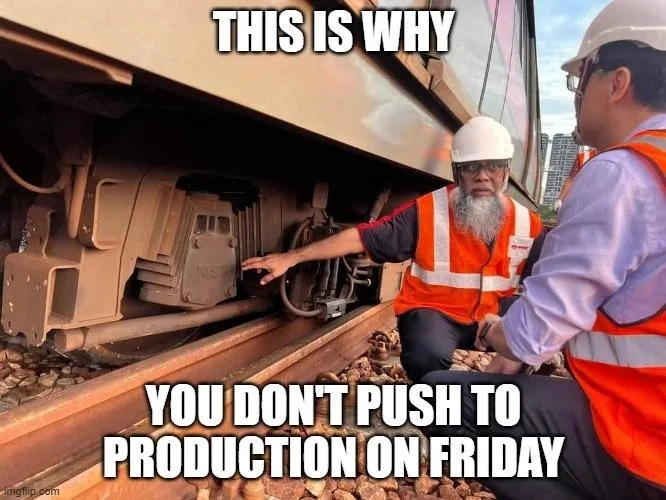
Let’s decode the image itself. We see a real train car with its wheel off the track — essentially a train wreck. Two engineers in orange vests and hard hats are inspecting the damage, one pointing at the machinery that’s come loose. In the software world, a production outage (when your app or service is down) feels just like that: your smooth-running train (the software) has suddenly derailed, and now engineers have to rush in and examine the broken parts to figure out what went wrong. The text “THIS IS WHY YOU DON’T PUSH TO PRODUCTION ON FRIDAY” is slapped on top and bottom in big bold font. This style of text is typical for meme images and is meant to deliver the punchline or message. Here, it’s basically shouting the lesson. It’s the equivalent of a senior team lead or your project manager pointing at the broken train (the outage) and saying, “See? This is exactly what we wanted to avoid!”

Now, why is this scenario so relatable among developers and IT folks? Because many of us have been in those engineers’ shoes (figuratively). Maybe during your first on-call rotation, you deployed something late on a Friday thinking it was a minor fix. Then a few hours later, you got a flurry of alerts: users can’t log in, or orders aren’t processing, or the website is throwing errors. Your heart sinks — it’s the start of the weekend and instead of relaxing, you’re suddenly in firefighting mode. “Firefighting” here means you drop everything to tackle an urgent problem, much like firefighters responding to a fire. It involves quick investigation (checking logs, error messages, system metrics), maybe rolling back the update (reverting to the previous stable version of the code), and restoring the service so customers aren’t affected for too long. It’s stressful! Early-career developers often learn about these DeploymentPainPoints the hard way once they start dealing with real production systems. That’s why more experienced colleagues often gently warn, “Let’s maybe hold off and not deploy that on a Friday, okay?” They’re not being superstitious for no reason — they likely remember times when a late-week release went sideways and they had to spend all weekend fixing it.

Some terms from the meme and tags might be new, so let’s clarify a few:

  • DevOps: It’s a culture and set of practices that combine Development and Operations. Instead of “throwing code over the wall” to operations folks, developers and ops engineers work together on things like deployment, monitoring, and automation. If you see someone with a title DevOps Engineer or SRE (Site Reliability Engineer), they focus on making deployments smooth and systems stable. They are often the ones on-call when something breaks in production.

  • On-call: This means being available to respond to urgent issues with the system, typically outside normal work hours. Teams usually have an on-call rotation (maybe each person takes a week of being on-call). If an alert comes (often via a system like PagerDuty or a similar “pager”), the on-call person must investigate and fix or escalate the issue. In the meme’s scenario, the on-call engineer is likely one of those people in the hard hats examining the derailment late on Friday. There’s a lot of OnCallHumor out there because being on-call can be intense — people joke as a way to cope with the stress (e.g., memes about pagers always going off at 2 AM or right when you sit down to dinner).

  • Production incident / outage: This is when something in the production environment goes wrong enough to impact users or critical functionality. It could be a server crash, a bug that breaks a feature, a database going down, etc. Companies often have an incident response process: detect the problem, alert on-call, communicate status, fix it, and later do a postmortem. A postmortem is a meeting or document written after an incident to analyze what happened, why, and how to prevent it in the future. The meme hints at a postmortem with those engineers looking at the wreck — they’ll definitely be figuring out, “What caused this derailment and how do we not do this again?” If a Friday deploy caused a big outage, you can bet the Monday postmortem will include the question, “Why did we push this on Friday, and how can we avoid that scenario?”

  • Change freeze: This is a policy to pause deployments or changes for a certain period. Many teams have a Friday change freeze, meaning no non-critical changes after a certain time on Friday (say, after lunchtime) until Monday. That way, if something goes wrong during the busy week, they have people around to fix it. And if it’s the weekend, they lower the chance of having to wake someone up. A change freeze is especially common before big events or holidays (for example, many e-commerce companies enforce a code freeze right before Black Friday sales to avoid messing anything up during the crucial sales period). The meme’s title and context mention a release_change_freeze plan, which implies the team tried to avoid releases on Friday, but somehow a deploy happened (maybe an exception, or someone merged last minute), and the result was exactly what they feared.

  • Rollback: A rollback is basically undoing a deployment. If version 2.3.4 caused a problem, you roll back to version 2.3.3 (the last good state). It’s like if the train goes off the track, you try to carefully move it back to the last safe spot on the rails. Rollbacks can be lifesavers if a new release is broken, but sometimes they’re not trivial (for instance, if the new release changed the database schema, you have to undo that too). The tag friday_deploy_rollback highlights that on Fridays, you might find yourself rolling back hurriedly if the new code misbehaves.

  • Firefighting mode: This is a slang for the state of dealing with an emergency. Imagine a system outage as a fire; when you’re in firefighting mode, you’re solely focused on extinguishing the flames (resolving the outage) and preventing damage. In a tech incident, that means developers and SREs drop their regular tasks, hop on a call or chat, and work intensely to figure out what’s wrong and fix it. It’s high-pressure and often extends after hours, which is why doing it on a Friday night is so dreaded.

The meme humor works on a couple of levels even for someone newer. First, it’s the over-the-top literal imagery: a train wreck is a dramatic way to represent a “bad outcome.” Even without deep tech knowledge, you know a derailed train is a fiasco. It visually exaggerates what a messed-up software deploy feels like. Second, the text is phrased like a warning or a lesson from someone experienced: “This is why you don’t do X.” It’s funny because it’s a bit like a teacher scolding a student after a mistake — except here it’s one engineer playfully scolding another (or their past self). If you’ve ever been warned about something and then did it anyway and faced the consequences, you can relate. In dev teams, there’s often that one time a rule was broken and it resulted in chaos, and that story becomes lore. New hires get told, “Trust us, we don’t deploy on Fridays. Remember what happened when Bob did that last year?” This meme is basically an entire cautionary tale condensed into one image and one sentence. Once you understand the context — that deploying code on Friday is a known risk — the meme’s joke lands: it’s saying “We told you so” in a humorous way.

Level 3: Release Train Wreck

The meme delivers a blunt DevOps truth with a dash of dark humor. Deployment gone wrong is depicted as a literal train derailment — a heavy machine off its rails, just like a Friday deployment that has careened out of control. The big white text “THIS IS WHY YOU DON’T PUSH TO PRODUCTION ON FRIDAY” reads like the exasperated voice of a battle-hardened SRE, echoing an unwritten industry rule. In the DevOps/SRE world, deploying to the production environment (the live systems used by real users) late on a Friday is almost asking for trouble. Why? Because if things go off the rails, you’ve got a major ProductionOutage at the worst possible time — when the office is empty and your team is hoping for a quiet weekend. The image’s train derailment metaphor nails this: an end-of-week release can slip off the tracks of your carefully laid change freeze plan, leaving your ops engineers crouched in the gravel (or huddled over dashboards) diagnosing the damage. It’s a visual ops postmortem of a release gone horribly wrong, and it hits home for anyone who’s been on on-call duty during a weekend firefight.

This scenario is painfully familiar in OnCallHumor circles. Code gets pushed Friday afternoon, and initially everything looks fine — until it’s not. Maybe a latent bug or an overlooked config issue starts jumping the rails after a couple hours of real traffic. Suddenly error rates spike, users start submitting angry tickets, and metrics go haywire. The hapless engineer carrying the pager (or smartphone) feels that sinking DeploymentAnxiety as alerts start flooding in. Cue the dreaded weekend_pager_dread: the on-call phone buzzes during dinner, and that engineer now has a hot date with their laptop instead of their friends or family. The meme’s text screams what every seasoned DevOps person has learned the hard way: pushing a change to production on a Friday is a gamble where you stake your weekend. It’s funny because it’s true; it’s DevOpsHumor born from real DeploymentPainPoints. The laughter is a coping mechanism for those memories of 3 AM server restarts and frantic rollbacks.

Let’s break down the friday_deploy_rollback horror story step by step. We’ve all seen some version of this timeline in the logs:

[Friday 16:45] INFO: Deploying version 2.3.4 to production...
[Friday 16:46] INFO: Database migration started (change #42).
[Friday 16:47] ERROR: Migration failed on step 7 — NULL value in column that cannot be NULL.
[Friday 16:50] WARN: Rolling back database changes...
[Friday 16:55] ERROR: Rollback incomplete — data inconsistency detected!
[Friday 17:00] CRITICAL: Service outage detected across multiple regions.
[Friday 17:01] ALERT: PagerDuty incident #INC-123 triggered for on-call engineer.
[Friday 17:30] INFO: Emergency patch deployed to fix the issue.
[Friday 17:45] INFO: Service restored, system stabilizing.
[Saturday 09:00] INFO: Postmortem meeting scheduled for Monday 10:00.

In this little log-from-hell, a “quick” Friday push turns into a full-blown ProductionIncident. Notice how the timeline doesn’t politely stop at 5 PM. The firefightingMode kicks in: first an attempt to rollback, then a messy partial failure, and finally a scramble to patch the system live. By 5:01 PM on Friday, the on-call engineer’s weekend plans have effectively been derailed just like that train. Instead of unwinding from the week, they’re urgently coordinating a fix, possibly messaging teammates on Slack with “Umm… guys? Something’s broken in prod 😰.” The meme resonates because every experienced engineer has either lived this or had nightmares about it. It’s the quintessential FridayDeployments fiasco: a change that couldn’t wait until Monday, now causing a ProductionOutage at the worst time. The image shows two engineers in high-vis vests inspecting the damage — that’s basically the Ops team doing an emergency root cause analysis on Friday night, pointing at the metaphorical broken “wheel assembly” in the code. The look on their faces isn’t visible, but you can imagine the mix of frustration, oh-no-not-again resignation, and maybe a bit of I told you so.

So why is this combination of elements so hilarious to tech folks? It’s a mix of schadenfreude and commiseration. The DeploymentAnxiety around end-of-week releases is a universal pain point. There’s even a trove of memes and jokes warning “No deploys on Friday” as a mantra. It’s humorous in the “laugh to keep from crying” way because we share the trauma. We laugh seeing the train off the rails because it’s a perfect analogy: once a train is off track, getting it back on is a massive ordeal — just like recovering from a botched deployment. If you violate the release_change_freeze policy and push a risky update late in the week, you might literally derail the release train (in Agile, a “release train” means scheduled regular deployments, but here we get a release train wreck instead!). The systemic issue here is often releasePressure versus prudence. Maybe a manager insisted on shipping “just one last feature” before end of week, or a developer was overconfident (“It’s a tiny change, what could go wrong?” – famous last words). Organizations keep making this mistake because incentives (deliver features, meet sprint goals) sometimes overshadow caution. Best practices say always have a rollback plan, do canary releases, test thoroughly, and avoid late Friday deploys. But reality? Tight deadlines and optimistic assumptions lead to “YOLO” pushes on Friday at 4:55 PM. And Murphy’s Law being what it is, that’s when a hidden bug in that one-line config change decides to surface and knock your service over. As the cynics say, anything that can go wrong will go wrong, and if it’s a Friday, it will go wrong spectacularly.

This meme also hints at the human cost of such decisions. It’s not just a system failure, it’s someone’s evening ruined and an entire team’s stress level spiking. Veteran developers have endured those bleary-eyed weekends, running on caffeine and adrenaline to fix prod. They’ve missed family dinners and lost sleep, all because a non-urgent change couldn’t wait. Over time, teams learn and institute rules like a change freeze (no changes after Thursday afternoon, for instance) to protect everyone’s sanity. The text “THIS IS WHY” in the meme is basically an elder engineer speaking from experience — a reminder that these policies aren’t just red tape, they exist because someone in the past made a Friday push that ended in tears. In many companies, deploying on a Friday without a very good reason is as taboo as merging to main without a code review. Some teams even automate safeguards: for example, a CI/CD pipeline script might block deployments on Fridays after 3 PM, or at least flash a big warning like “⚠️ Last call for deploys was 3 hours ago! Proceed at your own risk.” It’s half-joke, half-serious.

In summary, the meme humorously encapsulates a DevOps Murphy’s Law. The combination of the train_derailment_metaphor and the bold caption perfectly satirizes a common IT horror story. Seasoned engineers smirk (or groan) because they’ve lived it. They might even tag this meme in a Slack channel with #OnCallHumor or #DevOpsHumor, tagging that one teammate who pushed the limits last Friday. It’s a lighthearted way of saying “We’ve been there, let’s not do that again.” And for those new to the field, consider it a friendly, funny warning: if you deploy on a Friday, you might be on-call in full firefightingMode when you least want to be. Save yourself the pain — don’t let your release jump the rails right before the weekend.

Description

The image shows two railway engineers in orange safety vests and white hard hats inspecting the undercarriage of a train on the tracks. One older, bearded man is crouched and pointing at a mechanical part of the train's wheel assembly, seemingly explaining a serious issue to his colleague. The scene evokes a sense of technical failure and urgent problem-solving. Overlaid in a bold, white, impact font is the text: 'THIS IS WHY' at the top, and 'YOU DON'T PUSH TO PRODUCTION ON FRIDAY' at the bottom. This meme uses the powerful visual of a stopped or broken-down train as a metaphor for a catastrophic software failure. It plays on the widely-held superstition and practical wisdom in the software development community that deploying new code to a live production environment on a Friday is a recipe for disaster. The joke is that any resulting bugs or crashes will inevitably happen after everyone has left for the weekend, leading to emergency pages, stressful weekend work, and a 'train wreck' of a situation that needs to be fixed under pressure
Comments

20
Anonymous ★ Top Pick The only thing that travels faster than light is bad news from a Friday deployment making its way to the on-call engineer's phone
  1. Anonymous ★ Top Pick

    The only thing that travels faster than light is bad news from a Friday deployment making its way to the on-call engineer's phone

  2. Anonymous

    Until `git revert --train-wreck` becomes an official flag, let's keep the releases to Tuesday

  3. Anonymous

    The senior engineer pointing at the derailment is actually showing the junior dev the exact commit hash from last Friday's 'quick hotfix' that somehow managed to break both the primary and failover databases while also triggering a cascade failure in three microservices that weren't even supposed to be related

  4. Anonymous

    The Friday deployment: where 'it works on my machine' meets 'it's now everyone's weekend problem.' Seasoned engineers know that pushing to production at 4:45 PM on Friday isn't confidence - it's a hostage situation where your weekend is the ransom. The real tragedy isn't the derailment itself, but explaining to your VP why the rollback plan was 'we'll figure it out Monday' while you're debugging distributed transaction failures from a beach bar at 2 AM

  5. Anonymous

    Friday prod pushes: the unplanned chaos engineering exercise that tests your rollback more than your features

  6. Anonymous

    Release trains are fine; it's Friday plus an untested migration with no canary that turns your SLO into a derailment and your weekend into incident command

  7. Anonymous

    Friday deploys are “low risk” right up until the canary burns the error budget and your weekend becomes the rollback pipeline

  8. @sylfn 1y

    why tho

    1. @echedelle 1y

      removes you privileges to make changes on Friday for not knowing the explanation

      1. @sylfn 1y

        rm: cannot remove 'privileges': Permission denied

    2. @azizhakberdiev 1y

      to make you ask why

      1. @sylfn 1y

        lmao

        1. @dugeru42 1y

          And why do you even need to deploy in friday? You had whole week! Was it not enough time? You did have to rush on friday, didn't you? And now you want to deploy code that was made in a hurry and without time to properly test it? Madman.

          1. @sylfn 1y

            i have whole eternity who even cares if its friday or not

    3. @dugeru42 1y

      Cos in case it fails you spend weekends fixing and, some people are not available and it sucks

    4. @chupasaurus 1y

      cause of breaks

      1. @is5431 1y

        Makes sense

      2. @Grom_Gi 1y

        but that's spring

        1. @chupasaurus 1y

          I know, I tried to make sense

  9. @Grom_Gi 1y

    The train delaired, here's the thing

Use J and K for navigation