Comic debates brain-as-computer by literally loading DOOM from floppy disks
Why is this CS Fundamentals meme funny?
Level 1: Installing a Game in Your Head
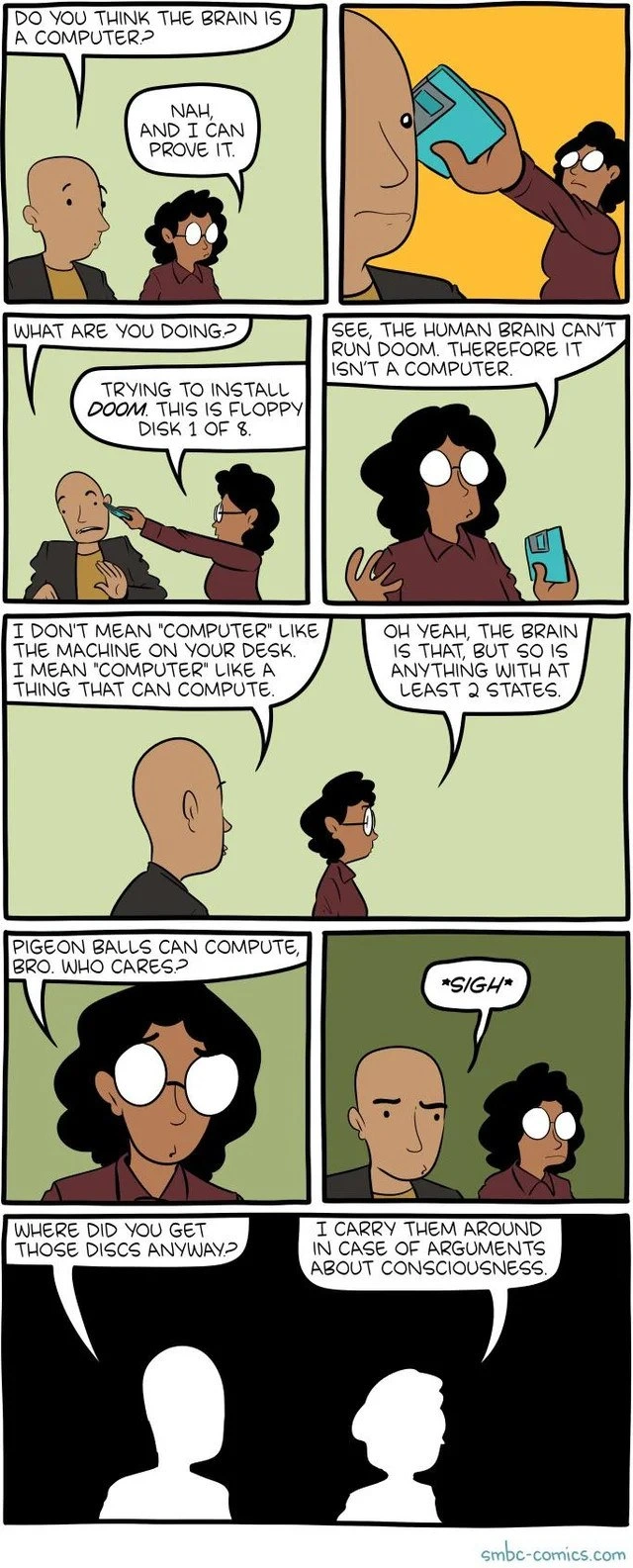
Imagine someone says, “Your brain is like a computer!” They mean that your brain can solve problems and store information kind of like a computer does. Now imagine a friend who takes that way too literally. In the comic, the woman hears “brain is a computer” and goes, “Oh really? Let’s see if I can put a computer game in it!” She grabs some old floppy disks (those are ancient little square disks that computers used to read data from) and pretends she’s going to install DOOM, a video game, into the man’s head. Of course, this is super silly – you can’t actually put a disk in someone’s brain or load a video game into a person! The man didn’t mean his brain is a computer in that way. He was speaking generally, but she joked as if he meant it literally. It’s like if your friend said “I’m so hungry, I could eat a horse,” and you responded by bringing them a saddle and saying “Go ahead, eat this horse.” They’d probably give you the same look the bald guy gives in the comic. 🤦♂️ In the end, the man tries to clarify, “I meant computer as in something that can do calculations,” and she basically says, “Well, yeah, your brain can do that, but so can anything if you’re being silly – even a pigeon’s… um… body part.” That’s her being cheeky and saying “calling your brain a computer doesn’t mean much.” The guy sighs because he’s a bit frustrated – his big idea got turned into a goofy joke. The humor here is that she proved the brain isn’t a computer by doing an absurd fake “experiment.” It’s funny and absurd, like trying to plug a video game cartridge into someone’s ear to show that people aren’t actually Nintendo consoles. The whole thing makes us laugh because we know brains don’t have game slots, and watching someone act as if they do is just cartoonishly goofy. The poor guy realizes he can’t win this argument, and all he can do is sigh while we giggle at how literally she took his words.
Level 2: Not That Kind of Computer
Let’s break down the terms and references for a newer developer or student. The big question in the comic is whether the human brain is a computer. Now, there are two meanings of “computer” being toyed with:
Computer (device): the ordinary meaning – a physical machine like the one on your desk or in your pocket. This includes desktops, laptops, smartphones, game consoles… devices with processors, memory chips, etc. These run programs (like video games) and have operating systems. When the woman in the comic pulls out a floppy disk and says she’s “trying to install DOOM,” she’s treating the man’s brain as if it were this kind of computer – essentially a PC capable of running software from disks. DOOM is a famous early 90s video game (a first-person shooter) that originally came on floppy disks. A floppy disk is an old storage medium – a flat square disk that can store a small amount of data (1.44 megabytes for the common 3½-inch floppies). Back in the day, games and programs were often distributed on multiple floppies because one wasn’t enough. You might see something labeled “Disk 1 of 8” and you’d have to insert each disk in sequence to install the whole game. In the comic, floppy disk “1 of 8” for DOOM is a direct reference to that era of RetroComputing. So when she holds up that teal disk, any onlooker familiar with 90s tech instantly knows she’s about to do something goofy – obviously, there’s no floppy drive in a human head! It’s the equivalent of trying to put a DVD into a toaster; the brain simply isn’t built to read magnetic disk data. By saying “the human brain can’t run DOOM, therefore it isn’t a computer,” she’s using computer = PC definition. And yeah, under that definition, a brain cannot run a PC video game. There’s no operating system in your brain that can execute
.exefiles, noA:\drive to load disk data from, and no compatibility with the code that runs on a normal computer. So in that literal sense, your brain is definitely not a computer.Computer (thing that computes): a more abstract meaning – basically anything that can process information or calculate. In computer science fundamentals, we often talk about computation in a general sense. For example, a mechanical abacus “computes” sums, a smartphone computes, and yes, even your brain computes. This is what the bald man actually meant. He clarifies, “I mean ‘computer’ like a thing that can compute.” In this broad sense, a computer could be any system that takes input, does some work on it, and produces output according to rules. Your brain does exactly that: it takes sensory input (sights, sounds), processes it (thoughts, decisions), and outputs actions or speech. It’s not running Windows or playing DOOM internally, but it’s doing computations – solving problems, processing data (like remembering facts, calculating a math problem in your head, etc.). In theory, you could say the brain operates on electrical signals (neurons firing or not firing), which can be seen as ones and zeros in a very loose way. That’s why some scientists and philosophers compare the brain to a computer, or more specifically they say the brain computes functions (it carries out algorithms like recognizing faces or navigating environments). When the woman says “anything with at least 2 states” can compute, she’s referencing the simplest case: binary states, like 0/1 or on/off. A bit is a basic unit of information in computing that can be 0 or 1. If something has two stable states (say, a light that can be either lit or unlit), it can hold one bit of information. Now, one bit by itself can’t do much, but if you have many bits and rules to manipulate them, you can perform complex computations. That’s essentially how digital computers work – billions of tiny switches (transistors) that are either on or off. So her point is: sure, the brain can compute in that abstract sense, but by that standard so can a pigeon_ball_computer – even something as silly as “pigeon balls” (a crude term she throws out for a laugh). She’s implying you could take any object that can be in two conditions and call it a computer. For instance, maybe a pigeon’s… um… balls (to use her joke) could be considered a 2-state system: up vs. down, or present vs. not, thereby holding a bit. It’s an intentionally absurd example to show how overly broad the term “computer” can get.
Now, why is this funny? It’s the clash between the two meanings of “computer.” The guy meant it in a broad, brainy way, but the girl initially acted like he meant a literal PC that you could install software on. This kind of misunderstanding is played for laughs. It’s as if someone said “my brain has an error” and a friend replied “have you tried turning it off and on again?” – taking a figurative idea and responding with a literal tech support joke. After proving her silly point (the brain isn’t a Doom-running PC), she does acknowledge the broader meaning but then reduces it to triviality (“even a random two-state thing counts”). This leaves the poor guy frustrated (sigh). In simpler terms, the conversation went like:
- Him: “Do you think the brain is a computer?” (meaning: does it compute like a machine in principle?)
- Her: “Nah, I can prove it isn’t!” (meaning: I’ll show it’s not a literal computer)
- (Floppy disk antics ensue...)
- Her: “See? Can’t run DOOM, so not a computer (like your PC).”
- Him: “I meant computer in the sense of computing things…”
- Her: “Oh that. Yeah, it is – but so is basically anything. Even pigeon balls. So who cares?”
For a junior developer or someone new to these concepts, the key takeaways are: (a) “computer” can mean different things depending on context – a physical device vs. an abstract information processor, (b) the brain doesn’t work like a regular computer even if we can draw comparisons, and (c) the joke exaggerates this mismatch in definitions by literally trying to use the brain as if it were an old-school gaming rig. It’s mixing a bit of tech humor with actual concepts from the fundamentals of how computing is defined. And of course, it’s making fun of how nerdy debates about mind and machines can spiral into the absurd. The woman carrying around eight floppy disks “in case of arguments about consciousness” is a final wink – it’s humorously suggesting she often gets into these debates, so she’s prepared a visual aid! Most of us don’t literally carry a consciousness_argument_kit, but it underscores how over-the-top and silly the whole exchange is meant to be.
Level 3: Will It Run DOOM?
For those of us who grew up with RetroComputing memories, this scenario hits multiple funny bones at once. First, there’s the classic geek challenge “Will it run DOOM?”. In GamingCulture and hardware hacking, enthusiasts joke about running the 1993 game DOOM on every device imaginable – TVs, calculators, fridges, oscilloscopes, even pregnancy tests. DOOM is lightweight by today’s standards and has been ported to absurd things, so “Does it run DOOM?” is the litmus test of a system’s computerdom. Here, the woman applies that trope literally to a human brain. She whips out floppy disk 1 of 8 and pretends she’s going to install this classic FPS game into the poor guy’s head. It’s a hilarious mashup of DeveloperHumor and GamingCulture: mixing a deep philosophical question with the image of someone shoving a teal floppy disk into a person’s ear like he’s an old IBM. Any developer who remembers swapping Disk 2, Disk 3, … up to Disk 8 while installing software will smirk at the reference. Back in the day, large programs were split across multiple floppies because each disk held only 1.44 MB. Installing DOOM from eight_floppy_disks was a real procedure – you’d be prompted to insert disks one after the other. So the phrase “This is floppy disk 1 of 8” instantly evokes that retrocomputing ritual. It’s comically incongruent to imagine a brain having a disk drive with a hungry “Insert Next Disk” prompt!
The deeper humor for seasoned tech folks is how she deliberately misconstrues his question to win an argument. He asks if the brain is a computer in the abstract sense (can it perform computations like a machine). She responds as if he meant a literal desktop PC and sets up a straw man “demo” to prove the brain isn’t a PC. It’s the kind of cheeky debate move you might see in online forums or late-night dorm arguments about AI. By panel 5, he clarifies “I don’t mean ‘computer’ like the machine on your desk. I mean ‘computer’ like a thing that can compute.” – essentially distinguishing hardware from the concept of computation. Any experienced developer knows this distinction: for example, we say our program runs on a “virtual machine” or abstract computer, which isn’t tied to a physical device. But the woman merrily steamrolls over that nuance. She agrees in panel 6, “Oh yeah, the brain is that, but so is anything with at least 2 states.” Then comes the mic-drop in panel 7: “Pigeon balls can compute, bro. Who cares?” This line is ComputerScienceHumor gold. It flagrantly trivializes the man’s point – equating the mighty human brain to, well, pigeon anatomy – all under the umbrella of “things with two states.” Seasoned readers recognize this as a jab at how overly broad definitions can make an argument meaningless. It’s like saying, “Congrats, you proved the brain can compute – but so can a rock, so you haven’t said much about consciousness.” The bald guy’s response is just sigh, a relatable reaction for anyone who’s had a pedantic conversation derail into absurdity. His thoughtful inquiry about mind vs. machine got “Doomed” by a comedic gotcha.
This multi-layered joke hits home for senior devs and computer science folks because it blends high-level theory with nostalgic low-level references. The contrast between installing_doom_on_brain (a playful impossibility) and the serious notion of the brain as an information processor is ridiculously funny. It’s also a nod to those flame-war style debates: Someone brings up a nuanced concept from CS fundamentals or cognitive science, and someone else responds with a flippant extreme interpretation. The woman even admits the brain is a computer in the broad sense, but by then she’s deflated the significance: if even a pair of pigeon… er… parts qualifies, then calling the brain a “computer” doesn’t grant it any special status. Her preparedness is the cherry on top – in the final panel, when he asks where she got those disks, she deadpans, “I carry them around in case of arguments about consciousness.” That absurd dedication is TechHumor at its finest: imagine carrying an argument kit with floppy disks labeled “Consciousness Debate Edition.” 😄 It satirizes how nerds love to be over-prepared with facts or demos to win intellectual arguments. Overall, the meme combines computer science humor, classic game references, and philosophical banter into one deliciously nerdy gag. Senior engineers and CS grads laugh both at the retro absurdity (floppy disks and DOOM installations on wetware) and at the accurate portrayal of how an earnest tech discussion can go off the rails into literalist comedy.
Level 4: Pancomputational Pigeons
Deep beneath the humor, this comic pokes at computationalism – the idea that the mind (or consciousness) is essentially an information processor, like a computer. The bald character is invoking a classical CS fundamental: “is the brain a computer?” In theoretical terms, a computer is anything that can perform computation. By the Church-Turing thesis, any device that can execute basic logical operations and has sufficient memory could simulate any other computing machine (given enough time). In other words, if the brain follows physical laws and processes inputs to outputs, one could argue it’s computing something. But the bespectacled woman deftly satirizes this by over-literalizing the claim. She grabs a retro 3.5-inch floppy disk and attempts to install DOOM on his brain, treating his head like a 90s PC. Of course, that’s absurd – a human brain has no I/O for a floppy drive, no magnetic disk interface, and certainly can’t execute x86 machine code. Her “proof” that the brain isn’t a computer (because it can’t run a 1993 video game) is a tongue-in-cheek twist on the philosophy of computation. It highlights a disconnect between a von Neumann architecture machine (what we normally mean by “computer”) and the squishy parallel wetware in our skulls.
She then dials the discussion into abstract territory: “the brain is that, but so is anything with at least 2 states.” This references a deep truth from theoretical CS: any system with at least two distinguishable states can hold a bit of information – the basic unit of computation. A light switch (on/off), a neuron (firing/not firing), even “pigeon balls” (presumably present/absent, in some crude sense) – all of these could qualify as two-state systems. In theory, you could map those states to 0 and 1. Given enough two-state components, you can build logic gates, memory, and in the extreme, a universal Turing machine. This is a nod to pancomputationalism: the satirical notion that if you stretch the definition, everything is a computer. A famous quip in computer science is that even a pile of rocks can “compute” some function if you interpret the physical state appropriately – but such a Turing tarpit isn’t useful. By pointing out that even “pigeon balls can compute”, she’s saying: Sure, by that trivial definition the brain computes, but so does basically any random junk – so who cares? The comic is thus riffing on how a profound statement (“the brain computes”) can be deflated into a banal one (“my shoe computes, too”) by shifting definitions. It’s a clever jab at the consciousness argument: if you define “computer” broadly enough, calling the brain a computer doesn’t actually explain much. The humor works on this high level because it merges a classic ComputerScienceHumor debate about minds and machines with a ridiculously concrete demonstration (loading DOOM from floppy disks) that physically highlights the difference between biological brains and electronic computers. The impossibility of running DOOM on neurons underscores that the brain isn’t a computer in the literal PC sense, even if it is computational in an abstract sense. The result is a nerdy mix of philosophy_of_computation satire and retro hardware absurdity.
Description
Nine-panel SMBC-style comic with flat colors and thick outlines. Panel 1 shows a bald person asking, “Do you think the brain is a computer?”; a woman with round glasses answers, “Nah, and I can prove it.” Panel 2 zooms on her hand holding a teal 3½-inch floppy. Panel 3: he asks, “What are you doing?”; she replies, “Trying to install DOOM. This is floppy disk 1 of 8.” Panel 4: she continues, “See, the human brain can’t run DOOM. Therefore it isn’t a computer.” Panel 5: he explains, “I don’t mean ‘computer’ like the machine on your desk. I mean ‘computer’ like a thing that can compute.” Panel 6: she retorts, “Oh yeah, the brain is that, but so is anything with at least 2 states.” Panel 7: she shrugs and says, “Pigeon balls can compute, bro. Who cares?” Panel 8 shows both characters in silence while he sighs, captioned “*sigh*”. Panel 9 switches to silhouettes on a black background; he asks, “Where did you get those discs anyway?” and she answers, “I carry them around in case of arguments about consciousness.” The joke riffs on theoretical computation, retro floppy-disk installs of the 1993 game DOOM, and the philosophical stance that anything with binary states is technically a computer

Comments
13Comment deleted
Sure, the brain is Turing-complete, but with its two-state “focused/distracted” scheduler it’s basically installing DOOM off eight floppies - every context switch is just someone asking where Disk 7 went
The real proof the brain isn't a computer is that it somehow manages to run in production for decades without proper error handling, no rollback strategy, and a deployment process that takes 9 months - yet we still haven't figured out how to reproduce the bugs consistently in dev
The real engineering insight here is that she's prepared for philosophical debates with an 8-disk DOOM installation set - clearly someone who understands the importance of reproducible proofs and carrying the right test cases. Though honestly, if you're going to argue computational universality, at least upgrade to the argument that anything Turing-complete can run DOOM, including PowerPoint, pregnancy tests, and apparently pigeon reproductive organs. The fact she's still using floppies suggests she's either a true believer in physical media redundancy or she's been in this argument since 1993 and refuses to update her proof methodology
Architects say anything with two states computes; the business says it’s not a computer until it runs Doom off eight floppies - aka the gap between formal spec and legacy NFRs
Turing completeness is cheap; running DOOM at 99.9% SLO is the hard part - by that metric, our Kubernetes cluster stops being a 'computer' every time autoscaling sneezes
We've got exaflop clusters chasing 86B neurons, but PMs still insert floppies label-in - now that's the real alignment problem
Hey, my brain can run any Doom just fine, it can also make new unique levels as it goes Comment deleted
I think he just has another operating system. Comment deleted
No, human brain simply does not support floppy disks Comment deleted
Btw, my brain using Arch. Comment deleted
Waited too long for this Comment deleted
one of the few memes after which I stopped flipping the feed for a couple of seconds Comment deleted
Damn good meme. Who interested in this theme I highly recommend this https://youtube.com/playlist?list=PL039MUyjHR1wfJpULVP1a1ZeCBmIHmhxt Comment deleted