A Developer's Social Network: Stack Overflow and GitHub
Why is this DevCommunities meme funny?
Level 1: Different Playground
Imagine your friends usually hang out and chat on the playground or share fun stuff on a popular app. Now suppose one day a friend asks you, “Where do you like to hang out or chat with people?” expecting you to say something like the park, a game, or a site like Instagram. But you answer, “I spend my time in the library and the science club.” That’s kind of what’s happening in this meme.
Most people think of social media as places online where you post pictures, messages, or videos about your life and comment on what others share. But this person’s answer is different. She basically says her favorite places to be online are two special websites: one where people help each other solve coding puzzles and another where people build things with code together. It’s like instead of playing and talking casually, she enjoys working on projects and solving problems with others as her way to socialize.
This is funny in a cute way because it’s unexpected. It shows that she’s a bit of a computer nerd (and proud of it!). While others are at a party (or on apps showing off what they ate for lunch), she’s happily spending time in her own corner of the internet — doing something productive and learning new things with people who love the same things she does. It’s a different kind of fun. The meme makes us smile because we see that her idea of “being social” is unique: she’d rather trade tips and code with fellow programmers than trade selfies or gossip. In simple terms, she prefers a different playground — one with code instead of swings and slides — and that little twist is what makes the scenario humorous and heartwarming.
Level 2: No Selfies, Just Code
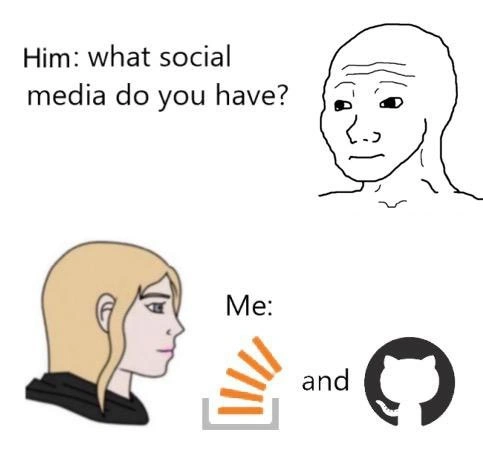
When someone asks “What social media do you have?”, they’re usually talking about popular platforms like Facebook, Instagram, Twitter, TikTok — places where people post pictures or updates about their lives and chat with friends. In this meme, though, the person replies with Stack Overflow and GitHub. Those aren’t traditional social media sites; they’re well-known tools in the programmer world. The joke here is that for this developer, these are basically their social hangouts online. Instead of posting selfies or status updates, they’re busy answering questions on a coding Q&A site or uploading code to a repository.
Let’s break down the two names mentioned, since they’re key to understanding the humor:
Stack Overflow: This is a famous question-and-answer website specifically for programmers. Picture a gigantic forum where anyone can ask a programming question (for example, “How do I center a div in CSS?” or “What does this Python error mean?”) and other users will post answers to help out. It’s extremely popular in the developer community; almost every coder has at some point Googled an error message and clicked on a Stack Overflow link that came up. On the site, good answers get upvotes (kind of like likes) from the community, and the person who asked the question can mark one answer as the accepted solution. Users earn reputation points for contributing useful answers or questions. Over time, someone might rack up thousands of points and many badges, which is a bit like having a high score or a strong reputation for being helpful. The orange logo shown in the meme is Stack Overflow’s logo — it looks like an orange staircase or an arch made of lines (it actually represents a stack of papers overflowin’ or a stack data structure, depending on how you see it). When the meme says her social media is Stack Overflow, it humorously means she spends her free time helping people or finding answers there, interacting with other developers through Q&A. It’s social in the sense that she’s connecting with thousands of other programmers — just discussing code, not personal life.
GitHub: GitHub is a website and service for storing code and working on programming projects together. It’s built on something called Git, which is a version control system. Version control is a way for developers to keep track of changes in their code and collaborate without overwriting each other’s work. Think of it like a Google Docs for code, where multiple programmers can edit and update the code, and Git keeps a history of every change. GitHub took this concept and made an online platform around it. It allows people to create a repository (a project with all its code files), and others can view that code, download it, suggest changes, or contribute improvements. Now, what makes GitHub a bit like a social network are its extra features: you have a profile, you can follow other users to see what they’re up to, you can “star” a repository to say “I like this” or “I want to save this for later,” and there’s a feed of recent activities (like “Alice starred Bob’s repository” or “Charlie pushed code to his project”). The logo shown — the black circle with a white cat-like octopus — is GitHub’s mascot called the Octocat. Developers often use GitHub to share open-source projects or even just to back up their own code in the cloud. When the person in the meme says GitHub is their social media, it implies they spend a lot of time on GitHub collaborating on code, browsing other people’s projects, and engaging with the developer community through issues and pull requests (which are basically discussions and reviews around code changes). In a way, GitHub is “social” because coding isn’t done in isolation there; people talk through code comments. For example, under a project, you might see conversations like “Hey, I have an issue with this function…” and someone else responds, working together to solve it — that’s a form of social interaction for programmers.
Now, why is it funny or notable that these are listed as social media? The humor comes from contrast. Imagine someone genuinely asking what apps or sites you use to be social, expecting an answer like “I’m on Instagram and Twitter”. But a developer might honestly answer, “I mostly just use Stack Overflow and GitHub.” To a non-tech person, that answer would be puzzling or nerdy, because those sites are about coding, not sharing personal pics or chatting with school friends. But to other developers, that answer makes a lot of sense. Developers form their own community on these platforms. They might not talk about what they had for lunch, but they do talk a lot — about code! For many in tech, solving a coding problem with strangers on the internet or contributing to a cool open-source project is a meaningful way to connect. It’s productive and social at the same time.
This meme is highlighting that mindset. The “Me:” character isn’t trying to be funny in-universe; she earnestly treats Stack Overflow and GitHub as her go-to social outlets. The fact that the image just shows the logos (and notably says “and” between them) is like she’s proudly presenting her two membership cards: one for the Q&A club, one for the coding collaboration club. No mention of TikTok or Snapchat at all! It’s a little bit of techie pride. A lot of developers actually joke in real life about not using Facebook or other social media much because they’re too busy on these coding sites or reading tech documentation. So this meme takes that common sentiment and puts it in a simple, universally understandable format.
The cartoon figures in the meme are part of an internet meme template often seen on forums. The top drawing (the bald, blank-faced guy) and the bottom drawing (the blonde woman in profile) are part of the Wojak meme family. Wojak characters are simple, almost crudely drawn personas that people use to act out dialogues or feelings. The blank face guy in the top panel represents a generic person (let’s say an average guy) asking the question. The bottom panel’s female Wojak (sometimes referred to as “Wojak girlfriend” in meme communities) represents the person responding — in this case, a developer girl. Using these generic cartoon faces makes it easy for anyone to put themselves in the scenario. It’s kind of saying, “We’ve all been this guy or girl in some conversation.” Here, it specifically resonates with developers: the guy asks a normal question, and the girl replies with a very developer-centric answer. The style is deadpan; the drawings have minimal expression. That makes the text – the question and the answer – the star of the show. And the answer itself is visual (just logos), which is a clever touch: it assumes the reader recognizes those symbols. If you do, you instantly get the joke. If you don’t, well, it might sail over your head (which in itself is another inside-joke: if you have to ask what those logos are, you’re not the target audience).
For someone early in their coding journey, this meme might also be a fun hint of what’s to come. As you get more into programming, you’ll likely find yourself visiting Stack Overflow regularly whenever you hit a problem you can’t solve alone. You might even make an account to ask your own questions or start answering others once you gain confidence. It’s almost like a rite of passage to earn your first few upvotes or to have an answer marked as accepted. Simultaneously, you might create a GitHub profile to share code or contribute to a project — maybe a class assignment, a personal project, or collaborating with friends. Over time, you might notice you’re checking GitHub notifications or browsing for interesting open-source repos like how you used to check Facebook or YouTube. In other words, you start to inhabit these developer platforms more. They become part of your daily routine and how you interact with the wider world of programmers.
So the meme is a light-hearted way of saying: developers have their own kind of social media. It’s not full of selfies or funny cat videos (well, unless the code you’re sharing is about cat videos 😄). Instead, it’s full of questions, answers, code snippets, version control commits, and technical discussions. That’s our social sphere. To someone not into programming, that might seem dull or confusing, which is exactly why this scenario is amusing — it’s a little clash of cultures in one question-answer exchange. The developer’s answer is totally valid to her and fellow devs, but comes across as geeky and unexpected to an outsider. This gentle nerd humor celebrates the fact that being immersed in technology changes what we consider “social” online. Instead of gossiping on Facebook, we’re busy debugging with strangers on Stack Overflow. Instead of curating cute photos on Instagram, we’re curating reliable code on GitHub. And we wouldn’t have it any other way!
Level 3: Follow, Fork, Upvote, Repeat
At first glance, this meme plays on a classic developer in-joke: treating coding platforms as if they were traditional social networks. The top panel’s question, “What social media do you have?”, sets an expectation of answers like Facebook, Instagram, or Twitter. But the punchline is the bottom panel’s response: Stack Overflow and GitHub – accompanied by their recognizable logos (the orange Stack Overflow staircase logo and the black Octocat for GitHub). For those in the know, this answer is both humorous and oddly relatable. It’s funny because it subverts the expectation: instead of listing mainstream social apps, the “Me” character names two developer-centric sites. And for many programmers, that answer isn’t just a joke — it’s practically true.
Stack Overflow and GitHub function as a sort of social hub for developers, even if they’re not “social media” in the conventional sense. On Stack Overflow, thousands of developers interact daily by asking and answering programming questions. This interaction has social elements: users gain reputation points (a score that increases when others upvote your answers or questions), earn badges for achievements, and build a standing in the developer community. A high reputation on Stack Overflow is like having a great Yelp rating as a chef — it signals expertise and engenders respect among peers. Long-time developers often recognize the usernames of top contributors, similar to how one might recognize popular influencers on Twitter. There’s a camaraderie in the comments and an ongoing community ethos of helping each other solve problems. In a tongue-in-cheek way, upvotes on Stack Overflow answers are the programmer’s equivalent of Instagram likes. An accepted answer (marked with a green check) is the ultimate thumbs-up. Experienced engineers joke that “if it’s not on Stack Overflow, it might not exist”, highlighting how integral this Q&A platform is to daily coding life.
Meanwhile, GitHub takes collaboration to a social level, often described as a “social network for programmers.” It’s built around Git (a version control system), but what made GitHub explode in popularity is how it added social features to code sharing. Developers on GitHub can follow other developers or projects, similar to following someone on Twitter to see their updates. When you follow someone on GitHub, your feed shows you the repositories they create or star and the contributions they make. Giving a repository a ⭐ star on GitHub is akin to liking or bookmarking content — it’s a quick way to say “I find this project cool or useful.” There’s even a contribution graph — those green squares that show your daily coding activity — which many devs treat like a streak counter of pride (who needs Snapchat streaks when you have an all-green GitHub commit calendar?). Forking a repository (making your own copy of someone’s project) is a bit like hitting the “share” or “retweet” button, allowing you to build upon others’ work and spread it around. And let’s not forget user profiles: a GitHub profile showcases your repositories, the contributions you’ve made to others’ code, and followers — effectively a résumé and social identity rolled into one. In the open-source world, a well-respected GitHub profile with popular projects and many contributors can grant you stature comparable to having a big following on a traditional social platform. It’s not uncommon to hear developers brag (half-jokingly) about how many GitHub stars their project has or what their Stack Overflow reputation is, the way someone else might brag about follower counts.
The combination of these two platforms as one’s “only social media” is hilarious because it rings true about developer culture. Many programmers genuinely spend more time on Stack Overflow and GitHub than on Facebook. Why? Because these platforms are where they learn, share, and connect with other developers. They might not be posting vacation photos or status updates, but they’re definitely engaging in conversations – just the technical kind. Helping a stranger debug a code snippet on Stack Overflow or reviewing a fellow coder’s pull request on GitHub can feel as socially rewarding to a developer as getting comments on a new profile pic might feel to someone else. The social interaction is there, but it revolves around problem-solving and coding rather than personal life. There’s a well-known pattern in tech circles: a developer might say, “I don’t really use social media,” yet spend their evenings avidly discussing in programming forums, answering questions on Stack Exchange, and pushing code to GitHub. This meme captures that irony in one neat exchange.
To put it another way, developer communities are the social networks for programmers. If Facebook is a big party where everyone’s sharing life updates, Stack Overflow is like a gigantic always-on workshop where everyone’s helping fix each other’s gadgets, and GitHub is a massive co-working space where people build things together. The humor cuts deep for those of us in tech: we chuckle because we see ourselves. We recall those late nights debugging with a dozen Stack Overflow tabs open, essentially “talking” with the collective wisdom of the internet. Or those times we refresh GitHub to see if a pull request comment came in — our equivalent of checking for new notifications. It’s an affectionate laugh that says, “Yep, this is my life.”
Even the visual style of the meme adds to the inside joke. The top panel features a simplified Wojak-style outline of a guy’s face with a neutral expression asking the question. Wojak characters are a staple in internet memes, often used to represent everyday people or feelings in a deliberately basic cartoon form. The bottom panel shows a blonde “girl” Wojak in profile saying “Me:” and then just presenting the logos of Stack Overflow and GitHub as her answer. The bland, almost serious look of these meme faces underscores that this conversation is straightforward and sincere from the characters’ point of view. The comedic effect comes from us, the audience, recognizing the disconnect: the guy (likely a non-developer) is drawn with that slightly puzzled blank face, as if he wouldn’t even recognize those logos as social media. The girl is calmly stating her answer, perhaps oblivious that it’s unusual. That cartoon dynamic — one character expecting a normal answer, the other delivering a nerdy twist — is a common formula in tech humor memes. It’s basically saying the developer’s reality is just different.
In a real-world context, imagine the scenario: a friend or maybe a date asks a programmer, “So what social media are you on? Instagram? Snapchat?” The programmer shrugs and says, “I have a Stack Overflow account and I’m on GitHub.” The friend might give a confused laugh, unsure if that was a joke or a serious answer. To fellow devs hearing this, it’s endearing because we’ve either said something similar or know someone who has. It highlights a sort of pride in being focused on coding and learning rather than on selfies and status updates. There’s a subtle self-deprecation too: we’re poking fun at ourselves for being such coding nerds that our idea of socializing is answering C++ questions for strangers or reviewing code on a repository.
Ultimately, this meme resonates among software engineers and IT folks because it wraps up a cultural truth (devs gravitate toward developer-centric communities) in a familiar meme format. It’s developer humor at its best – you have to know the context (what Stack Overflow and GitHub are, and why they matter) to get the joke. And when you do know that context, you immediately smirk or nod knowingly. After all, who needs Facebook dramas or Twitter rants when you have the thrill of a tough coding question to conquer and an open-source project to maintain? For code enthusiasts, platforms like Stack Overflow and GitHub aren’t just tools — they’re where we “hang out” on the internet. This meme playfully validates that way of life with a simple Q&A format, making it a perfect little inside joke for the developer community.
Description
This meme uses a simple, two-part comic format with Wojak-style characters to contrast mainstream social media with a developer's reality. In the top half, a male character asks, 'Him: what social media do you have?'. In the bottom half, a female character responds not with words, but by presenting the logos for Stack Overflow and GitHub, with the word 'and' connecting them. The humor lies in the recontextualization of these professional platforms as a developer's primary social sphere. For experienced engineers, Stack Overflow (for asking and answering technical questions) and GitHub (for code hosting, collaboration, and open-source contributions) are where they build reputation, interact with peers, and form their professional identity. These platforms effectively replace traditional social media, making the meme a highly relatable statement on developer culture

Comments
25Comment deleted
My social life is just a series of pull requests and arguments over syntax on Stack Overflow
My only social networks are GitHub and Stack Overflow - where “likes” are merge approvals, “stories” are git blame lines, and the closest thing to an influencer is the intern who just force-pushed to main
My most meaningful relationships are with people who've helped me fix production outages at 3 AM and strangers who've answered my questions about obscure race conditions from 2012
When asked about social media presence, a senior engineer's LinkedIn remains perpetually 'open to opportunities' while their GitHub contribution graph tells the real story - 47 commits last week, all between 11 PM and 3 AM. Their Stack Overflow reputation is higher than their credit score, and their most recent 'status update' was a pull request description that simply read 'fixed the thing.' Traditional social media? That's just another API they'll never integrate
Real dev influencers: Stack Overflow rep >10k trumps Instagram followers, GitHub stars actually launch careers
My social graph is a dependency tree - clout is Stack Overflow rep and GitHub stars; the only DMs I answer are CI failure pings
Social media? Stack Overflow and GitHub - followers are watchers, likes are LGTMs, and clout is an accepted answer from 2012 that still compiles
am i a joke to you? Comment deleted
what is this off brand headass telegram icon Comment deleted
the first from @pic, im not here for accuracy Comment deleted
fair Comment deleted
Explanation someone, please? ) Comment deleted
Normal people socialize with people on facebook instagram snapchat... Developers sozialize on Stack overflow and github Comment deleted
Oh, thanks! Don"t remember their logos ) Comment deleted
Do you use curl to browse the web? (JK) Comment deleted
No ) and I guess they would not work in lynx ) but I don't socialize there, just come to specific questions or repos, and apparently don't spend enough time on site to make a logo recognizable Comment deleted
When people ask me if I'm on Twitter or Facebook I just tell them I'm on IRC already and don't have intention of downgrading. Comment deleted
👍 Comment deleted
downgrading *wheeze* that's a burn Comment deleted
I agree though, I've long left WA, and I'm not looking back Comment deleted
I didn't have any of the other toxic medias, so that's a plus. You could say I'm completely detoxed Comment deleted
LinkedIn too Comment deleted
There are no girls in the internet Comment deleted
i am Comment deleted
There are no girls on the internet Comment deleted