If Composer Lock Files Were Made of Wood
Why is this Dependencies meme funny?
Level 1: Giant Bridge for a Tiny Task
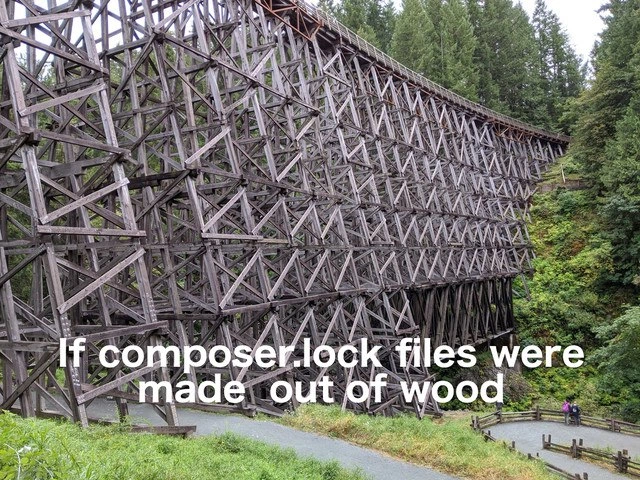
Imagine you want to grab a cookie from a high shelf. Instead of using a little step stool, you end up building a huge, wobbly wooden tower that fills the whole room just to reach that one cookie jar. Pretty over-the-top, right? That’s what this meme is showing in a coding sense. It’s comparing a simple list of things a project needs (normally a small thing) to a gigantic bridge made of criss-crossed wood. In other words, something that should be small and simple turned into something huge and complicated. It’s funny because it’s such an exaggerated, ridiculous solution for a small problem – like using an entire playground jungle gym just to grab one cookie. Even if you don’t code, you can laugh at the idea of using way too many pieces to do something basic. It’s a silly picture that makes us smile because we all get how crazy it looks to build a massive bridge for a tiny task.
Level 2: Towering Dependency Tree
Let’s break down the joke in simpler terms. In PHP, Composer is the tool for managing libraries that your project needs (this is called package management). You list the libraries you want in a composer.json file, and when you install them, Composer writes a composer.lock file. The composer.lock is basically a detailed inventory of dependencies (all the packages and specific versions that got installed, including the ones your chosen libraries themselves require). The meme imagines that if this lock file’s content were turned into physical stuff, it would be a huge rickety wooden bridge made of countless planks. Why? Because a typical composer.lock can contain dozens of packages once all the transitive dependencies (dependencies of your dependencies) are included. It’s showing how a seemingly small project can end up with a colossal dependency tree behind it.
Think of a simple example: say your PHP project needs Library A and Library B. But Library A needs helpers C and D to work, and D in turn needs libraries F and G. Meanwhile, Library B depends on E. If we draw that out as a tree, it looks like this:
MyProject
├── LibraryA
│ ├── LibraryC
│ └── LibraryD
│ ├── LibraryF
│ └── LibraryG
└── LibraryB
└── LibraryE
See how a couple of initial libraries led to many more? Your project directly required A and B, but indirectly it pulled in C, D, E, F, and G. Real Composer scenarios are often even larger. For instance, your composer.json might list just 5 primary libraries you added, but your composer.lock could end up with 50 entries once everything is resolved! Each entry in that lock file is one of the wooden beams in the picture — together they form the giant dependency tree holding up your project. The phrase “dependency hell” refers to how frustrating this can get, especially when two libraries need different versions of the same sub-dependency (causing conflicts) or when you want to update one thing and must carefully navigate updates to everything else. The lock file is there to help by freezing the exact versions, so everyone on the team and every server runs with the same set of pieces. That way, the bridge doesn’t change unexpectedly and collapse. It’s a safeguard: if it works on your machine and you have the same lock file, it should work on mine.
What makes this meme funny is that it visualizes something developers deal with all the time — lots of hidden complexity — in a very literal way. The wooden bridge metaphor exaggerates the size and complexity of a project’s dependency graph. Developers chuckle because it’s true: even a tiny feature can bring in an entire network of packages. And it’s not just PHP folks who get it. This joke is tech humor that rings true in other programming worlds as well: Node.js developers joke about the gigantic node_modules folder, Python devs have lengthy pip freeze lists, and Java projects pull in huge Maven/Ivy dependency trees. Every ecosystem has its version of this problem. So when we see that towering trestle, we all nod in understanding — managing lots of little pieces is a universal developer challenge, and sometimes it feels like we’ve built a bridge just to span a puddle.
Level 3: Dependency Jenga Bridge
The meme gives a seasoned PHP developer flashbacks: the photo’s enormous wooden trestle bridge looks exactly like the sprawling dependency tree hidden inside a composer.lock file. Each of those criss-crossed beams is like another package or library your project relies on. The humor comes from the absurd scale: modern PHP apps often pull in dozens (sometimes hundreds) of packages, all interconnected – it’s a giant lattice of code supporting your project. We call this dependency hell: you add one library and suddenly it drags in a cascade of others (each with their own dependencies). Your simple app now rests on a Jenga-like tower of third-party code. The caption “If composer.lock files were made out of wood” nails it – it imagines all those locked dependencies as real timber. Seen through a cynical eye, it’s a warning: your code might be just a thin road on top of a fragile mega-structure of packages. It’s basically a giant game of Dependency Jenga: stable until the wrong piece moves or disappears (like that one maintainer yanking a package – cough left-pad cough – and breaking the world).
Why is this so relatable? Because any dev who’s peeked at a Composer lockfile has seen lines upon lines of JSON listing every installed package and its version. It’s often shocking how a handful of direct dependencies balloon into a tangled graph of sub-dependencies. For example, require one popular framework or logging library and Composer pulls in a forest of support packages (HTTP clients, filesystem tools, half of Symfony’s core components, you name it). Instead of writing everything from scratch, we lean on existing packages – but that convenience comes at the cost of complexity. Each small beam in that bridge represents a transitive dependency (a dependency-of-a-dependency). Together, they form an elaborate support structure that holds up your app: it’s solid when all the pieces align, but if one plank (package version) is off or gets outdated, the whole thing can become shaky. Ever try updating a single package, only to find half your stack needs upgrades too? Welcome to DependencyManagement as practiced in real life. (That’s why veteran devs joke about playing “update roulette” on Friday afternoons – one wrong move and you’re stuck under the bridge fixing build errors at 2 AM.)
This meme pokes fun at how package management in PHP can lead to monstrous constructs. The composer.lock file “locks” the exact versions of every component, ensuring all developers and servers use the same build. It’s basically a manifest of that giant bridge – listing each bolt and beam by exact specification. This is how dependency management keeps your project reproducible. Seasoned devs chuckle (and maybe groan) because we’ve all been tasked with debugging an issue deep in that labyrinth, tracing through layers of vendor/ code we never knew we had. It’s a shared pain: the kind of developer humor that makes you nod and wince at the same time. After all, who hasn’t looked at a bloated lock file and thought, “Did we really build our application on top of this ridiculous scaffolding?” Yet here we are, crossing that ravine of DependencyHell on a creaky wooden bridge of third-party code, hoping no piece gives way. It’s funny because it’s painfully true.
Description
The image shows a photograph of an immense and incredibly complex wooden railway trestle bridge, built with a dense lattice of interlocking beams and supports, stretching across a forested ravine. Overlaid on the bottom left of the image is white text that reads, 'If composer.lock files were made out of wood'. This meme creates a powerful visual metaphor for the nature of dependency management in software development, particularly within the PHP ecosystem using Composer. The sprawling, intricate, and somewhat precarious-looking structure of the bridge is compared to a `composer.lock` file, which pins down the exact versions of every package a project depends on, including dependencies of dependencies. For senior engineers, this resonates by perfectly capturing the feeling of a project's dependency graph: massive, complex, and a bit terrifying to modify for fear of collapse
Comments
8Comment deleted
I see you've found the physical representation of our monorepo's `yarn.lock` after three teams merged their feature branches at once. Don't touch that one beam in the middle, it's holding up the entire authentication service
Composer.lock is that wooden trestle - every time product says “just bump Symfony,” I’m basically swapping one plank mid-train while praying the other 873 transitive boards all accept the same lumber spec
Just like this bridge, your composer.lock file started as an elegant solution to cross a simple gap, but after years of patches, security updates, and 'temporary' fixes, it's now a monument to technical debt that everyone's afraid to touch because removing even one beam might collapse the entire production environment
This perfectly captures the moment when you run 'composer update' on a legacy project and watch your lock file balloon from 500 lines to 15,000 lines because someone added a single package that depends on symfony/http-foundation, which pulls in psr/log, which somehow requires half of Packagist. The real horror isn't the size - it's explaining to your team why the PR diff is 99% composer.lock changes and realizing that one misaligned version constraint could bring the whole structure crashing down like a Jenga tower built by an over-caffeinated architect
This trestle has fewer layers than my composer.lock after one `require` - and it's easier to refactor
Composer.lock is a wooden trestle: it keeps prod upright until someone “just runs composer update” with ^ constraints, and we find out which transitive plank was load-bearing - at 2 a.m
Composer.lock: the only artifact where a single ^ in composer.json can turn a load‑bearing trestle into matchsticks during ‘composer update’
Pole Comment deleted