The Terror of a Flawless First Compile
Why is this Bugs meme funny?
Level 1: The Missing Alarm
Imagine you smell smoke in your house, but the smoke alarm isn’t beeping. The alarm’s little light is green and it’s calmly insisting “All clear, no fire here!” – yet your nose and eyes tell you something’s definitely burning. You’d probably walk around the house, checking every room, leaning in close to see where the smoke is coming from, right? You wouldn’t just trust the alarm saying “no problem” because you clearly see a problem. You might even get frustrated at the alarm: “Why aren’t you warning me?!”
That’s exactly the feeling this meme jokes about, but with a computer program. The “logs” (like the smoke alarm of software that should alert us to issues) keep saying “No error,” as if everything is fine. But the developer knows something is wrong – the program (like the house) is acting funny, even if the alarm isn’t going off. The picture of the man squinting and leaning forward is like someone peering harder and harder to find a hidden fire. It’s funny because we’ve all been in a situation where the thing that’s supposed to warn us doesn’t, and we have to become the detective. In simple terms, the meme is showing the frustration and determination of someone who knows there's a problem even when all the signals say “nope, no issues!” It’s poking fun at how sometimes our tools (or alarms) fail us, and we have to trust our instincts and look really closely to find that sneaky, invisible problem.
Level 2: Logging Blind Spots
Let’s break down what’s happening in simpler terms. Software applications usually keep logs – think of logs as a diary where the app writes down events, warnings, or errors as it runs. When something goes wrong, ideally the app should write an error message (and maybe a stack trace, which is like the app telling us the sequence of steps/calls it was in the middle of when it had an issue). In this meme, the logs are literally saying "No error". That represents a situation where, according to all the log messages and monitoring we have, nothing bad happened. Everything is reported as OK.
However, a bug (an error in the code causing incorrect behavior) is clearly happening despite the lack of any error message. This is what we call a silent failure – the program is failing, but doing so quietly. It’s like the software tripped but said, “I’m fine!” even as it limps. These are tricky for developers, especially those new to debugging and troubleshooting, because we’re taught to look for errors or exceptions as clues. When there’s no error log, it feels like driving at night with no headlights – you have to find another way to figure out what’s ahead.
Why might logs insist “No error” even when there is a problem? A few common reasons:
- The code might have error handling that is too quiet. For instance, the program might catch an error but then not report it. Imagine a piece of code that does
try...catcharound a task but doesn’t print anything if something goes wrong – it just keeps going. The error gets hidden. - The problem might not trigger an error at all. Not all bugs cause crashes or obvious errors. Some are logical mistakes. For example, say we have a program that calculates discounts on a shopping site. If there’s a bug and it gives 0% discount instead of 10%, that’s wrong, but the computer doesn’t know it’s “an error” – it’s just following incorrect instructions, so no error message is generated. The program thinks it ran fine, but the result is wrong.
- The issue might be happening in a part of the system that isn’t being watched. In a complex application (especially with multiple services or components), maybe one component had an issue but another component only got an empty response and moved on. The logs you’re looking at could be the wrong place – they have a blind spot for this particular failure. This is why companies use centralized logging and monitoring dashboards – to collect all clues in one place. But if those tools aren’t set up to catch this specific case, they’ll show “all clear” by mistake.
- The logging level might be set too low. Logs often have levels like DEBUG, INFO, WARN, ERROR. In a production environment, we might only record WARN and ERROR to avoid too much noise. If the only log about this bug was at DEBUG level (a very detailed level) and we didn’t capture it, then effectively we see nothing. It’s like having a security camera but not recording HD – the crucial details are lost.
So what does the right side with the man squinting mean? That’s the developer (us) basically saying, “I know something’s wrong, I just can’t see it yet.” We start searching intensely: maybe we increase the log level to see more detail, or we add new log statements in the code around the suspect area to print out values and progress. This is a very common technique in debugging: when the logs don’t show the issue, you instrument the code to make it more observable – in other words, you add more eyes and ears (print statements, metrics, etc.) to catch the bug in the act. It’s the “I don’t trust that ‘No error’ message, let me double-check everything” moment.
In summary, this meme is highlighting a scenario every developer encounters: the invisible bug. No errors reported anywhere, yet something is clearly going wrong. For a newer developer, this situation is confusing – “the computer says nothing’s wrong, so why isn’t it working?” Through experience (and some hair-pulling), we learn that no output or no error message often means we have to dig deeper. We check all the pieces of the system, use debugging tools, maybe replicate the scenario in a test environment with more verbose logging, until we find the culprit. It’s a rite of passage in learning software development: discovering that no news is not always good news in the land of programming.
Level 3: No Error, No Clue
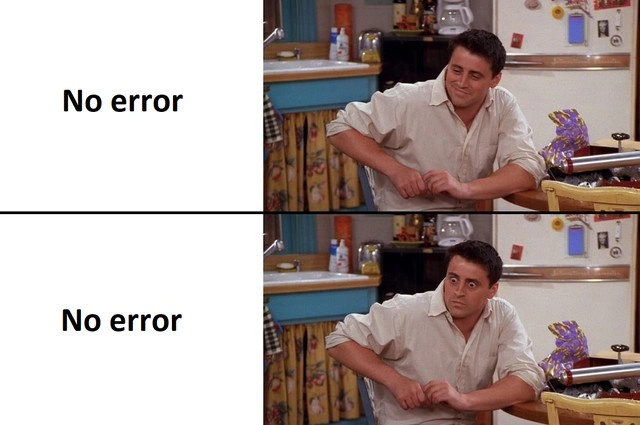
For experienced developers, this image hits a nerve. It’s depicting that classic debugging frustration: the software is misbehaving, but all your logs and monitors are smugly saying “No error.” On the left side of the meme, the bold text “No error” mimics what we see in logs or console output – essentially a blank slate or a reassuring message claiming nothing’s wrong. On the right side, the character (yep, that’s Joey from Friends, squinting intensely) represents us, the engineers, leaning in and scrutinizing every detail because we know a bug is lurking even though there’s zero evidence. The humor is in that contrast: the system declares innocence while the senior engineer in us is unconvinced, practically with our nose on the screen hunting for any anomaly.
Why is this so funny (and painful) to seasoned devs? Because we’ve all been there, often at 3 AM on an on-call shift. The app might be failing or some feature is clearly broken, users are complaining, but the logs are as placid as a lake on a windless day – not a ripple of error to be found. It’s the ultimate head-scratcher in DebuggingAndTroubleshooting: you’re facing a bug in software that leaves behind no trace. This meme nails the pain of such silent failures. There’s a shared trauma of sifting through thousands of lines of logs (INFO, WARN… nothing at ERROR level) searching for anything suspicious. Maybe a single warning or a strange timestamp jump – any clue to avoid the dreaded “I have no idea what’s happening” moment. The second panel, where he leans even closer, perfectly captures that escalating desperation: “Am I blind? Did I miss something?!” We start doubting our own eyes and the tools we rely on.
The industry wisdom behind this humor is that lack of errors in logs does not equal a clean bill of health. Often it points to insufficient logging or error handling. A well-built system should log unexpected events, but reality is messy:
- Sometimes an exception is caught and then completely ignored. This is a notorious anti-pattern:
Above, the code traps a failure but logs nothing – effectively telling the logs “No error” even though something blew up. Senior devs have felt the sting of suchtry { performCriticalTask(); } catch (e) { // quietly ignore the error, no logging } // Program continues as if nothing happened...designmistakes, spending days chasing a bug that was literally swallowed by code like this. - Other times, the bug isn’t an exception at all but a logic error. The code runs to completion thinking everything is fine. For example, a function might compute the wrong result – no crash, no error, just wrong output. The log won’t show an error because the program didn’t consider it one. (It’s a feature, not a bug, the code might as well be saying.)
- There are cases of error codes that get dropped. A call returns an error indicator, but if the developer forgot to check and log it, the software marches on obliviously. The failure is invisible in the logs – a ghost.
- Logging level misconfiguration can also bite. Perhaps the system did log something useful at DEBUG level, but in production the logs run at INFO level for performance, so that crucial message is never recorded. From the ops dashboard perspective, it's as if the error never occurred.
- In distributed systems or multi-component apps, the problem might be logged in a different place. The service you’re checking says “No error” because the fault happened downstream or in a separate log silo. Think of a front-end saying “no errors here” while the backend had a stack trace – but if your monitoring isn’t centralized, you miss it. Production bugs love to hide this way.
Experienced engineers laugh (and cry) at this meme because it satirizes the false sense of security we sometimes get from our tools. We invest in fancy observability/monitoring setups, expecting that whenever something goes wrong, alarms will blare and red indicators will flash. Yet here we are, staring at a wall of “All systems normal” green lights while something’s clearly on fire. It’s a parody of those post-incident meetings where someone asks, “How did our monitoring not catch this?” Well, because the system didn’t consider it an error worth reporting! The meme’s guy squinting is basically the senior engineer’s mindset: I refuse to believe everything is truly fine. We know better. We start digging deeper: checking memory usage, thread dumps, database records, or comparing what should be happening to what is. This often leads to the discovery of the real issue – maybe a misconfiguration, a recent code change that introduced a subtle bug, or an edge-case that wasn’t logged.
In essence, this meme resonates because it caricatures a universal debugging pain: the moment when our observability tools – logs, metrics, dashboards – give no clues, and yet we must trust our gut that a bug does exist. Seasoned devs find it funny-sad because we’ve developed a kind of sixth sense. We’ve learned that "No error" often just means "the error is hiding somewhere we’re not looking." And so the squinting intensifies, the search widens, and the troubleshooting adventure begins. Like the man in the picture inching closer, we dive deeper into the system until the invisible bug finally shows itself.
Level 4: No Error Event Horizon
Absence of evidence is not evidence of absence – in debugging, this principle haunts us. Here the logs blandly report "No error" while a bug wreaks havoc unseen. This meme nods to a deep observability paradox: parts of the system’s state are essentially unobservable, like data falling past a black hole’s event horizon. In control theory terms, the application isn’t fully observable – its internal failure state can’t be deduced from its outputs (the logs). The result? From our vantage point, everything looks normal even though something’s fundamentally wrong. We’re staring into a logging black hole where information should escape but doesn’t.
At a theoretical level, this underscores why proving a program’s correctness is so hard. A program can be logically incorrect (a bug) without ever violating a condition that triggers an exception or log. There’s no universal law forcing every software fault to produce a visible error. In fact, computer science tells us there’s no algorithm that can automatically catch all possible bugs – it’s related to the halting problem and other undecidable issues. Thus, a silent failure (one that produces no error message) is a ghost in the machine: it violates our assumption that every failure is observable. The meme’s humor comes from this gap between reality and our tools – we expect a failing system to tell us it’s failing, but fundamental limitations and design oversights mean sometimes it just doesn’t.
Modern distributed systems and microservices deepen this paradox. One service’s bug might not propagate an error up to the user-facing layer. Imagine Service A calls Service B; B encounters an issue but, instead of throwing an error, returns a default value. A sees nothing wrong – no exception, no log – yet the overall behavior is incorrect. We essentially get a Byzantine scenario where a component fails but lies about it. In a resilient architecture, components often try to handle errors internally (fallbacks, retries) to avoid crashes. But this “graceful degradation” can backfire if it conceals the problem entirely. The error vanishes into an observability black hole, and the overall system state drifts off course with no red flags.
The advanced irony is that attempts to observe the bug can even alter it – a classic Heisenbug situation. For example, adding extra logging or running the program in debug mode might change timing or memory layout just enough that the bug disappears or behaves differently, leaving logs clean. The very act of watching affects the system. This physicist’s-joke-turned-programmer-reality reminds senior engineers of countless late-night troubleshooting sessions: the logs insist nothing is wrong (as if that were final proof) while our deep knowledge of the system’s invariants tells us something is very wrong. In essence, the meme captures a scenario where the truth of a bug exists beyond the event horizon of our monitoring tools – a paradox that tickles those of us who know just how easily a Phantom Bug can defy our instrumentation.
Description
A two-panel meme using the 'Joey's Delayed Reaction' format from the TV show 'Friends'. In the top panel, the text on the left says 'No error', and on the right, the character Joey Tribbiani has a smug, self-satisfied look. In the bottom panel, the text 'No error' is repeated, but Joey's expression has changed to one of wide-eyed shock and panic. This meme perfectly encapsulates the paradoxical experience of a developer whose code runs without any errors on the first try. The initial relief quickly turns into suspicion and fear, as the absence of expected errors often implies a more subtle and sinister logical bug that will be much harder to find than a simple syntax error
Comments
10Comment deleted
A 'No error' message on a complex feature is the compiler's way of saying, 'Good luck on your treasure hunt, the bug is buried somewhere you'll never think to look.'
OpenTelemetry → Kafka → Grafana: the million-dollar observability pipeline. Legacy code: `catch (Throwable) {}` Logs: “No error.” Prod: *on fire.*
After 15 years in the industry, you develop a sixth sense for when your distributed system is silently failing - it's that eerie calm when all health checks pass, no alerts fire, but somehow customer data is being written to /dev/null and your Kafka consumer is just vibing in an infinite retry loop with exponential backoff set to 'yes'
Every senior engineer knows that 'No error' is just a polite way of saying 'the error hasn't manifested yet.' It's like when your distributed system reports all green metrics right before the cascade failure - the calm before the storm. The real question isn't whether there's a bug, it's whether it'll surface in dev, staging, or at 3 AM in production when you're on-call. That's why we have trust issues with clean builds and passing tests on the first try
No error. Still no error. Either we finally proved correctness, or Prometheus is down and catch(Exception) {} ate the stack trace
No errors in logs? That's just your distributed system's way of whispering 'good luck tracing eventual consistency'
CI is green, SLOs are green, logs say “No error” - translation: someone shipped catch (Exception) {} to production
the error called «No» Comment deleted
understandable, have a great day Comment deleted
NO error is why I hate YAML Comment deleted