The SolarWinds Hack Explained with a Meme
Why is this Security meme funny?
Level 1: Hidden Dangers Inside
Imagine you have a big toy box that you and all your friends get toys from. Everyone trusts that the toy box is safe because it’s from a famous company. Now, think of a sneaky bad guy who manages to put a bunch of broken or harmful toys into that box without anyone knowing. When kids grab toys, they look fine on the outside, but there’s something bad hidden inside them that could cause trouble. Scary, right?
Now picture a salesperson proudly patting that toy box and joking, “This box can fit so many hidden surprises in it!” It sounds silly because usually a salesperson would brag about good things (like a box fitting many fun toys), not bad surprises. That’s exactly what this meme is doing, but with computer software. The SolarWinds company is like that toy box provider. Lots of organizations trusted SolarWinds to give them good software (like toys) to help manage their computer networks. But a bad actor (the sneaky bad guy, allegedly from Russia) found a way to hide something dangerous inside the software updates (the toys). So when those organizations updated their software, it was as if they took toys from the box that had hidden problems.
The meme uses a funny car salesman picture to make a serious point: something that looks great on the outside – “shiny and reliable” – might secretly contain a lot of problems. It’s like someone saying, “This candy bar can hold so many worms inside!” as a joke. You’d normally expect them to say the candy bar has a lot of yummy filling, not worms. By flipping it around to brag about worms, it’s dark humor. It makes us laugh a little because it’s absurd, but it also makes us remember that we should be careful about what we trust. Even if a toy, candy, or software comes from a trusted place, it might have hidden dangers if a bad guy was able to tamper with it.
So, the simple idea is: The meme is a joke that warns, “Be careful! Even something that looks secure and high-quality can hide a nasty secret.” It’s funny in the way a spooky campfire story might be told in a playful tone – you smile, but you also get the message. In real life, it reminds everyone (even if you’re not a tech expert) that sometimes bad people try to sneak into all the products we take for granted. And it’s important, just like checking your candy on Halloween, to check and be cautious with software updates and things you install on your computer. The people who work in computer security found this meme extra funny because it used a popular joke format to talk about one of the biggest “oops” moments in their field, making a serious lesson a bit more lighthearted.
Level 2: When Dependencies Attack
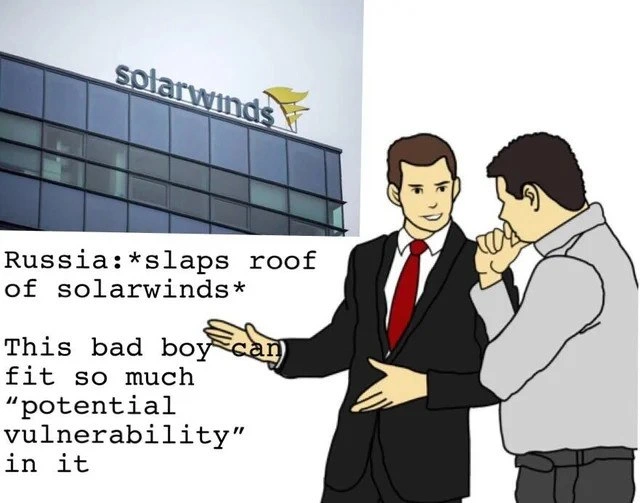
Let’s break down the meme’s meaning in simpler terms. First, the meme uses the popular “car salesman slaps roof” format. In that format, a car salesman pats a car and says a line like, “This baby can fit so much X in it!” to highlight a car’s capacity. It’s an Internet joke where X is usually something absurd or humorous. In this meme, the car is replaced by the SolarWinds company (represented by its office building and logo), and X is “potential vulnerability.” The salesman is labeled “Russia,” implying a Russian hacker or agent. So the meme literally shows a Russian hacker bragging about how many vulnerabilities he can stuff into SolarWinds’ products. It’s a way of poking fun at the SolarWinds hack that happened in 2020, but in a very tongue-in-cheek manner.
Now, what was this SolarWinds hack? SolarWinds is a company that makes IT management and monitoring software used by a lot of large organizations. One of their popular products, Orion, helps IT staff keep an eye on network performance and devices. In a supply chain attack, hackers target a supplier of software (in this case, SolarWinds) so that by compromising that one supplier, they can attack all the customers who use that software. It’s like attacking the root source to get into many places at once. In 2020, hackers managed to break into SolarWinds’ build system – that’s the part of the company’s infrastructure that puts together new versions of the software (the CI/CD pipeline, which stands for Continuous Integration/Continuous Delivery, basically an automated assembly line for code). The bad guys snuck malicious code into the Orion software during this build process. SolarWinds then unknowingly shipped out a software update that included this hidden bad code (often called a backdoor). Because SolarWinds was a trusted vendor, all these customer organizations (including companies and government agencies) installed the tainted update, not realizing it contained a security vulnerability planted by attackers. This gave the hackers a secret entrance (“backdoor”) into potentially thousands of networks – a very scary scenario in cybersecurity.
Let’s clarify some terms that appear in the meme and context:
Vulnerability: This is a weakness or flaw in software that can be exploited to cause harm. Think of it like a door or window left unlocked in a house – if a burglar finds it, they can get in. In software, a vulnerability might be a coding mistake or, as in this case, a deliberately inserted piece of malicious code that opens a door for hackers. The meme says “potential vulnerability” because at the time of shipping, it was an unknown hidden vulnerability – potential until discovered. Once discovered, it became a full-blown exploit.
Security: In general, this refers to protecting systems from threats. In software security (or cybersecurity), it means defending programs and data from unauthorized access or malicious changes. This meme is firmly in the realm of security humor. It’s making light of a serious security flaw for the sake of caution and comedy.
Dependencies: These are external components or software packages that a project relies on. For example, if your project uses a third-party library or a vendor product, that’s a dependency. Dependency management is the practice of keeping track of and updating these external pieces safely. Here, SolarWinds Orion was a dependency for many organizations – instead of building their own network monitoring tool, they depended on SolarWinds’ software. The meme highlights the danger in that: if your dependency is compromised, it can hurt you. It’s as if a part you bought for your car from someone else turned out to be faulty and made your whole car unsafe.
Build Systems / CI/CD: This stands for Continuous Integration/Continuous Delivery. It’s a set of practices and tools that let developers automatically integrate code changes, run tests, and deliver updates quickly. Think of it like an automated bakery for software: developers put dough (code) on one end, and fully baked software releases come out the other end continuously. In the SolarWinds case, the attackers poisoned the batter in that bakery. They inserted bad ingredients (malicious code) into the mix so that every cake (software update) coming out had a hidden nasty surprise. The meme jokes that SolarWinds’ bakery (the build system) was apparently spacious enough to hide a lot of bad ingredients (vulnerabilities) without anyone noticing the odd taste immediately.
Third-Party Risk: This term refers to the risk you take on by using software or services from an outside party. If that third party has a security failure, it can become your security failure. SolarWinds was a third-party vendor to many companies, and the hack demonstrated the huge third_party_vendor_risk inherent in such relationships. After this incident, a lot of developers and security teams started paying more attention to who their suppliers are and what security practices those suppliers follow. It was a big “learning moment” in SoftwareSupplyChainSecurity – a wake-up call that even trusted vendors need to be vetted and monitored.
To sum up this meme’s scenario in plain terms: A sophisticated attacker (allegedly Russian state hackers) managed to turn SolarWinds’ own software updates into trojan horses. A trojan horse in tech is just like the Trojan horse from the ancient story – something seemingly benign that actually contains enemies inside. SolarWinds delivered a trojan horse to thousands of networks (though unintentionally), and the hackers were the ones hiding inside it. The meme imagines the hacker bragging about this: “Look at this product, I loaded it with so many hidden problems!” It’s humorous in a sarcastic way because nobody wants vulnerabilities, yet the picture presents it as a selling point, as if vulnerabilities are a feature. It’s the kind of dry, ironic humor that DevOps and security professionals share to cope with the absurdity of such situations. They sigh and laugh a bit, because the alternative is to cry about how bad it could have been.
And indeed, the consequences were serious – but the meme’s role is to remind everyone (especially those of us who manage systems and dependencies) with a bit of levity: always be careful what you install and whom you trust. It’s saying, “This could be your network if you’re not careful – stuffed full of surprise vulnerabilities.” In other words, security folks often use memes like this as a friendly warning wrapped in humor: keep an eye on your supply chain and third-party software, or you might get more “features” than you bargained for. 😉
// Example of a glaring security vulnerability (for illustration):
std::string defaultPassword = "solarwinds123"; // Hardcoded weak password
if (userInput == defaultPassword) {
grantAdminAccess(); // Anyone who knows the password gets in!
}
Above: This snippet is a simple example of a security vulnerability – using a hard-coded, easily guessable password ("solarwinds123") that grants high-level access. It’s like hiding a key under the welcome mat; if attackers find it, they’re in. Rumor has it that SolarWinds had something similar as a real password in their infrastructure, which shows how even basic security hygiene was lacking. The meme emphasizes that when such weaknesses exist, attackers can load “so much exploit potential” into your systems. For a junior developer or someone new to cybersecurity, the takeaway is: small security oversights can lead to big compromises. Always secure your build pipelines, use strong passwords/keys, and treat external software as you would treat raw sushi – trust, but verify and handle with care!
Level 3: One Build to Pwn Them All
In late 2020, the SolarWinds saga became the nightmare before Christmas for many tech companies and government agencies. This meme captures the senior engineer perspective on that incident with biting humor. The format is the classic "car salesman slaps roof" meme, but instead of a car, it’s the SolarWinds company (with its glass-office facade and yellow swoosh logo) being “sold.” The salesman here is labeled as Russia – referencing the widely reported attribution that Russian state-sponsored hackers were behind the attack. The joke text says: “Russia: slaps roof of SolarWinds This bad boy can fit so much ‘potential vulnerability’ in it.” This perfectly sums up the grim punchline known to every security engineer: the SolarWinds Orion platform wasn’t just an IT management tool, it became a vehicle carrying loads of hidden vulnerabilities into thousands of organizations.
Why do experienced developers and DevOps folks chuckle (albeit nervously) at this? Because it’s darkly relatable. The meme mashes up a goofy Internet meme format with one of the most serious security incidents of the decade, highlighting an absurd truth: enterprise software can hide an enormous attack surface under a shiny exterior. It’s the ultimate supply_chain_attack joke – the idea that an innocent-looking “vendor” product update can smuggle in a digital bomb. When the meme says “This bad boy can fit so much potential vulnerability,” it satirically implies that the Orion software had room for all kinds of exploits once the attackers got inside the build process. Seasoned engineers have seen this pattern: one weak link in a third-party vendor or a CI/CD pipeline, and all the dominoes fall.
The SolarWinds hack was a wake-up call about third_party_vendor_risk. Here was a respected enterprise vendor, whose software and updates were trusted by tens of thousands of customers, including Fortune 500 companies and government agencies. Yet, behind the scenes, an APT (Advanced Persistent Threat) was lurking in their build system for months. The attackers (allegedly Russia’s Cozy Bear group) inserted a backdoor into SolarWinds’ Orion software updates. When unsuspecting IT departments installed what looked like a routine update, they were effectively installing a remote-control vulnerability for the attackers. This is why the meme’s “slaps roof” line is so biting – it implies the attackers are proudly showing off how they managed to cram an entire spy kit into the SolarWinds product without anyone noticing for a long time. It’s like a bad infomercial: “But wait, there’s more… hidden vulnerabilities!”
From an industry perspective, this incident and meme hit a nerve because it highlighted systemic issues in how we handle software dependencies and updates. Every senior dev knows that relying on third-party software (whether open-source libraries or vendor products) comes with a trade-off: you gain convenience and features, but you inherit all their bugs and risks. SolarWinds was a textbook example of an enterprise_software_security failure: the very pipeline meant to ensure quality releases was compromised. Insiders later revealed lapses like weak server credentials and security oversight. (One infamous anecdote: a SolarWinds server had the password "solarwinds123" – which is the kind of thing a junior intern might use as a joke. It was that bad.) Such weak points are catnip to nation-state hackers. Once inside, the attackers operated with stealth and precision: they implemented the malicious code in a way that was hard to distinguish from SolarWinds’ normal code. To defenders, it looked like just another part of the vendor’s software, making detection extremely challenging.
The meme resonates because it compresses all that drama into a single comedic image. It hints at the shared trauma of DevOps and security teams in 2020: the frantic all-hands-on-deck meetings, the emergency patches, the scramble to check if “we use SolarWinds Orion anywhere in our stack?!”. Many organizations discovered to their horror that yes, this one seemingly minor vendor component was deeply embedded in their network, quietly monitoring servers – and now it was a Trojan horse. The phrase “potential vulnerability” in the meme is doing a lot of work: it’s a tongue-in-cheek reference to how SecurityVulnerabilities can lurk as mere “potentials” (unknown, latent) until discovered. Here, those potentials were actively weaponized. It’s gallows humor: we laugh so we don’t cry about how something as mundane as a network monitoring tool update turned into a massive SecurityIncident spanning the globe.
In terms of DependencyManagement, senior devs also recognize in this meme the age-old dilemma: you are only as secure as your weakest vendor. We often joke that “it’s always DNS” or “it’s always the database” when troubleshooting issues – after SolarWinds, a new joke emerged: “it’s always the supply chain.” This meme encapsulates that with a visual gag. The “slaps roof” template is normally used to exaggerate a car’s capacity (e.g., “this car can fit so many x in it”). By substituting the car with SolarWinds, the meme implies the Orion software was so bloated or so unwittingly accommodating that adversaries could pack it full of exploits and still have room for more. It’s both a criticism of SolarWinds’ security posture and a jab at how much blind trust users placed in it.
Lastly, experienced folks see a commentary on corporate incentives and technical debt. SolarWinds, like many enterprise vendors, was focused on delivering features and updates rapidly – a selling point for DevOps efficiency with their continuous delivery (BuildSystems_CICD) approach. But speed can come at the expense of rigor in security. Without strong safeguards, a CI/CD pipeline can turn into a CI/CI – Continuous Integration, Continuous Infection. In this case, the attackers basically performed a malicious continuous deployment right into data centers worldwide. Fixing the mess was far harder than causing it; revoking certificates, issuing emergency patches, and scrubbing networks of an advanced persistent threat is a herculean effort. So, when a grizzled engineer sees this meme, they smirk and sigh because it’s too real. It distills a painful lesson: Security isn’t just about your code, but also about the code you import, the software you build upon, and the vendors you trust. As the meme jokingly points out, if you’re not careful, that trusted platform might just be carrying a boatload of vulnerabilities under the hood, ready to spill out at the worst moment.
Level 4: Reflections on Trusting Trust
At the most fundamental level of computer security, this meme hints at the fragile chain of trust in software systems. A software supply chain attack like the SolarWinds incident subverts the very notion of trust that underpins modern software distribution. In theory, we rely on digital signatures, code reviews, and build reproducibility to ensure that delivered software hasn’t been tampered with. However, the SolarWinds compromise (dubbed "Sunburst" in technical analyses) was a masterclass in trust exploitation: the attackers injected malicious code during the build process of the trusted Orion product and still produced a legitimately signed update. This meant every downstream system accepted the trojanized update as if it were perfectly safe – a Trojan Horse hidden in plain sight. Cryptography didn’t save the day here because the signing keys and build pipeline itself were under the attackers’ control. The CI/CD system, normally a fortress of automation, was turned into an assembly line for malware. It’s a poignant real-world instance of Ken Thompson’s famous lesson: trust, once compromised at the source, cascades into an avalanche of compromise down the line.
In fact, Ken Thompson (co-creator of Unix) illustrated this back in 1984 with his seminal talk “Reflections on Trusting Trust.” He demonstrated that if you corrupt a compiler to silently insert a backdoor, every program compiled with it – even if the source code is clean – will carry that backdoor. SolarWinds was essentially a massive remake of that concept using modern tools: the attackers effectively “backdoored” the build system. No matter how much code review or vulnerability scanning one does on the Orion software after the fact, if the build system itself adds the evil, traditional defenses are moot. It’s like a root certificate in an SSL/TLS chain being evil – if your root of trust is malicious, everything signed by it is automatically suspect. This is a profoundly disturbing security paradox: the very mechanisms meant to ensure integrity (digital certificates, trusted updates) were wielded against us. The meme’s dark humor draws from this deep irony.
From an academic perspective, the SolarWinds hack underscores some almost theoretical limits of program analysis and security. Determining whether software has a cleverly hidden malicious payload is akin to solving the Halting Problem – it’s undecidable in the general case. Attackers exploited this by making the malicious code blend in. The implanted backdoor was dormant for a period, activating only under certain conditions, which evaded many detection methods. Advanced persistent threats play a cat-and-mouse game with defenders, leveraging techniques like polymorphism and conditional triggers that formal verification or static analysis struggle to catch. While we have tools to verify compiler output or ensure build reproducibility (e.g., binary transparency logs, cryptographic build hashes), widespread implementation of these is lagging. The SolarWinds incident became a case study driving research into how we can mathematically guarantee build integrity or at least detect anomalies. It’s pushing discourse on ideas like distributed ledger verification of build steps, ephemeral build environments, and zero-trust architectures for development pipelines. In short, this meme evokes a smile (or a groan) from seasoned engineers because it echoes a fundamental truth in computer science security theory: a system is only as secure as its most insecure component. Once an attacker “owns” that component – be it a compiler, a package repository, or a build server – they effectively own everything downstream.
"No amount of source-level verification or scrutiny will protect you from using untrusted code."
– Ken Thompson, 1984 Turing Award Lecture (a prescient warning perfectly exemplified by SolarWinds)
Description
A meme using the 'Slaps Roof of Car' salesman format to comment on the 2020 SolarWinds supply chain attack. On the top left is a photo of the SolarWinds company building. Below that and to the right, the car salesman drawing is repurposed. The text reads: 'Russia: *slaps roof of solarwinds* This bad boy can fit so much "potential vulnerability" in it'. The meme satirizes the massive cybersecurity breach where Russian hackers compromised SolarWinds' software, using it as a trojan horse to introduce vulnerabilities into the systems of thousands of their clients, including US government agencies. The use of 'potential vulnerability' is ironic, as the vulnerabilities were very real and had significant consequences
Comments
7Comment deleted
The SolarWinds hack is the ultimate dependency injection attack. You don't even write the vulnerable code, you just politely ask your CI/CD pipeline to pull it from a trusted vendor
SolarWinds quietly upgraded CI/CD to “Commit, Inject, Compromise, Distribute” - and we still let the pipeline auto-merge to prod
The real vulnerability was trusting that 'solarwinds123' wasn't still hardcoded somewhere in production after all those security audits - turns out nation-state actors appreciate convenient password management as much as junior devs do
The ultimate irony: a network monitoring and management platform designed to detect security threats became the very vector for one of history's most sophisticated supply chain attacks. It's like hiring a security guard who's actually casing your building for a heist crew - except this guard had root access to 18,000+ organizations. The 'potential vulnerability' wasn't just a bug; it was a feature-complete nation-state backdoor with better code quality than most enterprise software. When your trusted security vendor becomes patient zero, you know we've entered the 'who watches the watchmen' endgame of software supply chains
SolarWinds reminded us: code signing proves origin, not intent - like a unit test that only asserts the file exists
SolarWinds: the hack that retrofitted every enterprise SBOM with a 'trust no binary' clause
Zero Trust everywhere except the build pipeline - apparently our root of trust was “whatever the CI signs on Friday.”