Skip to content
DevMeme
4800 of 7435
The Humble Satisfaction of a 0.01% Test Coverage Increase
Testing Post #5258, on Jun 25, 2023 in TG

The Humble Satisfaction of a 0.01% Test Coverage Increase

Why is this Testing meme funny?

Level 1: Every Bit Counts

Imagine you have a giant 10,000-piece jigsaw puzzle, and you manage to fit in just one more piece. The puzzle isn’t much closer to finished – you’d barely notice the difference – but you still feel good because you made a little progress. That’s how a developer feels after writing one extra test for their code. The project is only a teeny bit more tested, but it’s still an improvement to be proud of. It’s like saying, “it’s not much, but it’s honest work.” In other words, even a tiny win is still a win!

Level 2: CI Coverage 101

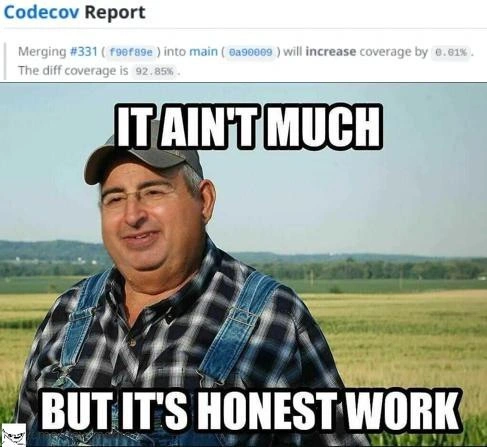
In simpler terms, this meme highlights a scene many new developers will encounter. Modern software teams use Continuous Integration (CI) systems – automated build and test pipelines – that run every time we push code or open a Pull Request. One thing these pipelines check is test coverage, which is a percentage measuring how much of our code is executed by the test suite. The top half of the image is a real example of a CI tool (Codecov) reporting on coverage for a proposed change (PR #331). It says merging that change into the main branch will increase the project’s coverage by 0.01%. In other words, if the code was, say, 75.00% covered by tests before, now it will be 75.01%. That’s such a tiny improvement it’s almost comical. It also notes the diff coverage is 92.85%, meaning 92.85% of the lines touched in this PR have tests exercising them. That’s actually very good for new code and explains why the overall coverage didn’t drop and even crept up by a hair. CI dashboard stats like these (coverage changes, diff coverage) are posted on pull requests so the team can see if a change is maintaining code quality. Many projects have a rule that coverage must not decrease with new changes – so even a minimal test coverage gain like +0.01% is better than nothing (and certainly better than a decrease that might break the BuildPipeline checks).

Now, the bottom half of the meme is a popular image known as the “It ain’t much, but it’s honest work” meme. It features a friendly farmer in a field with that caption. People use it to humorously express pride in doing something necessary, even if the result is small. Developers often joke in this exact way about testing (classic TestingHumor): you put in a lot of effort writing unit tests and all you get is a barely noticeable bump in a metric. Here the farmer’s phrase is used to say, “I know +0.01% coverage isn’t a huge accomplishment, but I’m still proud I did it right.” Writing tests doesn’t create flashy new features or big visual changes – it’s the quiet, behind-the-scenes work that makes the software more reliable. So when a developer sees their hard work result in the coverage number nudging up ever so slightly, it feels satisfying. The meme perfectly captures that feeling: it ain’t much, but it’s honest work. Together, the Codecov report and the farmer image convey a little story every programmer understands: even a tiny win in the CI pipeline is worth a pat on the back.

Level 3: Continuous (Integration) Improvement

For an experienced developer, this meme nails the bittersweet triumph of incremental test coverage gains in a Continuous Integration pipeline. The top panel shows a Codecov report automatically posted to a Pull Request (PR #331) that proudly declares a coverage increase of just 0.01%. That’s essentially a rounding error in a large codebase, and yet any CI old-timer knows: even a tiny bump means we wrote more tests and didn't let coverage slip. Many teams set strict coverage requirements in their CI/CD build pipelines (for example, requiring coverage not to drop below the current level or aiming for at least 80%). In that context, a +0.01% change can be the difference between getting a friendly green check or a dreaded red X on your merge. We’ve all been in that sprint where you scramble on Friday afternoon to add a couple of unit tests just to satisfy the CodeQuality gate and appease the CI gods. So when we see that number tick upward – however minutely – it feels like a small but significant triumph.

This scenario drips with DeveloperHumor because it captures a universal experience: writing tests is often tedious, unglamorous work, much like tending a farm. It rarely yields dramatic results all at once, but it's fundamentally necessary. The meme’s bottom panel uses the famous farmer_meme_template known for the line:

“IT AIN’T MUCH, BUT IT’S HONEST WORK.”
This pixelated farmer image is the go-to meme to express humble pride after a modest achievement. Here it perfectly voices how a dev feels after nudging test coverage upward by a mere fraction of a percent. Adding tests to cover one more corner-case or function isn’t flashy – it won’t make headlines in the release notes – but it’s honest work that leaves the codebase a little more robust than it was yesterday. Seasoned devs chuckle because they've all felt that mix of irony and pride: 0.01% is almost nothing, yet it represents real effort that only fellow programmers appreciate.

Underneath the humor, there’s a grain of truth that senior engineers appreciate. Code coverage metrics, like the one from Codecov, are an imperfect but useful proxy for code quality. A 0.01% bump might not significantly reduce bugs by itself, but it’s a visible sign of progress. Notably, the diff coverage here is 92.85%, meaning the new changes in PR #331 are thoroughly tested – a good sign that the developer did due diligence. In sprawling, legacy codebases, increasing overall coverage can be slow going, so every little bit counts. This meme hits home because it turns that mundane CI dashboard stat into an emotional payoff. It’s a pat on the back for all the grunt work: writing unit tests, refactoring hairy legacy code to be testable, and babysitting the pipeline to keep it green. Experienced devs recognize the truth behind the joke – sure, a 0.01% gain is trivial quantitatively, but the effort behind it is real, and darn it, we’ll take that win every time.

Description

A two-part tech meme that combines a screenshot of a CI/CD process with a popular reaction meme. The top portion displays a 'Codecov Report' for a pull request, indicating that merging it into the main branch 'will increase coverage by 0.01%.' The diff coverage is noted as a respectable 92.85%. The bottom portion features the 'It Ain't Much, But It's Honest Work' meme, showing a smiling farmer in a plaid shirt and overalls standing proudly in his field. The text overlay reads, 'IT AIN'T MUCH' and 'BUT IT'S HONEST WORK'. The meme humorously captures the feeling of pride developers take in making small, incremental improvements to code quality. While a 0.01% increase in test coverage is statistically tiny, it represents a positive contribution, preventing regression and maintaining a high standard of testing. For experienced engineers, this reflects the daily reality of software maintenance: the work isn't always glamorous or groundbreaking, but the disciplined effort of writing tests and improving the codebase is fundamental, 'honest work' that pays off in the long run by ensuring stability and reliability
Comments

11
Anonymous ★ Top Pick My PR increased test coverage by 0.01%. It's the software equivalent of a rounding error, but it's a rounding error in the right direction, and more importantly, it makes the little green checkmark appear
  1. Anonymous ★ Top Pick

    My PR increased test coverage by 0.01%. It's the software equivalent of a rounding error, but it's a rounding error in the right direction, and more importantly, it makes the little green checkmark appear

  2. Anonymous

    We added one assert to a mocked DAO, Codecov calls it a 0.01% quality surge - we call it the cheapest SOC 2 control we’ve ever shipped

  3. Anonymous

    After 15 years of watching teams chase 100% coverage, I've learned that the difference between 92.85% and 92.86% is usually one test that checks if true equals true, but hey, at least the coverage badge turns a slightly greener shade of green in the README

  4. Anonymous

    When your PR increases coverage by 0.01% but you've spent three days writing those tests because the legacy codebase has zero dependency injection and everything's a singleton with global state. The diff coverage is 92.85% though, which means you actually wrote good tests for your changes - the 0.01% overall increase just reveals the existential horror of that 500K-line monolith you inherited. But hey, at least Codecov is green and you can merge before the heat death of the universe

  5. Anonymous

    0.85% coverage bump after asserting that legacy getter returns null - the enterprise basis point we defend in code review trench warfare

  6. Anonymous

    92.85% diff coverage and a surgical test in a legacy file to tick global +0.01% so the gate flips green - tiny harvest, honest work

  7. Anonymous

    At 92.85% diff coverage, nudging global by +0.01% doesn’t test the scary bits - but it does successfully negotiate with the quality gate

  8. @ZgGPuo8dZef58K6hxxGVj3Z2 3y

    So coverage is <0.02% in main?

    1. @RiedleroD 3y

      no. the coverage of main will increase by 0.01% and the coverage of newly added code is 92.85% that doesn't say anything about existing coverage

      1. @ZgGPuo8dZef58K6hxxGVj3Z2 3y

        Oh okay

      2. @SamsonovAnton 3y

        So, that's one small step for mankind, but giant leap for developer.

Use J and K for navigation