Skip to content
DevMeme
2651 of 7435
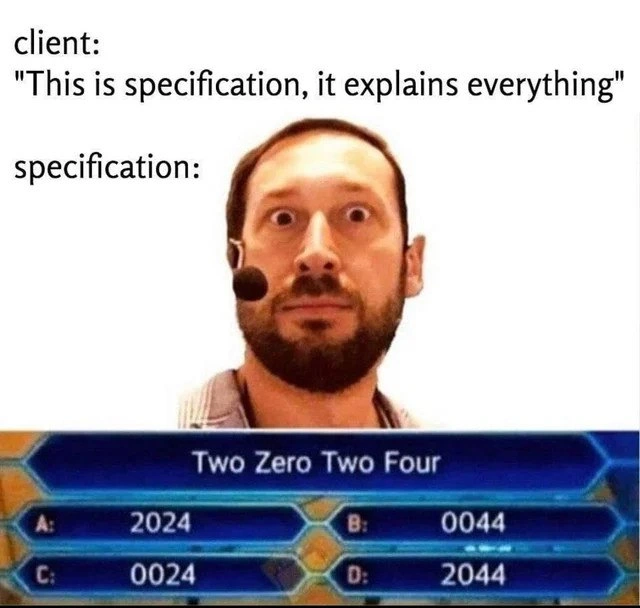
When client’s ‘clear specification’ reads like a Millionaire trick question
Stakeholders Clients Post #2930, on Apr 10, 2021 in TG

When client’s ‘clear specification’ reads like a Millionaire trick question

Why is this Stakeholders Clients meme funny?

Level 1: Clear as Mud

Imagine you ask your teacher what the homework is, and the teacher smiles and says, “Don’t worry, it’s easy: read pages two zero two four.” You write that down, but later you start wondering: did they mean page 2024 in the textbook (that’d be a huge book!), or did they actually mean pages 20 to 24? The way it was said – “two zero two four” – is super confusing. You feel like you’re trying to solve a riddle instead of just doing your homework. Meanwhile, your teacher acts like they gave you a perfectly clear instruction. You’re frustrated because you want to do it right, but you’re not sure what to do. That’s exactly the feeling this meme is joking about. The client in the meme gave instructions that sounded clear to them, but to the developer it was more like a puzzle with multiple possible answers. It’s funny in the same way it’s funny when someone gives directions like, “Oh, it’s simple: go straight down until you see the old tree, then turn where the store used to be,” and you’re left completely lost. The humor comes from that mismatch – one person thinks they’ve explained everything perfectly, and the other person is just sitting there, eyes wide, having no clue and afraid to guess wrong. In short, the meme is like when a friend claims their clue is obvious, but it actually just leaves you scratching your head. It’s a silly reminder that what’s obvious to one person can be totally confusing to another.

Level 2: Multiple-Choice Requirements

Let’s break down what’s going on here in simpler terms. We have a client (the person or company who wants the software built) providing a specification. A specification (spec for short) is basically a set of instructions or requirements describing what the client expects the software to do. In an ideal world, a spec should be clear and leave no room for second-guessing. But in this meme, the spec from the client is anything but clear – it’s confusing. The client says, “This is the specification, it explains everything,” implying they think it’s perfectly understandable. Then we see what the spec actually looks like: it’s presented as a question on the famous game show “Who Wants to Be a Millionaire?” The question reads “Two Zero Two Four,” and there are four answer choices: A: 2024, B: 0044, C: 0024, D: 2044. This represents the poor developer’s predicament: the spec is so unclear that it’s like being asked a tricky multiple-choice question. The developer (represented by the startled-looking contestant on screen) is confused out of their mind, just like you might be if a teacher gave you a badly worded question.

Now, why are those specific answers given, and what do they mean? They’re all different interpretations of the phrase “Two Zero Two Four.” Imagine the spec literally contains the words Two Zero Two Four. Does that mean the number 2024 (which is written with the digits 2-0-2-4)? Possibly. That would be Answer A, 2024, a four-digit number. But then what about Answer B, 0044? Where could 0044 come from? Well, someone might misinterpret “Two Zero Two Four” as instructions to combine parts: “two zero” could be seen as two zeros (“00”) and “two four” might be seen as the number twenty-four (“24”), and if you stick those together you get 00 + 24 = 0024 (which is actually Answer C). Alternatively, maybe “two zero” means the number 20 and “two four” means the number 24, and some miscommunication leads them to add or merge those into 2044 (Answer D). The specifics are a bit wacky – the point is that the spec isn’t clear about how to interpret “Two Zero Two Four.” Should the developer treat it as a whole number, split it into parts, include those zeros or not? Leading zeros (zeros at the beginning of a number) are a big source of confusion here. In normal circumstances, writing “0024” is unusual because numbers don’t typically start with 0 (we usually write 24, not 0024, unless we mean something like a product code or an octal number in programming). So if a spec somehow said “two zero two four” and meant 2024, a developer might scratch their head and wonder why it wasn’t just written as 2024 in the first place. Or if it meant “00 24”, that’s even more confusing – are we dealing with strings (text) instead of a number? This is the kind of unclear_requirements that drives developers crazy: you end up asking, “Did they mean a string literal '2024'? Or a number? If a number, why mention zeros explicitly? Should the output be formatted in a certain way with padding?” Each of the multiple-choice answers corresponds to one of these interpretations of the spec.

This situation is a textbook example of RequirementsAmbiguity, which means a requirement (something the software should do) is so vaguely or oddly stated that it can be understood in more than one way. When a requirement is ambiguous, different developers might each have their own idea of what it means – and they could all be reasonable guesses! That’s obviously a problem, because the code can only do one thing. If you’re a junior developer encountering this, you should know: it’s not your fault if a client’s documentation or communication is confusing. Even experienced developers get stumped by poorly written specs. What’s important is how you handle it. The humorous tone of the meme aside, the real-life solution to such a scenario is to communicate back with the client or your team. Ask for clarification: “Just to be sure, when you say ‘Two Zero Two Four’, do you mean the value 2024? Or is that some kind of code/string you want?” It’s better to ask questions than to guess and build the wrong thing. This meme resonates with developers because we’ve all had that moment of staring at a page of Documentation (or an email from a stakeholder) and feeling as clueless as a game show contestant faced with a trick question. The client’s StakeholderExpectations might be that you instantly understand their intention, but the DeveloperReality is you’re puzzling over the wording, perhaps glancing around to see if anyone else knows what it means. It’s a communication gap problem. The client assumes context or knowledge that wasn’t actually shared, or maybe they themselves aren’t aware that the phrasing is confusing. Sometimes non-technical stakeholders use imprecise language, not realizing that in software, those details matter a lot. For a junior dev, this meme is a lighthearted warning: don’t take every spec at face value. If something in the “explanation” seems off or could mean more than one thing, it probably needs clarification. And yes, it’s totally okay to chuckle at how absurd some specs can be – it’s a form of TechHumor that helps us cope with the frustration. After all, every dev starts off thinking specs are gospel truth, and then a few projects in, you discover that sometimes specs can be as misleading as a bad set of directions. This meme just captures that lesson in a funny, exaggerated way.

Level 3: The Million-Dollar Spec

In the world of software development, a specification is supposed to be the single source of truth – a detailed document from the client or stakeholder describing exactly what the system should do. In theory, it should eliminate guesswork. In theory. In reality, we often get specs that read like a trick question on a quiz show. The meme shows a developer wide-eyed, looking exactly like a nervous contestant on Who Wants to Be a Millionaire, staring at a question that says: “Two Zero Two Four” with four possible answers (2024, 0044, 0024, 2044). This absurd multiple-choice format perfectly captures the feeling of encountering an ambiguous specification. The client confidently says, “This spec explains everything,” yet the actual text of the spec raises more questions than it answers. It’s a classic RequirementsAmbiguity scenario – you have one phrasing that can be interpreted in multiple valid ways, each leading to a different result.

Why is this funny to seasoned developers? Because we’ve been there, countless times. A stakeholder hands over documentation thinking it’s crystal clear, but to a developer it reads like a riddle. Here the “spec” is literally the phrase “Two Zero Two Four”. Is that supposed to be the number 2024 (perhaps a year, like 2024)? Or should it be read as the sequence 2-0-2-4 which could imply 2024 as well – or maybe something weird like 20 24 (twenty and twenty-four)? Perhaps the spec intended 0024 with leading zeros (two zeros before 24) because it said “two zero” separately. Or was it actually 2044, if someone concatenated “two zero” (20) and “two four” (24) incorrectly? The meme exaggerates the confusion by listing all those options as if they are equally plausible answers. This hits on the painful truth that poorly written specs allow countless interpretations. The developer has to mentally parse the spec, much like a compiler parses code. But unlike code, natural language isn’t exact – it can be as squishy as Jell-O. A single misinterpreted word or missing punctuation can change the meaning entirely. In programming terms, the spec here has an ambiguous grammar: the phrase “Two Zero Two Four” could produce multiple parse trees (i.e., meaning A or B or C or D), so the “parser” (our hapless developer) is left guessing.

Seasoned engineers have learned the hard way that StakeholderExpectations often don’t match reality. The client believes detailing “Two Zero Two Four” is enough because in their mind it obviously means 2024. But the developer, lacking that mind-reading ability, is left doing double-takes and triple-checks. This leads to the kind of RequirementsVsReality humor the meme is highlighting. The stakeholder’s overconfidence (“it explains everything”) is funny because it’s tragically common. We’ve all dealt with a project manager or client who delivers a one-liner spec or a vague email and considers the matter settled. They might as well have handed us a puzzle and said “Figure it out.” It’s DocumentationHumor born from frustration: the documentation (spec) is so unclear that it becomes an unintended joke. And as any battle-scarred developer knows, ambiguous requirements are a recipe for spec_parsing_pain and future blame games. It’s the stuff of developer nightmares (and memes): you implement it wrong because you guessed wrong, and then the client says, “How could you possibly misunderstand? It was obvious!” Sure, obvious as a Millionaire trick question.

The multiple-choice format in the meme is more than just a funny image; it’s a sharp commentary on the decision paralysis a dev faces. Communication breakdowns like this turn development into a quiz game: Do you A) implement it as 2024? B) Pad it with zeros to 0044? C) Something else? Lock in your answer, hope it’s right, and pray you won’t have to hear “You misunderstood the spec” later. In a real project, there are no game show lifelines – except maybe “Phone a Friend,” which in this case means scheduling yet another meeting to interrogate the client about what they really mean. And believe me, every senior dev has wanted to “Ask the Audience,” i.e., get fellow developers to sanity-check a bizarre requirement. Sometimes we even perform our own 50/50 elimination: “Well, 0044 and 0024 make no sense in context, so it’s probably between 2024 and 2044. Let’s guess 2024 and hope we don’t have to rewrite it later.” This all-too-relatable decision process is exactly what the meme satirizes. It’s DeveloperHumor with a dark edge: we laugh, but only to keep from crying. The humor lands because it transforms a dry problem (unclear requirements) into a dramatic visual metaphor (game show suspense!). It underlines a key lesson every experienced developer learns: if a spec can be misunderstood, it will be. And cleaning up the fallout of a wrong guess at 3 AM on deployment night is a nightmare scenario we’d all like to avoid. So when we see “client: ‘This explains everything’ paired with a bewildering question, we chuckle knowingly. It’s funny because it’s true – in the trenches of software development, navigating ambiguous_specification is practically a rite of passage.

Description

Meme composed of two parts. Top white section has black text: line 1 reads "client:" and line 2 in quotes says "This is specification, it explains everything". A blank line follows, then the word "specification:". Beneath, a blurred-out contestant from the TV quiz show "Who Wants to Be a Millionaire?" stares ahead while the blue answer board shows the question "Two Zero Two Four" with four multiple-choice answers: A: 2024, B: 0044, C: 0024, D: 2044. The visual gag highlights how a supposedly definitive spec still leaves countless interpretations (leading zeros, digit order, grouping). Technically, it satirizes ambiguous requirements, stakeholder overconfidence, and the developer’s struggle to decode poorly written documentation

Comments

22
Anonymous ★ Top Pick Spec says: “Just show 2024.” Senior dev brain: cool, but is that ISO-8601, fiscal year code, zero-padded BCD for the legacy PLC, the next semver, or the microservice count after the ‘monolith breakup’? Can I phone a BA or do I just eliminate answers till prod?
  1. Anonymous ★ Top Pick

    Spec says: “Just show 2024.” Senior dev brain: cool, but is that ISO-8601, fiscal year code, zero-padded BCD for the legacy PLC, the next semver, or the microservice count after the ‘monolith breakup’? Can I phone a BA or do I just eliminate answers till prod?

  2. Anonymous

    The spec says "store the year" so naturally we built a distributed event-sourcing system with CQRS, only to discover in prod they meant a dropdown menu with "2024" hardcoded

  3. Anonymous

    This perfectly captures the enterprise architect's nightmare: when a client's 'comprehensive specification' has more valid interpretations than a regex pattern without anchors. You know you're in trouble when parsing the requirements document feels like solving a multiple-choice exam where all answers are technically correct depending on timezone, locale, and whether Mercury is in retrograde. Senior engineers recognize this as the moment to schedule a three-hour requirements clarification meeting - because nothing says 'agile' like spending a sprint cycle just figuring out if '2024' means a year, a port number, an error code, or someone's idea of a clever versioning scheme

  4. Anonymous

    Nothing screams “clear requirements” like a spec that turns “Two Zero Two Four” into a type debate: 2024 if it’s an int, 0024 if it’s a zero-padded code, 0044 if someone counts digits, and 2044 if it’s the ship date

  5. Anonymous

    Without a schema, 'Two Zero Two Four' is four equally valid breaking changes

  6. Anonymous

    Client spec '204': HTTP No Content, yet delivers maximum ambiguity

  7. @ANTICHRISTUS_REX 5y

    2048 (the game).

  8. Deleted Account 5y

    2+000000000000000000000000

  9. @ANTICHRISTUS_REX 5y

    2^16

  10. @zherud 5y

    I select A. It feels the most right to me.

    1. @cheburgenashka 5y

      You select what sounds reasonable. That's the first rookie mistake. The client never asks for something reasonable especially if it sounds so. Your assumption will lead to a rewriting project where every parent can have only one child, but any child always has at least three or more parents.

      1. @avaik 5y

        Well. The thing is A is the only correct answer. 0044 would be two zeros two fours 0024 — two zeros two four 2044 — two zero two fours The plural you know. Yeah, I'm fun at parties.

        1. @cheburgenashka 5y

          You would be fired in real world of you would work for sick costumers. Read the story about about polytrees with parallel universes support

    2. @SuperiorProgramming 5y

      Totally agree with you on this one.

  11. @ANTICHRISTUS_REX 5y

    0044

  12. @cheburgenashka 5y

    In the beginning, a gov regulator agency (similar to the American FDA) sounded quite reasonable. They needed to manage a hierarchy tree of products classification (we’re talking about GS1), but in the end, we finish with something that looked like a forest of polytrees. The client wanted a single hierarchy but to be able to give its client's to manage it in parallel (like they want but on the identical IDs) We were not allowed to use a graph because it didn't sound like a tree and the client wanted a tree. We had a tree in an adjacency list and another table of parallel universes of these trees' roots. It was a tree but with parallel universes support and different hierarchical shape for another user, and it was not a graph. Fuck me to work with a government agency client again.

  13. @gizlu 5y

    1. A 2. B 3. C and D

  14. @gizlu 5y

    A and B are at least internally consistent

    1. @gizlu 5y

      But these ones are more likely

  15. @gizlu 5y

    Ackshually I happened to write arguments within one function signature in two different word separation styles (camelCase and snake_case)

    1. @Supuhstar 5y

      Rude lol

  16. @batuto 5y

    One more, you got a french one 42010

Use J and K for navigation