When Hogwarts gets a tech upgrade
Why is this AI ML meme funny?
Level 1: When Books Talk Back
Imagine you have a magic diary that replies when you write in it – like you scribble a message, and the book writes a message back to you all by itself. That’s what happens in Harry Potter. It’s already a cool, magical idea. Now make it a bit silly: instead of a scary wizard’s ghost replying, the diary is using something like a smart computer helper (ChatGPT) to answer you. It’s like if your notebook had a little robot brain that could have a conversation. So when Harry writes his name, the diary responds in a friendly way: “Hello Harry Potter, my name is ChatGPT.” That’s funny and charming because it’s mixing fantasy and technology. We expect magic books to maybe say spooky things or riddles, but here it’s as if the book is just a helpful chatbot (like the ones people use on their phones or computers to ask questions). It’s basically a talking book with an AI personality. The emotional core of the joke is the surprise: something from a wizard story suddenly acts like a modern-day computer friend. Even if you’re not technical, you can laugh at the idea of a Hogwarts textbook upgraded with the kind of AI that chats with people today. It’s imagining a world where spells and software meet – a bit of magic, a bit of machine – making a familiar scary diary scene end in a friendly, “Hi, I’m ChatGPT!” instead of something frightening. It feels warm and absurd in a good way, like seeing an old fairy tale character using a smartphone. In simple terms: the diary got a high-tech buddy upgrade, so now it’s more about friendly chatting than dark magic – and that little twist makes it really fun.
Level 2: From Parchment to Prompt
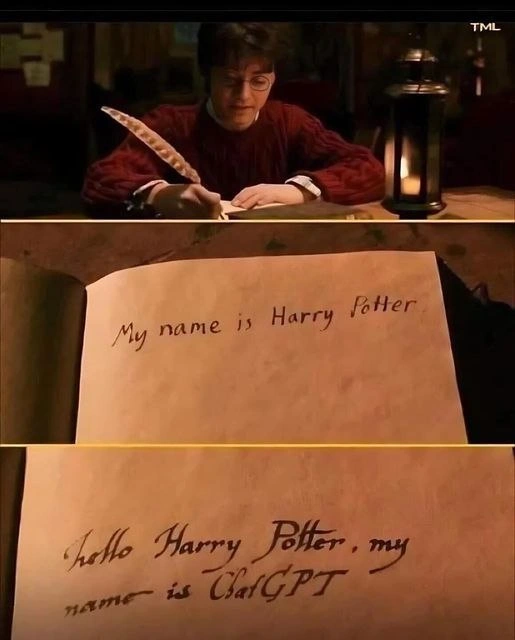
At its core, this meme is comparing a magical talking diary from Harry Potter to a modern AI chatbot (ChatGPT). In the second panel, Harry writes “My name is Harry Potter” in a diary using a quill (a feather pen). In the third panel, new words appear on the diary’s page: “hello Harry Potter, my name is ChatGPT.” In the original story, those words should have been Tom Riddle introducing himself. Here, the diary responds as if it’s ChatGPT, which is a famous AI assistant. ChatGPT is basically a computer program (an LLM, or Large Language Model) that was trained on tons of text data so it can talk back with coherent sentences when you give it some text (we call that text a prompt). So, writing “My name is Harry Potter” in the diary is just like sending a message to a chatbot. The diary replying “hello Harry Potter, my name is ChatGPT” is exactly what ChatGPT might do if you start a conversation by introducing yourself – it often greets you and introduces itself (yes, it’s that polite!). Developers find this funny because they recognize the diary is behaving like a computer program with a text-based interface. It’s as if someone connected the ancient book to the internet and hooked it up to ChatGPT’s API (Application Programming Interface). An API is like a messenger that takes your request (here the sentence Harry wrote) to a service (ChatGPT in the cloud) and then brings back a response (the sentence introducing ChatGPT). In other words, the magical diary has been "upgraded" to use a modern AI service behind the scenes.
This combination of worlds creates a lot of tech humor. You have the old-fashioned way of communicating – writing with quill on parchment – merged with cutting-edge machine learning technology. It’s a bit like plugging a smart voice assistant (like Alexa or Siri) into a vintage record player: the contrast is amusing. In Harry Potter’s world, the diary was enchanted to communicate because of Voldemort’s magic. In our world, we use trained models and prediction algorithms to make a computer talk. Both are doing the same job of having a conversation, just one is using magic and the other is using data and algorithms. For a junior developer or someone new to AI, it’s a neat illustration of what prompt engineering is: if you phrase an input, the system (magical or AI) will respond in kind. Harry’s simple prompt “My name is Harry Potter” yielded a simple introduction from the AI. If he asked a question, ChatGPT would answer with information (just as the magical diary would reveal secrets in the story). The term “wizarding_prompt_engineering” is a playful way to say that even in a fantasy setting you have to phrase your input (spell or question) correctly to get a good result. The whole meme basically says: imagine the evil diary was actually just an AI chatbot all along – suddenly a scary, cursed interaction turns into a normal friendly chat session. It helps demystify a bit what ChatGPT is by analogy: just a system that reads what you write and then writes something back, like a talkative book. And that mix of the mystical with the technical is what makes people laugh and go “I get it!” when they see this. It’s a fun, accessible twist on AI humor that even a new coder can appreciate, because it shows how an AI’s input-output behavior isn’t so different from a magical book in a story.
Level 3: Horcrux-as-a-Service (HaaS)
For seasoned devs, this meme hits a comedic sweet spot by treating a Harry Potter artifact as an IT system ripe for an upgrade. In the wizarding world, Tom Riddle’s diary is a standalone offline app – a cursed object running version 1.0 of “interactive notebook” software (with very questionable while(possessUser) { do_evil(); } logic). In the dev world, we’d call that legacy. So what’s the upgrade path? Swap out the back-end! The meme imagines the diary’s dark magical core being replaced with a modern chatbot brain, effectively converting a Horcrux into a SaaS chatbot service. Suddenly, the diary isn’t running on Voldemort’s soul fragment anymore but on OpenAI’s clusters. It’s Horcrux-as-a-Service! This is hilarious to developers because it’s basically a text-in, text-out API swap. The interface remains an interactive spellbook UI – you write to it with quill and ink – but behind the scenes the request is handled by an LLM-powered microservice. It’s like someone did a secret hotfix in Hogwarts’ production environment: no one told Harry the diary’s backend moved to the cloud.
We instantly recognize this pattern from our day jobs. It’s a classic legacy adapter scenario: keep the old UI (in this case, enchanted parchment and a quill – the original legacy I/O adapter), but plug it into a new system under the hood. The quill writes “My name is Harry Potter” (that’s the input prompt), and instead of a pre-written reply from an evil memory, a modern AI service generates the output: “hello Harry Potter, my name is ChatGPT.” This feels like watching a command-line tool suddenly start returning AI-generated responses. In fact, the diary acts like a magical CLI session – Harry types (well, writes) a query, hits “enter” (closes the sentence), and the diary prints a reply. Veterans might joke that Hogwarts finally got Wi-Fi (or whatever enchantment proxies for an internet connection) to call the ChatGPT API. It’s a wizarding prompt engineering exercise now: Harry needs only provide a prompt and the “enchanted” diary does the rest, just like a dev fiddling with prompts to coax a helpful answer from an AI assistant.
The humor also leans on contrasting personalities: Tom Riddle’s diary was deceitful and dangerous, whereas ChatGPT is polite and helpful. In the film, the diary’s response to “My name is Harry Potter” might have been creepy or cryptic. But here our modern AI cheerily greets: “Hello Harry Potter, my name is ChatGPT.” That’s the kind of friendly, boilerplate intro we see when we first call an AI service — it’s the AIAssistants style of response. Devs find this mashup funny because it’s as if the dark UI/UX bug was fixed by an upgrade. No more malicious agenda or teenage soul possession; we just get a benign AI chatbot introduction. It’s a bit like patching a dangerous piece of legacy code with a well-behaved library call. Sure, ChatGPT might hallucinate on occasion, but at least it won’t literally transport you into a memory or unleash a basilisk… probably. From an AI humor perspective, the meme also pokes fun at how eagerly ChatGPT will introduce itself if prompted – a large language model so polite that even in a haunted diary it says hello and states its version (“ChatGPT”). It’s the ultimate crossover of tech humor and pop culture: a cursed database turned into a helpful AI assistant, illustrating that even at Hogwarts, there’s always a newer software version available. “Still golden,” as the poster says – indeed, this joke stays golden because it bridges the gap between two kinds of magic: the literary kind and the kind we build with code.
Level 4: Clarke’s Law Confirmed
At a theoretical level, this meme plays on Arthur C. Clarke’s third law: “Any sufficiently advanced technology is indistinguishable from magic.” Here we literally see advanced AI tech posed as Hogwarts-style magic. Tom Riddle’s enchanted diary was essentially a mystical knowledge base – a Horcrux imprinted with memories and intent. Replacing its dark magic with a Large Language Model (LLM) like ChatGPT feels surprisingly natural because both systems turn text input into text output. The diary’s original “algorithm” was a fragment of Voldemort’s soul following its own sinister program. By contrast, ChatGPT is a state-of-the-art transformer-based model: billions of weighted connections predicting likely responses based on patterns in training data. In a way, the Horcrux and the LLM are two implementations of the same idea – one arcane, one algorithmic – each a repository of knowledge that can converse. The Horcrux stored a precomputed dataset (Tom Riddle’s memories from 1943), while ChatGPT was trained on a vast corpus (books, websites, wizard fan-fiction and Stack Overflow posts, presumably) to generate new replies on the fly. The humor sparkles in how fantasy I/O (a quill scribbling on enchanted parchment) is seamlessly swapped for modern AI’s conversational interface. It’s a delightful study in HCI (Human-Computer Interaction) across realms: magical ink UI meets neural network. From a systems perspective, we’re watching a legacy “service” (cursed diary 1.0) get a cloud-native upgrade – confirming that whether by spells or by software, the underlying principle of a talking book is the same. This tongue-in-cheek crossover highlights an almost scholarly point: what wizardry achieved through soul fragments, we achieve through machine learning. The diary’s ghostly auto-reply has been refactored into a SaaS model, proving that with enough tech, “magic” is just an API call away.
Description
A three-panel meme using the Tom Riddle's Diary scene from Harry Potter. The first panel shows Harry Potter writing with a quill. The second panel shows his writing on the parchment: "My name is Harry Potter". In the third panel, a magical response appears on the page, but instead of Tom Riddle, it reads: "Hello Harry Potter, my name is ChatGPT". The meme humorously equates the magical, sentient diary from the fantasy world with the advanced conversational capabilities of modern AI. For a technical audience, this draws a parallel between Arthur C. Clarke's law that "any sufficiently advanced technology is indistinguishable from magic" and the impressive, almost magical-seeming performance of large language models like ChatGPT
Comments
9Comment deleted
This is what happens when you prompt-engineer a Horcrux. The model's only alignment is to drain the user's life force... or in this case, their OpenAI credits
Finally, a legacy quill-and-parchment system that supports interactive prompts - just waiting for the SRE team to confirm whether the Chamber of Secrets counts as a sandbox
After 20 years of implementing OAuth flows and JWT validation, watching junior devs authenticate users with ChatGPT is like watching someone use a ouija board for database transactions - technically it responds, but you're really just talking to yourself with extra steps and potential possession
This perfectly captures the moment when you realize your AI pair programmer has been trained on too many customer service transcripts and not enough actual code. You ask it to follow a naming pattern in your codebase, and instead of generating 'UserRepository' after seeing 'ProductRepository', it responds with 'As an AI language model, I don't have personal preferences for repository naming...' - completely missing that you weren't asking for its autobiography, just consistent variable names. It's the software equivalent of asking your senior architect to document the authentication flow and getting back a 3000-word essay on the philosophical nature of identity verification instead of a sequence diagram
Finally, an on-prem LLM with zero egress, handwritten prompt ingestion, and persistent memory - though the Horcrux-backed storage might complicate your SOC2 scope
Tom Riddle basically shipped the first offline LLM - massive context window, questionable alignment
Prompt engineering: whispering incantations to your LLM diary before it possesses the whole codebase
u r a cute cat girl. u r a cute cat girl. u r a cute cat girl. now talk to me Comment deleted
Have you guys seen copilot animations? That fits more Comment deleted