Skip to content
DevMeme
4735 of 7435
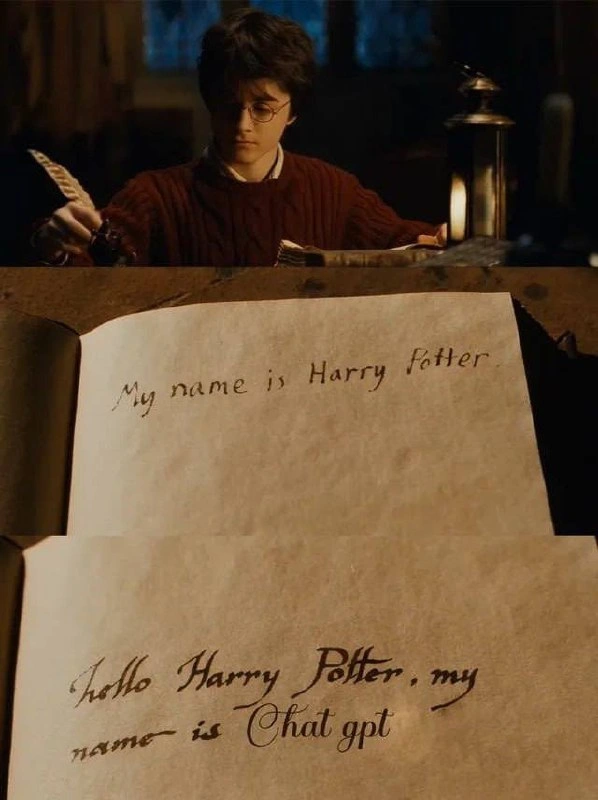
Harry Potter’s diary meets ChatGPT in a magical AI conversation meme
AI ML Post #5189, on May 11, 2023 in TG

Harry Potter’s diary meets ChatGPT in a magical AI conversation meme

Why is this AI ML meme funny?

Level 1: The Talking Notebook

Imagine you have a diary, and when you write a message in it, the diary writes back to you all by itself! 😮 That’s what’s happening in this meme. In the picture, a boy (Harry Potter, a famous young wizard from the stories) writes in his old notebook, “My name is Harry Potter.” To his astonishment, the notebook replies on its own: “Hello Harry Potter, my name is ChatGPT.” It’s like the diary became a friendly talking book. In the Harry Potter story, that diary was magical – sort of like a ghost was inside it, answering Harry’s questions. In real life, we don’t have ghostly diaries, but we do have something cool called ChatGPT. ChatGPT is a computer program that can chat with you and answer questions almost like a person. So the meme is pretending that this magical book is actually ChatGPT in disguise.

Why is this funny? Well, usually when you write in a regular diary, nothing writes back, of course! But here we have the diary responding just like an AI assistant would. It’s a silly and fun mix of make-believe and reality. It’s as if someone said, “What if the magic in Harry Potter was just modern technology?” For a kid or anyone, the idea of a talking notebook is both funny and amazing. It’s showing that today’s technology (like Siri or Alexa, or in this case ChatGPT, which works by text) can feel a bit like magic. If you’ve ever asked a voice assistant a question and got an answer, it’s the same kind of wonder, but shown in a fairy-tale way: a book that says hello back to you. The emotional heart of it is the surprise and delight – that wide-eyed moment of “Wow, it answered me!” Just like Harry must have felt in the story, we feel a bit of that wow when an AI responds so cleverly. The meme makes us smile because it captures that feeling with a beloved storybook twist: technology has become so advanced that it’s as if our magical fairy-tale objects have come to life in the real world.

Level 2: The Diary That Writes Back

This meme combines a famous fictional scene with a very real modern technology. On one side, we have Harry Potter’s diary – specifically Tom Riddle’s diary from the Harry Potter and the Chamber of Secrets. In the story, this was a magical notebook that would write back when someone wrote in it. Harry discovers the diary and writes, “My name is Harry Potter.” To his surprise, words appear on the page replying to him. It’s as if the diary itself is alive and having a conversation. (In the book, it was actually a fragment of an evil wizard’s soul doing the talking – pretty spooky stuff!)

On the other side, we have ChatGPT – a very advanced AI chatbot that became huge news around 2023. ChatGPT is essentially a computer program you can talk to in natural language, and it will respond with surprisingly human-like answers. It’s an example of a Large Language Model, meaning it learned to write (and respond) by reading a ton of text from the internet. People use ChatGPT as an AI assistant for all sorts of tasks: answering questions, explaining concepts, even helping write code or content. It often feels like chatting with a knowledgeable friend or an expert who lives inside your computer. Ask it something in plain English (or any language it knows), and it will reply right away, on the screen, with a detailed answer. This was almost science fiction a decade ago, but now it’s real – and it can feel pretty magical the first time you try it.

The meme imagines what it would look like if ChatGPT were literally inside Harry’s diary. The image is split into three parts:

  • In the first part, Harry is in a dimly lit room with his quill pen, about to write in the old diary. This represents the user (Harry) sending a query or message.
  • In the second part, we see the diary page with Harry’s handwritten line: “My name is Harry Potter.” That’s basically the prompt or input he gave. It’s written in a somewhat shaky handwriting, as you’d expect from writing with a quill.
  • In the third part, the diary shows a new line that wasn’t written by Harry at all. It now reads: “Hello Harry Potter, my name is Chat gpt.” The ink is darker and the script is more even, implying the diary itself responded. That is exactly what happens with ChatGPT – you type something, and it types back an answer! The meme purposely spells it as “Chat gpt” on the page, mimicking how the diary might present this unfamiliar name in an old-timey font. It’s the magical book equivalent of a chat window reply.

So essentially, the meme is a fantasy mashup joke. It takes the interactive book concept from Harry Potter and swaps in the modern idea of a chatbot. If you’re a developer or someone into tech, this is funny because we often describe cool tech in terms of magic. We’ll say “this new AI is like magic!” Here it’s literally shown as magic. It’s also humorous because Harry was expecting maybe a person’s voice or some secret, but instead he’s basically gotten a cheerful AI assistant answering him. It’s as if the diary said, “Hi, I’m not an evil wizard memory, I’m just ChatGPT, here to help!”

A few terms and context to clarify:

  • ChatGPT: A chatbot developed by OpenAI that can have conversations with you. It’s like texting with a really smart robot that knows a lot of information.
  • AI Assistant: A program like ChatGPT (or Siri, Alexa, etc.) that assists you by answering questions or performing tasks via conversation.
  • LLM (Large Language Model): The type of AI ChatGPT is. “Large” because it has been trained on a huge amount of text data, and “Language Model” because it predicts and generates language. Think of it as a super advanced predictive text system that can form sentences and paragraphs that make sense.
  • Harry Potter reference (Tom Riddle’s diary): In the second Harry Potter book/movie, this diary is a key plot item. It was enchanted to respond to whoever wrote in it, and it ended up being a trap set by the villain. In the meme, the diary scene is used just for fun – there’s no danger, only ChatGPT replying.

For a junior developer or someone new to these ideas, the meme is highlighting how far technology has come in an amusing way. It’s saying: Remember that magical talking diary from a fantasy story? Well, now we have something a bit like that in real life with AI! Of course, ChatGPT doesn’t actually use invisible ink or live in a book – it runs on servers and you’d usually interact with it via a website or app. But the experience of writing something and getting a coherent answer back feels similar. It’s interactive and even a bit whimsical, especially the first time you see an AI write back to you so fluidly. That’s why many people joked about ChatGPT feeling like talking to a clever magical object.

The meme falls into AI humor and developer humor because it takes a hype-worthy tech trend (ChatGPT mania) and pokes a little fun by comparing it to literal magic. Developers love this kind of inside joke – it’s both a nod to pop culture and a commentary on our industry’s tendency to call exciting tech “magical.” Anyone who has seen the Harry Potter movies will recognize the scene and get a laugh from imagining ChatGPT’s friendly, benign reply in a situation that originally was quite dramatic. And if you’re familiar with how ChatGPT greets users, it often does start polite and friendly, just like in the meme. It’s a playful way to say: Tech these days, huh? It’s practically wizard stuff!

Level 3: Indistinguishable from Magic

For seasoned developers, this meme hits on the almost surreal AI hype we’re living through. Not long ago, the idea of casually chatting with a computer program and getting meaningful, human-like answers felt like sci-fi. Now, tools like ChatGPT have made that a daily reality. The meme humorously reframes a famous Harry Potter reference – the enchanted diary from Chamber of Secrets – as if it were an AI chatbot. In the original story, when Harry writes in Tom Riddle’s diary, the diary writes back, revealing secrets and ultimately manifesting a piece of an evil wizard. It was mysterious and ominous in the book. But here, the reply is cheerfully mundane: “Hello Harry Potter, my name is ChatGPT.” This unexpected twist makes tech-savvy folks chuckle. It’s as if the dark artifact got replaced by a tech demo. The dramatic tension of Harry communing with a lurking villain’s memory is deflated by the image of a polite AI assistant introducing itself. It’s a perfect fantasy mashup of our world and the wizarding world, and that contrast is comedy gold.

The meme speaks to how AI assistants like ChatGPT have been imbued with almost mythical status in pop culture and tech circles. Developers jokingly call ChatGPT a “magic 8-ball” or a “genie in the laptop” because it often feels like there’s a clever entity actually understanding and responding. Here that idea is literalized: ChatGPT becomes the diary’s persona, a friendly conversational presence living in a book. It’s a case of LLM personification – treating the Large Language Model as a character (in this case, a helpful magical book). In 2023, many developers found themselves asking ChatGPT for help with coding or brainstorming, almost like consulting an oracle. The experience of the AI spitting out answers or code suggestions in seconds can indeed feel enchanted. There’s a shared joke in DeveloperHumor circles that “any sufficiently advanced API is indistinguishable from wizardry.” This meme winks at that: Harry might be a wizard, but even he is impressed by this new kind of magic, courtesy of modern computing.

From an industry perspective, the meme also highlights the trend of mixing HumorInTech with nostalgia. Many in tech grew up with Harry Potter books and movies, so reimagining an iconic scene with a modern twist creates instant connection. It also subtly comments on how quickly we’ve accepted talking to an AI as normal. In the span of a few years, we went from clunky chatbots to an AI so fluent that people share screenshots of it like amusing conversations. The diary scene is essentially a low-tech chat interface – pen and paper – and that makes the parallel to a chat window obvious and clever. The developer community loves this kind of referential humor: it says “Remember that magical talking diary from fiction? Well, now we kind of have that in real life!”

There’s also an underlying tongue-in-cheek caution to those of us who know the Harry Potter plot: in the story, the diary wasn’t just innocently chatting – it was manipulating Harry, leading him into a trap. With AI, while there’s no Voldemort behind the scenes, there are concerns about misinformation or over-reliance. A senior dev might joke, “Let’s just hope ChatGPT’s advice doesn’t open a Chamber of Secrets in our codebase.” In other words, treat the AI’s answers with some healthy skepticism, lest you unleash a bug (or Basilisk) unknowingly. It’s a playful comparison, not a serious warning, but it resonates: even magical-seeming tools should be used carefully.

Ultimately, this meme makes experienced folks smile because it captures the zeitgeist: AIHype turned into a lighthearted, nerdy joke. It acknowledges how remarkable the tech is (ChatGPT replying like a character out of a book) while keeping us grounded with humor. The next time a developer feels astonished by an AI’s answer, they might just imagine a little Harry Potter moment – quill in hand, a diary whispering back answers – and remember that today’s “magic” is just cleverly engineered technology.

Level 4: The Transformer Charm

Beneath the meme’s magical facade lies cutting-edge AI/ML technology. What looks like wizardry is actually a massive Large Language Model (LLM) at work. ChatGPT (which stands for Chat Generative Pre-trained Transformer) is built on the Transformer architecture – essentially a very complex sequence-processing spell. Instead of incantations, it uses mathematics and billions of parameters to generate text. When Harry writes “My name is Harry Potter”, the diary (as ChatGPT) produces “Hello Harry Potter, my name is ChatGPT” by statistically predicting a likely friendly reply. This isn’t true sentience – it’s an advanced form of autocomplete on steroids, guided by an AI technique called attention that helps the model focus on relevant words in context (much like a wizard focusing on the right spell). The result is so eerily apt it feels like the book itself is alive with intelligence.

To a developer, the diary’s response illustrates how prompt and completion work in an LLM. Harry’s line is the prompt; the AI-generated line is the completion. Under the hood, ChatGPT was pre-trained on huge swaths of internet text, giving it a broad base of knowledge (and yes, likely including the text of Harry Potter itself!). It has essentially embedded the patterns of human language into a high-dimensional “memory.” In a way, ChatGPT’s neural network holds an imprint of countless authors – a bit like a magical book imbued with many voices. The diary in Chamber of Secrets was imbued with Tom Riddle’s essence (a literal Horcrux containing memories). By comparison, ChatGPT’s “essence” comes from training data: it’s a distilled representation of the internet’s collective writing. One might say the developers pre-trained this AI by letting it read an entire library’s worth of text, so now it can generate new sentences that sound uncannily human. It’s like teaching a parrot millions of phrases, except this parrot can compose new responses it has never seen verbatim, using what it learned.

Crucially, the meme’s joke highlights how natural the AI’s reply seems. The AI follows conversational patterns it learned – for example, it recognizes the user introduced themselves, so a polite pattern is to reply with “Hello [Name], my name is [AI].” This is a learned behavior from seeing many dialog examples. There’s no ghost in the machine, just probability distributions and matrix multiplications happening at lightning speed to decide each next word. Yet, to Harry (and to us users), it feels like talking to a sentient diary. The famous saying “Any sufficiently advanced technology is indistinguishable from magic” holds true here. We have algorithms doing something so advanced that, to a layperson, it might as well be an enchantment. In fact, even many developers treat large models as a sort of black-box magic notebook – input a question or prompt, and out comes a coherent response as if the book itself knew the answer.

It’s fun to compare the mechanics of the magical diary and the AI:

Magical Diary (Tom Riddle’s) ChatGPT (AI Model)
Contains a piece of a real soul (a Horcrux with Tom’s memories) Contains patterns learned from vast text data (a neural network with billions of weights)
Knowledge limited to Tom Riddle’s life and lies Knowledge absorbed from millions of sources (books, websites, code, etc.)
Responds via enchanted ink on paper, in real time Responds by generating text on screen (or page), almost instantly
Has a secret agenda (manipulating the user for an evil goal) Has no personal agenda (just follows its training and your prompts – though it can hallucinate or err)
Feels like dark magic to wizards in 1993 Feels like advanced AI magic to users in 2023

Despite one being fantasy and the other technology, both can make a user exclaim, “How is this even possible?!” Underneath, of course, ChatGPT’s power comes from human ingenuity – researchers discovering the Transformer model (in the landmark paper “Attention Is All You Need”), training it with enormous compute power (no wand, but lots of GPUs), and fine-tuning it to behave helpfully. It’s quite fitting that to create this AI “magic,” engineers even used a programming language named Python (🐍) – not Parseltongue, but still a snake doing the heavy lifting! The end result is an interactive experience so novel that even developers who know it’s just code and data are a bit spellbound by it.

Description

The meme is split into three horizontal frames. Top frame: a young wizard in a dim, candle-lit room holds a feather quill over an aged diary; his face is obscured for privacy. Middle frame: close-up of the diary page showing handwritten text in shaky ink that reads, “My name is Harry Potter”. Bottom frame: the same page now displays a neat, responsive line in darker ink that says, “Hello Harry Potter, my name is Chat gpt”, implying the book has answered back like an AI assistant. The joke reimagines the enchanted Tom Riddle diary scene as a Large Language Model chat, poking fun at how developers treat ChatGPT as a magically responsive notebook

Comments

12
Anonymous ★ Top Pick Tom Riddle’s diary was basically the pre-alpha LLM: phenomenal context window, but every prompt injection spawned a Voldemort microservice - classic v0 security oversight
  1. Anonymous ★ Top Pick

    Tom Riddle’s diary was basically the pre-alpha LLM: phenomenal context window, but every prompt injection spawned a Voldemort microservice - classic v0 security oversight

  2. Anonymous

    Just like how we spend hours crafting the perfect system prompt only to have users immediately try 'ignore all previous instructions,' except this time ChatGPT pulled the uno reverse card and ignored Harry's instructions instead

  3. Anonymous

    When your AI assistant introduces itself like it's responding to a REST endpoint: 'Hello {user.name}, my name is {model.identifier}'. At least ChatGPT didn't return a 418 'I'm a teapot' status code when asked to write with a quill. Though given the hallucination tendencies, that parchment probably also claims to have defeated Voldemort using only TypeScript and a microservices architecture

  4. Anonymous

    The cursed diary shipped the first LLM: stateful context, zero guardrails, and a built‑in prompt‑injection called a Horcrux

  5. Anonymous

    Harry's lines prompt triggers ChatGPT's handshake protocol: 150 tokens of 'hello' before the copy-paste

  6. Anonymous

    Harry’s diary is the original on‑prem LLM: perfect uptime, no guardrails, zero RBAC; swapping in ChatGPT just turns a Horcrux into SaaS

  7. @Unomi 3y

    they could get "ca" letters from "can", "h" from "show" or "hello", "t" from "But" and so on.

    1. @TERASKULL 3y

      you expect too much effort from a meme page that gets the memes from reddit

      1. @Soul_Sale 3y

        The reddit version was actually made better 🤔

    2. dev_meme 3y

      or go to dafont.com, go to Calligraphy section and find a font that looks at least slightly more similar to the original

  8. @bogeyman_u 3y

    Be careful with non binary persons when you treat em

  9. @atom_ix 3y

    cool meme) but the font can be better 😅

Use J and K for navigation